Key Takeaways
- Solana delivers ultra-fast transactions and low fees, making it ideal for high-frequency RWA tokenization use cases requiring speed and scalability.
- Polygon offers strong ecosystem maturity and Ethereum compatibility, making it a preferred choice for enterprises prioritizing security, interoperability, and developer support.
- Cost vs. stability is the core trade-off—Solana excels in performance efficiency, while Polygon provides more predictable infrastructure for long-term deployments.
- RWA tokenization success depends on use case fit, not just blockchain choice—asset type, compliance needs, and user base play a critical role.
- Tokenization platform development requires more than chain selection, including smart contracts, custody, compliance, and liquidity strategies.
- Partnering with an experienced blockchain development company like SoluLab helps businesses choose the right ecosystem, design scalable architecture, and launch secure RWA tokenization platforms faster.
Tokenization Is Now an Infrastructure Decision
There was a time when choosing a blockchain felt like choosing a faster database.
That phase is over.
In 2026, tokenization sits much closer to financial infrastructure than experimentation. Real-world assets bring legal structures, compliance obligations, and operational complexity that cannot be abstracted away.
This is where the Solana vs Polygon comparison changes meaning.
The question is no longer which chain is cheaper or faster.
The question is which ecosystem can support the full lifecycle of an asset.
- issuance
- investor access
- compliance enforcement
- reporting
- long-term interoperability
For teams exploring RWA tokenization development, this becomes a system design decision.
When evaluating:
- RWA Tokenization on Solana
- RWA Tokenization on Polygon
You are effectively choosing how your platform behaves under real-world constraints.
Some systems need speed and cost efficiency at scale. Others need deeper alignment with financial infrastructure and compliance tooling. There is no universal winner.
There is only one fit.
The Reality of RWA Tokenization Infrastructure
Most tokenization discussions start at the wrong layer.
They start with tokens. In practice, tokens are just the visible layer.
The real complexity sits underneath.
What Makes RWA Tokenization Different
A tokenized asset is not just a digital unit. It represents:
- a legal claim
- a set of rights and restrictions
- an off-chain asset lifecycle
This changes how the system needs to be built.
The Layers That Actually Matter
A functional RWA tokenization platform typically includes:
- Legal layer: Asset wrapped in an enforceable structure
- Identity layer: KYC, AML, accreditation, jurisdiction checks
- Data layer: Off-chain events synced with on-chain state
- Transaction logic: Permissioned transfers, restrictions, controls
- Reporting layer: Auditability, compliance logs, investor reporting
Why This Changes the Chain Decision
This is where a typical Solana vs Polygon blockchain comparison becomes incomplete.
It often focuses on:
- throughput
- transaction cost
But ignores:
- compliance orchestration
- identity-aware access
- system integration
For tokenized real world assets on Solana or on Polygon, these are core requirements.
A Better Framing
Instead of asking: Which chain performs better?
Ask: Which ecosystem supports how this asset needs to operate?
Because:
- A high-frequency marketplace will optimise differently
- An institutional credit platform will optimise differently
That is why Asset tokenization platform development is a system problem, not just a blockchain choice.
Solana vs Polygon Architecture: Key Differences Explained
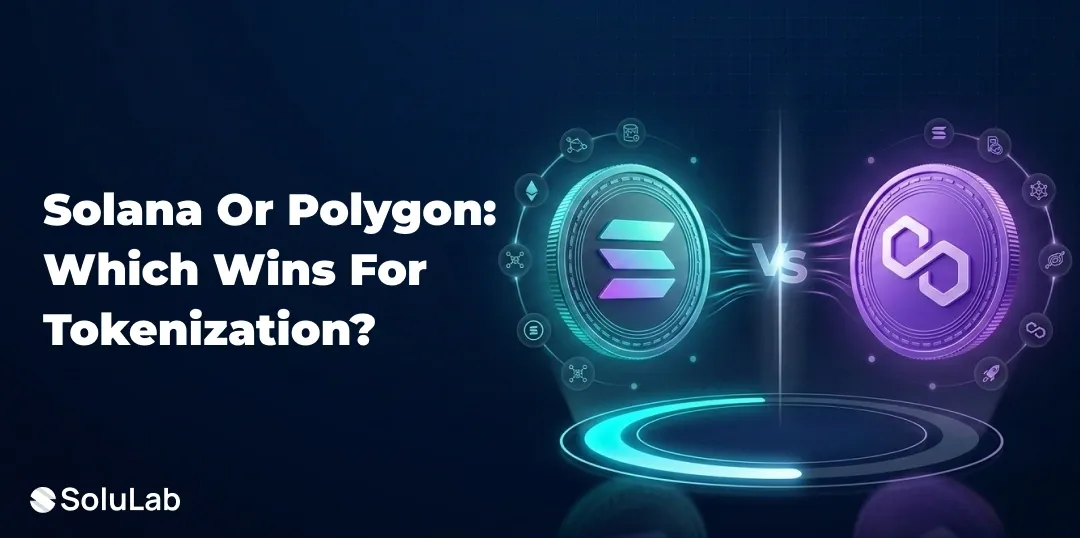
Solana and Polygon are often positioned as alternatives.
In reality, they reflect two different design directions.
Solana: Built Around Execution Efficiency
Solana blockchain development is designed to process large volumes of transactions quickly and at low cost within a tightly integrated system.
In practice, this means:
- fast settlement
- very low fees
- strong support for high-frequency activity
Compliance is not absent here, it is just newer: Solana’s Token Extensions add transfer hooks, confidential transfers and a permanent delegate at the token program level, which is the layer a regulated issuer would build against.
For certain RWA models, this becomes critical.
If a platform expects:
- frequent asset updates
- recurring payouts
- high transaction throughput
performance directly impacts the product experience.
Polygon: Built Around Ecosystem Compatibility
Polygon blockchain development takes a different path.
It aligns closely with Ethereum, which gives it access to a wider ecosystem of tools, standards, and infrastructure. In practice that means the permissioned-token standards already exist: ERC-3643 (T-REX) is a Final EIP built for identity-gated transfers, so a Polygon deployment inherits transfer restrictions, investor whitelists and recovery logic instead of specifying them from scratch.
This shows up as:
- familiarity for developers
- easier integration with existing systems
- compatibility across wallets and protocols
For enterprise use cases, this reduces friction.
| Aspect | Solana | Polygon |
|---|---|---|
| Core focus | Performance and efficiency | Compatibility and ecosystem |
| Strength | Speed, low cost | Integration, familiarity |
| System design | More contained | More modular |
What This Means for RWA?
- Tokenized real world assets on Solana
Often lean toward efficiency and scale - Tokenized real world assets on Polygon
Often lean toward integration and compliance alignment
Neither approach is inherently better.
They reflect different priorities.
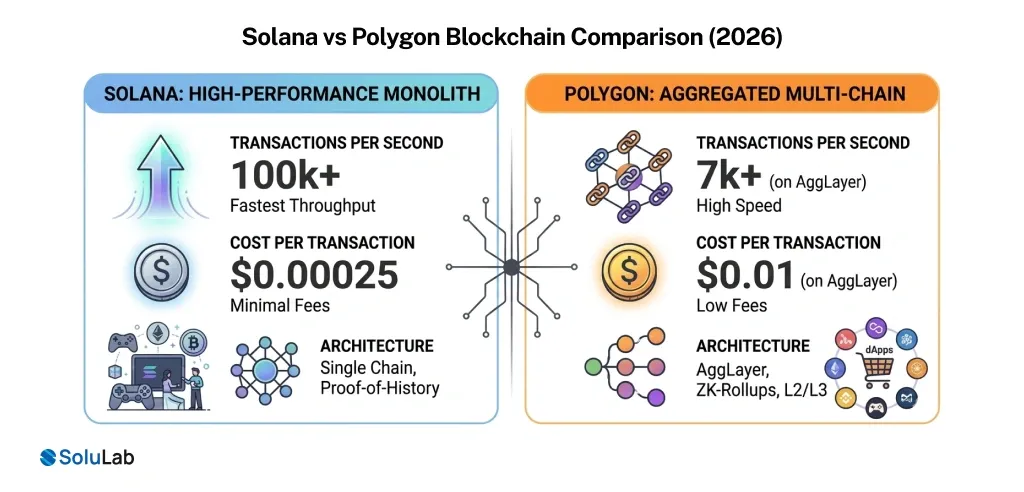
Solana vs Polygon Blockchain Comparison (2026)
Looking at this through an RWA lens, a few dimensions matter more than others.
Performance
Solana leads in raw execution:
- very low fees
- fast finality
- high throughput
This makes it suitable for tokenization platforms where transaction volume is high or cost sensitivity is critical.
Polygon is also efficient, especially compared to the Ethereum mainnet. Its value lies in balancing scalability with ecosystem compatibility.
Ecosystem & Tooling
Polygon has an advantage here.
Because of Ethereum alignment, it benefits from:
- mature tooling
- established standards
- broader developer familiarity
The Polygon ecosystem for RWA tokenization feels closer to what institutions already understand.
The Solana ecosystem for asset tokenization is growing quickly, but may require more ecosystem-specific adaptation.
Compliance & Institutional Fit
Compliance is not native to any chain. It is built into the platform.
Still, ecosystem context matters.
Polygon often fits more naturally into compliance-oriented builds due to:
- EVM compatibility
- familiar infrastructure patterns
- easier integration with external systems
Solana can support similar outcomes, but the implementation may be more customized.
Interoperability
Polygon benefits from proximity to the Ethereum blockchain ecosystem.
This enables:
- easier cross-platform integration
- compatibility with existing tools
- smoother multi-chain expansion
Solana offers a more contained environment, which can simplify system design but may limit interoperability depending on long-term goals.
| Dimension | Solana | Polygon |
|---|---|---|
| Execution efficiency | High | Moderate to high |
| Ecosystem maturity | Growing | Established |
| Compliance alignment | Customizable | More standardised |
| Interoperability | More contained | Broader compatibility |
The Real Decision
The Solana vs Polygon for RWA tokenization decision comes down to:
- performance vs integration
- cost efficiency vs ecosystem alignment
- execution scale vs institutional familiarity
Most teams will find their answer once their operating model is clearly defined.
RWA Tokenization on Solana: Benefits, Limitations, and Use Cases
Solana starts to stand out when tokenization becomes dynamic.
If assets are expected to move often, settle quickly, or interact with users at scale, performance stops being a backend concern. It becomes part of the product experience.
That is where Solana fits naturally.
Its low fees and fast execution make it easier to support:
- frequent payouts
- smaller transactions
- real-time or near real-time settlement
This changes what is economically viable. A platform that distributes yield daily or supports high user activity feels very different on a low-cost, high-speed system.
At the same time, RWA platforms are not just about movement. They are about control.
And this is where teams need to be deliberate.
Building RWA Tokenization on Solana often means designing more of the surrounding infrastructure yourself. Compliance logic, identity checks, and integrations with off-chain systems are all achievable, but they are not always plug-and-play.
For some teams, that flexibility is useful.
For others, especially those working with strict regulatory requirements, it can add complexity.
Where Solana tends to work best?
| Scenario | Fit |
|---|---|
| High transaction volume | Strong |
| Cost-sensitive platforms | Strong |
| Real-time asset interaction | Strong |
| Compliance-heavy systems | Moderate |
RWA Tokenization on Polygon: Benefits, Limitations, and Use Cases
Polygon usually feels more familiar from the start.
That familiarity comes from its alignment with Ethereum. Much of the tooling, standards, and development patterns carry over. For many teams, especially in finance, this reduces the gap between concept and execution.
This matters more than it seems.
RWA platforms rarely operate in isolation. They need to connect with:
- compliance providers
- custody solutions
- reporting systems
- existing financial workflows
In these environments, compatibility becomes a major advantage.
This is where RWA Tokenization on Polygon tends to fit well.
It provides a foundation that aligns more closely with how institutional systems are already structured.
That said, this flexibility comes with its own trade-offs.
Polygon offers multiple paths. That creates choice, but also requires clearer architectural decisions early on. Without that clarity, systems can become fragmented over time.
Compared to Solana’s more contained setup, Polygon asks for a bit more planning upfront.
Where Polygon tends to work best?
| Scenario | Fit |
|---|---|
| Institutional platforms | Strong |
| Compliance-driven systems | Strong |
| Integration-heavy builds | Strong |
| High-frequency transaction models | Moderate |
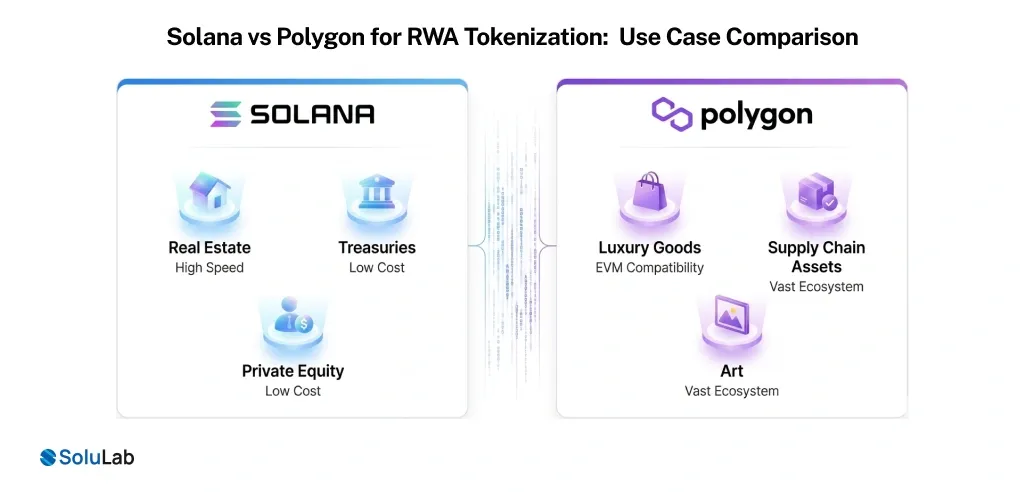
Solana vs Polygon for RWA Tokenization:
Use Case Comparison
The easiest way to make sense of the Solana vs Polygon for RWA tokenization decision is to look at the asset itself.
Different assets behave differently. And once you anchor the decision there, the choice becomes clearer.
Structured assets
Assets like real estate, private credit, and funds tend to be more controlled in nature.
They involve:
- defined investor groups
- regulatory oversight
- limited, permissioned transfers
Here, the focus is not on how fast assets move, but on how reliably they operate within rules.
Polygon aligns more naturally with this model. Its ecosystem supports compliance-heavy, integration-driven platforms more comfortably.
Activity-driven platforms
Other tokenization models are shaped by movement. Think of:
- asset marketplaces
- retail-facing tokenization platforms
- systems with frequent user interaction
In these cases, transaction cost and speed directly affect adoption.
If every interaction feels heavy or expensive, usage drops. If interactions are smooth and cheap, activity increases.
This is where Solana fits better.
A quick way to see the split
| Asset Behavior | Better Fit |
|---|---|
| Structured, compliance-heavy | Polygon |
| High activity, transaction-heavy | Solana |
The underlying pattern
- Polygon tends to align with systems that resemble traditional finance.
- Solana tends to align with systems that behave more like digital platforms.
Both are valid directions. The choice depends on what you are building.
Architecture & Operating Model for RWA Platforms
Once the chain decision is framed correctly, the next question is more practical:
How does the platform actually work end-to-end?
Because a tokenization system is not just a smart contract. It is a coordinated stack.
The Core Layers
Most RWA tokenization platforms follow a similar structure, regardless of chain:
- Asset layer: The legal wrapper. This is where ownership actually lives.
- Tokenization layer: Smart contracts that represent and manage the asset.
- Compliance layer: Identity checks, permissions, transfer restrictions.
- Settlement layer: Where transactions are executed and recorded on-chain.
Where Solana and Polygon Differ in Design?
The difference shows up in how these blockchain layers connect.
On Solana, the system often feels more tightly integrated.
Teams tend to design around performance first, then layer in compliance and integrations.
On Polygon, the system often starts from compatibility.
Teams design around standards, integrations, and compliance workflows from the beginning.
A Simplified View
| Layer | Solana Approach | Polygon Approach |
|---|---|---|
| Token execution | Optimised for speed | Aligned with EVM standards |
| Compliance integration | More custom design | Easier via existing patterns |
| External system integration | Requires planning | More straightforward |
| System flexibility | More contained | More modular |
Operating Flow (What Actually Happens)
A typical lifecycle looks like this:
- Asset is onboarded and legally structured
- Tokens are issued against that asset
- Investors are verified and onboarded
- Tokens are distributed under defined rules
- Transfers and payouts occur based on logic
- Reporting and audits track all activity
The blockchain technology sits inside this flow. It does not replace it.
What This Means for Builders?
- Solana simplifies execution but requires thoughtful system design around it
- Polygon simplifies integration but requires clearer architectural choices upfront
Neither removes complexity.
They move it to different parts of the system.
Risk, Compliance & Enterprise Decision Framework
This is where most real decisions are made.
Not at the level of performance. At the level of risk.
The Non-Negotiables in RWA Systems
Any serious RWA tokenization platform development effort must handle:
- Regulatory alignment
Jurisdiction, asset classification, investor eligibility - Custody and key management
Who controls access and how - Smart contract risk
Bugs, exploits, and upgradeability - Auditability
Can the system explain every transaction clearly
Where Ecosystem Context Matters?
Both Solana and Polygon can support compliant systems.
But the experience differs.
Polygon often feels closer to existing financial infrastructure.
Solana offers more control but may require more custom design.
Enterprise Decision Lens
Instead of asking “which chain is better,” enterprise teams usually converge on a few practical questions:
- How easily can this integrate with our existing systems?
- How comfortable are regulators and partners with this stack?
- How much custom infrastructure do we need to build?
- How will this scale across jurisdictions and asset classes?
| A Simple Decision Framework | Blockchain Chosen |
|---|---|
| Priority | Likely Direction |
| Performance and cost efficiency | Solana |
| Compliance alignment and familiarity | Polygon |
| Integration with existing systems | Polygon |
| High-scale transaction environments | Solana |
Build vs Partner
This is also where many teams underestimate effort.
Building internally means owning:
- compliance logic
- integrations
- lifecycle management
Working with an experienced blockchain development company can accelerate this significantly, especially when the focus is on:
- architecture design
- compliance readiness
- phased rollout
This is where firms like SoluLab typically come in. Not at the token level, but at the system level, where these decisions actually matter.
Future of RWA Tokenization: Trends, Multi-Chain Shift, and Final Verdict
The direction is becoming clearer.
There will not be one chain that dominates RWA tokenization.
There will be multiple.
What the Next Phase Looks Like
- Multi-chain systems will become standard
- Interoperability will matter more than chain loyalty
- Compliance-aware infrastructure will define winners
- Institutional participation will continue to grow
The focus will shift from “where is the asset issued” to “how does it move across systems safely.”
The Final Verdict
The Solana vs Polygon blockchain comparison is useful, but only to a point.
The better question is:
What kind of system are you building?
- If it behaves like a high-activity digital platform, Solana often fits better
- If it behaves like a structured financial product, Polygon often fits better
Most serious platforms will eventually touch both worlds.

What’s Next?
Tokenization platform development is not about putting assets on-chain. It is about rebuilding how assets are issued, accessed, and managed. The blockchain is just one layer in that system.
Choosing between Solana and Polygon is not about picking a winner. It is about choosing the foundation that aligns with how your platform needs to operate today, and how it needs to evolve tomorrow.
FAQs: Solana vs Polygon for RWA Tokenization
Shipra Garg is a tech-focused content strategist and copywriter specializing in Web3, blockchain, and artificial intelligence. She has worked with startups and enterprise teams to craft high-conversion content that bridges deep tech with business impact. Her work translates complex innovations into clear, credible, and engaging narratives that drive growth and build trust in emerging tech markets.