Machine learning stopped being a research curiosity a while ago. Companies now lean on it to squeeze value out of data, cut manual work, make sharper calls, and push out ideas that would have stalled otherwise. According to Fortune Business Insight, the global ML market is expected to jump from $21.17 billion in 2022 to $209.91 billion by 2029, a compound annual growth rate of 38.8% across that window. And MLOps? That is the piece that sits between the model and the messy reality of running it, borrowing as much from software engineering as it does from data science.
Think of MLOps as the discipline that keeps a model alive from the first line of training code through deployment and every retrain after that. In a world where GenAIOPs-driven decisions keep multiplying, that kind of order matters. It pulls together habits from data science, DevOps, and software engineering so teams can scale their ML work without losing reproducibility or reliability. Pair that with large language models, and the payoff shows up where it counts: better model performance, and results that actually move a business rather than sitting in a notebook.
This piece walks you through what MLOps really is and how you build a pipeline around it. Let’s get into it.
What is MLOps?
MLOps, short for machine learning operations, is a set of practices for running ML models in production without the whole thing falling apart. It covers the loop you keep circling back to: building the model, shipping it, watching it, fixing it, and wiring it into the systems that actually use its output. The point is reliability, scale, and models that keep performing. Some teams treat GenAI services, MLOps as a deployment-only step machine learning models. but plenty of organizations lean on it across the whole ML lifecycle, from Exploratory Data Analysis (EDA) and data preprocessing right through model training.
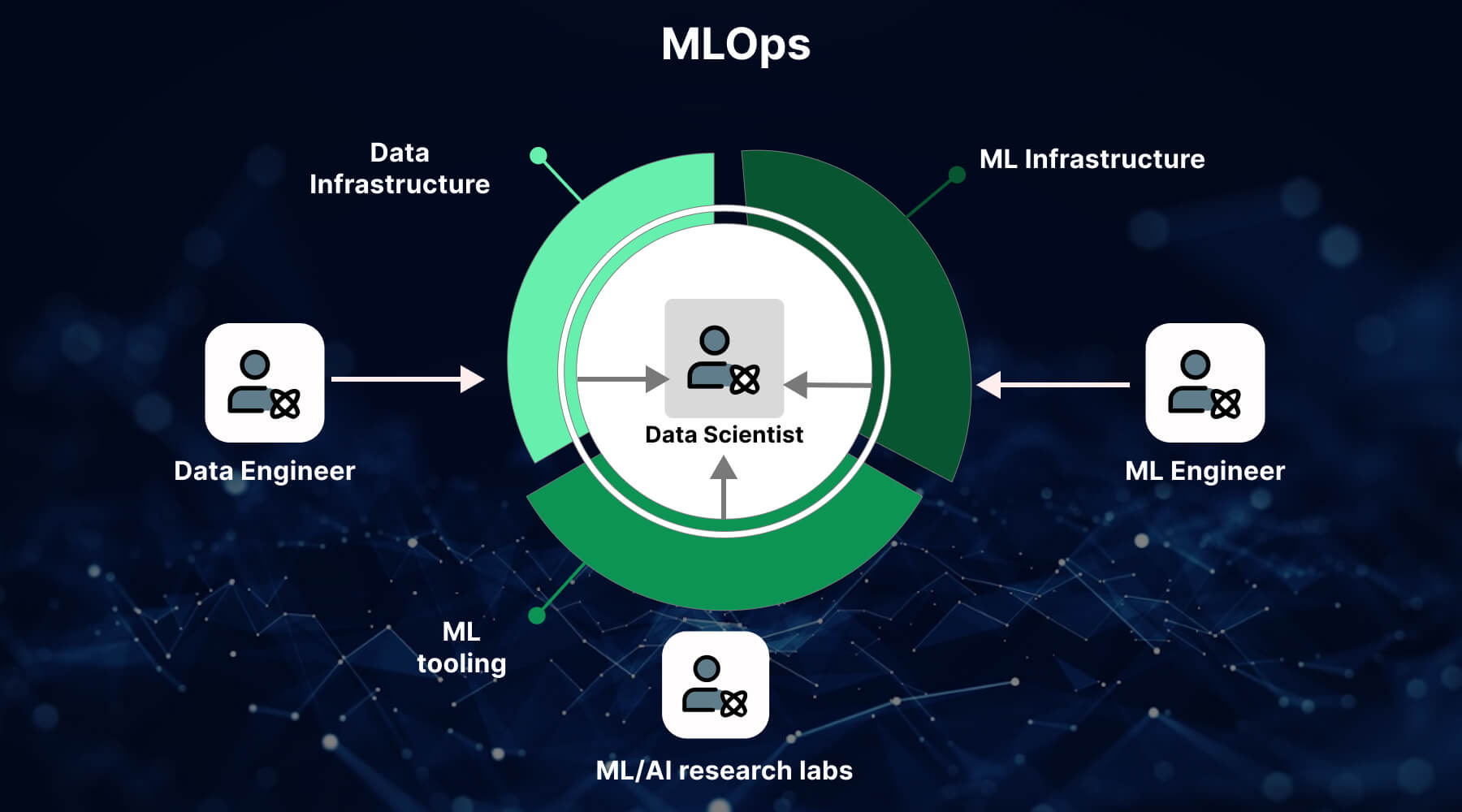
MLOps takes its cues from DevOps. DevOps grew out of the need to get software development teams (Devs) and IT operations teams (Ops) talking to each other, and MLOps applies that same instinct to machine learning. A working pipeline usually pulls in a mix of people: data scientists, machine learning engineers, software developers, and IT operations folks. Data scientists shape and study the datasets with AI and ML algorithms, while Private LLM engineers push that data through models using structured, automated steps. What is the team chasing? Less waste, more automation, and insights you can actually trust.
Getting the development, deployment, monitoring, and upkeep of ML models right takes the right tools, methods, and habits, the kind that hold up when the model hits real traffic. So what is an MLOps pipeline, exactly? It is the connective tissue between data scientists, developers, and operations teams, the thing that gets a model into production cleanly instead of over the wall. At its core, MLOps builds an automated workflow for managing AI and ML in data integration and everything downstream, which is what lets a business actually put machine learning to work outside the lab.
MLOps vs DevOps- What’s the Difference?
MLOps and DevOps chase the same broad goal, smoother workflows and tighter collaboration between dev and ops, as noted by AI use cases. But where they point and what they produce split apart fast. Here is the short version:
| Aspect | DevOps | MLOps |
| Development Focus | Focuses on developing, testing, and deploying traditional software applications. | Centers on creating, training, and deploying machine learning models. |
| End Product | A deployable software unit (e.g., an application or interface). | A serialized machine learning model that makes predictions based on data. |
| Version Control | Tracks change in code and artifacts, with limited metrics for tracking. | Tracks code, training datasets, hyperparameters, model artifacts, and performance metrics for each experiment. |
| Reusability | Emphasizes reusable and automated processes across projects. | Encourages consistent, reusable workflows for model training and deployment to maintain accuracy across projects. |
| Automation | Automates CI/CD pipelines for smooth software delivery. | Automates model training, retraining, and deployment while managing ongoing model performance. |
| Monitoring | Continuous monitoring ensures reliability, though the software does not degrade over time. | Requires continuous monitoring as ML models degrade with evolving real-world data, needing retraining to remain effective. |
| Infrastructure | Relies on cloud technologies, Infrastructure-as-Code (IaC), and CI/CD tools. | Uses cloud infrastructure with resources like deep learning frameworks, GPU support, and large data storage. |
| Performance Decay | No performance degradation once the software is deployed. | ML models can degrade as new data is encountered, necessitating continuous retraining and updates |
MLOps Pipeline Architecture
You cannot build, ship, and maintain models well without an end-to-end pipeline architecture behind them. A solid MLOps setup, paired with AI development, keeps the whole lifecycle moving: it makes work efficient, keeps the team in sync, and leaves room to adapt. Here is how the main pieces of a straightforward MLOps pipeline break down.
Data Gathering and Ingestion
Almost every pipeline opens the same way: raw data gets pulled from various sources and fed into the system. That usually means building a data warehouse that gathers information from scattered places into one spot, which makes preprocessing simpler and lets you check data quality before any training starts. Get this stage right and the model trains on something complete and relevant. Data connections, ingestion scripts, and prep routines all shape what the model ends up learning from, so they carry real weight here.
Preparing Data and Feature Engineering
Once the data is in, the pipeline shifts to feature engineering and prep. Here you run the raw data through transformations, feature extraction, normalization, cleaning, until you have an organized, enriched dataset the model can actually learn from. This is often where a project quietly succeeds or fails. Data pretreatment scripts and feature engineering techniques do the heavy lifting.
Model Development and Training
After the data is transformed, the model gets built and trained. This is where you train the machine learning model, pick the right methods, and tune the hyperparameters. Three things really drive how well the model predicts: the experimental frameworks, the model configuration files, and the training scripts.
Model Assessment and Validation
Training done, the AI Applications model gets assessed and validated to confirm its output clears the bar you set. You run it against training and testing sets, compare what it predicts on unseen data to what you expected, and adjust from there. Comparison tools, validation metrics, and evaluation scripts are what make that judgment honest rather than hopeful.
Model Implementation
Once training and validation check out, the trained model moves into a production environment for batch or real-time predictions. Deployment scripts, containerization tools like Docker, and a clean handshake with the serving infrastructure are what let it cross from development into live use without friction.
Observation and Recordkeeping
A deployed model still needs watching. You log the data that matters and keep an eye on performance around the clock, because problems rarely announce themselves. Monitoring tools, logging structures, and alerting systems let you catch the odd behavior early and deal with it before it spreads.
Iteration of the Model and Feedback Loop
The pipeline also loops back on itself. A feedback loop pulls signals from models already in production, and that input lets the model keep pace with shifting data and sharpen its predictions over time. Automated retraining routines and version control are what make this loop practical instead of a manual chore.
Governance and Compliance
Governance and compliance get baked into the pipeline so the whole thing stays inside business and regulatory lines. In practice that means compliance frameworks, thorough audit trails, and documented procedures, the paper trail that keeps everyone accountable and the process transparent.
Continuous Deployment/Continuous Integration (CI/CD)
Automation is the whole story at this stage. The pipeline runs on continuous integration and continuous deployment (CI/CD), automating testing, integration, and release so models reach production safely and without a scramble every time.
Resource Management and Scalability
When demand swings, scalability and resource management move to the front. Scalability tools, smart resource allocation, and disciplined use of cloud resources let the pipeline stretch or shrink to match whatever compute the moment calls for.
Why are MLOps Necessary?
Data keeps getting bigger and more tangled, and automated decision-making shows up in more places every year. That combination throws real technical problems at anyone trying to build and run machine learning systems. MLOps, the engineering culture that grew up to tame those systems, is the answer to that pressure.
To get MLOps, you have to see the whole ML system lifecycle, which touches several teams across an organization. It starts with the business development or product team setting the goals and the key performance indicators (KPIs).
MLOps solves a few nagging problems. For one, there simply are not enough data scientists who can also build and ship scalable web applications. That gap gave rise to the “ML engineer,” a hybrid role blending DevOps chops with data science. And weak communication between business and technical teams sinks projects more often than anyone likes to admit, so a shared vocabulary becomes the thing that keeps people cooperating instead of talking past each other.
Then there is risk. These systems are largely “black boxes,” so weighing the cost of failure is not optional. A bad YouTube recommendation is an annoyance. Flagging an innocent person for fraud is something else entirely. MLOps tries to hold that balance, which is what makes the resulting machine learning system both safer and more useful.
Why Do We Need MLOps?
Same forces, worth restating. Data is scaling up and growing more complex, automated decision-making is spreading, and building and deploying ML systems runs into technical walls because of it. MLOps steps in here as an engineering culture built to optimize those systems.
To understand MLOps, start with the ML system lifecycle, which spans multiple teams. It kicks off with the business development or product teams laying out clear objectives and KPIs, which sets the ground for everything that follows.
From there, the data engineering team handles acquiring and prepping the data, and the data science team builds the ML models. One recurring snag: there are too few data scientists who can also build scalable web applications, which is exactly why the ML engineer role emerged, folding together data science and DevOps skills in one person.
And as business goals shift and data drifts, LLMOps become the mechanism that helps ML models keep up. Continuous retraining and solid AI governance are what hold performance standards in place over time.
The other stubborn hurdle is the gap between technical and business teams, which tanks projects again and again. MLOps Consulting Services stress collaboration for exactly this reason: close that gap, and deployments actually land.
Finally, you have to size up the risk in ML/DL systems, especially given how opaque they are. Striking the right balance between efficiency and risk matters most in high-stakes settings, where a mistake can carry real weight. LLM use cases demand the same careful risk management if their real-world use is going to stay reliable and safe.
What is MLOps Pipeline?
A machine learning pipeline is a chain of connected steps built to automate and tidy up how models get made. The stages can vary, but you will usually see data extraction, preprocessing, feature engineering, model training, evaluation, and deployment. The main aim is simple: automate the whole model-building process so it stays consistent, scalable, and maintainable across its lifecycle.
Pipelines matter because ML projects get complicated fast. They give data scientists room to experiment methodically with data before locking in treatment methods, feature engineering, and algorithms. With MLOps pipelines in place, teams get smoother workflows, which means cleaner experimentation and models that actually make it into production.
At bottom, a pipeline is a set of organized, automated tasks that smooth out workflows across industries, machine learning and data orchestration especially. Through MLOps consulting services, organizations can tune these workflows so models get deployed well and stay maintained against real business needs.
Folding both large and small language models into machine learning pipelines widens what you can handle, letting the system work across different data types and lift model performance. These models offer scalable answers to a range of ML tasks, which is how businesses put AI to work more effectively.
What is the Process of MLOps?
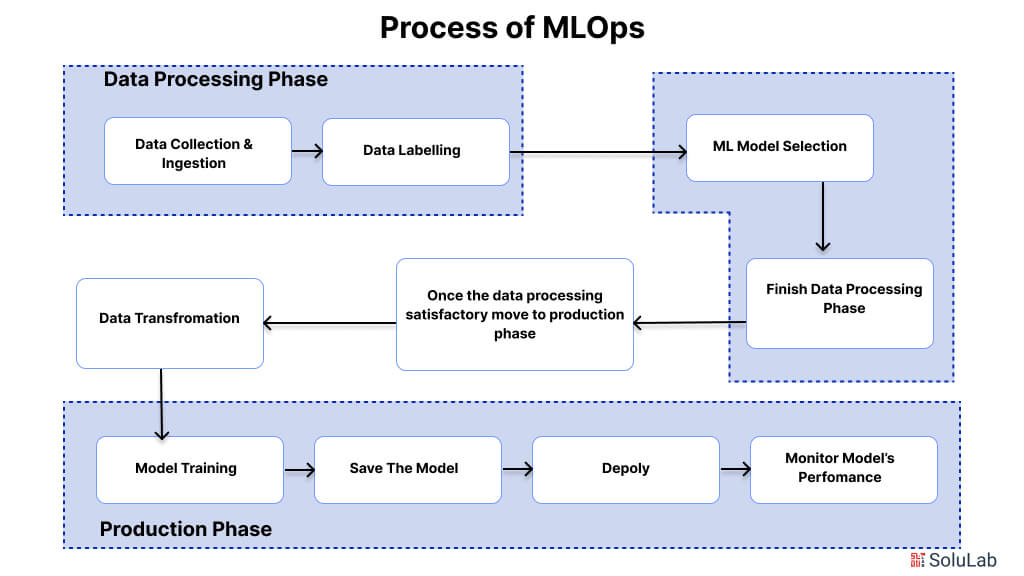
Let’s walk through the MLOps process step by step. It splits into two distinct phases, an experimental one and a production one, and each has its own workflow stages.
A. Experimental Phase
This phase breaks into three stages, covered below:
Stage 1: Problem Identification, Data Collection, and Analysis
First you define the problem, then you collect the data to train the model on. Take a fall-detection app for hospitals. Video feeds come from cameras in patient rooms and hallways, and those feeds are the model’s input. After preprocessing and labeling, the system learns to spot falls and alert staff. The key sub-stages:
- Data Collection and Ingestion: The collected video lands in a data warehouse, where it gets cleaned, normalized, and processed for consistency. Once it is ready, it flows into the system, whether that means loading it into data lakes or pushing it through real-time streaming platforms.
- Data Labeling: This is the tagging work that teaches the model to recognize a fall. Data scientists annotate short video clips showing patient behavior, a fall, say, so the model learns from accurate examples.
Stage 2: Machine Learning Model Selection
Now you test algorithms to find the one that fits the job. In the fall-detection case, data scientists try things like motion analysis to catch the patterns tied to a fall. Iterate across enough models and parameter settings, and the right one for real-time detection surfaces.
Stage 3: Model Training and Hyperparameter Tuning
Here the team runs experiment after experiment, trying different hyperparameters and writing down what they see. Cloud platforms usually handle the many test runs and help push performance higher. Once the results hit the mark, the work moves into the production phase.
B. Production Phase
The aim now is to get a fully tested ML application running in a live environment.
Stage 1: Data Transformation
This is where the model trains on the complete dataset. With large datasets, data parallelism or model parallelism can be brought in to speed things up.
Stage 2: Model Training
Scalable methods like data parallelism train the model on big datasets. The idea is straightforward: split the dataset into smaller batches and process them at once across multiple devices, which keeps learning efficient.
Stage 3: Model Serving
With the model ready, it gets served into production. A/B testing and canary testing then pit model versions against each other, and those tests surface the most stable, best-performing candidate to deploy.
Stage 4: Performance Monitoring
After it goes live, you watch it. Drift monitoring, which flags shifts in data distribution or drops in accuracy, is what keeps a model useful over the long haul rather than quietly rotting.
How to Build an MLOps Pipeline?
Building an MLOps pipeline runs through a handful of stages that smooth out how you deploy, monitor, and manage ML models. The trick is marrying machine learning with DevOps practices, so you get continuous integration, continuous delivery, and room to scale.
Step 1: Data Collection and Processing
It starts with gathering and preprocessing data. Clean it, label it, get it ready for training. This is also where data versioning and automated workflows come in, so your training datasets stay consistent instead of drifting run to run.
Step 2: Model Development and Training
Next you build the model architecture and train it on that processed data. With tools like TensorFlow or PyTorch, data scientists can cycle through different models quickly. Set up automated training pipelines here so retraining is easy the moment new data shows up.
Step 3: Model Validation and Testing
Trained, but not trusted yet. The model has to pass validation and testing first, checked against metrics like precision, recall, and F1-score. Automated testing acts as the gate, so only the models that actually perform get promoted forward.
Step 4: Continuous Integration and Deployment
Continuous integration (CI) is where a lot of the value sits. You fold the model and its dependencies into a deployment pipeline with tools like Jenkins or GitLab CI/CD, and that is what gets the model into production without a manual mess each time.
Step 5: Model Monitoring and Maintenance
Once it is deployed, keep watching it in real time. Tools like Prometheus and Grafana track latency, prediction accuracy, and drift. And when performance slides because the data has moved on, that is your cue to retrain or swap the model out.
Step 6: Conversational AI Integration
Building something conversational? Fold natural language processing (NLP) models into the pipeline. They are what let chatbots, virtual assistants, and similar tools handle text and speech. Automated retraining pipelines really earn their keep in conversational AI, since the interactions keep getting better as user feedback rolls in.
Follow these steps and you end up with an MLOps pipeline that supports continuous deployment, monitoring, and scaling for your ML models, whether you are working with conversational AI or any other data-driven application.
Best Practices for Building an MLOps Pipeline
A pipeline that actually holds up at scale follows a few habits worth spelling out. Here are the ones that matter most:
1. Automate Data Pipeline and Model Training
Lean on business process automation to automate data collection, cleaning, and feature engineering. Do that and your models keep training on fresh data with no one babysitting the process, which shortens the development cycle and cuts down on the human slips that creep in otherwise.
2. Establish Continuous Integration and Delivery (CI/CD)
CI/CD for machine learning means models get tested, validated, and deployed automatically once training wraps. Continuous integration checks every change to the model or data pipeline, while continuous delivery lets you push reliable updates to production fast.
3. Leverage Model Monitoring and Alerting
Watching models in real time is how you catch performance drift or data inconsistencies before they bite. Set up automated alerts on accuracy, latency, and data drift, so the team can react quickly and retrain the moment something slips.
4. Utilize Robotic Process Automation (RPA) for Efficiency
Bring robotic process automation into the pipeline and it takes over the repetitive, administrative grind, things like infrastructure provisioning and model deployment. RPA keeps those tasks consistent and lifts a chunk of the load off data scientists and engineers.
5. Ensure Model Versioning and Reproducibility
Version control for both models and data is what keeps the whole thing reproducible. Track model versions alongside their datasets, and you can trace how each iteration performed and keep your machine learning operations consistent instead of guessing after the fact.
6. Focus on Security and Compliance
Hold your pipeline to solid security practices: data encryption, access control, and compliance with the regulations in your field. This matters even more when you are handling sensitive data or deploying models in industries like healthcare and finance, where the stakes leave no room for slack.
Stick with these practices and you build MLOps pipelines that hold up: automated, always improving, and running high-performance machine learning models.
How SoluLab Can Be Beneficial in Developing MLOps Pipeline?
Building a good MLOps pipeline is rarely smooth. Tangled data workflows, models that need to scale, continuous integration and monitoring that has to just work, it adds up. A lot of companies stall here, short on the skilled people and worn down by the technical weight of it. SoluLab, a leading AI development company, offers end-to-end MLOps solutions that take that weight off. From automating data pipelines to standing up dependable CI/CD systems for machine learning, , A machine learning development company like SoluLab keeps your models scalable, accurate, and secure, which cuts down on performance drift and the operational bottlenecks that stall everyone else.
Hire AI developers from SoluLab and you get a team that has already wrestled with the usual pain points, clumsy model deployment, no real-time monitoring, all of it. We build pipelines that run themselves, so you can scale your machine-learning models and get them into production without the friction. With MLOps solutions shaped around your specific needs, you ship faster and hold performance over the long run. Reach out today and let’s talk about building your pipeline the right way.
FAQs
Shipra Garg is a tech-focused content strategist and copywriter specializing in Web3, blockchain, and artificial intelligence. She has worked with startups and enterprise teams to craft high-conversion content that bridges deep tech with business impact. Her work translates complex innovations into clear, credible, and engaging narratives that drive growth and build trust in emerging tech markets.