
Key Takeaways
- The term describes two unrelated industries. Marketing agencies use it for brand visibility inside AI answers. Engineering firms use it for making a model you own faster and cheaper.
- One question tells you which you need. Do you own the model, or are you trying to appear in someone else’s? “Our competitor gets recommended” points one way; “our inference bill tripled” points the other.
- A vendor claiming both is strong at one. Content authority work and inference engineering share almost no skills, so judge the claim by which half they can show numbers for.
- Cheap wins come before clever ones. Model selection, routing and caching return more than fine-tuning in most products. A partner opening with distillation is proposing the most billable option.
- Nothing gets optimised without an evaluation set. It is the only way to know the cheaper version is still good enough.
- Every optimization trades something. Any vendor claiming a saving with no accuracy cost has not measured it.
- Governance is the one thing you cannot optimise away. Data residency, GDPR and the EU AI Act constrain which levers are available, so settle where data may go before choosing how to make it cheaper.
“LLM optimization companies” describes two industries that share a phrase and nothing else. One is marketing: getting your brand mentioned, cited and recommended when someone asks an AI assistant for a recommendation. The other is engineering: making a large language model you already run faster, cheaper and more accurate in production.
They have different buyers, different deliverables, different pricing and different failure modes. Consequently, the fastest way to waste a quarter is to brief the wrong one.
On this page: how to tell which one you need, what each category actually does, what to check before signing with either, where the two genuinely overlap, how governance constrains the options, and how model optimization works in practice.

Which Kind of LLM Optimization Company Do You Actually Need?
Choosing between LLM optimization companies starts with one question: do you own the model, or are you trying to appear in someone else’s?
| Brand visibility (LLMO / GEO) | Model optimization | |
| Your goal | Be cited when an AI answers a buying question | Run your own model faster and cheaper |
| You own | Content, a website, a brand | A deployed model or AI product |
| Bought by | Marketing, growth, SEO leads | Engineering, product, CTO |
| Delivered by | Marketing and SEO agencies | AI engineering firms |
| Measured in | Citation share, mention rate, referral traffic | Cost per request, P95 latency, accuracy on an eval set |
| Typical engagement | Monthly retainer, months to see movement | Project or ongoing engineering |
| Failure mode | Visibility that never converts | A cheaper model that quietly got worse |
If your problem is “ChatGPT recommends our competitor and not us,” you need the first. However, if it is “our inference bill tripled and responses take four seconds,” you need the second. Nobody credible does both well, and a vendor claiming both is usually strong at one.
What Do Brand Visibility LLM Optimization Companies Do?
This category is covered here because half the people searching this term want it. SoluLab does not offer this service; this section exists to help you evaluate someone who does.
In short, the work is content and authority engineering aimed at the sources AI assistants draw on. That means structured, citable content, presence in the third-party sources models retrieve from, review and directory coverage, and monitoring which prompts your brand appears in.
Four things to check before signing:
1. What they measure. Citation and mention rate across named assistants, tracked over time, on prompts a real buyer would type. Vague “AI visibility” scores with no methodology are unverifiable.
2. Whether they show the prompt set. Specifically, you should see the exact questions being tracked and be able to change them.
3. How they handle volatility. Model providers update constantly, so visibility moves without anyone doing anything. An agency that reports only upward movement is selling noise.
4. Whether it converts. Being mentioned is not the goal. Instead, ask what happened to qualified enquiries.
Finally, treat any single-vendor “we rank number one” award as marketing rather than evidence. Several of the highest-visibility results for this term are press releases.
What Do Model Optimization Companies Do?
Engineering-side LLM optimization companies start with measurement. Any firm that proposes a technique before seeing your traffic pattern, latency distribution and evaluation set is guessing.
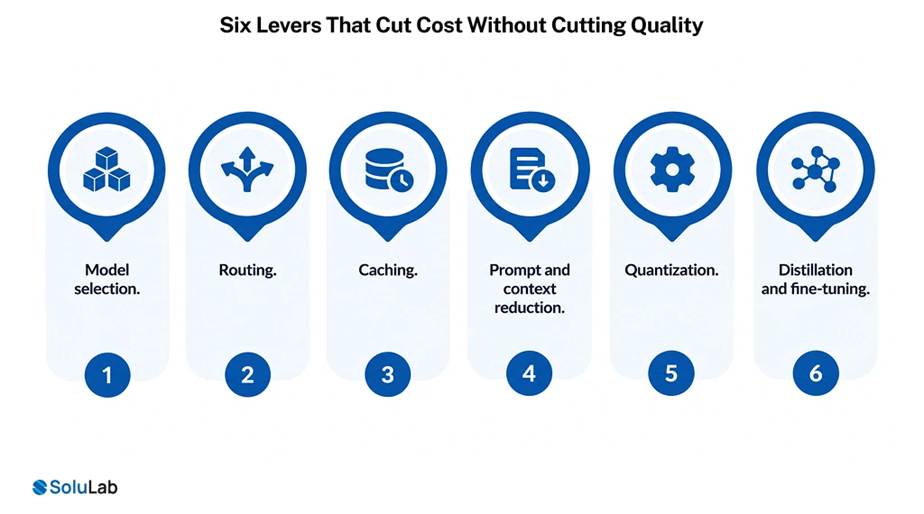
1. Model selection. First, the largest available model is rarely the right one. Most production workloads have a cheaper model that clears the same accuracy threshold, and finding it is usually the single biggest saving.
2. Routing. Next, send easy requests to a small model and hard ones to a large one. In practice, a classifier deciding which is which often pays for itself in weeks.
3. Caching. Then add semantic caching for repeated or near-identical requests. It is underused, and effectively free money in high-volume products.
4. Prompt and context reduction. Because tokens cost money in both directions trimming retrieved context and system prompts reduces spend and latency at once, and often improves accuracy by cutting noise.
5. Quantization. Similarly, reduced numerical precision for self-hosted models, cutting memory and inference cost with a measurable and usually small accuracy trade-off.
6. Distillation and fine-tuning. Finally, training a smaller model to do one job as well as a large general one. This is the highest effort and highest ceiling, and only worth it at volume.
Behind all six sits the non-negotiable: an evaluation set that tells you whether the cheaper version is still good enough. Otherwise, teams ship a model that costs far less and quietly performs worse until customers notice. The unit economics of this are covered in SoluLab’s guide to scaling AI products.
Where Do the Two Actually Overlap?
The two kinds of LLM optimization companies overlap narrowly, and it is worth knowing where.
For example, if you are building a product that answers from your own content, retrieval quality is an optimization problem on the engineering side and a content problem on the marketing side. Well-structured, unambiguous source content improves both what an external assistant can cite and what your own RAG application can retrieve.
However, that is the whole overlap. It does not make one vendor able to do both jobs.
How Does Governance Constrain Model Optimization?
Governance is the one input you cannot optimise away, and it decides which levers are even available to you.
Data residency. For instance, if your data may not leave a region, some hosted models and routing options are off the table before cost is discussed.
Self-hosting versus API. Quantization and distillation assume you run the model yourself. Therefore teams restricted to a vendor API are limited to selection, routing, caching and prompt reduction.
Regulatory scope. GDPR governs personal data in prompts and logs, and the EU AI Act adds obligations for higher-risk uses. Both affect what you can cache and retain.
Audit and certification. Additionally, SOC 2 and ISO/IEC 42001 expectations shape logging, monitoring and change control, which in turn shapes how aggressively you can iterate.
So settle where data may go first, then choose how to make it cheaper. Reversing that order is how teams build an optimised system they are not permitted to run.

What Should You Check Before Hiring LLM Optimization Companies?
Six checks for engineering LLM optimization companies, in rough order of how much they predict the outcome.
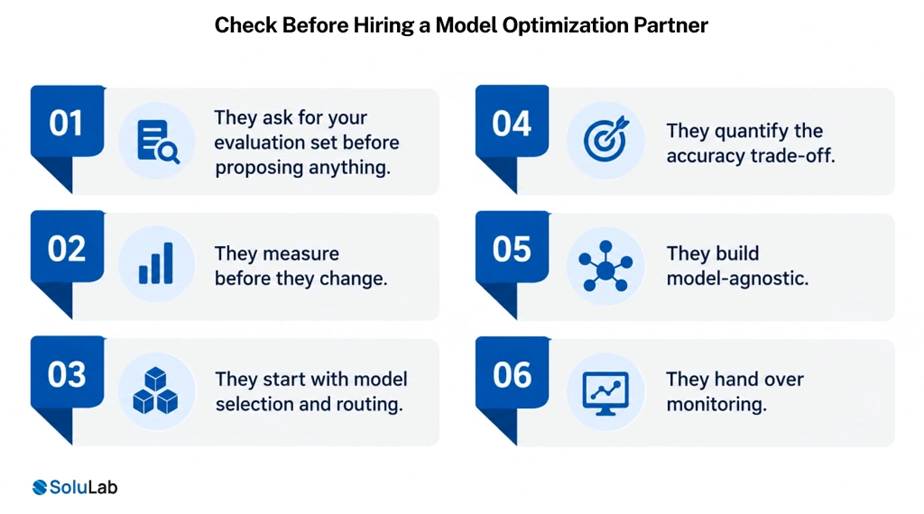
1. They ask for your evaluation set before proposing anything. No eval set means no way to prove the optimised version still works. If you do not have one, building it is the first engagement.
2. They measure before they change. That means current cost per request, token distribution, and latency at the tail rather than the average.
3. They start with model selection and routing. After all, the cheap wins come first. A partner opening with fine-tuning is proposing the most billable option, not the most effective one.
4. They quantify the accuracy trade-off. Indeed, every optimization costs something, so a partner claiming otherwise has not measured.
5. They build model-agnostic. Providers change pricing and behaviour without asking, so architecture bound tightly to one model is a rewrite waiting for a release note.
6. They hand over monitoring. Optimisation that degrades silently three months later was not optimisation. The longer version of this evaluation sits in SoluLab’s guide to choosing an AI development partner.
Where Does SoluLab Fit?
Among LLM optimization companies, SoluLab works on the engineering side of this term, not the marketing side. That means taking a model or AI product you already run and making it cheaper, faster and more reliable in production, with an evaluation set in place before anything changes.
In practice, engagements start with measurement: cost per request, tail latency and accuracy against your own test set. From there, the work moves through model selection and routing first, then caching and context reduction, and only reaches fine-tuning or distillation where volume justifies it. Delivery runs through SoluLab’s generative AI development and LLM development practices.
If what you need is brand visibility in AI answers, SoluLab is the wrong partner, and the checklist in the brand visibility section above will help you evaluate the agencies that do it.
Frequently Asked Questions
Shipra Garg is a tech-focused content strategist and copywriter specializing in Web3, blockchain, and artificial intelligence. She has worked with startups and enterprise teams to craft high-conversion content that bridges deep tech with business impact. Her work translates complex innovations into clear, credible, and engaging narratives that drive growth and build trust in emerging tech markets.