Key Takeaways
- A Polymarket-style prediction market runs on four layers: an order-matching engine, settlement smart contracts, a resolution oracle, and a compliance stack.
- Most platforms that fail don’t fail on technology. They fail on vague market rules, thin liquidity, and slow dispute handling.
- A hybrid design (off-chain matching, on-chain settlement) gives users exchange-grade speed while keeping funds non-custodial.
- Your licensing route decides your architecture. Pick the jurisdiction before you pick the chain.
- Insider trading surveillance and a written market rulebook are launch requirements, not post-launch upgrades.
- An MVP with admin-curated markets and a seeded order book is the fastest way to test demand before going fully custom.
A Polymarket-style prediction market lets users buy and sell shares in the outcome of real-world events, with prices that move between $0 and $1 as opinion shifts. Building one takes four connected layers: an order-matching engine, settlement smart contracts, a resolution oracle, and a compliance stack.
Demand isn’t the hard part, and the numbers back that up. Grand View Research projects the global sports betting market will reach $187.39 billion by 2030, growing at an 11% CAGR from 2025, and sports is now the largest category on prediction platforms.
The hard part comes after launch. Most guides stop at features and tech stacks. This one also covers what decides whether a platform keeps its users: how markets are written, how disputes get settled and how insider trading gets caught. If you’re scoping prediction market platform development, start with this guide.

What Is a Polymarket-Style Prediction Market?
A Polymarket-style prediction market is a peer-to-peer exchange where every question (“Will X happen by date Y?”) becomes a tradable pair of YES and NO shares. One share of the correct outcome pays $1 at resolution. The wrong side pays nothing. So a YES share trading at $0.62 is the crowd’s way of saying “about a 62% chance.”
1. How Outcome Shares Work
Every market starts with collateral. A user deposits $1 in a stablecoin, and the contract mints one YES share and one NO share. Users then trade those shares with each other at whatever price they agree on. When the event resolves, holders of the winning share redeem it for $1 each.
That’s the whole economic engine. It’s simple on paper. The engineering challenge is making it fast, fair, and impossible to cheat at scale. If you want the conceptual background first, our guide on how a decentralized prediction market works covers the basics.
2. How It Differs From a Sportsbook
A sportsbook sets the odds and takes the other side of your bet. A prediction betting platform doesn’t. Users trade against each other, and the platform earns from fees, not from customers losing.
That difference matters for three reasons. Prices reflect real collective belief rather than a bookmaker’s margin. The operator carries far less balance-sheet risk. And the regulatory treatment can differ sharply, since a regulated exchange for event contracts is not the same legal animal as a decentralized betting platform. For a side-by-side view of how the major models differ, see our breakdown of the Polymarket prediction market against Kalshi, Augur and Manifold.
3. Why Demand Is Climbing in 2026
The volume numbers have stopped looking niche. According to Statista, combined global trading volume on Polymarket and Kalshi reached almost $25 billion in April 2026, and $15.5 billion of that came from sports alone. Kalshi accounted for close to $15 billion of the total, with Polymarket at $9 billion.
Two things are driving it. Sports leagues and media companies now treat event contracts as an engagement product. And Polymarket’s 2025 acquisition of QCEX, a CFTC-licensed exchange, for $112 million gave the category a regulated path back into the US. When the market leader starts buying licenses, newcomers should read that as a signal about where the category is heading.
Why Do Most Polymarket Clones Struggle After Launch?
Most Polymarket clone projects ship working software and still lose users within months. The code isn’t usually the problem. The problems sit in the layer that almost every build guide skips: how markets are written, how liquidity starts and how outcomes are defended. A short round of blockchain consulting before development often catches these gaps while they’re still cheap to fix.
1. Ambiguous Market Rules
A market titled “Will the deal be signed in March?” sounds clear until someone asks: signed by whom, announced where, and does a memorandum count? Every ambiguity becomes a dispute, and every dispute costs trust. Polymarket’s March 2025 Ukraine minerals market, worth about $7 million, showed how fast this escalates when a large holder of UMA governance tokens influenced the resolution vote.
2. Empty Order Books on Day One
Traders won’t come to a market with a two-cent spread and $200 of depth. Nobody wants to be the first one in. Without a plan for seeding liquidity, a new crypto prediction market looks dead even when the product is solid.
3. Slow or Opaque Resolution
Users will tolerate a loss. They won’t tolerate waiting two weeks to find out whether they lost. Resolution needs clear sources, published timelines, and a visible escalation path.
4. Insider Trading Exposure
Event contracts attract people who know the outcome early. By August 2026, Polymarket said it had referred more than 100 cases to law enforcement, including a wallet allegedly linked to a US soldier who used classified information to bet on the capture of Nicolas Maduro. If the category leader needs a dedicated investigations function, a new entrant does too.
What Does the Architecture of a Polymarket-Style Platform Look Like?
A Polymarket-style platform uses a hybrid design: orders are matched off-chain for speed, while settlement and custody happen on-chain through smart contracts. Users sign orders with their own wallets, so the operator never holds their funds. Here’s how the main components of a blockchain prediction market fit together.
1. Hybrid Order Book and Matching Engine
The central limit order book (CLOB) is where buyers and sellers meet. Users sign orders off-chain using a typed-data standard such as EIP-712, and an off-chain operator matches them in milliseconds. Matched trades are then submitted on-chain for settlement. This is the same pattern used by a hybrid crypto exchange, and it’s why Polymarket feels like a trading app rather than a slow dApp.
2. Conditional Token Settlement Contracts
Settlement typically uses the Conditional Tokens Framework (CTF), originally built by Gnosis. It represents YES and NO positions as ERC-1155 tokens, handles the split of collateral into outcome shares and pays winners on redemption. Getting this layer right is core smart contract development work, because a single rounding or access-control bug here touches every dollar on the platform.
3. Oracle and Resolution Layer
Polymarket resolves most markets through UMA’s Optimistic Oracle. Someone proposes an outcome and posts a bond. If nobody disputes it within a short challenge window (about two hours), the result stands. If someone does dispute it, the question escalates to a vote by UMA token holders. You can copy this model, use a data oracle such as Chainlink for price-based markets, or run a committee for regulated markets.
4. Wallets and Collateral
Most users of a Web3 prediction market don’t want to manage seed phrases. Embedded wallets with email or social login, backed by MPC wallet key management, remove that friction without giving up self-custody. Collateral is usually a dollar stablecoin such as USDC.
5. Indexer, Data and API Layer
Charts, positions, leaderboards, and portfolio history all come from an indexer that reads chain events and order data into a fast database. Add WebSocket feeds for live prices and a public API. Market makers and trading bots will ask for that API before they ask for anything else.
CLOB vs AMM: Which Trading Model Should You Choose?
Choose a CLOB if you expect professional market makers and high-volume markets. Choose an automated market maker (AMM) if you need every market, including long-tail ones, to be tradable from minute one. Many teams end up running both.
| Factor | CLOB (Order Book) | AMM (e.g., LMSR) |
| Liquidity source | Market makers and traders | A funded pricing curve |
| Price quality in busy markets | Tight spreads | Wider, with slippage |
| Long-tail markets | Often empty | Always quotable |
| Operator capital at risk | Low | The subsidy can be lost |
| Build complexity | Higher (matching engine) | Lower (contract-based) |
| Best fit | Sports, elections, crypto prices | Niche, community or internal markets |
How to Build a Polymarket-Style Platform Step by Step
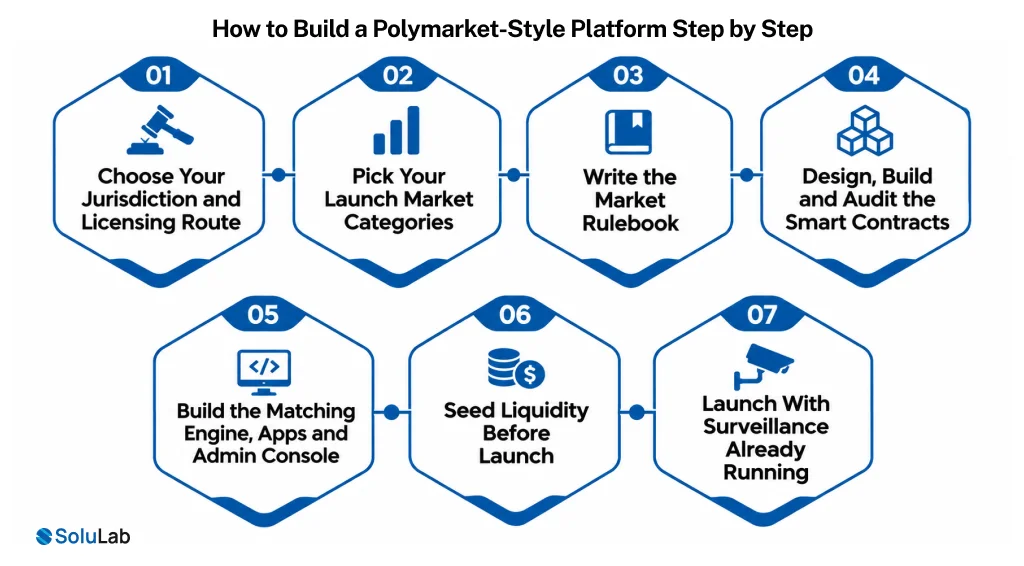
To build a Polymarket-style platform, settle your legal route first, then design markets, contracts, matching, liquidity, and surveillance in that order. Reversing the order is the most expensive mistake teams make, because licensing decisions change almost every technical choice downstream.
1. Choose Your Jurisdiction and Licensing Route
Decide whether you’re building a regulated exchange, an offshore crypto platform with strict geofencing, or a private market for internal forecasting. This one decision sets your KYC depth, custody model, and the market categories you’re allowed to list.
2. Pick Your Launch Market Categories
Start narrow. Sports is the obvious entry point because the audience already exists. A Deloitte survey of sports fans found roughly 80% of those who bet say it makes games more entertaining, and 15% of all fans place bets on a website or app while watching. That share rises to 22% among Gen Z and 24% among Millennials. Those are second-screen users, and a mobile prediction market app is built for exactly that behavior.
3. Write the Market Rulebook
Before any code ships, write the template every market must follow: the exact question, resolution source, cut-off time, edge-case rules, and what happens if the source goes offline. We cover this in detail in the next section.
4. Design, Build and Audit the Smart Contracts
Build the collateral, outcome-token and settlement contracts, then get them independently reviewed. A professional smart contract audit before mainnet is non-negotiable when user funds sit inside the contracts.
5. Build the Matching Engine, Apps and Admin Console
Prediction market app development should cover the CLOB, web and mobile front ends, and an admin console for market creation, pausing and resolution. Choosing a fast, low-fee network matters here. Polymarket settles on Polygon, which is why Polygon blockchain development remains a common pick for teams that want proven tooling and low gas costs.
6. Seed Liquidity Before Launch
Sign two or three market makers before go-live. Offer rebates, reduced fees or a liquidity rewards program tied to quoted spread and depth. Keep a small treasury-funded AMM as a fallback for new markets.
7. Launch With Surveillance Already Running
Turn on trade monitoring, wallet clustering and alerting on day one. Retrofitting surveillance after a scandal is far more expensive than launching with it.
How Do You Build the Market Integrity Layer?
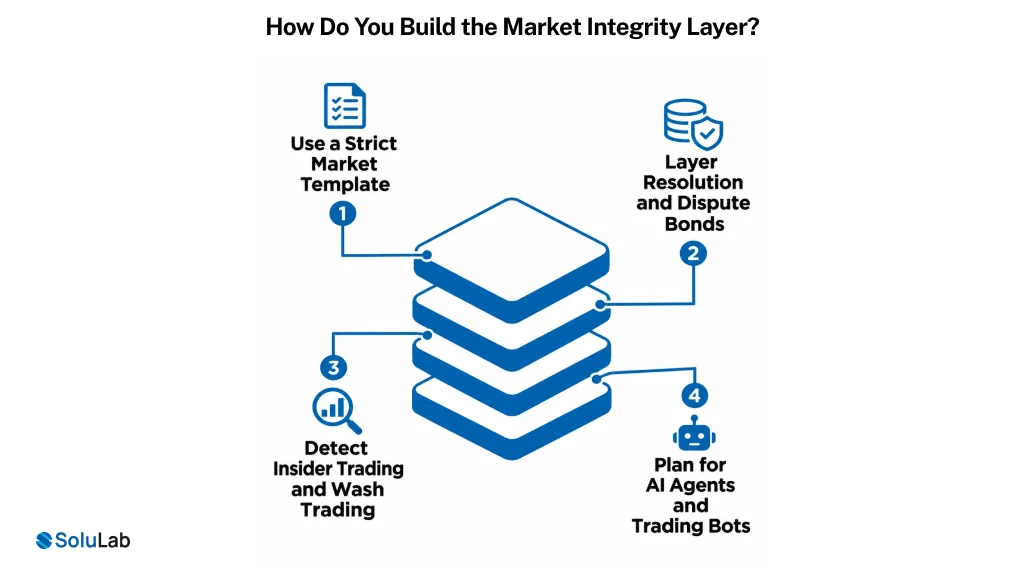
The market integrity layer is the set of rules, resolution processes and surveillance tools that keep outcomes fair. It’s the piece most build guides leave out, and it’s the piece that decides whether users trust your prices. Treat it as a product, not a policy document.
1. Use a Strict Market Template
Every market should answer six questions in writing: what exactly counts as YES, which named source decides it, the deadline and time zone, what happens if the event is postponed, what happens if the source contradicts itself, and who has the final call. Publish the template. Reject any market that can’t fill it in.
2. Layer Resolution and Dispute Bonds
Use automatic resolution for data-driven markets (prices, scores) and a bonded proposal-and-challenge process for everything else. Set bonds high enough that frivolous disputes are costly, and cap the voting weight any single wallet can hold on your own dispute committee. The Ukraine minerals episode is the case study for why that cap matters.
3. Detect Insider Trading and Wash Trading
Flag new wallets that place large, concentrated bets shortly before news breaks. Cluster wallets funded from the same source. Watch for self-matched trades that inflate volume. Machine learning models trained on these patterns catch far more than static thresholds do, and the same techniques power AI crypto exchange fraud prevention on centralized venues.
4. Plan for AI Agents and Trading Bots
Automated traders are coming whether you plan for them or not. Gartner predicts 40% of enterprise applications will feature task-specific AI agents by 2026, up from less than 5% in 2025. On a prediction market, that means bots quoting prices, arbitraging between venues and reacting to news faster than humans. Give them a documented API with rate limits and identity rules. Gartner also expects over 40% of agentic AI projects to be canceled by the end of 2027, so build your own AI agents in crypto use cases (market-making, news-driven resolution checks) around a clear business case, not hype.
What Compliance Rules Apply to a Prediction Betting Platform?
Compliance depends on where your users are and what you list. In the US, event contracts fall under the CFTC. Elsewhere, regulators may treat the same product as gambling, a financial derivative or something in between. Most offshore crypto prediction markets block US users entirely.
1. Regulated Exchange vs Offshore Crypto Platform
A regulated route means licensing as an exchange (or partnering with or acquiring a licensed one, as Polymarket did with QCEX). It brings bank-grade onboarding and reporting duties but opens mainstream audiences. The offshore route is faster to launch but locks you out of the largest markets and limits payment and app store partners.
2. KYC, AML and Geofencing
Build identity checks, sanctions screening and IP plus device-based geofencing into onboarding from the start. Automating document checks with AI in KYC cuts onboarding drop-off without lowering the bar.
3. Contract Types Regulators Favor
On June 12, 2026, the CFTC proposed replacing its categorical bans on five kinds of event contracts with a case-by-case public-interest review. Contracts settled on aggregate sports outcomes, such as a final score, were viewed favorably. Contracts based on one person’s actions or on pure chance were not. If you’re planning prop-style markets, design them with that direction in mind.
How Much Does Prediction Market Development Cost?
Prediction market development typically costs between $25,000 for a customized white-label build and $400,000 or more for a fully custom, regulated-grade platform. The biggest cost drivers are the matching engine, the surveillance stack, mobile apps and the licensing route. The ranges below are indicative estimates for typical scopes.
| Build Option | Typical Scope | Indicative Cost | Indicative Timeline |
| White-label Polymarket clone | Existing contracts and UI, rebranded, curated markets | $25K to $60K | 6 to 10 weeks |
| Custom MVP | One chain, CLOB or AMM, web app, admin console, basic KYC | $60K to $80K | 3 to 5 months |
| Full custom platform | Hybrid CLOB, mobile apps, surveillance, multi-region compliance | $80K+ | 6 to 12 months |

Conclusion
Building a Polymarket-style prediction market is less about cloning screens and more about getting four layers right: matching, settlement, resolution and compliance. The technology is well understood. What separates platforms that last from the ones that fade is the integrity layer: clear market rules, defended outcomes, seeded liquidity and surveillance that runs from day one.
Start with your licensing route, launch in one category and treat every disputed market as a test of your rulebook.
If you’re evaluating a Polymarket-style prediction market development company, SoluLab, an AI development company, can help your business plan, build and launch a compliant, secure prediction market platform, from smart contracts and matching engines to AI-driven surveillance. Book a free scoping call with our blockchain engineers to map your architecture and launch plan.
FAQs
Neha is a curious content writer with a knack for breaking down complex technologies into meaningful, reader-friendly insights. With experience in blockchain, digital assets, and enterprise tech, she focuses on creating content that informs, connects, and supports strategic decision-making.