If you’re running a crypto exchange, wallet, or any DeFi-adjacent product in 2026, there’s one number you can’t afford to ignore.
| More than $17 billion in crypto scams and fraud was estimated to have moved on-chain in 2025 alone. That’s up from roughly $12 billion in 2024, and the shift isn’t random. AI-enabled scams are now generating 4.5× more revenue per operation than traditional scams, which means attackers are scaling faster than most platforms. |
This isn’t background noise. It’s a direct margin risk. At the executive level, it’s no longer whether to invest in AI-driven fraud detection and compliance for crypto exchange development, but how quickly you can scale it before one of three things happens.
In this piece, we break down how modern crypto platforms are actually responding, using AI fraud detection in crypto exchanges, AI-powered KYC checks, blockchain forensics, and automated AML systems to protect users and keep growth intact in 2026.
Key Takeaways
- The problem: Crypto fraud is no longer just phishing or rug‑pulls. Today you’re facing AI‑powered crypto scams, industrialized phishing‑as‑a‑service kits, deepfake impersonation, and cross‑chain laundering that can compromise your platform, users, and balance sheet in minutes.
- The solution: Next‑gen exchanges anchor security on an AI‑driven fraud‑prevention stack: real‑time AI‑based crypto compliance platform providers, AI‑powered KYC checks, on‑chain monitoring, automated incident response, and enterprise crypto fraud monitoring solutions that scale with volume.
- How SoluLab helps: As a Crypto Exchange Development partner, we can design and integrate AI‑powered fraud detection in cryptocurrency layers into your client’s core trading engine, AI AML solutions for crypto exchanges, plus AI‑powered KYC checks, and fully configurable enterprise crypto fraud monitoring solutions and AI‑based crypto compliance platform providers tailored to each jurisdiction.
Why AI-Powered Fraud Detection Is Now Essential in 2026?
To understand why AI fraud detection in top crypto exchanges is non‑negotiable in 2026, you need to see the battlefield:
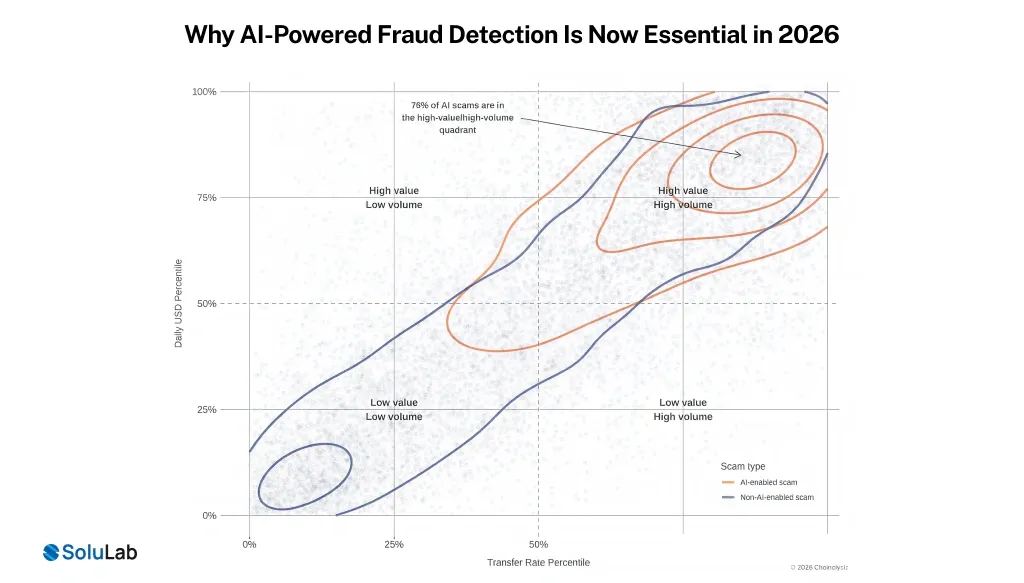
- Chainalysis estimates crypto scams received at least $14 billion on‑chain in 2025, with projections that the total could exceed $17 billion as more illicit wallets are mapped.
- AI‑enabled scams extracted on average $3.2 million per operation, versus $719,000 for non‑AI scams, making them 4.5× more profitable.
- Impersonation scams grew by over 1,400% year‑on‑year, and the average scam payment ballooned from $782 in 2024 to $2,764 in 2025.
At the same time, regulatory bodies like the SEC and DOJ are targeting crypto asset trading platforms running fake AI‑driven investment clubs, using KYC‑bypassed accounts and social‑media pumps to siphon tens of millions from retail investors.
For a founder, the implication is:
- User trust is fragile. One high‑visibility scam on your platform can tank your brand.
- Regulatory risk is rising. Non‑compliant projects are being fined, shut down, or seized in coordinated cross‑border actions.
- Volume and margins are linked to perceived security. Exchanges that visibly invest in enterprise crypto fraud monitoring solutions and AI‑based crypto compliance platform providers attract more deposits and institutional liquidity.
This is why just cold‑storage and 2FA isn’t enough anymore. You need AI‑powered fraud detection in cryptocurrency capabilities that run in real time, at the protocol level.
How AI Fraud Detection Systems Prevent Crypto Exchange Fraud?
At the core of hack-resistant crypto exchange solutions sits an AI‑powered fraud‑detection engine that observes behavior, not just transactions.
1. Behavioral profiling of users and bots
Legacy systems rely on hard‑coded rules (large withdrawal → flag). But AI‑driven fraud prevention models learn normal user behavior per cluster:
- Typical trading frequency,
- Average order size,
- Device and location patterns,
- Login‑time distribution,
This is where AI agents for fraud detection come in: each user gets a behavioral fingerprint, and deviations (e.g., sudden massive withdrawals, 200 trades per minute, cross‑continent logins) are flagged in real time.
For exchanges, this means:
- Fewer false positives for legitimate high‑volume traders,
- Faster detection of account takeovers and bot attacks,
- A visible reduction in AI‑powered crypto scams that rely on synthetic or hijacked accounts.
2. Real‑time transaction monitoring
Every on‑chain and off‑chain transaction is evaluated in milliseconds by models that:
- Compare amounts, frequencies, and destinations with historical patterns,
- Cross‑check addresses against known scam, mixer, and dark‑net‑linked wallets,
- Flag circular transfers, rapid withdrawals, and multi‑hop laundering patterns.
Platforms using crypto AML automation tools can automate watchlist hits, sanctions screening, and AI solutions for crypto exchanges, which reduces manual review queues by up to 70–80% in some implementations.
How AI Strengthens Identity Verification and KYC/AML in Crypto Exchanges?
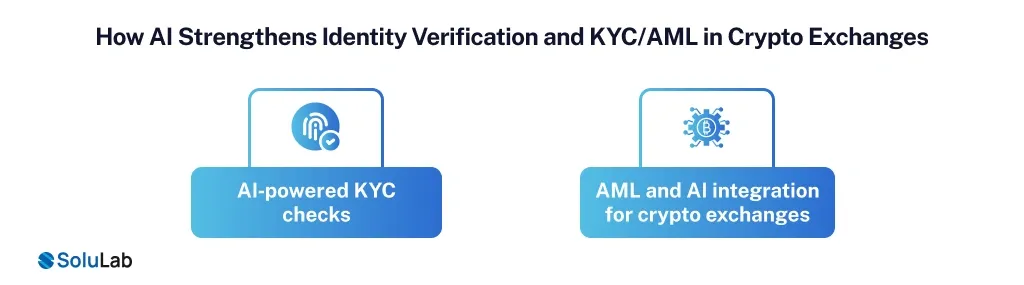
Onboarding a user is the first line of fraud defense. If you miss a fake or synthetic identity, you’re simply building a money‑laundering funnel instead of an exchange.
1. AI‑powered KYC checks
Today’s best practices in AI‑powered KYC checks combine:
- Document authenticity checks (AI‑powered forgery and liveness detection),
- Biometric verification (face match, liveness detection, and behavioral cues),
- Risk‑based segmentation (low‑risk vs. high‑risk users, with different review thresholds).
These AI‑powered KYC checks:
- Speed up onboarding for compliant users,
- Reduce KYC fraud and synthetic‑identity attacks,
- Feed into enterprise crypto fraud monitoring solutions so that new accounts are continuously monitored, not just checked once.
2. AML and AI integration for crypto exchanges
AML and AI integration solutions for crypto exchanges mean:
- Continuously screening users against global sanctions, PEP, and adverse‑media lists,
- Automatically enriching profiles with on‑chain wallet‑risk scores,
- Flagging suspicious source‑of‑funds or laundering‑prone patterns.
This is why AI‑based crypto compliance platform providers are becoming must‑haves for any exchange that wants to scale globally without constant regulatory friction.
How On-Chain Forensics and Blockchain Analytics Prevent Crypto Exchange Fraud?
Once funds move on‑chain, Layer‑1 solutions and cross‑chain analytics become your early‑warning system.
Blockchain analytics tools like those from Chainalysis, Elliptic, and similar providers track:
- Clusters of wallets linked to scams, mixers, or dark‑net markets,
- Source‑of‑funds trails for deposits,
- Multi‑hop laundering via DeFi protocols, bridges, and mixers.
Exchanges that integrate these tools into their AI‑powered fraud detection in the cryptocurrency stack can:
- Pre‑block incoming deposits from known scam wallets,
- Auto‑freeze recently compromised funds,
- Trace outgoing flows to understand where fraud is leaking out.
This is especially important for AI‑powered crypto scams, where attackers use AI‑generated deepfakes, phishing templates, and bot‑driven impersonation to route money through multiple wallets and services.

How Automated Threat Response Systems Shape the Future of Crypto Exchange Security?
Preventing crypto scams with AI isn’t just about detection; it’s about what happens next. Modern enterprise crypto fraud monitoring solutions automate:
- Tiered alerts to security teams,
- Risk‑score‑based actions (e.g., 2FA reset, withdrawal limits, or full‑hold if risk is high),
- Automated enrichment of incidents with on‑chain data and KYC context.
This reduces mean‑time‑to‑detect and mean‑time‑to‑respond from hours or days to seconds or minutes, a critical advantage when dealing with AI‑powered crypto scams that move funds in one transaction.
How AI Prevents Crypto Fraud Across Exchanges?
1. Bybit: How AI Stopped Phishing Before It Spread
In 2025, Bybit was hit by a new wave of phishing-as-a-service. These weren’t amateur scams. The kits copied real login pages, dashboards, and even 2FA flows, which made them hard to spot from the outside.
What saved them was timing. Bybit already had AI fraud detection running as core infrastructure.
As new accounts came in, the AI noticed things humans usually catch too late:
- Hundreds of accounts created in tight time windows
- Shared device fingerprints and IP clusters
- Nearly identical behavior right after funding
Most of them tried to withdraw immediately, traded very little, and interacted with wallets already linked to scams.
The response was automatic. Withdrawals were frozen, risk scores spiked, and compliance teams were pulled in only where needed. Several million dollars in potential losses were stopped quietly, before the phishing campaign could scale. At this level, AI fraud detection isn’t a feature. It’s table stakes.
Read more- Build a Crypto Exchange Like Bybit in Dubai
2. Ston.Fi & DeDust: Catching Rug Pulls in the First Minutes
On TON, DEXs like Ston.Fi and DeDust faced a different problem. Rug-pull tokens launching fast, pulling liquidity, and disappearing just as fast.
Instead of reacting after users were burned, the platforms leaned on AI models that focus on the earliest trading signals.
The system watched for:
- Liquidity and volume patterns that match past rugs
- Wallet clustering that shows developer-controlled supply
- On-chain links to known scam wallets
When a token matched those patterns, the response was controlled but effective. Large trades were limited, pool parameters adjusted, and alerts sent to moderators and watchdog tools.
In one confirmed case, this stopped the decentralized exchanges from becoming the main liquidity hub for a rug pull. No drama. Just early detection is doing its job. That’s how AI agents quietly protect users on permissionless platforms, by acting before things go wrong, not after.
How AI Fraud Detection Architecture Prevents Crypto Exchange Fraud?
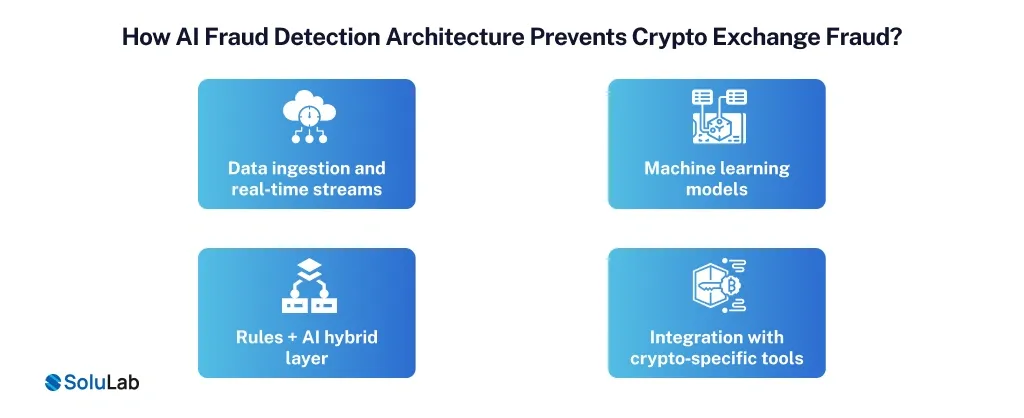
From a technical‑but‑business‑level point of view, a strong AI‑powered fraud‑detection stack usually looks like this:
1. Data ingestion and real‑time streams
- Streaming transaction logs (on‑chain and off‑chain),
- User behavior events (logins, trades, withdrawals, device changes),
- KYC and identity data (encrypted and privacy‑respected). Tools like Redis or Kafka are often used to handle millions of events per second with low latency.
2. Machine learning models
- Supervised classifiers trained on historical fraud/non‑fraud data,
- Unsupervised anomaly detection to catch new patterns,
- Graph‑AI models mapping wallet
These models are retrained regularly to keep up with AI‑powered crypto scams, which evolve constantly.
3. Rules + AI hybrid layer
Pure machine learning is powerful, but pure rules are brittle. The best AI‑powered fraud detection in cryptocurrency stacks uses a hybrid model:
- Hard rules for obvious red flags (e.g., known scam addresses),
- AI scores for complex, evolving patterns.
- This reduces false positives and keeps the user experience smooth while still protecting the platform.
4. Integration with crypto‑specific tools
- Blockchain analytics (e.g., Chainalysis, Elliptic‑style stacks),
- AML and AI integration for crypto exchanges using crypto AML automation tools,
- KYC vendors offering AI‑powered KYC checks and AI‑based crypto compliance platform providers.
As a crypto development services firm, we can either build this AI Integration Services layer ourselves or integrate best‑in‑class SaaS tools into your clients’ crypto exchange security solutions.
Regulatory & Compliance Imperatives for AI Fraud Detection in Crypto Exchanges
In 2026, regulators expect crypto companies to treat themselves like regulated financial institutions, especially when it comes to AI consultation for crypto exchanges.
Key trends:
- FATF‑style recommendations are becoming enforceable in dozens of jurisdictions,
- Exchange licenses now require KYC, AML, and transaction‑monitoring capabilities as standard,
Failures to detect or report suspicious activity can trigger fines, license revocations, or even criminal exposure. For an executive, that means:
- AI‑powered KYC checks are not just nice‑to‑have but compliance‑critical,
- AI‑based crypto compliance platform providers are becoming core budget lines, not “optional add‑ons”.
If your crypto exchange practice doesn’t include AI‑powered KYC checks, your clients will struggle to get licensed or face softer but still damaging regulatory friction.
How AI Fraud Detection Is Defining the Next Era of Crypto Exchange Security?
Where does this go by 2027–2028?
- AI agents in crypto for fraud detection will become more autonomous, orchestrating workflows instead of just flagging events.
- Cross‑chain fraud detection will mature, as attacks move across Ethereum, Solana, Bitcoin, and emerging rollups.
- Synthetic identity detection powered by AI will become standard, closing the loop on one of the most common types of crypto exchange fraud.
From a business perspective, this means:
- AI‑driven fraud‑prevention platforms will be viewed as core infrastructure,
- Exchanges that bake AI‑powered fraud detection in cryptocurrency into their DNA from the start will gain long‑term trust and higher lifetime value per user.

Conclusion
Preventing crypto scams with AI is currently the baseline requirement for any exchange or crypto‑native product that wants to survive 2026 and beyond.
With AI‑powered crypto scams generating 4.5× more revenue per operation and scam volumes exceeding $17 billion on‑chain, the cost of ignoring AI‑powered fraud detection in cryptocurrency is too high both financially and reputationally.
From KYC and AML integration to on‑chain forensics, behavioral AI agents, and automated threat response, next‑gen crypto exchange security solutions provider like SoluLab can help you build around AI development services that sit at the intersection of machine learning, blockchain analytics, and compliance.
If you’re leading a crypto‑focused product, the question is simple:
- Do you want to wait for regulators and markets to force you into AI‑driven fraud prevention, or
- Do you want to proactively build trust, compliance, and scalability from day one?
FAQs
With over 3 years of experience, I specialize in breaking down complex Web3 and crypto concepts into clear, actionable content. From deep-dive technical explainers to project documentation, I help brands educate and engage their audience through well-researched, developer-friendly writing.