Key Takeaways
- Kalshi leads on volume. As of mid-2026, Kalshi holds roughly 73% market share to Polymarket’s 27%, driven partly by traders favoring regulated venues.
- Polymarket now operates two distinct products. The original international exchange stays geoblocked for US users and requires no KYC. Polymarket US is a separate, fully CFTC-regulated exchange with full KYC that launched in December 2025.
- Augur clones give you full control of the stack with no platform risk, but liquidity is fragmented, it only makes sense with a specific decentralization thesis or community.
- Manifold Markets proves play-money prediction markets can work at niche and internal-community scale, without real-money stakes.
- A fully compliant, market-ready platform typically costs $2M–$5M to launch, and $10M+ to seriously compete with Kalshi or Polymarket.
- The prediction market sector moved roughly $63 billion in total notional volume in 2025, with combined monthly volume between the two leaders rising from under $5 billion in September 2025 to about $24 billion by April 2026.
A prediction market platform lets people trade contracts on real-world outcomes — elections, sports, economic data — with prices reflecting the crowd’s live probability estimate. Kalshi and Polymarket dominate the category, though the competitive picture is more layered than it looks: Kalshi now leads on trading volume, Polymarket runs two distinct products with different regulatory status, and Augur and Manifold serve smaller, more specific niches. This guide breaks down how all four actually differ and what it costs to build your own.
SoluLab has built blockchain infrastructure across dozens of industries; here’s what we’ve learned evaluating and building on top of this category.
What Is a Prediction Market, and Why Should You Care Right Now?
If you haven’t paid close attention to prediction markets yet, 2026 is the year to start. A prediction market platform is essentially a betting exchange where people stake money on the outcomes of real-world events, such as elections, sports, weather, mergers, product launches- you name it. The price of a contract reflects the crowd’s real-time belief about what will happen.
Here’s why this matters to you: prediction markets aren’t just entertainment. They’re becoming serious business infrastructure. Companies use them to forecast demand, assess merger probability, and test product viability without spending millions on traditional research. Governments quietly consult them for policy signals. Traders make money. And platforms that host these markets are sitting on something valuable: information, liquidity, and user attention.
The sector has genuinely exploded. Total notional volume across the two largest platforms hit roughly $63 billion in 2025, and by early 2026, monthly combined volume was running close to $24 billion, nearly double the $14 billion monthly average across all legal US sportsbooks in 2025.
But here’s the catch: not all prediction markets are created equal. Choosing between platforms, or building your own, requires understanding what each one optimizes for. Let’s dig in.
Polymarket vs. Kalshi: The Head-to-Head Battle
These two platforms define the modern prediction market landscape, but they operate in almost opposite ways.
| Factor | Polymarket | Kalshi |
| Foundation | Two products: international exchange (blockchain/Polygon, crypto-native) + Polymarket US (CFTC-regulated) | CFTC-regulated Designated Contract Market since 2021 |
| US Access | International exchange: geoblocked for US IPs. Polymarket US: live on iOS, full KYC | US brokerage account, traditional onboarding |
| Volume (mid-2026) | ~27% market share; $7.08B notional in May 2026 | ~73% market share; $17.91B notional in May 2026 — 9th consecutive monthly record |
| Regulatory status | Split: unregulated internationally, regulated domestically via Polymarket US | Fully CFTC-regulated across all US markets |
| Strength | Global reach, deep politics/crypto markets, still the larger platform outside the US | Regulatory legitimacy and the larger platform by US volume |
| Risk | State-level pushback (Nevada, Tennessee cease-and-desist orders); wash-trading concerns flagged by Columbia University researchers | Narrower market catalog due to CFTC restrictions |
Why Does Polymarket Have Two Different Regulatory Statuses?
In November 2025, the CFTC granted Polymarket an Amended Order of Designation, clearing the company to operate a fully regulated US exchange following its acquisition of QCEX, a registered derivatives exchange. Polymarket US launched in December 2025 and dropped its iOS waitlist in May 2026, with full KYC required, operating under the same reporting, surveillance, and clearing obligations as any federally supervised exchange.
That’s a separate product from the original polymarket.com, which remains geoblocked for US users and continues to operate without KYC. So “is Polymarket regulated?” doesn’t have a single answer anymore, it depends on which product you mean. Several states, including Nevada and Tennessee, have pushed back with cease-and-desist orders even after the federal approval, so the legal picture is still settling state by state.
Why Does Kalshi Lead on Volume Now?
Kalshi closed May 2026 with $17.91 billion in notional volume against Polymarket’s $7.08 billion, a 21% decline from Polymarket’s March peak. (DeFi Rate) Traders appear to be consolidating around the regulated, CFTC-approved venue, especially for sports contracts — 87% of Kalshi’s March 2026 volume came from sports event contracts alone.
For anyone building in this space, the lesson is that regulatory legitimacy isn’t just a compliance checkbox anymore. It’s become a genuine liquidity advantage, not just a trust one.
The Real Difference
Polymarket asks: “How do we remove friction?” Kalshi asks: “How do we build trust?” Neither is wrong. Polymarket wins on volume and global reach. Kalshi wins on legitimacy and institutional adoption. If you’re building a platform, you need to pick a philosophy and commit.
What Makes a Top Prediction Market Platform?
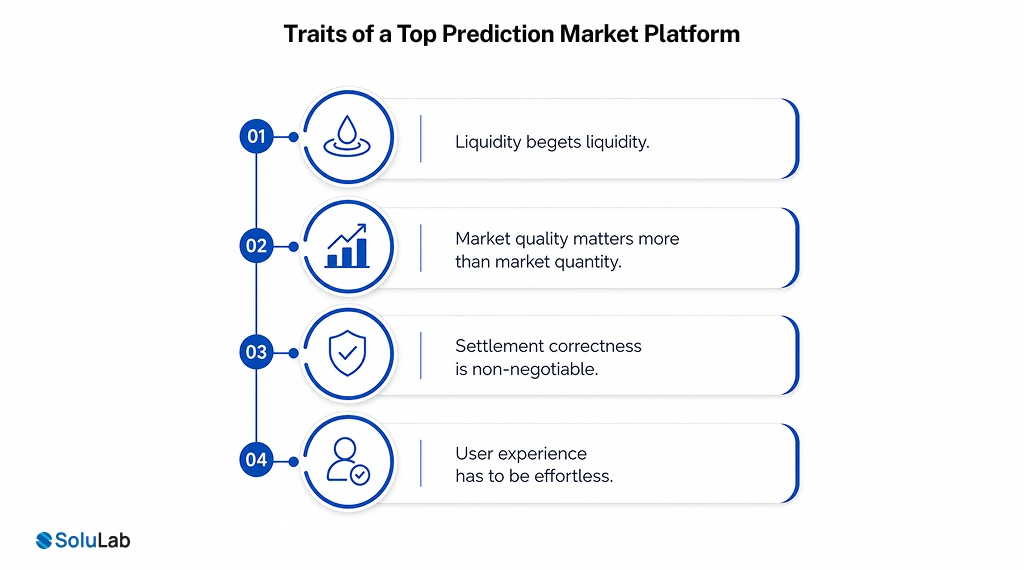
Not every prediction market platform succeeds. We’ve seen dozens of launches and dead projects. The winners share a few core traits.
Liquidity begets liquidity. The first hurdle is the liquidity chicken-and-egg problem. Traders don’t come to thin markets, but thin markets can’t attract traders. Kalshi solved this by having regulatory approval and a US audience demand. Polymarket solved it through enabling permissionless markets and attracting crypto-native users. If you’re starting from scratch, you need an unfair advantage, regulatory approval, a specific community, or serious venture capital to subsidize trades.
Market quality matters more than market quantity. One of the biggest mistakes new platforms make is launching with hundreds of poorly defined markets. The result is a graveyard of abandoned positions and settlement disputes. You need expert curators. Kalshi uses its regulatory constraints to force quality. Polymarket curates through community moderation and reputation. If you’re building a clone, invest in market design as much as engineering.
Settlement correctness is non-negotiable. Platforms have collapsed because of a single botched settlement. When money and predictions meet, people’s trust is fragile. You need bulletproof logic, clear rules, and transparent processes. This is where regulated platforms have a genuine advantage; the legal framework forces clarity.
User experience has to be effortless. Polymarket wins here. The onboarding is basically frictionless if you have a crypto wallet. Kalshi requires traditional brokerage approval, which is slower but also filters out casual users. Know your audience and build for them.
Augur Clones: Is Full Decentralization Worth the Trade-Off?
Augur was the original decentralized prediction market, forked dozens of times since. Augur clones are attractive if you want to build something custom or fully autonomous; you control the entire stack, no middleman, no platform risk, markets that live permanently on-chain.
The trade-off: Augur clones are harder to use, liquidity is fragmented, and regulatory uncertainty doesn’t go away just because there’s no central operator. Unless your users specifically want decentralization, a real value proposition in some communities, they’ll default to Polymarket or Kalshi instead. An Augur clone makes sense with a specific thesis about your niche or a strong community already backing it, not as a default choice.
Manifold Markets: What’s the Case for Play-Money Only?
Manifold Markets occupies a different space entirely: play-money, hobby prediction communities: gamers, rationalists, hobbyist forecasters. Markets are free to create, settlement is community-driven, and the social graph matters as much as the market mechanics.
Manifold matters not because it’s large, but because it proved play-money prediction markets can work and scale within specific niches. If you’re building for a gaming community, internal company decisions, or a friend group, Manifold’s playbook is worth studying regardless of whether you use real money.
Where Does Real Value Live in Prediction Markets?
- Corporate decision-making. Companies quietly run internal markets to forecast product adoption, project timelines, and market opportunities wisdom-of-the-crowd forecasts without expensive consultants.
- Risk management and hedging. Serious traders hedge exposure through election markets, Fed rate decision markets, and crypto sentiment markets. This is where real money concentrates.
- Research and public good. Academics and policy researchers use prediction market data to study crowd forecasting accuracy. Some government agencies are exploring these markets for pandemic preparation and long-term policy forecasting.
- Entertainment and community building. Manifold and smaller platforms prove prediction markets can be pure fun, the forecast is the game.
- Sales and marketing forecasting. A newer, less mature use case, teams experimenting with prediction markets to forecast demand signals and competitive moves.
Build a Prediction Market Platform: The Engineering Reality
If you’re thinking about launching your own platform, here’s what you need to know. Building a prediction market platform requires careful decisions about technology, regulation, and market design.
Core Technical Requirements
A functional prediction market platform needs these components: an order matching engine, a settlement oracle (how do you determine what actually happened?), a wallet or payment system, market creation tools, and a user interface. Sounds simple. The implementation is brutal.
The order matching engine is where most projects stumble. You need sub-second latency, handle high concurrency, and execute deterministically. Centralized order books (like Kalshi uses) are easier to operate but create counterparty risk. Automated market makers (like some Polygon-based platforms) are more decentralized but have worse price discovery.
The oracle problem is the philosophical killer. How do you prove that an election happened? That a sports team won? That a merger closed? Regulated platforms use CFTC-approved data feeds. Decentralized platforms use mechanisms like Chainlink or Uniswap’s oracle, but these have weaknesses. You need to decide: speed or certainty? Centralization or decentralization? If you want the deeper build-out of these decisions specifically modeled after a regulated exchange, how to build a prediction market platform like Kalshi walks through the compliance and architecture trade-offs in more depth than fits here.
What Features Actually Matter?
- Multiple market types: yes/no, multi-outcome, and continuous scalars for different use cases.
- Transparent fee structure: most successful platforms charge 2–5% on settlement.
- Clear settlement rules, written in plain language and reviewed by a legal team.
- API for developer integrations brings liquidity.
- Mobile-first design: if users can’t trade on mobile, you’ve lost them.
- Reporting and analytics: historical data, volume charts, win/loss statistics.
What Kills Most New Platforms?
Plenty of projects build technically sound platforms and still fail. The common killers:
- No differentiation. Launching another Polymarket clone in the same space is a money pit. You need a specific angle: a vertical market, a regulatory jurisdiction, a community, or a technical innovation.
- Liquidity death spiral. Markets that don’t grow beyond $100K daily volume struggle to retain traders. Once you fall below a threshold, recovery is nearly impossible.
- Regulatory surprises. The SEC, CFTC, and state regulators are still figuring out prediction market policy. If you’re in the crypto space, expect regulatory uncertainty. If you’re targeting the US, expect CFTC scrutiny.
- Settlement disputes. One ambiguous market resolution ruins your credibility forever. Invest in clarity and legal review, and treat smart contract security auditing as a launch requirement, not an optional line item, if any part of settlement runs on-chain.
Prediction Market Platform Development: Cost and Timeline
Real talk: building a legitimate prediction market platform isn’t cheap.
| Cost Category | Typical Range | What It Covers |
| Technology stack | $200K – $500K | Production-grade matching engine, oracle integration, smart contracts |
| Legal and compliance | $500K – $2M (6-12 months) | CFTC approval path, if pursuing a Kalshi-style regulated model |
| Marketing and liquidity | $500K – $2M+ | Subsidizing early traders to bootstrap liquidity |
| Total (compliant, market-ready) | $2M – $5M minimum | Full launch; $10M+ to seriously compete with Kalshi or Polymarket |
This is why most successful platforms had one of a few advantages going in: regulatory approval from day one (Kalshi), massive crypto-native liquidity (Polymarket), a specific community advantage (Manifold, niche markets), or serious venture capital backing.
The Hidden Costs Nobody Mentions
Operations are expensive. You need 24/7 monitoring. Settlement disputes happen on weekends. Market curation is a full-time job. Customer support costs scale with user base. If someone loses money, they’ll sue. Budget for it.
Why Enterprises Choose Custom Prediction Market Platforms
Here’s something interesting: the biggest value isn’t in public prediction markets. It’s in custom, internal, and institutional platforms.
Companies launching internal prediction markets on proprietary infrastructure typically see better outcomes because they control the entire user experience and market design. They’re not competing with thousands of other markets, and user adoption is easier because employees have skin in the game.
This is where building a custom prediction market platform makes financial sense. The cost is justified by the specific value to your organization.
Key Decisions for Custom Platforms
- Participation model: play money, real money, or a hybrid?
- Market design: what questions do you want answered?
- Settlement mechanism: who decides what’s true?
- Regulatory approach: do you care about compliance, or are you internal-only?
- Technology: centralized or decentralized? Traditional database or blockchain?
Why SoluLab Stands Out for Prediction Market Development
If you’re serious about building a prediction market platform, whether you’re aiming for public markets or internal enterprise use, you need a development partner who understands both the technology and the market.
At SoluLab, we’ve built and deployed custom blockchain development solutions across dozens of industries. When it comes to prediction market platform development, we bring a specific combination of skills: deep blockchain expertise, smart contract security, platform scalability, and real understanding of market mechanics. If you’re comparing partners before committing, our own breakdown of the top prediction market platform development companies in the USA is a useful place to benchmark expectations, even for the sections where we’re not the company being described.
We’ve worked with teams building Kalshi-like prediction market platforms, internal forecasting tools, and enterprise prediction systems. We know the engineering bottlenecks. We know the regulatory landmines. We know what separates a fun prototype from a production system that handles real money.
Our approach is hands-on. We don’t just build to spec; we challenge your assumptions about market design, help you navigate regulatory questions, and architect for scale from day one. Whether you’re deploying on traditional infrastructure, Ethereum, or another blockchain, we’ve done it. We also specialize in cryptocurrency development, which means we can help you navigate the unique challenges of crypto-based prediction markets: oracle integration, liquidity management, smart contract audits, and blockchain-specific security.
If you’re considering integrating prediction market modules into an existing platform, or you need to hire blockchain developers who actually understand market microstructure and not just smart contracts, that’s our wheelhouse.
The Prediction Market Landscape in 2026 and Beyond
Prediction markets are maturing fast. The regulatory clarity Kalshi brought is forcing the entire sector to get serious. Polymarket’s dominance forces competitors to differentiate. Smaller platforms carve out niches.
The next wave won’t be about copying Kalshi or Polymarket. It’ll be about vertical specialization prediction markets for supply chains, IP valuation, climate outcomes, and specific industry decisions. It’ll be about embedded prediction markets inside enterprise software. It’ll be about better settlement mechanisms and more sophisticated market design.
If you’re building in this space, the opportunity is real. But it requires capital, expertise, and clarity about your differentiation.
Your Next Move!
If you’re exploring whether a prediction market platform is right for your business, here’s what to do:
- Define your audience. Are they crypto-native or traditional finance? Hobbyists or institutions? Regulatory sophistication matters.
- Understand your use case. Entertainment? Risk management? Research? Corporate forecasting? Your answer changes everything about platform design.
- Assess your regulatory appetite. CFTC approval takes time and money but creates a durable moat. Going crypto-only is faster but riskier.
- Calculate the real cost. Don’t underestimate technology, legal, operations, and liquidity subsidies.
- Get expert help early. The best time to involve a blockchain development company that understands prediction markets isn’t after you’ve built something, it’s before you start.
FAQs
Shipra Garg is a tech-focused content strategist and copywriter specializing in Web3, blockchain, and artificial intelligence. She has worked with startups and enterprise teams to craft high-conversion content that bridges deep tech with business impact. Her work translates complex innovations into clear, credible, and engaging narratives that drive growth and build trust in emerging tech markets.

![Top Prediction Market Platform Development Companies in the USA [2026 Edition]](https://www.solulab.com/wp-content/uploads/2026/06/Prediction-Market-Platform.webp)