Key Takeaways
- A smart contract automates the money and the record, not the law. Legal title still transfers through whatever registry your jurisdiction recognises, and no amount of on-chain logic changes that.
- Escrow, rent collection, distributions, and compliance screening are where these contracts genuinely pay back today, because the rules are mechanical and the current process is slow.
- Token standards carry the compliance. ERC-3643 and similar permissioned standards enforce investor restrictions on every transfer, which is the difference between a tradeable security and an unusable one.
- Tokenized real estate is far earlier than the discourse suggests. The long-term forecasts are credible; the on-chain totals today are small.
- The oracle and the admin key are the attack surface. Most losses in this space come from configuration and privileged access, not from flawed contract logic.
Property transactions are slow for structural reasons: multiple intermediaries, manual verification, sequential handoffs, and money sitting in escrow while someone checks a document.
Smart contracts remove some of that and leave the rest untouched, and knowing which is which is the whole value of understanding them. Deloitte’s Center for Financial Services projects more than $4 trillion of real estate tokenized on blockchain by 2035, up from under $300 billion in 2024, a compound growth rate above 27%.
That is a genuine structural trend over a decade. It is also not a description of today. This guide walks through how smart contracts in real estate actually execute a property transaction step by step, which parts of a closing they can automate, which parts they legally cannot touch the code however it is written, what major jurisdictions require, and what a build realistically costs.
This article is technical and market analysis. It is not legal, tax, or investment advice, and property law varies by jurisdiction. Take local counsel before structuring any transaction.
What Are Smart Contracts in Real Estate?
A smart contract in real estate is self-executing code on a blockchain that holds funds and enforces the terms of a property agreement automatically. When pre-agreed conditions are met, such as verified payment or a completed inspection, the contract releases escrow, records the transfer or distributes income without an intermediary processing it manually. The code handles the transaction; legal title transfer still follows local property law.
1. It Automates Conditions, Not Judgment
A smart contract is excellent at “if the payment of $470,000 has arrived and the inspection oracle reports pass, release funds to the seller.” It cannot decide whether a survey discrepancy is material. Mechanical conditions automate; judgment does not.
2. The Money Moves On-Chain, the Deed Usually Does Not
Funds, token ownership and the audit record live on-chain. The deed registration sits with a land registry that, in most jurisdictions, has no blockchain integration. What transfers on-chain is a token representing an interest, not the legal title itself.
3. The Contract Is Only as Good as Its Inputs
Inspection results, valuations, payment confirmations and identity checks all arrive from outside the chain. Every one of those is an oracle, and an oracle that reports wrongly produces a confident, irreversible wrong outcome.
How Do Smart Contracts Work in Real Estate?
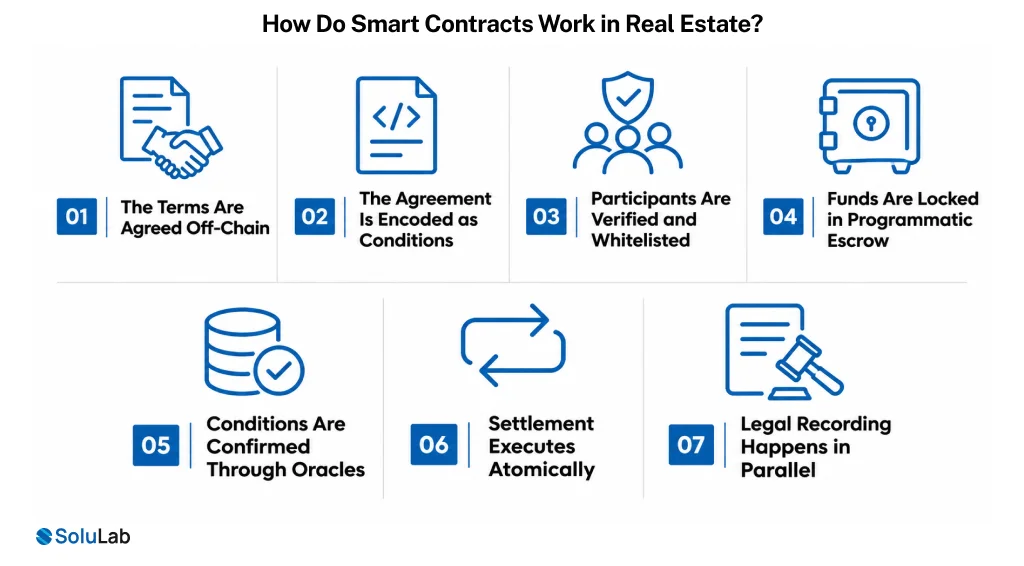
Seven steps, traced through a single property sale.
1. The Terms Are Agreed Off-Chain
Price, deposit, contingencies, closing date and who pays which fee. This happens in negotiation exactly as it always has. Nothing about blockchain removes this step.
2. The Agreement Is Encoded as Conditions
Developers translate the agreed terms into contract logic: amounts, addresses, deadlines, the conditions that release each payment and what happens on default. Ambiguity that a human lawyer would resolve by reading intent has to be resolved here explicitly.
3. Participants Are Verified and Whitelisted
Buyer, seller and any agent are identity-verified off-chain, then their wallet addresses are added to the contract’s allowlist. Only whitelisted addresses can interact, which is how KYC and AML obligations reach an on-chain process. The mechanics sit close to blockchain identity management.
4. Funds Are Locked in Programmatic Escrow
The buyer deposits into the contract, which holds the funds and releases them only when conditions verify. Neither party can withdraw unilaterally, which removes the counterparty risk that a human escrow agent exists to absorb.
5. Conditions Are Confirmed Through Oracles
Inspection completion, lien clearance, appraisal values and insurance binding are reported by whatever data source the parties agreed to trust. This step is where the design effort concentrates, because the contract cannot verify the physical world itself.
6. Settlement Executes Atomically
When all conditions report satisfied, the contract releases payment to the seller, distributes fees to the agreed addresses and transfers the ownership token in a single transaction. Either everything completes or nothing does.
7. Legal Recording Happens in Parallel
The deed is recorded with the land registry under local procedure. A handful of jurisdictions are piloting registry integration; most are not. Treat this as a manual step that runs alongside the on-chain settlement rather than a consequence of it.
How Are Smart Contracts Used in Property Transactions?
Eight applications, ordered by how reliably they work in production.
1. Programmatic Escrow and Closing
The clearest win. Funds held and released by code rather than by an escrow agent processing paperwork, with the split to seller, brokerage and fees executed in one transaction.
2. Rent Collection and Lease Enforcement
Monthly rent pulled automatically, late fees applied by rule, security deposits held in contract and released against a condition report. Lease logic is mechanical, which is exactly what suits automation.
3. Income Distribution to Multiple Owners
Rental income or sale proceeds split across many holders according to an ownership snapshot. Distributing to a thousand holders costs the contract no more effort than ten, which is the structural advantage over spreadsheet administration.
4. Fractional Ownership and Investor Registries
Ownership interests represented as tokens, with the register updating on every transfer. This is the engine underneath real estate tokenization, which deserves its own treatment rather than a paragraph here.
5. Compliance Screening on Every Transfer
Permissioned token standards check investor eligibility, jurisdiction, accreditation status and holding limits before allowing a transfer. The restriction travels with the token rather than being enforced by a gatekeeper.
6. Mortgage and Loan Servicing
Payment schedules, interest accrual, escrow for taxes and insurance, and default triggers encoded and executed on time. Servicing is rule-driven and heavily manual today.
7. Property Management Payments
Contractor payments released against verified completion, utility settlement and maintenance reserve management, all against a maintained reserve balance.
8. Title History and Chain of Custody
An immutable record of every recorded transaction on a property, which does not replace the registry but does give a verifiable parallel history that is hard to dispute.
What a Smart Contract Cannot Do in a Property Transaction
Most articles on this topic stop before this section. It is the one that prevents expensive mistakes.
1. It Cannot Transfer Legal Title by Itself
In nearly every jurisdiction, ownership of real property transfers when a deed is recorded with a government registry. A token transfer is evidence of a beneficial interest, often held through a special purpose vehicle that owns the property. The chain and the registry are two separate records, and the registry is the one a court recognises.
2. It Cannot Resolve a Dispute
Code executes; it does not adjudicate. If a buyer claims undisclosed defects after settlement, that is litigation or arbitration under the governing law of the agreement. Build the dispute path into the legal wrapper, because the contract will not provide one.
3. It Cannot Verify Physical Condition
No contract can inspect a roof. Everything about the property’s actual state reaches the chain through a human or a sensor, and both can be wrong or manipulated.
4. It Cannot Override a Lien or an Encumbrance
A mortgage, tax lien or easement attaches to the property under law regardless of what the token register says. Lien clearance remains a legal search, not a contract function.
5. It Cannot Make an Unregistered Interest Enforceable
A token sold to someone who could not legally hold that interest does not become valid because the transfer succeeded technically. Compliance has to be enforced before the transfer, which is why permissioned standards exist.
6. It Cannot Be Easily Corrected
An error in a recorded deed gets amended. An error in an executed smart contract has already moved funds. This asymmetry is the argument for extensive testing and for a pause mechanism, and it is covered in our smart contract development practice.
Smart Contracts vs Traditional Real Estate Contracts
| Factor | Traditional contract | Smart contract | Honest caveat |
| Execution of payment terms | Manual, via escrow agent and bank wires | Automatic on condition satisfaction | Only for conditions a data source can confirm |
| Settlement time | Typically 30 to 60 days | Hours to days once conditions verify | Legal recording timeline is unchanged |
| Intermediary cost | Escrow, transfer agent, administration fees | Gas plus platform cost | Legal, audit and compliance costs do not fall |
| Record of ownership | Registry plus private files | Registry plus immutable on-chain register | Two records to reconcile, not one |
| Investor administration | Scales with headcount | Scales with code | Compliance review still scales with headcount |
| Amendability | Negotiated amendment | Requires upgrade path designed in advance | An upgrade key is also an attack surface |
| Dispute resolution | Courts or arbitration | Not provided by the contract | Legal wrapper must supply it |
| Enforceability | Well established | Depends on the legal wrapper, not the code | Code alone is not a contract in most jurisdictions |
Where Real Estate Tokenization Actually Stands Today
A reality check, because the gap between forecast and current state is where most commercial misjudgement happens.
Token Terminal’s September 2026 snapshot put total tokenized on-chain assets at $346.1 billion across 47 asset types. Dollar stablecoins account for roughly $298.5 billion of that, about 86.2%. Everything else comes to around $47.6 billion, led by US Treasuries at $15 billion, with yield strategies at $10.5 billion, credit funds at $6.4 billion, and gold at $5.1 billion. Tokenized equities sit at $2.4 billion, or 0.7% of the total.
So the tokenization market is overwhelmingly a stablecoin market today, and real property is a small share of the small remainder. Set against Deloitte’s $4 trillion by 2035 projection, both things are true at once: the direction is real and the starting point is early.
1. What That Means for Build Decisions
If your business case depends on deep secondary liquidity for property tokens existing now, it does not. If it depends on operational efficiency, compliance automation and investor administration, those benefits are available today and do not require a liquid market.
2. Where the Volume Actually Is
Treasuries and credit led institutional adoption because they are simple, yield-bearing and legally uncomplicated. Real estate has the largest theoretical prize and the hardest problems: title, jurisdiction and valuation are legal rather than technical obstacles. Our RWA tokenization guide covers the comparison across asset classes.
Technologies Behind Real Estate Smart Contracts
1. Blockchain Network
Ethereum for credibility and tooling depth, Polygon and other Layer 2s for transaction cost, and permissioned chains where regulators require named participants. Gas cost matters when you are distributing income monthly to a thousand holders.
2. Token Standards
ERC-20 for simple fungible interests, ERC-721 for whole-asset representation, and ERC-3643 or similar permissioned standards where investor restrictions must follow every transfer. The standard choice is a compliance decision disguised as a technical one.
3. Identity and Compliance Layer
Decentralised identifiers, verifiable credentials and on-chain allowlists tied to off-chain KYC providers. Jurisdiction, accreditation status and holding limits all enforce here.
4. Oracles and Data Feeds
Valuation feeds, payment confirmation, inspection attestation and insurance status. Single-source oracles are single points of failure, so fallbacks and staleness checks are architectural rather than optional.
5. Special Purpose Vehicle Structure
The legal entity that actually owns the property, whose interests the tokens represent. This is where the on-chain register connects to enforceable ownership, and getting it wrong invalidates everything above it.
6. Custody and Key Management
Multisig for administrative functions, timelocks on privileged actions, and hardware-backed custody for keys that can move property interests. Our asset tokenization development work treats this as a first-class design problem.
Benefits of Smart Contracts in Real Estate
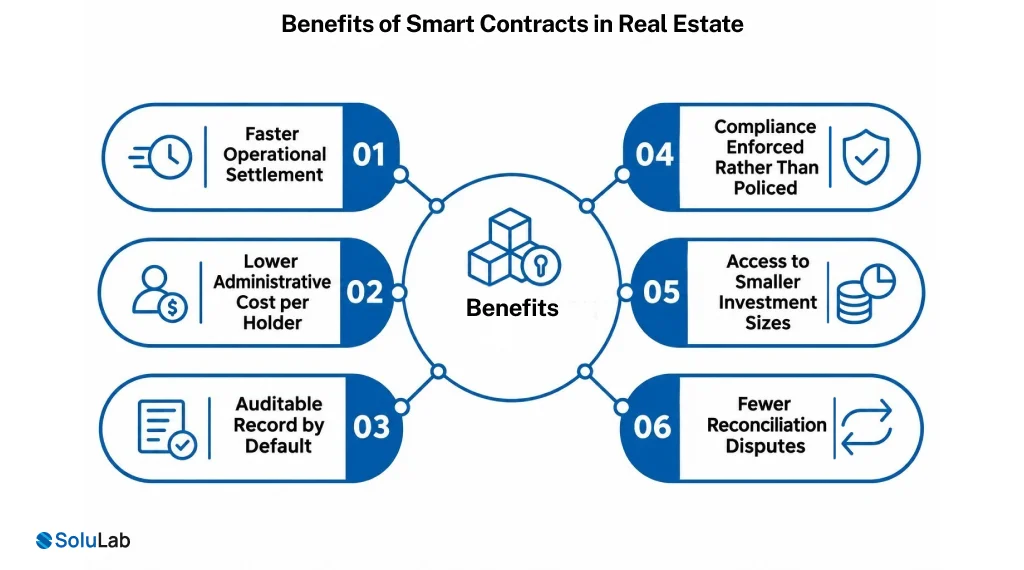
1. Faster Operational Settlement
Conditions that currently take weeks of sequential checking execute in a single transaction once the data is available.
2. Lower Administrative Cost per Holder
Distribution, register maintenance and reporting cost roughly the same for a thousand holders as for ten, which changes what structures are economically viable.
3. Auditable Record by Default
Every action is a timestamped public transaction. You get the audit trail without building one, which matters for both investors and regulators.
4. Compliance Enforced Rather Than Policed
Restrictions encoded in the token cannot be bypassed by a transfer nobody reviewed, which is a stronger control than a post-hoc check.
5. Access to Smaller Investment Sizes
Fractional interests make minimum investments viable at levels that administrative cost previously ruled out.
6. Fewer Reconciliation Disputes
One shared register, visible to all parties, removes a category of argument that private record-keeping creates.
Risks and What Actually Goes Wrong
1. The Admin Key Is the Real Exposure
Immunefi reported roughly $972 million lost across 207 incidents in the first half of 2026, the highest incident count recorded, and the severe damage increasingly comes from private key compromises, privileged access weaknesses and configuration errors rather than from clever code exploits. A contract that can reassign property interests needs its admin key treated accordingly.
2. Oracle Failure Produces Irreversible Wrong Settlement
A valuation or payment confirmation that reports wrongly releases funds that cannot be recalled. Fallback feeds and staleness checks are the control.
3. The Legal Wrapper Does Not Match the Code
The most common structural failure. The contract distributes income one way and the SPV agreement says another, and the agreement wins. Review both together.
4. Secondary Liquidity Does Not Materialise
A tokenized property with no buyers is a database entry with extra steps. Do not promise investors liquidity the market does not supply.
5. Upgrade Keys Cut Both Ways
An upgradeable contract can fix a bug and can also replace the entire ownership logic. Timelocks and multisig narrow this, and they do not eliminate it.
6. Regulatory Change Mid-Structure
Rules in this area are moving. A structure compliant at launch may need amendment, which is an argument for designing the upgrade path deliberately rather than discovering you need one.
Real Estate Smart Contract Development Cost
Cost tracks compliance scope and contract surface far more than feature count.
| Engagement | Typical range | What it covers | Timeline |
| Architecture and legal structuring review | $8,000 to $18,000 | Token standard selection, SPV structure review, compliance mapping, build estimate | 2 to 4 weeks |
| Escrow or lease contract set | $20,000 to $50,000 | Contract development, invariant and fuzz testing, testnet deployment, audit preparation | 5 to 9 weeks |
| Fractional ownership platform | $70,000 | Permissioned token, investor registry, distribution logic, admin console, audit cycle | 12 to 20 weeks |
| Full tokenization platform with secondary transfers | $80,000 | Compliance engine, transfer restrictions, reporting, multi-jurisdiction support, custody integration | 18 to 28 weeks |
| Independent smart contract audit | $15,000 to $80,000 | Third-party review, scoped by contract count and complexity, passed through | 2 to 6 weeks |
| Ongoing support retainer | Monthly, scoped to assets under management | Monitoring, parameter review, regulatory updates, feature work | Rolling |
How SoluLab Can Help
We have engineered blockchain systems since 2014, including tokenization platforms, permissioned token standards, and property-backed structures.
1. Structure and Token Standard Design
We work out what the tokens legally represent and which standard enforces your restrictions before writing contracts, because reversing that order is expensive.
2. Contract Development and Audit Coordination
Escrow, lease, distribution and transfer-restriction contracts with invariant testing, plus independent audit managed end to end through our smart contract audit company practice.
3. Platform Builds for Sponsors and Operators
Investor onboarding, registry, distribution and reporting as an operating platform rather than a token launch. Related work sits on our tokenization development company and real estate tokenization platform pages.
4. Compliance and Identity Integration
KYC and AML provider integration, accreditation verification and jurisdiction-aware transfer rules, built with the audit trail regulators ask for. Broader engineering capability is covered under blockchain development services.
If you want real estate smart contract development for a specific workflow, or smart contract development for real estate across a portfolio, start with an architecture call. We will tell you plainly when an off-chain system does the job better, because for single-property transactions it frequently does.
Conclusion
Smart contracts work well on the mechanical parts of a property transaction: holding and releasing escrow, collecting rent, splitting income across many owners, and enforcing who can hold what. They don’t transfer legal title, resolve disputes, inspect buildings, or override liens, and no roadmap changes soon, because those are legal functions rather than technical gaps.
The teams getting real value are the ones treating the contract as the operational layer underneath a properly structured legal wrapper, not as a replacement for it. Start with the workflow that is slow, rule-driven, and already measured, usually escrow or distributions. Get the legal structure right first. Then automate.
If you are weighing whether a property workflow belongs on-chain, or how to structure a tokenized offering without inheriting avoidable risk, SoluLab, a Smart contract development company, can help your business scope it properly. Book an architecture call, and we will work through the structure with you.
FAQs
Neha is a curious content writer with a knack for breaking down complex technologies into meaningful, reader-friendly insights. With experience in blockchain, digital assets, and enterprise tech, she focuses on creating content that informs, connects, and supports strategic decision-making.