Key Takeaways
- AI governance becomes critical once models influence real decisions
- Governance ensures explainability, compliance, and risk control
- Consultants help design systems, not just policies
- Key components include policy, technical, compliance, and operations layers
- Governance must be embedded into AI architecture
- Hiring should focus on technical + regulatory expertise
- Strong governance enables safe and scalable AI adoption
The Silent Risk Layer in Enterprise AI
AI rarely enters an organization with a governance plan.
It usually begins with a use case. A small experiment. A model that delivers a quick win.
Then another team picks it up. Another workflow gets automated.
Over time, these systems begin to influence decisions that truly matter.
Approvals. Risk scores. Customer actions.
At that point, something changes.
The conversation shifts from “Is the model working?” to “Do we understand how it is working?”
Most enterprises today are not struggling with AI platforms. They are struggling to stay in control once it starts operating at scale.
The early signs are easy to miss:
- A model behaves slightly differently in production
- A decision cannot be fully explained
- Compliance teams start asking for clarity that no one can provide
What initially appeared to be a technical system begins to become a business risk.
This is where governance enters the picture.
Not as a formality, but as a control layer that determines whether AI can be trusted in real-world conditions.
And this is the point where organizations begin to hire AI consultants, not to slow things down, but to make sure AI does not move ahead without visibility.
From Innovation to Accountability: Why AI Governance Consulting Exists
The first wave of enterprise AI was driven by opportunity.
Teams focused on what could be automated, predicted, or optimized. Speed mattered. Efficiency mattered. Getting something into production mattered.
For a while, that worked.
But as AI systems started moving closer to core decision-making, a different set of questions began to surface.
Can the system justify its output?
Can it operate within regulatory expectations?
Can leadership stand behind its decisions if challenged?
These are not modeling problems. They are governance problems.
Enterprises are now expected to demonstrate not just capability, but responsibility. The way AI behaves has become just as important as what it delivers.
This shift is driving demand for:
- AI governance consulting services that bring structure to how AI is managed
- Responsible AI consulting services that address fairness and transparency
- AI ethics consulting services that define acceptable system behavior
- AI regulatory compliance consulting that aligns systems with evolving laws
AI does not fail in obvious ways. It fails in subtle ways that go unnoticed until the impact is visible.
Governance brings those risks into view and gives organizations a way to act on them before they become problems.

What AI Governance Consultants Actually Do (Beyond Compliance)
Many teams approach AI governance with a narrow expectation.
They assume consultants will help with documentation, policies, or audit readiness.
That is only one part of the role.
Strong AI consultants focus on how governance becomes part of the system itself. Their work is less about creating documents and more about shaping how AI operates across its lifecycle.
They bring structure to unclear problems
AI introduces questions that do not have straightforward answers.
What qualifies as acceptable model behavior?
Who owns the outcome of an automated decision?
How should risk be measured when outputs are probabilistic?
These are not questions most organizations can resolve on their own.
This is where AI governance strategy consulting plays a role. It turns uncertainty into structured approaches that teams can actually implement.
They align teams that operate in silos
In most enterprises, Artificial intelligence involves multiple functions:
- Engineering builds models
- Compliance defines rules
- Business teams rely on outputs
Each group works with different priorities and different assumptions.
Governance consultants help align these layers so that:
- Policies can be enforced within systems
- Systems meet regulatory expectations
- Decisions remain traceable and explainable
Without this alignment, governance either remains theoretical or becomes difficult to apply in practice.
They design for ongoing control, not one-time approval
AI systems are not static.
Data changes. Models evolve. New AI use cases are introduced.
Governance cannot be treated as a checkpoint before deployment. It needs to operate continuously.
This is why AI governance consulting services often include:
- Monitoring systems
- Audit mechanisms
- Feedback loops
Capabilities like AI audit and monitoring services ensure that organizations maintain visibility into how AI behaves over time, not just at the moment of launch.
They work across multiple layers of the organization
Depending on the need, different types of specialists may be involved:
- AI risk management experts focus on identifying and mitigating risks
- Experts in AI compliance consulting services handle regulatory alignment
- Technical specialists work on AI governance framework consulting and system design
The most effective consultants understand how these layers connect. Governance is not isolated to one function. It sits across policy, technology, and operations.
The Real Problem: Why Enterprises Struggle Without AI Governance
Most AI systems do not break in obvious ways. They drift. They change.
hey behave slightly differently over time.
And often, no one notices early enough.
What it looks like in reality
A model that worked well in testing starts giving inconsistent outputs in production.
A decision is questioned, but no one can fully explain how it was made.
Data gets reused across systems without proper visibility.
Individually, these issues feel manageable.
Together, they create a system that is difficult to trust.
Where things start slipping
- Decisions cannot be traced back clearly
- Model versions are not tracked consistently
- Monitoring is limited to performance, not behavior
- Ownership of AI risk is unclear
This is not a technical failure.
It is a control failure.
Common failure patterns
- Invisible bias
Patterns emerge over time, but they are not immediately visible. Certain outcomes start skewing, and the cause remains unclear. - Lack of auditability
There is no complete record of how decisions were generated. Reconstructing events becomes slow and uncertain. - Model drift
The environment changes. The model adapts in uncontrolled ways. Performance gradually degrades. - Regulatory exposure
Systems operate in ways that do not fully align with evolving compliance expectations.
The underlying issue
In many organizations, governance exists as documentation.
Policies are written. Guidelines are shared. But AI systems do not operate inside documents.
They operate inside pipelines, data flows, and decision loops.
When governance is not embedded into these layers, it loses its effect.
Why this leads to hiring AI governance consultants
By the time these gaps become visible, internal teams are already stretched.
What organizations need at this point is not more documentation.
They need structure.
- A system that enforces policies
- Visibility into how AI behaves
- Clear ownership of risk
This is where AI governance consultants step in.
They help move governance from theory into execution.
Core Components of Enterprise AI Governance Solutions
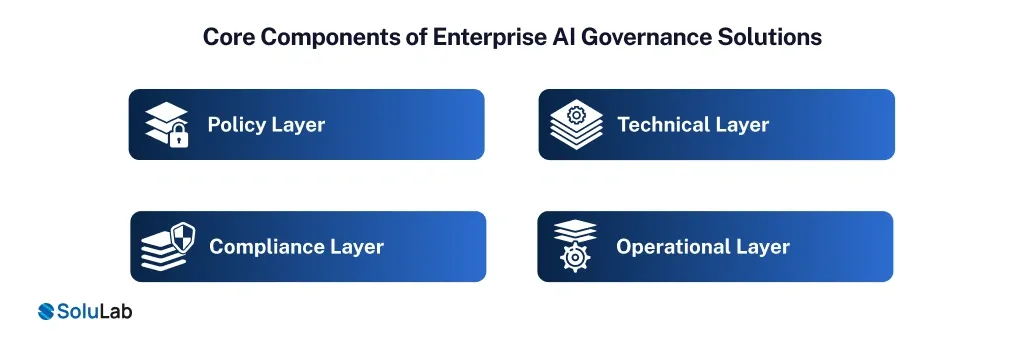
Once governance is treated as a system, its structure becomes clearer.
It is not one framework or one tool. It is a set of layers that work together to create control and visibility.
1. Policy Layer
This is where intent is defined.
What is the acceptable use of AI in the organization?
What risks are tolerable?
Where are the boundaries?
These decisions are often guided by experienced AI policy and governance experts who can translate abstract principles into rules that teams can actually follow.
This layer involves ethical AI and governance experts who translate high-level principles into actionable guidelines.
But policies alone do not change behavior. They need to be enforceable.
2. Technical Layer
This is where governance becomes real.
It includes:
- Model versioning and tracking
- Explainability mechanisms
- Monitoring pipelines
These systems ensure that AI behavior is not a black box. They make it observable.
Without this layer, governance remains theoretical.
This is where AI governance framework consulting overlaps with engineering.
3. Compliance Layer
Here, governance aligns with external expectations.
It covers:
- Regulatory mapping
- Documentation standards
- Audit readiness
Organizations working with AI compliance solutions focus heavily on this layer.
It ensures that what is built internally can stand up to external scrutiny.
4. Operational Layer
This is often overlooked, but critical.
Who owns AI risk?
Who approves deployment?
What happens when something goes wrong?
This layer defines:
- Governance committees
- Approval workflows
- Escalation paths
It turns governance from a concept into an operating model.
What these layers create
When these components come together, governance stops being fragmented.
It becomes a system that provides:
- Visibility into AI behavior
- Accountability across teams
- Control over how decisions are made
This is what mature enterprise AI governance solutions look like in practice.
Architecture of AI Governance Systems (How It Actually Works)
Governance only works when it is part of the AI lifecycle itself.
Not before it. Not after it. Within it.
Core architectural elements
- Data governance layer
Tracks where data comes from, how it is used, and whether it meets
compliance requirements. - Model lifecycle management
Handles versioning, validation, and controlled deployment of models. - Risk scoring systems
Classify models based on their impact and exposure. A fraud detection model and a recommendation engine should not be governed in the same way. - Monitoring and alerting systems
Continuously track model performance, drift, and anomalies. - Audit logs and reporting systems
Maintain a complete record of decisions, inputs, and system behavior.
How the flow works
- Data enters the system and feeds into models.
- Models generate outputs that influence decisions.
- Those decisions are monitored in real time.
- Every step is logged and can be audited.
- Insights from monitoring feed back into model updates.
This creates a loop rather than a one-time process.
What makes this architecture effective
The strength of governance architecture is not in individual components, but in how tightly they are connected.
- If monitoring exists without audit logs, visibility is partial.
- If policies exist without technical enforcement, compliance is weak.
- If risk classification is missing, all models are treated the same regardless of impact.
Strong AI governance consulting services focus on integrating these pieces into a cohesive system.
A practical insight
Governance should not feel like an external control applied to AI. It should feel like a natural part of how AI systems are designed, deployed, and maintained.
That is the difference between organizations that manage AI risk and those that react to it.
When and Why to Hire AI Governance Consultants?
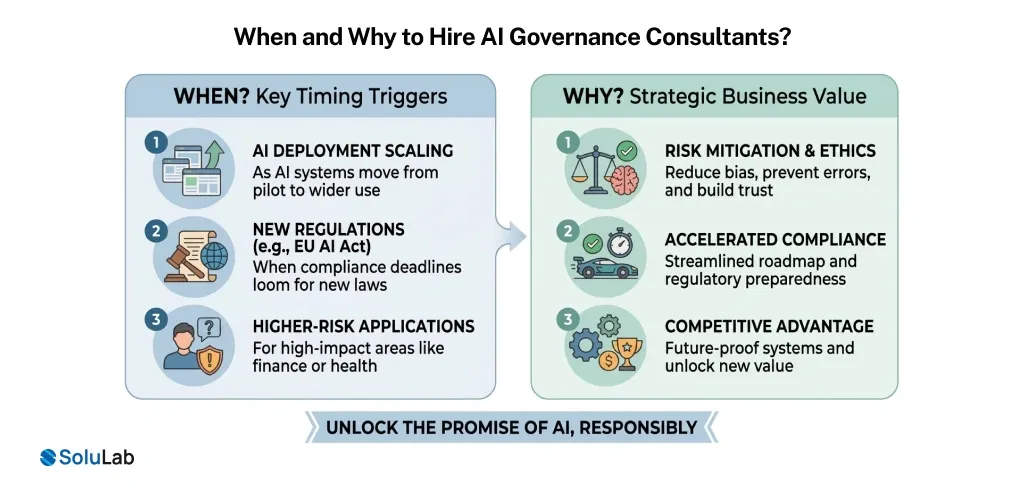
Most organizations do not wake up one day and decide to invest in governance.
It usually happens when something feels slightly off.
A model behaves unpredictably. A compliance review raises questions. A leadership discussion surfaces gaps no one can clearly answer.
These moments are signals.
Typical inflection points
- AI moves from pilot to production
What worked in a controlled environment starts interacting with real-world data and decisions. The stakes increase. - Multiple teams start building AI independently
Different models, different assumptions, no shared standards. Fragmentation sets in. - AI begins to influence financial or customer outcomes
At this point, decisions are no longer internal. They have external impact and accountability. - Regulatory exposure increases
Entering new markets or operating in regulated industries introduces requirements that internal teams may not be prepared for.
What organizations are really looking for
At this stage, companies are not just searching for advice. They are looking for structure.
- A clear AI governance framework
- Defined ownership of risk
- Systems that enable AI audit and monitoring services
- Alignment with AI regulatory compliance consulting expectations
Early warning signs
- No central view of AI systems in use
- No monitoring beyond basic performance metrics
- No documentation that connects data, models, and decisions
- No clear answer to “who owns AI risk?”
These are not edge cases. They are common in fast-moving environments.
Bringing in AI native strategy at this stage helps organizations move from reactive fixes to structured control.
How to Evaluate and Hire AI Governance Consultants?
Hiring in this space is not straightforward.
Choosing the best AI governance consultants for enterprises requires a different lens than a typical vendor evaluation.
AI governance sits across technology, compliance, and operations. Few providers handle all three well.
Start with depth, not presentation
Some firms are strong on frameworks and documentation.
They deliver policies, guidelines, and reports.
That is useful, but not enough.
Governance only works when it connects to real systems.
What actually matters
Focus on a few core capabilities:
- Architecture understanding
- Technical depth
- Regulatory awareness
- Implementation ability
If one of these is missing, gaps will show later.
Key evaluation criteria
1. Architectural capability
Can they design governance into your AI pipelines?
2. Technical understanding
Do they understand monitoring, explainability, and model lifecycle in practice?
3. Regulatory alignment
Are they comfortable with global and local compliance requirements?
4. Implementation approach
Will they stay involved beyond strategy?
5. Integration mindset
Can they work with your current systems instead of replacing everything?
Questions worth asking
- How do you classify AI risk across different use cases?
- What monitoring systems do you implement?
- How do you ensure governance continues after deployment?
- How do you handle regulatory changes over time?
The answers should feel grounded in real execution, not just theory.
Build vs Hire
Some organizations consider building governance internally.
It offers control, but comes with trade-offs:
- Slower execution
- Limited expertise
- Higher effort to stay compliant
Hiring AI experts brings speed and experience.
It helps organizations move from scattered efforts to a structured system.
What a strong partner looks like
A good partner does not stop at recommendations.
They help you:
- Design governance into your architecture
- Implement monitoring and audit systems
- Align compliance with technical workflows
This is what turns governance into something that actually works.
Governance vs Development: Why Hiring AI Developers Isn’t Enough
A common assumption is that strong engineering teams can handle governance as well.
Many organizations that hire AI consultants for development assume governance will be covered along the way.
In practice, these are different problem spaces.
Where development focuses
Teams working on custom AI development or looking to hire AI developers are focused on:
- Model accuracy
- Performance
- Scalability
- Deployment
These are critical. But they do not address how the system behaves over time under scrutiny.
Where governance operates
Governance looks at a different set of questions:
- Can decisions be explained when needed?
- Is the system operating within defined boundaries?
- Are risks being tracked and managed continuously?
- Can the organization defend its AI decisions externally?
The gap that emerges
Without governance:
- High-performing models can still create risk
- Systems can operate without visibility
- Decisions can become difficult to justify
What mature organizations do differently
They do not treat governance as an extension of development.
They run both tracks in parallel:
- Development builds capability
- Governance builds control
This is where strong enterprise AI governance solutions take shape.
Where partners like SoluLab fit in
At an execution level, enterprises often need support that goes beyond strategy.
Teams like SoluLab, #1 AI-led development agency, operate at the system design layer, helping organizations:
- Integrate governance into AI architecture
- Align compliance with technical implementation
- Build phased, scalable governance models
The focus is not on adding governance later, but on making sure AI systems are built with governance in mind from the start.

Conclusion – Governance as a Long-Term AI Advantage
AI is becoming part of how decisions are made across the enterprise.
That shift brings opportunity, but also responsibility.
Organizations that succeed with AI applications over the long term are not just the ones that build powerful models. They are the ones that understand how those models behave, how they are controlled, and how they can be trusted.
Governance plays a central role in that.
It creates clarity where there would otherwise be ambiguity. It introduces structure where systems might drift. It builds confidence in environments where decisions need to stand up to scrutiny.
Hiring the right AI app development agency is not only about reducing risk. It is about creating a foundation that allows AI to scale without losing control.
Book a strategy call to get started!
FAQs
Shipra Garg is a tech-focused content strategist and copywriter specializing in Web3, blockchain, and artificial intelligence. She has worked with startups and enterprise teams to craft high-conversion content that bridges deep tech with business impact. Her work translates complex innovations into clear, credible, and engaging narratives that drive growth and build trust in emerging tech markets.