Key Takeaways
- Hiring a CV developer is not the same as hiring an ML engineer. The difference is physical. The system depends on what the camera saw. No model can recover what the camera missed.
- Detection models are cheap. Camera sense is not. The lens, light, angle and frame rate decide if the problem can be solved. A candidate who asks about those understands the field.
- Many so-called computer vision projects do not need a CV developer. If the target is in public data, like faces, cars or printed text, you just set up an API. Custom work is for your own defects, products or machines.
- Labelling data is usually the biggest cost. Boxes are cheap, but you need many. Exact outlines cost several times more, and some fields need experts.
- Expect data work to outweigh modelling in the budget. Teams that plan the reverse run out of money at the point where the model is almost working.
- Hire people who have shipped, not people who know models. Ask about a model that passed testing but failed in real use. No answer means no production experience.
- CV drift is physical, not just statistical. Products change, seasons change, cameras get bumped. Retraining belongs in scope from the first deployment.
Hiring a computer vision developer is not the same as hiring a machine learning engineer. The difference is physical. A CV system depends on what the camera saw. That means the lens, the light, the angle, the frame rate and the blur. So an engineer who cannot advise on that builds a good model on footage that was never going to work.
The scarce skill is not training a detector. Detectors are close to commodities. Instead, the scarce skill is knowing which problems your capture setup can solve. It is also knowing what it costs to fix the setup when it cannot.
On this page: whether you need a CV engineer at all. Which skills to test. Why the camera matters most. What to ask in interviews. The hidden costs. Edge versus cloud. And how to judge a partner.

Do You Actually Need to Hire a Computer Vision Developer?
Ask this first, because many projects called computer vision can be solved without one.
| Your situation | What you need |
| Reading text from documents | A ready-made OCR or document API |
| Detecting people, cars or faces | A ready-made model or vision API |
| Detecting your own defects, products or equipment | A computer vision developer |
| Cameras in place, but no idea what is possible | A short trial first, not a hire |
| A prototype that fails in real conditions | A CV developer who has shipped, not a researcher |
The test is simple. So start here: does the thing you need to spot appear in public training data? If it does, then you are simply configuring. If it does not, however, you must collect and label data. That is a project.
Which Skills Should You Test When You Hire a Computer Vision Developer?
| Skill area | Non-negotiable | Nice to have | Why |
| Python with OpenCV and NumPy | Yes | — | The working language of the field |
| PyTorch or TensorFlow | Yes | — | Depth in one beats passing knowledge of both |
| Detection, segmentation, classification | Yes | — | Knowing which task your problem is |
| A plan for labelling data | Yes | — | Where most of the budget and most failure sits |
| Judging results beyond accuracy | Yes | — | Precision, recall, and the trade-off you need |
| Shipping and tuning: ONNX, TensorRT | Yes | — | The gap between a notebook and a system |
| Classical CV methods | Yes | — | Many problems solve faster without deep learning |
| Camera, lens and light judgement | Yes | — | The rarest skill here, and the most useful |
| Video and object tracking | Depends | — | Only if your input is video, not stills |
| 3D vision, depth, point clouds | No | Yes | Robotics, AR and inspection work |
| Edge devices: Jetson, mobile | Depends | — | Needed if the work cannot go to the cloud |
The lesson is clear. When you hire a computer vision developer, value good data sense and shipped work over model theory. Model designs are public and easy to swap. By contrast, knowing your problem needs better light, not a bigger model, is rare.
Why Does the Camera Decide the Project?
However, most hiring guides skip this part. Yet it is the part that predicts how the project ends.
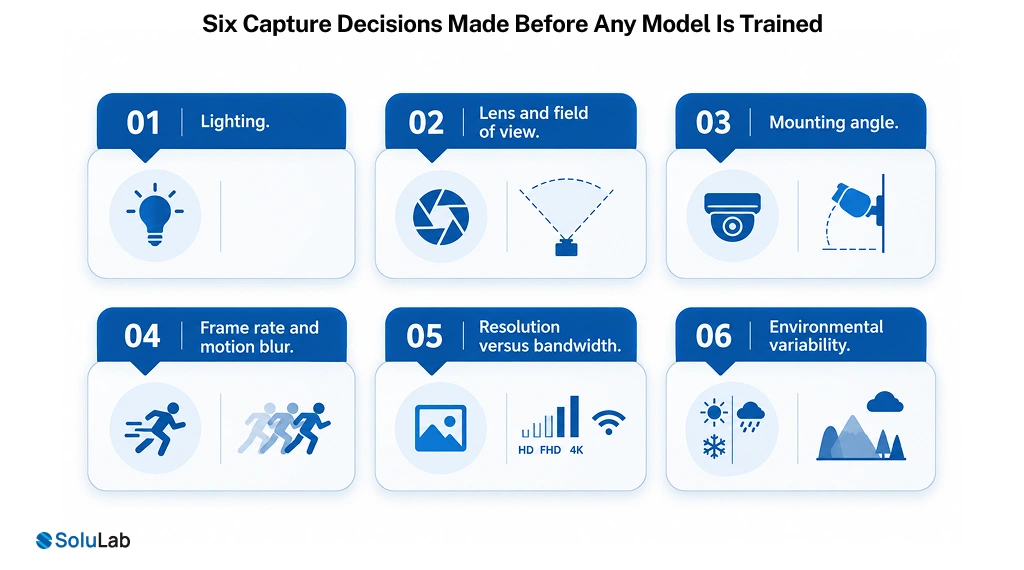
1. Lighting. First, uneven light causes shadows and glare. No model learns through them well. Fixing the light is usually cheaper than the extra data you would need instead.
2. Lens and field of view. Second, go too wide and your target fills forty pixels. Then accuracy on small objects drops, and no model can fix it.
3. Mounting angle. Third, a camera placed for people to watch is often wrong for a machine. So blocked views and skewed angles are design problems, not model problems.
4. Frame rate and motion blur. Similarly, fast-moving objects on a slow shutter produce smeared frames. The model cannot learn what the sensor did not capture.
5. Resolution versus bandwidth. Next, higher resolution helps accuracy. But it costs storage, bandwidth and time. So that choice is made at the camera.
6. Environmental variability. Finally, outdoor light changes hourly. A model trained on afternoon footage fails at dusk unless the data covers it.
A candidate who asks about these knows the field. One who jumps straight to models finds them in month three, at a cost.
What Should You Ask a Computer Vision Developer in the Interview?
Before you hire a computer vision developer, use these seven questions, with what a good answer sounds like.
1. “What would you want to know about our camera setup before quoting?” This is the single most revealing question. A good answer covers lighting, mounting and lens before models.
2. “How much labelled data would this need, and how would you get it?” Listen for a real number and a clear plan. Not a vague “we’ll fine-tune a model.”
3. “When would you use classical CV instead of deep learning?” Because anyone who says never has only ever used deep learning, the answer is telling.
4. “How do you evaluate this — is a false positive or a false negative worse here?” This shows whether they think about the business or just the score.
5. “Tell me about a model that worked in testing and failed in production.” After all, everyone with deployment experience has one. No answer means no deployment experience.
6. “Where would this run — cloud, edge or device — and why?” A good answer covers speed, bandwidth, privacy and cost, not taste.
7. “What would you do if we cannot change the cameras?” This tests whether they can work within limits or only design ideal systems.
Finally, ask them to walk you through a shipped project, not a demo reel. Demo footage is picked. Real footage is not.
What Does It Cost to Hire a Computer Vision Developer?
When you hire a computer vision developer, the obvious costs are skill level, location, length of work and time zone. These apply to any specialist. However, the CV-specific costs are the ones that surprise people.
Data annotation. In fact, this is often the largest single line item. Boxes are cheap per image, and you need many. Exact outlines cost several times more each. Some fields, like medical scans or factory defects, need expert labellers. That changes the number again.
Data collection. Also, if the footage does not exist, someone has to film it in every condition the system will face. That means time, access and sometimes production downtime.
Camera and lighting hardware. This is often cheaper than working around bad footage. It is also often left out of the budget.
Edge hardware. Next, you need a device at every camera, plus a way to update each one.
Re-annotation. Needs change, defect types get split, and part of the data needs redoing. So budget for it.
Ongoing retraining. In addition, products change, seasons change and cameras get bumped. Drift in CV is physical as well as statistical. So retraining belongs in scope from day one.
In short, the rule of thumb is simple. For a bespoke CV system, expect data work to consume more of the budget than modelling. Teams that plan the reverse run out of money just as the model starts to work. The model work itself runs through machine learning development.

Should Inference Run on the Edge or in the Cloud?
The answer turns on four things, and a good computer vision developer reaches for them rather than a preference.
Latency. First, some decisions must happen in a split second, like rejecting a part or stopping a machine. Those belong on the device. A trip to the cloud is too slow.
Bandwidth. Sending sharp video from many cameras costs more than handling it on site. As a result, sites with dozens of cameras usually push inference to the edge.
Privacy. Additionally, footage of people or sensitive premises may not be allowed to leave the site. In that case, running on site is a legal need, not a choice.
Cost and maintenance. The cloud is easier to update and scale. Edge devices, by contrast, need updating at every site. That is real, ongoing work.
In practice, most live systems end up mixed. Fast decisions happen on site, and heavy work happens in the cloud.
Which Engagement Model Fits?
| Model | Best for | Watch out for |
| Short trial first | You have cameras and an idea, but no proof | Skipping it, then finding the footage cannot do the job |
| Dedicated CV developer | Ongoing product work with a vision element | Paying for a full seat when work is patchy |
| Full team through a partner | You need labelling, models and shipping together | Vendors who model only and leave you the data |
| Fixed-scope project | One clear detection task | Change requests when the classes shift |
Therefore, for a first project, start with a short trial. Next, build a proof of concept on real footage. Then hire once you know what you are building. For hiring basics like interviews and contracts, see hire dedicated developers.
How Do You Evaluate a Partner?
Six checks before you hire a computer vision developer or team. They are listed in rough order of how much they matter.
1. They ask for sample footage first. Otherwise anyone quoting without seeing your images is guessing.
2. A labelling plan, not just a modelling plan.
3. Real, shipped systems, ideally on devices, not just test code.
4. Willingness to say no. A good partner tells you when your setup cannot support the job. Those who say yes to everything find the problem later, on your budget.
5. Accuracy in your terms. False alarms per shift, or missed defects per thousand units. Not a benchmark score.
6. A retraining plan, because CV drift is physical.
Where Does SoluLab Fit?
Meanwhile, SoluLab supplies computer vision engineers and full teams. The work covers camera review, data labelling, models and live deployment. In practice, work usually starts with a review of your real footage. That is where most CV projects succeed or fail. When you hire a computer vision developer through SoluLab, the work sits alongside computer vision development. Where a model needs more than a ready-made design, deep learning development handles it.
Still unsure whether your data can carry the project? An AI readiness assessment answers that first.
FAQs
Shipra Garg is a tech-focused content strategist and copywriter specializing in Web3, blockchain, and artificial intelligence. She has worked with startups and enterprise teams to craft high-conversion content that bridges deep tech with business impact. Her work translates complex innovations into clear, credible, and engaging narratives that drive growth and build trust in emerging tech markets.