Key Takeaways
- What it is: Big data software development services build and run the pipelines, storage, analytics, and machine learning that handle data too large, fast, or varied for standard databases.
- Same scope, two names: “Application development” points to the layer built on top of the platform, such as recommendation engines, risk models, and monitoring tools.
- When to build: Two or more of these signals usually justify a custom build: data silos, pipelines that don’t scale, real-time needs, conflicting reports, AI-readiness gaps, and rising infrastructure costs.
- Pick storage by workload: A warehouse suits BI, a lake suits raw data and machine learning, and a lakehouse serves both. Most production platforms pair batch with streaming.
- Quality comes first: Gartner puts the average annual cost of poor data quality at $12.9 million, so validation and governance belong in the pipeline from day one.
- Cost has drivers, not a fixed price: Data volume and variety, real-time versus batch, cloud setup, integrations, and engagement model decide it. SoluLab scopes it during discovery.
- SoluLab’s role: End-to-end delivery, from consulting and data engineering through analytics, ML, and managed operations.
From massive datasets to real-time analytics, SoluLab develops big data solutions designed around your infrastructure, business goals, and growth plans. Our data science and analytics services cover the full path from data strategy to a running platform. This page explains what big data software development services include, how the systems are built, and what drives cost.
What Are Big Data Software Development Services?
Big data software development services are custom engineering services that design, build, and operate systems for data that is too large, too fast, or too varied for standard databases. They cover data pipelines, storage, analytics, and machine learning, so a business can turn high-volume, high-velocity, high-variety data into decisions.
You will also see the same scope called big data application development services. The difference is emphasis. Application development focuses on the layer built on top of the data platform: recommendation engines, risk models, monitoring tools, and the products that read and write at scale.
The pressure is growing. Statista forecasts that global data creation will triple between 2025 and 2029.
What are the three Vs of big data?
- Volume: datasets measured in terabytes or petabytes rather than gigabytes
- Velocity: data arriving continuously and needing fast or real-time handling
- Variety: a mix of structured records, semi-structured logs and JSON, and unstructured text, images, or video
Some frameworks extend this to five Vs by adding Veracity (how trustworthy the data is) and Value (whether it is worth the cost to process). Either way, a well-designed platform stores and queries all of it without forcing everything into one rigid format. Structured data fits tables and columns. Semi-structured data such as JSON, XML, and logs has some organization but no fixed schema. Unstructured data, including emails, documents, sensor feeds, and media, has no predefined model at all.
Custom development beats packaged tools when your data spans many systems, when you need real-time or near-real-time processing, or when reporting has to follow rules a generic product can’t model. A packaged BI tool can chart what you already collect. A custom platform decides how data is ingested, cleaned, stored, and served, so the charts can be trusted in the first place.
When Do You Need Big Data Application Development Services?
Consider a dedicated big data build when two or more of these signals sound familiar:
- Data silos across systems: sales, product, and finance data live in separate tools and never reconcile
- Pipelines that don’t scale: nightly jobs run longer every month, or break under load
- Real-time analytics needs: you need decisions in seconds or minutes, not the next day
- Inconsistent reporting: two teams pull the same metric and get two numbers
- AI-readiness gaps: you want machine learning, but the data isn’t clean or accessible enough to train on
- Rising infrastructure costs: storage and compute bills climb while the value you get from them doesn’t
If several of these apply, cost out a planned rebuild against the ongoing price of patching the current setup. The comparison is usually clearer than people expect.
Is Custom Big Data Development Better Than Off-the-Shelf Tools?
It depends on your data. The table shows where each approach wins.
| Dimension | Custom Big Data Development | Off-the-Shelf Tools |
|---|---|---|
| Flexibility | Fits your data model and rules | Fits the vendor’s assumptions |
| Scalability | Sized to your volume and velocity | Capped by product tiers |
| Integration | Built to connect your systems | Limited to supported connectors |
| Cost model | Higher upfront, lower marginal cost at scale | Lower upfront, recurring per-seat or per-usage fees |
| Ownership | You own the code and architecture | You rent access |
Off-the-shelf is the right call when your data lives in a few systems and the vendor’s model fits. Custom pays off when it doesn’t, and when lock-in would limit where the platform can go.
What Big Data Development Services Does SoluLab Offer?
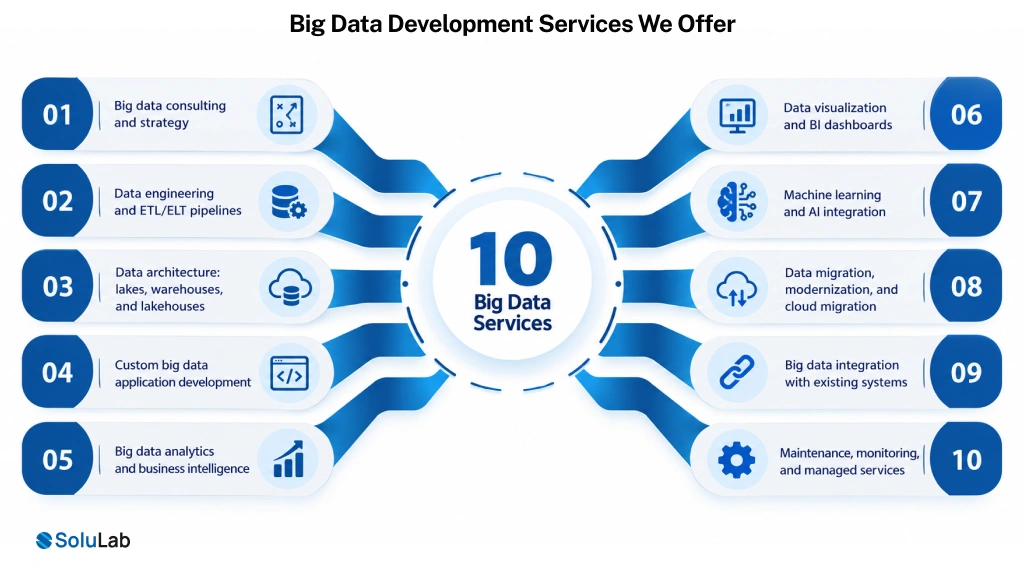
SoluLab covers the full path from strategy to a running system. Take it as one program or pick the pieces you need.
- Big data consulting and strategy. Technology assessment, data maturity review, tool selection, and a phased delivery roadmap. We map your data sources, define governance rules, and set the sequence of work. You shouldn’t build a data lake before you know what questions it must answer.
- Data engineering and ETL/ELT pipelines. Batch and real-time pipelines that move data from source to destination: ingestion, transformation, and orchestration, so data arrives clean, on schedule, and in the right shape. This is the core of the service and what keeps analytics reliable.
- Data architecture: lakes, warehouses, and lakehouses. The storage and compute foundation, built on-premises, cloud-native, or hybrid. We decide where raw data lands, where cleaned data lives, and how the two connect, then implement it on your chosen cloud.
- Custom big data application development. The application layer on top of the platform: recommendation engines, risk models, monitoring tools, and internal or customer-facing products that read and write at scale.
- Big data analytics and business intelligence. Descriptive, diagnostic, and predictive analytics that answer what happened, why, and what’s likely next, connected to dashboards and built on clean pipelines instead of ad hoc extracts. For teams exploring AI-assisted analysis, see our guide to generative AI for data analysis and modeling.
- Data visualization and BI dashboards. Reporting layers in Power BI, Tableau, and Looker Studio, so business users get answers without writing queries. They run on the same governed data as the analytics layer.
- Machine learning and AI integration. Models built on the data platform, from feature pipelines through training and serving, where ML drives a decision such as demand forecasting, churn scoring, or fraud detection. Our guide to machine learning ROI covers how to judge which ones pay off.
- Data migration, modernization, and cloud migration. Moving off legacy warehouses or on-premises clusters to modern cloud platforms, with schema redesign and validation so nothing is lost in transit.
- Big data integration with existing systems. Connecting the platform to the tools you already run (CRMs, ERPs, transactional databases, third-party APIs) so it reflects the whole business instead of one silo.
- Maintenance, monitoring, and managed services. Ongoing operation after launch: pipeline monitoring, cost tuning, scaling, and fixes. Big data systems drift as data grows, so support is part of the service.
What Does a Big Data Architecture and Tech Stack Look Like?
Tool choice depends on your data profile and cloud commitments, and the final selection happens during the consulting phase, not before. The diagram shows a typical reference architecture. Your build will differ in the details.
Many platforms follow a Lambda architecture. It runs a batch layer and a speed layer in parallel, so the system serves both historical accuracy and real-time freshness from the same data. We use it where a use case needs both, and keep the design simpler when it doesn’t. Frameworks like Apache Spark typically anchor the batch side.
| Layer | Tools |
|---|---|
| Processing and compute | Apache Spark, Hadoop (MapReduce), Apache Kafka, Apache Flink, Apache Storm |
| Orchestration and ingestion | Apache Airflow, Apache NiFi, Talend |
| Platforms | Databricks, Snowflake, AWS, Microsoft Azure, Google Cloud Platform |
| Storage | Amazon S3, Azure Data Lake, GCP Cloud Storage, Amazon Redshift, Delta Lake |
| Databases | Cassandra, MongoDB, HBase, DynamoDB, ClickHouse, Elasticsearch |
| ML and AI | TensorFlow, Spark MLlib, Amazon SageMaker, Azure ML, Python, Scala, R |
| Transformation and visualization | dbt, Power BI, Tableau, Looker Studio |
Data Lake vs. Data Warehouse vs. Lakehouse: Which Do You Need?
Choosing the storage foundation is one of the first architecture decisions. A data warehouse suits clean, structured reporting. A data lake holds everything cheaply for exploration and machine learning. A lakehouse combines both, adding transactions and governance on top of low-cost storage.
| Attribute | Data Warehouse | Data Lake | Lakehouse |
|---|---|---|---|
| Data type | Structured | Structured, semi-structured, unstructured | Structured, semi-structured, unstructured |
| Schema | Schema-on-write (defined before loading) | Schema-on-read (defined when queried) | Schema-on-read with warehouse-style governance |
| Best for | BI, reporting, known queries | Raw storage, data science, ML on varied data | One platform for both BI and ML |
| Cost profile | Higher storage cost, optimized compute | Low storage cost, cheaper to retain raw data | Low storage with added table management |
| Example tech | Snowflake, BigQuery | AWS S3, Azure Data Lake | Databricks, Delta Lake |
Batch vs. Real-Time Processing: Which Fits Your Use Case?
Batch processing handles large volumes with no immediate deadline. Real-time (stream) processing handles data that must be acted on within seconds. Most production platforms combine the two: batch for historical depth, streaming for live signals.
| Attribute | Batch Processing | Real-Time (Stream) Processing |
|---|---|---|
| When to use | Large volumes, no immediate deadline | Data that must be acted on within seconds |
| Latency | Minutes to hours | Milliseconds to seconds |
| Example tools | Apache Spark (batch), Hadoop | Apache Kafka, Spark Streaming, Apache Storm |
Which Industries Benefit From Big Data Applications?
Big data applications pay off wherever data volume and speed exceed what standard tools handle.
- FinTech and banking: fraud detection, risk scoring, transaction analytics, and real-time regulatory reporting built on streaming pipelines.
- Healthcare: unifying clinical, operational, and device data for population analytics and operational efficiency, under strict privacy controls.
- Retail and e-commerce: recommendation engines, personalization, demand forecasting, and inventory optimization from combined web, POS, and supply data.
- Manufacturing: predictive maintenance and quality analytics from sensor and machine data on the factory floor.
- Logistics and supply chain: route optimization, demand planning, and end-to-end shipment visibility across partners.
- Energy and utilities: smart-grid and smart-meter analytics for load forecasting and asset management.
- IoT-driven products: ingesting and acting on continuous sensor streams from distributed devices.
For a deeper look at one industry, read our guide to big data analytics in the oil and gas industry.
What Are Common Big Data Use Cases?
The same platform capabilities show up as different products across industries:
- Predictive maintenance: flagging equipment failures before they happen, from sensor data
- Demand forecasting: predicting inventory and staffing needs from historical and live signals
- Fraud detection: scoring transactions in real time against learned patterns
- Customer segmentation: grouping users by behavior to target offers and content
- Real-time recommendation and bidding: serving personalized suggestions or ad bids within milliseconds
- Supply chain optimization: modeling routes, suppliers, and stock across a network
- Smart-grid and IoT monitoring: tracking distributed devices and reacting to anomalies
These lean on predictive analytics and machine learning, where processed data feeds models that forecast, classify, or recommend, and the results flow back into the application. Our AI development services cover that modeling layer.
What Are the Benefits of Big Data Software Development?
- Faster decisions from trustworthy, near-real-time data instead of stale reports
- Cost reduction by right-sizing storage and compute and cutting duplicated pipelines
- Personalization at scale for customers and users
- Risk and fraud detection through pattern models on high-velocity data
- Operational efficiency from automating manual data work
- Scalability so the platform grows with your data instead of breaking under it
How Does Our Big Data Development Process Work?
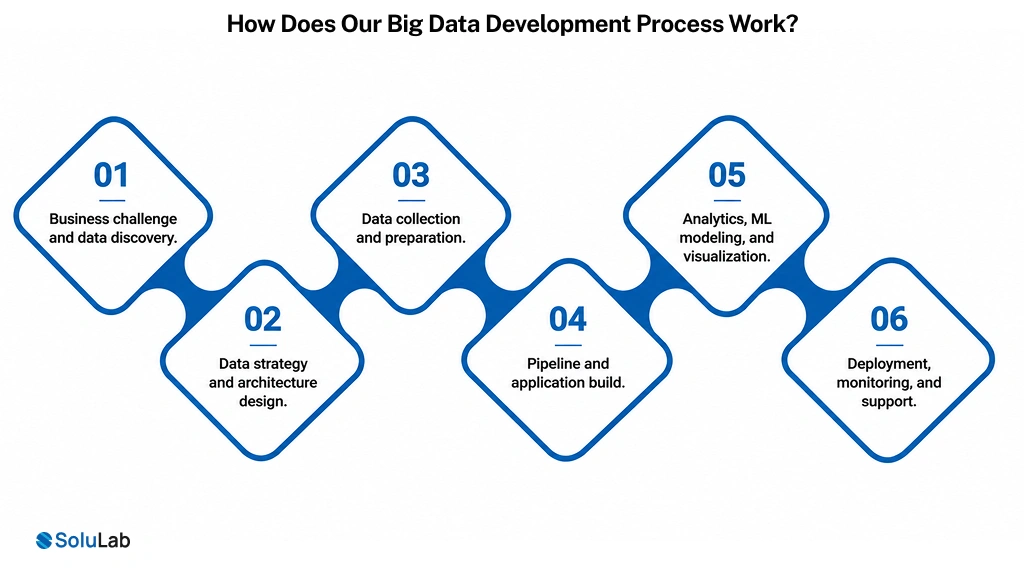
- Business challenge and data discovery. Define the decisions the platform must support and inventory your data sources, current tooling, and success measures.
- Data strategy and architecture design. Design the storage model (lake, warehouse, or lakehouse), the pipeline flow, and the technology stack, and document the target architecture.
- Data collection and preparation. Ingest, clean, validate, and structure data so downstream work rests on trustworthy inputs.
- Pipeline and application build. Build the ingestion, transformation, and orchestration pipelines and the application layer, choosing batch or real-time processing per use case, in iterative increments you can review.
- Analytics, ML modeling, and visualization. Build the analytics layer and, where it drives a decision, predictive models, plus dashboards integrated into the tools your teams already use.
- Deployment, monitoring, and support. Validate data quality, test at load, deploy, set up monitoring and alerting, tune performance and cost, and provide managed services as data and usage grow.
How Do You Ensure Data Quality and Consistency?
Bad data is expensive. Gartner estimates that poor data quality costs organizations an average of $12.9 million a year, a figure that comes from a 2020 survey of data quality vendors’ customers. Treat it as a directional benchmark, not a prediction for your company. The mechanism is what matters: conflicting numbers erode trust in every report built on them.
We build validation, deduplication, and schema checks into the pipeline, apply data governance rules, and reconcile metrics against source systems. Teams then see one consistent number instead of two conflicting ones from different tools.
How Do We Handle Data Governance, Security, and Compliance?
Governance and security are built into the architecture, not added afterward: access controls, data lineage, encryption in transit and at rest, and audit logging. For regulated data, the platform is designed to support the relevant framework, such as GDPR for personal data or HIPAA for healthcare data. We confirm specific compliance requirements with you during discovery.
How Much Does Big Data Software Development Cost?
There is no single price, because cost tracks the shape of the project, not a fixed rate. The main drivers:
- Data volume and variety: more data and more data types mean more storage, compute, and pipeline work
- Real-time versus batch: streaming architectures cost more to build and run than scheduled batch jobs
- Cloud infrastructure: ongoing compute and storage spend depends on platform choice and how well the system is tuned
- Integrations: each connection to an existing system adds development and testing effort
- Engagement model: a dedicated team, staff augmentation, or a fixed-scope project each price differently
SoluLab scopes cost during the discovery phase against your actual data and goals, so you see a number tied to your project. Scalability and cost control are part of the design, not a later fix. Auto-scaling keeps compute matched to load, and storage tiering keeps rarely used data cheap, which holds down the ongoing cloud bill as data grows.
What Engagement and Hiring Models Are Available?
You can hire big data developers or a full team, depending on how much you want to own internally.
- Dedicated team: a full big data team assigned to your project and managed by SoluLab.
- Staff augmentation: individual big data developers who join and work within your existing team
- Fixed-scope project: a defined deliverable, timeline, and price for a bounded build
A big data developer on these engagements designs and builds data pipelines, models storage schemas, writes processing jobs in tools like Spark, sets up orchestration, integrates data sources, and tunes systems for scale and cost. Senior engineers also own architecture and data quality across the platform.
Why Choose SoluLab for Big Data Software Development?
- Consulting-led: we start from the decisions the platform must support, then choose tools. Not the other way around.
- One team across the stack: consulting, pipelines, analytics, ML, and cloud operations, so nothing falls between vendors.
- Environment-flexible: delivery across on-premises, cloud, and hybrid setups on AWS, Azure, and Google Cloud Platform.
- Security built in: access control, encryption, and audit logging designed into the pipeline from the start.
- Proven on live data: real-time fraud scoring for banking and a unified operations platform for a public-sector agency, as shown above.
FAQs
Chintan leads SoluLab's highest-level AI consulting conversations, assessing whether a client's business problem actually justifies an AI investment before any solutioning begins.