Key Takeaways
- What it is: Oil and gas software development builds custom applications that digitize upstream, midstream, and downstream work, from asset monitoring and pipeline integrity to HSE compliance and trading.
- Why custom: Off-the-shelf tools rarely match how an operator runs its wells, pipelines, or refineries. Custom software fits the real workflow and connects to equipment already in the field.
- Downtime is the business case: Siemens’ 2024 survey found that oil and gas downtime costs rise and fall with the oil price, reaching record levels in 2022.
- Predictive maintenance pays: Siemens reports that its customers’ deployments cut unplanned machine downtime by 50% and maintenance costs by 40%. That is vendor data from mostly manufacturing sites, so treat it as directional.
- Integration comes first: Most projects connect new software to SCADA, historians, IoT gateways, and ERP instead of replacing them.
- Security is a design input: Control-system environments need access management, segmentation, and monitoring from day one. SoluLab holds ISO 27001:2022, SOC 2, and CMMI Level 3 credentials.
- Start small, scale after: An MVP validated in the field lowers risk. Cost depends on scope and integrations, and SoluLab engages on a fixed-price, time-and-material, or dedicated-team basis.
SoluLab designs and builds custom oil and gas software solutions for operators, oilfield-services firms, and energy enterprises across the full value chain. As a custom software development company, we apply the same engineering discipline to energy-sector work: field-ready apps, SCADA and ERP integration, and analytics your operations teams can act on.
Why Do Oil and Gas Companies Need Custom Software Development?
Off-the-shelf tools rarely match how a specific operator runs wells, pipelines, or refineries. Custom software fits the actual workflow, connects to the equipment already in the field, and gives teams data they can act on. These are the four reasons operators most often start a build.
Operational efficiency and automation of manual field workflows
Many field processes still run on paper, spreadsheets, and radio calls. Custom apps replace manual data entry with mobile capture, automate approvals, and remove the delay between something happening in the field and someone acting on it. That shortens cycle times and reduces transcription errors.
Real-time visibility across upstream, midstream, and downstream operations
Data usually sits in separate systems for drilling, production, transport, and refining. A purpose-built platform pulls those feeds into one view, so managers can see production rates, tank levels, pipeline flow, and refinery throughput as they change instead of a day later.
Cost reduction, predictive maintenance, and reduced downtime
Unplanned downtime is expensive. Sensor data plus machine-learning models can flag a failing pump or compressor before it stops, so maintenance is scheduled rather than reactive. The next section puts sourced numbers on what downtime costs and what predictive maintenance has delivered.
Regulatory compliance, HSE, and emissions and sustainability reporting
Operators report to multiple regulators on safety incidents, emissions, and environmental impact. Software that logs incidents, tracks corrective actions, and compiles emissions data turns compliance from a manual scramble into a repeatable process, with an audit trail attached.
How Much Does Unplanned Downtime Cost Oil and Gas Operators?
The cost of an hour offline is not fixed in oil and gas. Siemens’ True Cost of Downtime 2024 report, based on 181 interviews with maintenance, engineering, and IT professionals at large industrial organizations, found that the hourly cost of lost production in the sector tracks the oil price. Costs hit record levels in 2022, when crude spiked to nearly $120 a barrel. They fell sharply in 2023, when prices returned to the $60 to $80 range seen in 2019. In short, an hour of downtime costs the most exactly when output is most valuable.
| Result reported by Siemens predictive maintenance customers | Value |
|---|---|
| Improvement in downtime forecasting accuracy | 85% |
| Reduction in unplanned machine downtime | 50% |
| Increase in maintenance staff productivity | 55% |
| Reduction in maintenance costs | 40% |
What Oil and Gas Software Development Services Does SoluLab Offer?
SoluLab covers the full delivery lifecycle, from first discovery workshop to long-term support. You can engage us for a single build or as an ongoing development partner.
- Custom oil and gas software development. We build applications from scratch around your operation: production dashboards, well-management tools, field apps, or trading systems. This is the core of our custom software development practice, applied to energy-sector requirements.
- Legacy modernization and migration. Older SCADA front-ends, on-premises databases, and desktop tools often block integration and scaling. We migrate legacy systems to modern, cloud-ready architectures without losing historical data or interrupting operations. Our cloud consulting team supports the infrastructure side.
- Oil and gas web and mobile app development. We build field-ready mobile apps for inspections, data collection, and asset tracking, including offline modes for remote sites with no connectivity, plus web portals for back-office teams. For a closer look at the field use case, read how mobile apps improve productivity and safety in oil and gas.
- System integration (ERP, SCADA, IoT, third-party). New software rarely lives alone. We integrate with ERP platforms, SCADA and historian systems, IoT gateways, and third-party data providers so data flows across the stack instead of being re-keyed.
- Consulting and IT strategy. Before building, we help you scope the problem, choose a tech stack, and plan a roadmap. This helps when you know operations need to change but are not sure which system to build first.
- Maintenance and support. After launch we handle monitoring, updates, security patching, and enhancements, with support tiers matched to how critical the system is to daily operations.
What Oil and Gas Software Solutions Can We Build?
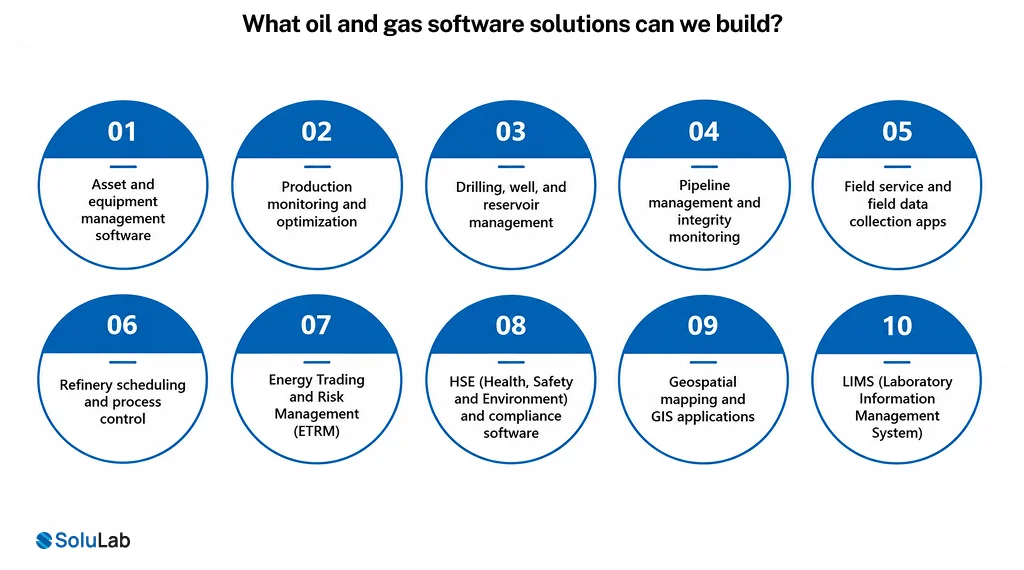
This list maps to the main solution categories operators ask for. We build them as standalone products or as connected modules on one platform.
- Asset and equipment management software: Track pumps, compressors, valves, and rigs across their lifecycle: location, condition, maintenance history, and spare-parts inventory in one system.
- Production monitoring and optimization: Collect production data from wells and facilities, visualize it in real time, and apply models that suggest how to lift output or reduce flaring and losses.
- Drilling, well, and reservoir management: Support drilling operations, well planning, and reservoir modeling and simulation, so engineering teams can plan well placement and forecast recovery with current data.
- Pipeline management and integrity monitoring: Monitor pipeline flow, pressure, and integrity to detect leaks or anomalies early, combining SCADA feeds with IoT sensors along the line.
- Field service and field data collection apps: Give field crews mobile tools for work orders, inspections, and data capture, with offline support and sync when connectivity returns.
- Refinery scheduling and process control: Plan refinery runs, sequence batches, and connect to process-control data to reduce scheduling conflicts and improve throughput.
- Energy Trading and Risk Management (ETRM): Support trading desks with position tracking, risk exposure, and forecasting for commodity price volatility.
- HSE (Health, Safety and Environment) and compliance software: Log incidents, manage corrective actions, run safety audits, and compile emissions and environmental reports for regulators.
- Geospatial mapping and GIS applications: Map assets, pipelines, leases, and field locations with GIS layers for planning and situational awareness.
- LIMS (Laboratory Information Management System): Manage sample tracking, test results, and quality data for crude, refined products, and environmental samples.
We also build offshore rig-management tools and fleet and logistics systems for tankers, trucks, and support vessels, plus delivery platforms through our on-demand delivery app development practice.

How Do We Serve Upstream, Midstream, and Downstream Operations?
Each segment of the value chain has distinct data, equipment, and regulatory needs. We tailor solutions to where you sit in the chain.
Upstream: exploration and production (E&P)
We build drilling optimization, well and reservoir management, production monitoring, and predictive maintenance for high-value rotating equipment.
Midstream: pipeline, storage, LNG transport
We focus on pipeline integrity monitoring, storage and terminal management, LNG logistics, and fleet tracking across long distances.
Downstream: refining, distribution, retail
We build refinery scheduling, process-control integration, distribution and logistics tools, and retail and fuel-delivery systems.
Which software fits which pain point?
The table maps common problems to the solution and core technology we would apply.
| Segment | Pain point | Software solution | Core technology |
|---|---|---|---|
| Upstream (E&P) | Unplanned equipment downtime | Predictive maintenance and asset monitoring | IoT + AI/ML |
| Upstream | Suboptimal well placement | Reservoir modeling and drilling optimization | Big data + 3D visualization |
| Midstream | Pipeline leaks and integrity risk | Pipeline monitoring and integrity software | SCADA + IoT |
| Midstream | LNG and logistics tracking | Fleet and logistics management | Cloud + IoT |
| Downstream | Refinery scheduling inefficiency | Refinery scheduling and process control | AI + real-time analytics |
| Cross-segment | Regulatory and emissions reporting | HSE and compliance software | Cloud + analytics |
| Cross-segment | Commodity price volatility | ETRM software | Big data + AI forecasting |
Which Technologies Power Our Oil and Gas Solutions?
We select technology based on the operational problem, not on hype. The diagram shows a typical reference architecture. Your build will differ in the details, especially around the control systems you already run.
- IoT and real-time asset monitoring: Connect field sensors and gateways to stream equipment and production data continuously, so decisions rest on current readings. See our IoT development services.
- AI and machine learning for predictive maintenance and forecasting: Apply machine-learning models to sensor and production history for failure prediction, production forecasting, and anomaly detection. Our enterprise AI development team builds these.
- SCADA integration and digital twins: Integrate with existing SCADA and historian systems, and build digital twins that mirror physical assets for simulation and monitoring.
- Big data analytics: Store and process large volumes of sensor, seismic, and operational data to surface patterns across facilities and time. For the analytics angle, read big data analytics in the oil and gas industry.
- Cloud (AWS, Azure, Google Cloud): Deploy on AWS, Azure, or Google Cloud for scalability, remote access, and managed infrastructure, with hybrid options where on-premises control is required.
- Blockchain for transparent transactions and supply-chain traceability: Use blockchain for tamper-evident records in trading, custody transfer, and supply-chain traceability where multiple parties need a shared source of truth. One example is global oil market tokenization.
- Cybersecurity for critical infrastructure: Oil and gas is critical infrastructure, so we build with security controls from the start. The security section below covers the approach.
We also apply 3D visualization, RPA, and AR/VR where they fit a specific field or training use case.
Technically reviewed by Chintan Thakkar, Founder, SoluLab. The architecture on this page reflects how we scope and build industrial and energy platforms for clients.
What Is Our Oil and Gas Software Development Process?
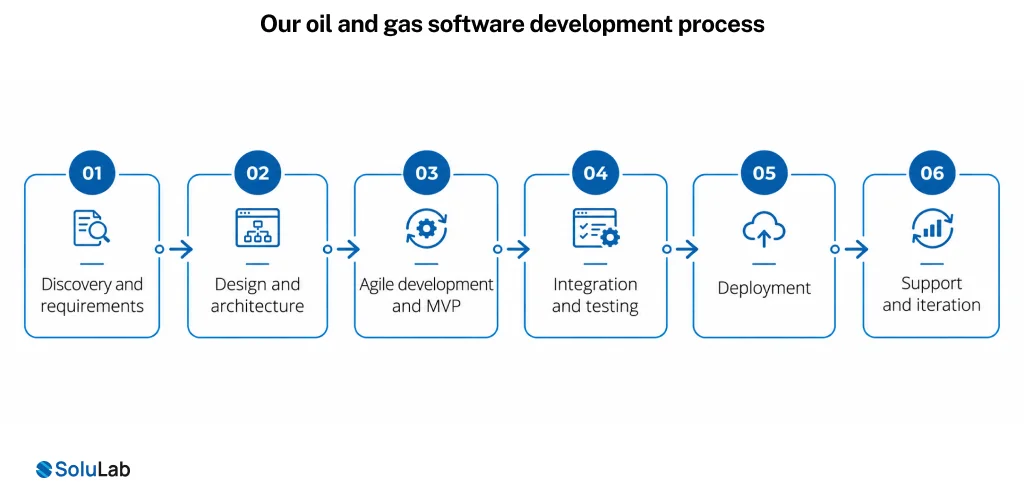
We follow a structured, agile process so you see working software early and can adjust as operations reveal new requirements.
- Discovery and requirements. Workshops with your operations and IT teams to define scope, data sources, and success measures.
- Design and architecture. Solution design, tech-stack selection, and integration planning.
- Agile development and MVP. Iterative builds, starting with a minimum viable product you can validate in the field.
- Integration and testing. Connect to ERP, SCADA, and IoT systems, then test for function, performance, and security.
- Deployment. Roll out to production, cloud or hybrid, with data migration where needed.
- Support and iteration. Monitoring, maintenance, and ongoing enhancements.
How Do We Secure Critical Oil and Gas Infrastructure?
Control-system environments carry safety and continuity risk that ordinary business apps do not. We build with access management, encryption, network segmentation, secure development practices, and monitoring. For operational technology specifically, NIST SP 800-82 Rev. 3 is a widely used reference: it covers SCADA and other OT systems and aligns with the NIST Cybersecurity Framework. We design to the security standards your organization already follows and confirm them during discovery.
SoluLab holds ISO 27001:2022, SOC 2, and CMMI Level 3 credentials, which cover how we handle information security and run delivery. They are not a substitute for your own site security review, and we plan that review into the project.
How Much Does Oil and Gas Software Development Cost?
There is no single figure. Cost depends on scope, integrations, and complexity. A focused mobile field app costs far less than a multi-system production platform with SCADA and ERP integration. The main drivers:
- Number and age of integrations: every SCADA, historian, ERP, or third-party connection adds build and test effort, and legacy systems add more
- Data volume and latency: real-time streaming from many sensors costs more to build and run than daily batch reporting
- Offline and field requirements: remote sites with poor connectivity need offline modes and sync logic
- Security and compliance scope: segmentation, audit trails, and regulator-ready reporting add design and testing work
- Hosting model: cloud, hybrid, or on-premises changes both build effort and ongoing run cost
- Engagement model: fixed-price, time-and-material, and dedicated-team engagements each price differently
SoluLab scopes a fixed-price, time-and-material, or dedicated-team estimate during discovery against your actual systems, so the number reflects your project. Starting with an MVP keeps early spend small and tests assumptions in the field before you commit to a full rollout.
Why Choose SoluLab as Your Oil and Gas Software Development Company?
- Consulting-led delivery: we start from the operational problem, then choose the technology. Our dedicated developers and architects work as an extension of your team.
- Verified credentials: ISO 27001:2022, SOC 2, and CMMI Level 3, listed on solulab.com.
- Experience since 2014: software delivered for enterprises and startups from offices and teams across the USA, India, Canada, and Australia.
- Relevant technology depth: IoT, AI, and blockchain, the technologies most oil and gas builds now depend on.
- Flexible engagement models: fixed-price, time-and-material, or dedicated team, matched to how well your scope is defined.
- Full lifecycle: from discovery workshop through integration, deployment, and long-term support.
FAQs
Chintan leads SoluLab's highest-level AI consulting conversations, assessing whether a client's business problem actually justifies an AI investment before any solutioning begins.