Key Takeaways
- Do not average the six scores. A single 1 in data or governance blocks a project even when everything else scores well. Total out of 30, then look at the lowest number rather than the average.
- Data and governance score lowest in most SMB assessments. Compute is rarely the blocker it is assumed to be, because cloud inference removes the need to own hardware.
- The most common gap is not technical, it is ownership. Nobody is accountable for the pipeline, so data stays messy and every project restarts from zero.
- Compliance is often the first hard stop, not the last. EU AI Act risk tier, GDPR lawful basis and, in Germany, works-council involvement all need answering before a build, not after.
- Most SMBs land in the 13 to 20 band. That means one narrow pilot on your strongest use case, not a platform.
- A low score is a map, not a failure. It tells you exactly which foundation to fix first and stops you spending on the wrong gap.
- You can run this yourself. The scorecard is designed to be completed in one sitting with your IT lead, with no data science hire required.
An AI readiness assessment for SMBs scores whether your data, compute, cloud, skills and governance can support AI in production. For German and EU businesses it adds GDPR and EU AI Act checks. Rate each of six dimensions from 1 to 5, total the score, then fix the lowest-scoring gaps before you run any pilot.
Most small and mid-sized businesses skip this step and jump straight to a tool. That is why so many pilots stall. SoluLab runs the assessment first, then builds only what the score says you are ready for. If you want that done with you, our AI development company team maps your gaps to a concrete roadmap.
On this page: what the assessment is, why EU SMBs need it now, the six dimensions, the 1 to 5 scoring scale, how to judge your data and compute, the compliance gaps that stop projects first, and what each score band means for your next move.
What Is an AI Readiness Assessment for SMBs?
An AI readiness assessment for SMBs is a structured scorecard that measures whether a business can put AI into real use, not just experiment with it. It looks at six things: the quality of your data, your compute and cloud setup, how well AI would integrate with existing systems, your team’s skills, and your governance and compliance position.
The output is a number per dimension and a total. That total tells you one of three things: fix your foundations first, run a scoped pilot, or scale what already works. Academic work on the topic frames readiness as a multidimensional construct, because no single metric captures it (ScienceDirect).
It is not a sales qualifier and not a maturity badge. It is a diagnostic you run before spending money, so you spend it on the right gap.
Why Do SMBs Need This Assessment Now?
European SMBs are far behind large firms on AI, and the gap is widening. OECD analysis of 2024 Eurostat data shows European SMEs lagging large enterprises across every AI application measured (OECD). A separate European Commission study found only 13.5% of EU enterprises used AI as of 2024 (World Economic Forum).
The reason is rarely ambition. It is readiness. Data sits in spreadsheets and disconnected apps. There is no one who owns the pipeline. Cloud spend is unpredictable. And in the EU, compliance rules add a layer that a US playbook ignores.
An assessment turns “we should do AI” into “here is the one thing blocking us.” For a business with a small IT team and no data science hire, that focus is the difference between a working pilot and a wasted quarter.
What Are the Six Dimensions of AI Readiness?
Readiness splits into infrastructure factors and organisational factors. The table below defines each dimension, what “ready” looks like, and the gap SMBs hit most often.
| Dimension | What “ready” looks like | Common SMB gap |
| Data | Clean, labelled, accessible in one place, with clear ownership | Data scattered across apps and spreadsheets, no owner |
| Infrastructure / compute | Access to enough CPU or GPU for training and inference | No GPU access, no plan for inference cost |
| Cloud | Scalable cloud with EU-region hosting available | On-prem only, or cloud with no data-residency control |
| Integration | AI can read from and write to core systems via APIs | Legacy systems with no APIs, manual data exports |
| Skills | Someone can scope, ship and maintain an AI feature | No ML or data engineering skill in-house |
| Governance | Documented rules for data use, risk and compliance | No AI policy, unclear GDPR lawful basis |
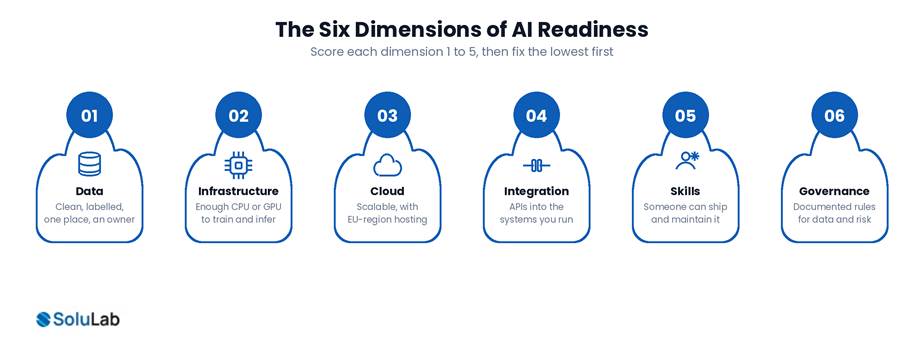
Data and governance are where most SMB assessments score lowest. Compute is rarely the blocker it is assumed to be, because cloud inference removes the need to own hardware.
How Do You Score Your Infrastructure Readiness?
Score each of the six dimensions from 1 to 5, where 1 means “not started” and 5 means “production-ready.” Use this scale.
1. Not started. No capability exists. Example: no consolidated data source.
2. Aware. You know the gap but have no plan.
3. In progress. A partial capability exists but is not reliable.
4. Repeatable. The capability works and can be repeated for a new use case.
5. Production-ready. Governed, monitored and safe to build on.
Add the six scores for a total out of 30. Do not average, because a single 1 in data or governance can block a project even when everything else scores high. Weight data and governance manually if you want a sharper read: a 1 in either is a hard stop regardless of the total.
This is the self-scoring model none of the top-ranking guides ship. You can complete it in one sitting with your IT lead.
How Ready Is Your Data for AI?
Your data is ready when it is accurate, labelled, accessible and legally usable. Score it low if any of these is missing, because a model trained on bad or ungoverned data fails no matter how good the compute is.
Run these checks.
Quality. Is the data complete, consistent and current? Duplicates and gaps degrade every model.
Labelling. For supervised tasks, do you have labelled examples? Unlabelled data needs work before training.
Access. Can you pull the data through an API or export, or is it locked in a vendor tool?
Lawful basis. Under GDPR, personal data must have a defined lawful basis and be limited to what is necessary. The data minimisation principle requires you to collect and process only the personal data needed for a specific purpose (European Commission).
Data quality and lawful basis feed the same conclusion: if you cannot trust or legally use the data, fix that before anything else. For teams building models, our machine learning development company work starts with exactly this data audit.
Is Your Compute and Cloud Setup AI-Ready?
Your compute is ready when you can run training and inference without buying hardware you cannot justify. For most SMBs the answer is cloud, because it turns a large capital purchase into a usage-based cost and gives access to GPUs on demand.
Three checks matter.
Cloud versus on-prem. Cloud suits SMBs because you pay for what you use and scale down between projects.
EU region hosting. If you process EU personal data, host it in an EU region to keep data residency clean. Most major clouds offer German or EU data centres.
GPU access. Training larger models needs GPUs. Inference for many SMB use cases runs on CPU or small GPU instances, so do not over-provision. Confirm specific instance types and costs against a current quote rather than a published figure.
Cloud readiness ties directly to integration. Our cloud application development company work covers moving workloads to a compliant, scalable cloud footprint.

What Compliance Gaps Block SMBs First?
Compliance, not technology, is often the first hard stop for EU SMBs. Three gaps recur.
EU AI Act risk tier. The EU AI Act entered into force on 1 August 2024 and became applicable on 2 August 2026, with some staggered exceptions for prohibited practices and general-purpose AI (European Commission). You need to classify your intended use into a risk tier before you build, because a high-risk use carries obligations that a chatbot for internal search does not.
GDPR data minimisation. You may only process personal data that is necessary for the stated purpose. Training data assembled “just in case” breaks this.
Works-council notification. In Germany, introducing AI that affects employees may require notifying or involving the Betriebsrat. Confirm your specific co-determination obligations with counsel before rollout.
None of these require a lawyer to start the assessment. They require you to score governance honestly and flag the items that need legal sign-off before launch.
What Does Each Readiness Score Mean for Your Next Step?
Your total out of 30 maps to a next action. The table below turns the score into a decision.
| Score band | Readiness level | Next step |
| 6 to 12 | Foundational | Fix data and governance first. No pilot yet. |
| 13 to 20 | Developing | Run one scoped, low-risk pilot on your strongest use case. |
| 21 to 26 | Ready | Move a validated use case toward production with monitoring. |
| 27 to 30 | Scaling | Standardise, add MLOps, and expand across functions. |
A low score is not a failure. It is a map. Most SMBs land in the 13 to 20 band, which means the correct move is one narrow pilot, not a platform.
Where Does SoluLab Fit?
SoluLab runs the assessment with you, then builds only what your score supports. That means starting with a data and governance audit, defining the lawful basis and risk tier for your use case, and picking a cloud footprint that keeps EU data compliant.
Our approach separates consulting from build. Consulting resolves use cases, ROI, data readiness, feasibility, governance and roadmap; development starts once the use case is validated and you need a scalable product (SoluLab). When a pilot proves out, our AI deployment services and enterprise AI development teams move it to production with monitoring.
The most common SMB gap our architects see is not compute, it is a data owner. Nobody is accountable for the pipeline, so data stays messy and every project restarts from zero.
Frequently Asked Questions
Shipra Garg is a tech-focused content strategist and copywriter specializing in Web3, blockchain, and artificial intelligence. She has worked with startups and enterprise teams to craft high-conversion content that bridges deep tech with business impact. Her work translates complex innovations into clear, credible, and engaging narratives that drive growth and build trust in emerging tech markets.