
Machine learning and AI for credit risk modeling have quietly rewritten how lenders decide who gets a loan and who doesn’t. For decades, the work leaned on statistics and whatever history a borrower had left behind. That still matters. But AI-driven models read the same data differently, and often more sharply, because the algorithms got better and the machines got faster.
There’s a second payoff most people miss. Pull in AI and machine learning, and you don’t just cut risk. You surface people the old models couldn’t see. Feed a system transaction histories, even social media signals, and it starts assessing risk from angles a credit bureau never captured, which opens lending to groups that were shut out before. And the AI for credit risk modeling approach bends. Markets shift, regulators change the rules, and the model adjusts instead of breaking.
This guide walks the whole build. How you get from raw data to a credit risk model that actually holds up in production, using real analytics, predictive modeling, and the algorithmic muscle behind them. The goal is a lender who reads borrower creditworthiness more clearly, makes sharper lending calls, and eats fewer defaults. We start with the basics of credit risk and work up to the harder AI pieces, so by the end you know the ideas, the methods, and the traps that come with building AI-driven credit risk models.
What is the Credit Risk Model?
Credit risk is simple to state and hard to price. It’s the loss a lender or investor takes when a borrower stops paying. That possibility is baked into every loan, because you can never be fully sure someone will, or can, pay you back. What tips the odds? The economy, the borrower’s own situation, where their industry is headed, and the fine print of the agreement itself.
Credit risk models exist to put a number on all of that. They lean on statistics, past data, and financial signals to estimate how likely a borrower is to miss payments or walk away entirely. Here’s why they carry so much weight:
- Risk Assessment: These models tell a lender something concrete about who they’re dealing with. Is this borrower creditworthy or not? That answer drives whether a loan gets approved and whether a financial product is worth backing. Score the odds of default and the size of the likely loss, and both lenders and investors can protect themselves before the money goes out the door.
- Pricing and Risk-Based Choices: Price follows risk. Credit risk models set the terms on bonds, loans, and other credit instruments based on how dangerous the borrower looks. A riskier borrower pays more, posts more collateral, or lives with tighter terms. The same read feeds bigger calls too: who gets approved, how high the credit limit goes, and when a loan needs restructuring before it sours.
Read Blog: A Brief Guide to AI in Portfolio Management
- Portfolio Management: Zoom out to the whole book and these models earn their keep again. They guide how assets get spread, how a portfolio stays diversified, and how risk and return get balanced. Judge the creditworthiness of each borrower or asset one by one, and a firm can build a mix that matches its own appetite for risk and whatever the regulators require. That’s how you end up with a portfolio that fits, not one that just happened.
- Regulatory Compliance: Banks especially can’t skip this part. Credit risk models sit at the center of staying compliant. Take the Basel Accords: they require institutions to use internal models or standardized methods to work out how much capital they must hold against risk. Run solid credit risk models and you tighten your risk management and keep the regulators satisfied at the same time.
Types of Credit Risk
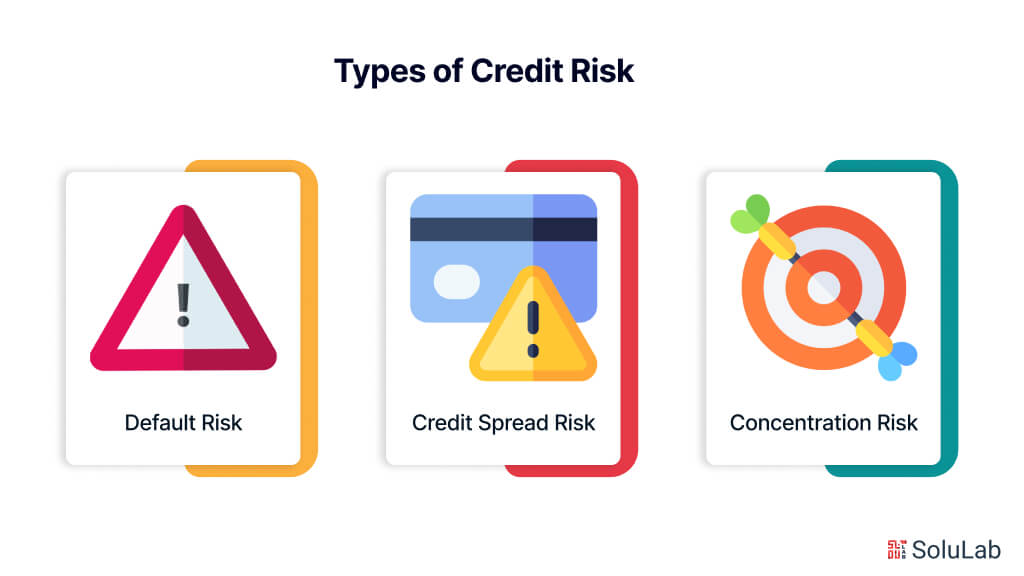
Credit risk doesn’t show up in one shape. It arrives in a few, and each one hits lenders and investors differently. If you want to manage it, you first have to name it. Here are the three big buckets:
1. Default Risk
This is the one everyone pictures first. Call it default probability or default hazard if you like. It’s the chance a borrower simply stops paying as agreed and breaks the loan. Sometimes they can’t pay. Sometimes they won’t. Either way, the lender or investor is the one left holding the loss. A bad economy, a borrower whose finances are slipping, a sudden shift in the market: any of these can push default risk up.
2. Credit Spread Risk
Spread risk is subtler. Think of the yield gap between credit-sensitive assets, corporate bonds and credit default swaps, and the safe stuff like government bonds. Credit spread risk is the danger that gap moves against you. What drives it? How the market feels about credit quality, how liquid things are, and the broader macro picture, all of which push credit instrument values around. For a fixed-income portfolio stuffed with credit-sensitive assets, that swing shows up directly in both returns and valuation.
3. Concentration Risk
Put too many eggs in one basket and you get concentration risk, sometimes called exposure risk or portfolio concentration risk. It happens when a big slice of a portfolio piles into one borrower, one industry, one region, or one asset class. The math is unforgiving here. When most of your assets sit in a single sector, one bad event in that sector hits far harder than it should. Weak diversification, rough market conditions, or plain investor choices can all steer a portfolio into that corner.
Once you can tell these three apart, the response gets clearer. Lenders, investors, and financial institutions can build real mitigation plans, spread their holdings, and brace for the setbacks that will eventually come. The point is to stay ahead of it. Spot your credit risk exposures early, manage them on purpose, and you’re far better placed to ride out a market that turns ugly and stay standing long after.
Benefits of Machine Learning for Evaluating Credit Risk
As finance keeps growing more data-heavy, AI and machine learning (ML) has turned into a serious tool for credit risk modeling, mostly because of how well it predicts and how deep it digs. Stack it against the old statistical methods and the gaps show fast. Machine learning gives financial firms sharper risk management and faster decisions. Here’s what actually stands out:
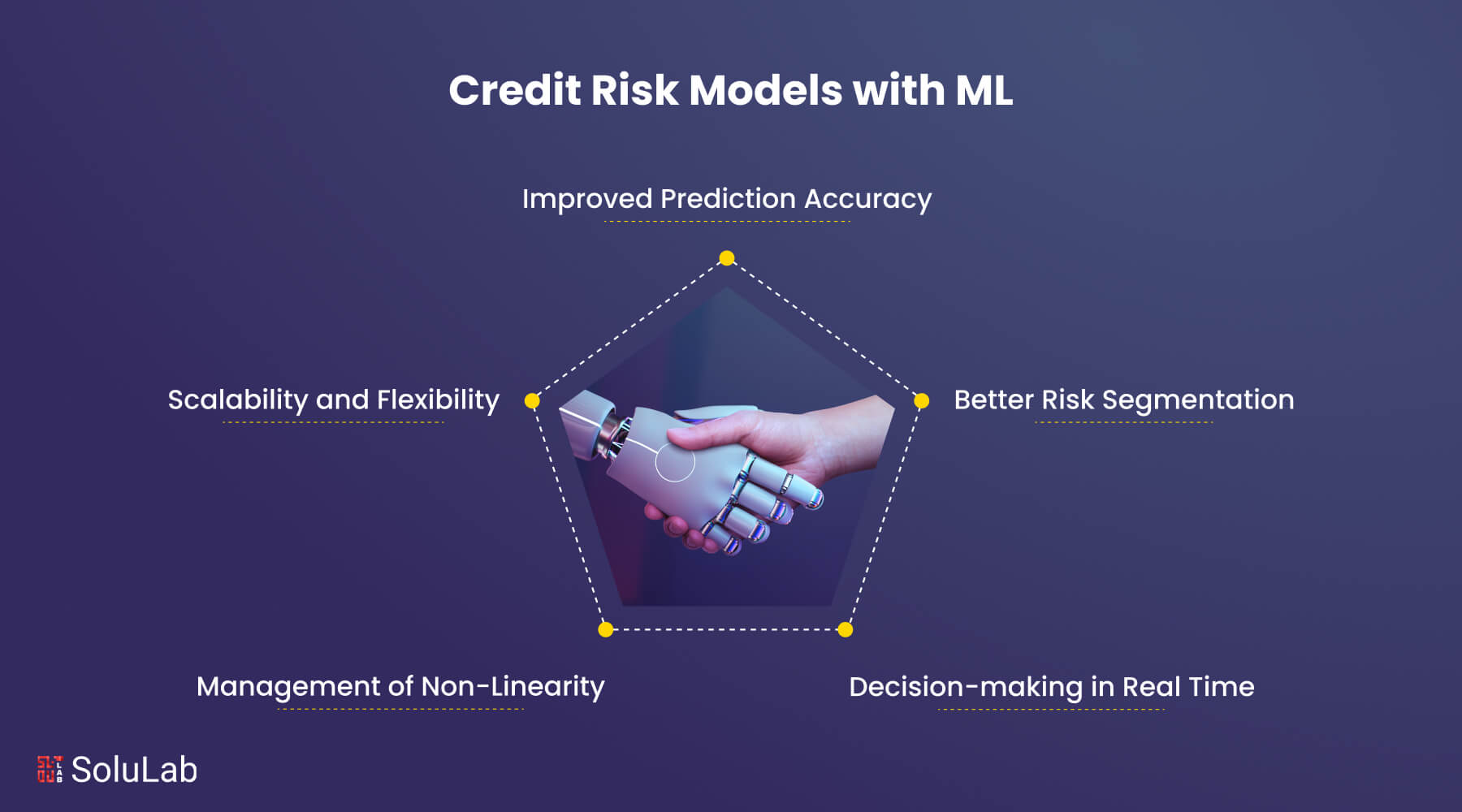
1. Improved Prediction Accuracy: Credit data is messy. The patterns twist, the relationships aren’t linear, and variables interact in ways a traditional model shrugs off. Machine learning catches that. Lean on gradient boosting machines, random forests, or neural networks and the predictions sharpen, the model tells good risk from bad more cleanly, and lenders make smarter credit calls with fewer defaults slipping through.
2. Better Risk Segmentation: Not every borrower belongs in the same bucket, and machine learning is good at drawing those lines. It groups borrowers by their actual risk profiles, so pricing and assessment can be tuned to each group instead of averaged across all of them. The algorithms pick up small shifts in risk signals and let you shape credit scoring or underwriting rules around a specific sector, a specific loan product, or a specific slice of people.
3. Decision-making in Real Time: Speed changes the game. Machine learning chews through huge volumes of data as it arrives, so lenders can decide on the spot and shift when a borrower or the market shifts. The algorithms score credit applications instantly, run approvals automatically, and flag fraud or odd behavior the moment it appears. Customers wait less, processing runs faster, and the whole operation gets leaner.
4. Scalability and Flexibility: Markets move, rules change, new risk factors show up. Machine learning models flex to keep up. Institutions can update and retune them as conditions shift, and the algorithms will pull in new data sources, adjust their own parameters, and respond to fresh risk without someone standing over them. That’s how a credit risk model stays useful instead of going stale.
5. Management of Non-Linearity: Here’s where machine learning really pulls ahead. Credit risk is full of non-linear relationships, and traditional linear models assume the world is straighter than it is. It isn’t. Through feature engineering, kernel methods, and deep learning architectures, ML algorithms capture the tangled interactions a linear model flattens out. That means they can surface hidden patterns and risk factors that bend in unexpected ways against credit outcomes, and the risk assessments that come out the other side are simply more accurate.
Use Cases of Machine Learning in Credit Risk Modeling
So where does this actually get used? Machine learning has reshaped credit risk modeling by bringing better analytics and real predictive power to the table. A few of the places it earns its keep:
1. Default Prediction: This is the flagship use case. Feed algorithms like logistic regression, random forests, and gradient-boosting machines a mix of past loan data, borrower details, and economic signals, and they estimate how likely a borrower is to default. What makes them worth the effort is early warning: they flag high-risk borrowers and possible defaults before those defaults actually land, so institutions can size up credit risk properly and head off losses in their loan books.
2. Credit Scoring: In credit scoring, machine learning automates the process of evaluating creditworthiness by analyzing vast amounts of historical credit data. Push in advanced modeling and alternative data, and ML-based scoring reads borrowers more accurately and more fairly, which makes the credit decisions that follow easier to trust.
3. Risk-Based Pricing: Price shouldn’t be one-size-fits-all, and machine learning makes sure it isn’t. Look at borrower traits, market conditions, and what competitors are doing, and the algorithms sort borrowers into risk tiers, estimate default odds, and calculate risk-adjusted pricing. The result: loan prices that match actual risk, better margins, and less exposure than a flat rate would leave you with.
4. Fraud Detection: Fraud hides in the noise, and machine learning is built to find it. Institutions run transaction data through ML models in real time to spot the odd pattern that says something’s wrong. And the models keep learning from history, so detection gets sharper over time and teams can move on credit fraud before it spreads.
Related: Machine Learning Use Cases in the Automotive Sector
5. Automation of Credit Decisions: Machine learning speeds up approvals by sizing up an applicant’s creditworthiness fast, which strips out a lot of the errors and bias that creep into manual review. Less human hand-holding means more consistency, cleaner workflows, and a smoother experience for the person on the other end.
6. Customer Segmentation: ML algorithms sift through mountains of customer data to find the patterns and behaviors that mark out different risk profiles and credit habits. Split customers into clear groups and a financial institution can shape products, services, and messaging around what each group actually needs. Customers feel understood, and loyalty tends to follow.
7. Dynamic Pricing of Loans: With enough data behind it, machine learning lets lenders move interest rates in real time, reading borrower credit risk and market conditions as they change. That flexibility means loan terms can be fair and personal at once, keeping margins healthy while still fitting the range of borrowers walking through the door.
Read Our Blog: AI Use Cases and Applications in Key Industries
8. Early Warning Systems: Trouble usually leaves clues before it hits. Machine learning reads borrower behavior and economic signals to catch the faint patterns that point to distress ahead. These early warning systems let lenders spot borrowers drifting toward default while there’s still time to step in, prevent the loss, and keep the relationship intact.
9. Credit Limit Management: Credit limits shouldn’t sit frozen. Machine learning adjusts them as a customer’s finances move, watching recent behavior, income changes, and the wider economy. Match the limit to the risk profile and you manage exposure better, keep customers happier, and cut down on the credit trouble that catches institutions off guard.
10. Collections Optimization: Collections is where a blunt approach backfires. By predicting who’s actually likely to repay, machine learning lets institutions tailor collection strategies to each borrower instead of treating everyone the same. That means resources go where they’ll work, and someone in a temporary rough patch isn’t hit with heavy-handed tactics that would only push them further away. Recovery improves, and so does the relationship.
How to Build a Credit Risk Model Using Machine Learning?
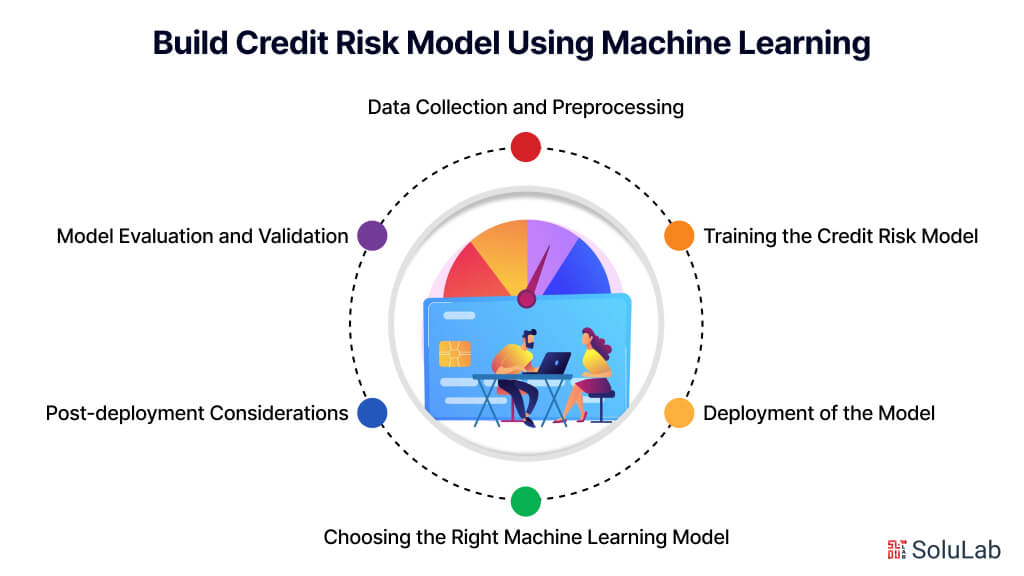
Building a credit risk model with machine learning is a sequence of steps, and each one matters if you want the thing to be accurate and actually work. Let’s break down every phase.
A. Data Collection and Preprocessing
- Data Sources: Everything starts here, and if the data is thin, the model will be too. You want a wide, relevant pull: historical loan performance, borrower details like credit scores, income, employment history, and demographics, plus macro indicators such as GDP growth, unemployment, and interest rates. Then go further. Alternative sources like social media activity, transaction history, even psychometric assessments can add color on how a borrower actually behaves.
- Preprocessing Techniques: Raw data is rarely usable as-is. Before anything trains, you clean it. That means handling missing or wrong values, hunting down outliers that would skew the model, and scaling features so they’re comparable through normalization or standardization. Categorical variables get encoded, usually with one-hot or label encoding, so the algorithms can read them. And this is where feature engineering lives: building new features, reshaping old ones, and picking the variables that carry real predictive weight. Skip this stage and the fanciest algorithm won’t save you.
B. Choosing the Right Machine Learning Model
- Supervised Learning Models: These train on labeled data, where you already know the outcome, default or non-default, for each case. Logistic regression, random forests, support vector machines, and gradient boosting machines are the usual suspects for credit risk work. None is best across the board. Each has strengths and weak spots, and the right pick depends on how big your dataset is, how complex the problem is, and how much you need to explain the model later.
- Unsupervised Learning Models: You see these less often in credit risk, but they have their place. Clustering algorithms find patterns and segments in the data without any labeled outcomes to lean on. That makes them handy for poking around the data early and spotting groups of borrowers who share a similar risk profile.
- Ensemble Methods: Ensemble methods combine multiple base models to sharpen prediction and cut the risk of overfitting. Bagging pulls this off one way, random forests being the classic case. Boosting does it another, through AdaBoost or gradient boosting. Stacking layers model predictions on top of each other. Blend them and you usually land on better accuracy and a model that holds up under pressure.
C. Training the Credit Risk Model:
- Data Splitting: Split the dataset in two. One part trains the model on past data, the other tests how it does on cases it hasn’t seen. Most teams go 70/30 or 80/20, training first, testing second.
- Hyperparameter Tuning: Hyperparameters are the knobs that steer how the algorithm learns. You tune them to find the sweet spot. Grid search, random search, and Bayesian optimization all sweep through the possible settings to land on the combination that pushes your chosen metric as high as it’ll go.
- Cross-Validation: This is how you get an honest read on performance. Cross-validation carves the dataset into several subsets and trains the model across different combinations of them, so you’re not fooled by one lucky split. Stratified k-fold, plain k-fold, and leave-one-out are the ones you’ll reach for most.
D. Model Evaluation and Validation
- Performance Metrics: Numbers tell you whether the model is any good. ROC-AUC, F1 Score, accuracy, precision, recall, and the confusion matrix each measure a different angle: how well it separates default from non-default, how it balances false positives against false negatives, and how accurate it is overall. No single metric tells the whole story, which is why you watch several.
- Backtesting and Stress Testing: Backtesting runs the model against historical data to see whether its predictions actually held up and how sturdy it is. Stress testing goes darker on purpose, simulating rough scenarios or extreme market conditions to find out how the model, and the institution’s exposure, hold up when things go wrong.
E. Deployment of the Model
- Integration with Decision Systems: A trained, validated model does nothing sitting on a shelf. It has to plug into the systems and workflows where decisions actually get made. In practice that means fitting it into existing software, building APIs so it talks to everything else cleanly, and setting up governance around how it’s deployed and watched.
- Real-time Scoring: This is where the model meets the borrower. Real-time scoring lets a lender assess someone’s credit risk and decide on a loan or credit line right then and there. Pulling that off takes efficient data processing, low-latency inference, and a system built to handle high transaction volumes without lagging.
F. Post-deployment Considerations
- Monitoring Model Performance: A model isn’t done when it ships. You have to watch it, because accuracy drifts and data quality slips over time. Track the KPIs that matter, calibration, discrimination, stability, on a regular cadence so you catch the decline before it costs you.
- Retraining and Model Updating: The credit world doesn’t sit still, and neither should your model. As conditions change and fresh data comes in, you retrain to keep it accurate and relevant. That can mean rethinking parameters, folding in what your monitoring turned up, and refreshing the model with the newer data.
- Model Governance and Compliance: In a financial institution, compliance isn’t optional. Deployment has to line up with regulatory standards and industry rules covering documentation, fair lending, model validation, and transparency. On top of that, you have to lock down data privacy and security and take the ethical questions around ML in credit risk seriously, not as an afterthought.
Work through these steps carefully and a financial institution ends up with credit risk models that read risk accurately and back up smarter lending decisions. That’s the whole point.
Important Things to Think About When Using AI for Credit Risk Modeling
Bring artificial intelligence (AI) into credit risk modeling and a few hard questions come with it. Get them wrong and the technology that was supposed to help you can land you in real trouble. Three things you can’t skip:
1. Data Privacy and Ethics: AI-driven credit models run on a lot of sensitive borrower data, which puts privacy front and center. You need real protections: encryption, access controls, anonymization, the works, to keep people’s information safe. But it goes past privacy. Fairness, transparency, and accountability have to shape how the model is built and used, or you risk baking bias and discrimination straight into credit decisions that affect real lives.
2. Regulatory Compliance: If you operate in a regulated market, and in finance you do, the rules around credit risk and data protection are strict and not negotiable. That means meeting the relevant requirements, running thorough impact assessments, and standing up governance frameworks before you lean on AI for credit risk modeling. Do that work and you keep the oversight of AI implementation and monitoring of compliance lined up with what regulators actually mandate.
3. Interpretability of Models: Can you explain why the model said no? The interpretability of AI models decides whether stakeholders can actually understand a credit decision and the factors behind it. Here’s the tension: the most accurate algorithms are often the hardest to see inside, and that opacity makes it tough to explain outputs or catch hidden bias. Leaning toward transparent techniques and building in validation opens the model up to real scrutiny, from regulators and consumers alike, and that scrutiny is what earns trust.
Future Trends and Innovations in Credit Risk Modeling
Credit risk modeling never really stands still. Market forces push it, regulation pulls it, and technology keeps moving the whole thing forward. Look ahead and a handful of shifts stand a real chance of reshaping how the industry manages risk. Three worth watching:
1. Explainable AI
The more complex machine learning gets, the louder the demand grows to actually understand what it’s doing. Explainable AI is the response. It works to expose the factors behind a credit risk decision and to surface bias that would otherwise stay buried. By showing how a model reached its prediction, Explainable AI builds trust, keeps regulators on side, and gives users what they need to judge the model for themselves.
2. Federated Learning
What do you do when the data can’t leave the building? Federated Learning is one answer, and it’s gaining ground fast. It lets several institutions train a shared model together without ever pooling their raw data, keeping the sensitive stuff encrypted and where it belongs. Because only model updates move around, not the underlying records, Federated Learning protects privacy, scales cleanly, and makes collaborative risk assessment possible across data that’s scattered in different places.
3. Integration of Alternative Data Sources
Traditional financial metrics only tell part of the story, and credit risk modeling is starting to reach past them. Alternative sources, social media activity, transactional data, and more, say something about how people actually behave and how healthy their finances really are. Blend that in with advanced analytics and data fusion, and models get more accurate, credit reaches more people, and lenders can tell one kind of risk from another with far more nuance.

Concluding Remarks
Credit risk modeling is heading somewhere good. AI, better data analytics, and sharper regulatory frameworks are all pushing it forward at once. For financial institutions caught between shifting markets, new technology, and tightening rules, the job now is to manage credit risk in ways that are both responsible and genuinely inventive, not one at the expense of the other.
Machine learning and AI have opened doors that were shut before. Combine strong algorithms, alternative data, and explainable AI, and a financial institution can build credit risk models that are more transparent and more resilient at the same time, models that back real decisions, earn trust, and support growth that actually lasts.
Ready to rethink how you model credit risk with AI and machine learning? Work with SoluLab, a top AI development company, and put real technology and real expertise behind credit risk models that hold up. Our AI consulting and development services are built around what you actually need, with accuracy, reliability, and regulatory compliance carried through the whole build. Team up with SoluLab and take on the shifting demands of credit risk management without flinching.
FAQs
Shipra Garg is a tech-focused content strategist and copywriter specializing in Web3, blockchain, and artificial intelligence. She has worked with startups and enterprise teams to craft high-conversion content that bridges deep tech with business impact. Her work translates complex innovations into clear, credible, and engaging narratives that drive growth and build trust in emerging tech markets.