Key Takeaways
- By mid-2026, over 50% of the top global asset managers have integrated tokenization strategies, turning solar energy from a fringe interest into a core portfolio capability.
- Regulations like MiCA (EU) and the latest SEC/CFTC joint guidance have removed legal risk as a barrier, allowing for frictionless, cross-border solar financing.
- Through blockchain-driven automation and smart contract payouts, operating costs have dropped, leading to a verified 2–5% annual improvement in net returns compared to traditional infrastructure models.
- The integration of IoT Green Oracles provides investors with immutable, second-by-second data on energy generation and carbon credit accrual.
Solar energy is growing fast, but financing it has historically been complex and restricted. While installations are increasing and governments are pushing for clean energy, smaller projects still struggle to access capital.
According to BloombergNEF, global investment in solar is expected to exceed $380 billion by 2030.
At the same time, the global tokenization market is projected to reach $4.7 billion in 2026, showing how rapidly digital asset infrastructure is maturing. Investors are no longer waiting for banks; they are becoming the bank.
This shift is powered by blockchain and tokenization for solar energy. By turning physical solar assets into digital tokens, more people can invest in and benefit from clean energy projects.

What Is Solar Asset Tokenization?
Solar asset tokenization is the process of converting ownership rights of a solar project into digital tokens on a blockchain. These tokens can represent a share in a solar farm’s output or revenue. Just like stocks represent part ownership in a company, these tokens represent a stake in a tokenized solar asset.
This approach is gaining popularity because it breaks down large, centralized energy investments into accessible, fractional opportunities for everyday investors.
Why Is Tokenization Gaining Traction in Renewable Energy?
Energy demand is rising. So is the urgency to transition to cleaner energy. But solar farms need big upfront capital, and traditional financing methods are slow. Tokenizing solar farms changes that. It introduces a faster, more inclusive financing model through blockchain technology.
Several market forces are driving the rapid adoption of solar energy tokenization platforms:
- Soaring global energy demand
- Increased interest in ESG and green finance
- Need for decentralized, community-based energy models
- Lack of access to traditional investment vehicles in many regions
Moreover, blockchain for energy provides tamper-proof records of ownership and energy generation, making the process transparent and easier to audit.
Between 2024 and 2025, tokenization was considered experimental. In 2026, it is regulated and operational.
- EU Regulation: Markets in Crypto-Assets (MiCA) is now fully enforced (March 2026), enabling passportable licenses across 27 countries.
- US Clarity: A joint ruling by U.S. Securities and Exchange Commission and Commodity Futures Trading Commission (March 17, 2026) classifies major digital assets as commodities, removing long-standing uncertainty.
- Blockchain Adoption: Solana has surpassed $873M in tokenized RWAs, driven by institutional demand and low transaction costs.
- Masdar + Elite Agro launched the first agricultural solar tokenization model, combining farming and energy production.
- Solar infrastructure is now financed via tokenized debt models, reducing reliance on banks.
- Masdar reached 65 GW capacity globally, with tokenization pilots powering 300,000 homes in Angola.
What this means: Solar tokenization is no longer “early-stage.” It is now legally viable and institutionally backed, and industrially active.
How Tokenizing Solar Projects Powering Global Industries
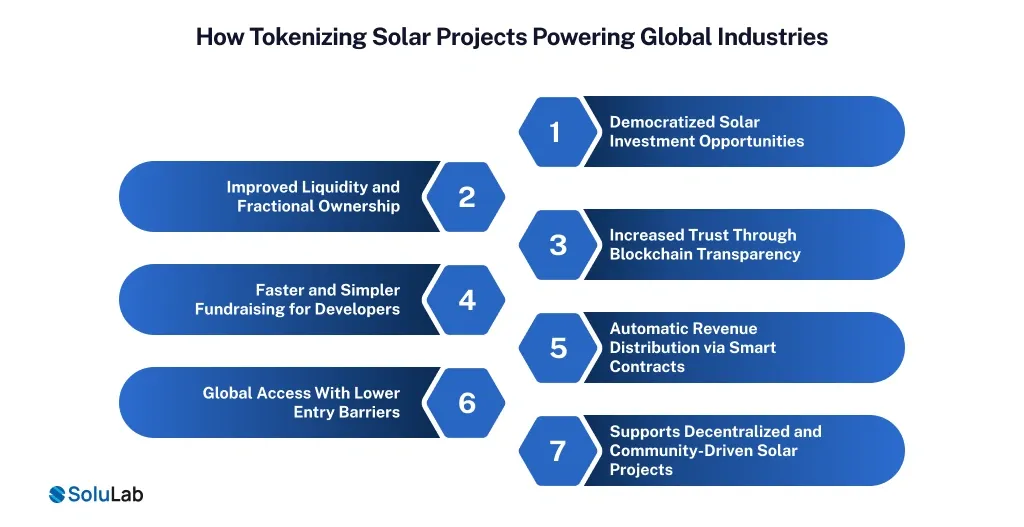
Solar asset tokenization isn’t just about using blockchain. It changes how people invest in clean energy. Here are the major benefits of solar project tokenization, broken down clearly:
1. Democratized Solar Investment Opportunities
- Anyone with internet access and a digital wallet can now invest in a solar project.
- There’s no need to commit thousands of dollars, you can start small.
- This makes solar energy investment open to everyday people, not just wealthy investors or institutions.
- It’s especially helpful in areas where there’s rising interest in green investing and sustainable finance, but limited access to traditional investment routes.
2. Improved Liquidity and Fractional Ownership
- Traditional solar investments are long-term; you often have to wait 15–20 years to get your returns.
- With solar tokenization, tokens can be sold on secondary markets (when available), letting investors exit earlier.
- You can also buy just a fraction of a tokenized solar asset.
- This reduces risk and lets people diversify their holdings across multiple tokenized solar assets rather than putting all their money into one.
3. Increased Trust Through Blockchain Transparency
- Every transaction – buying, selling, or revenue sharing is recorded on-chain.
- This makes it easy to audit and almost impossible to tamper with.
- Investors can see who owns what and where money is flowing, in real time.
- It also removes the need for multiple intermediaries (banks, brokers, legal services) in cross-border investments.
- This makes international solar project tokenization easier to fund and manage
4. Faster and Simpler Fundraising for Developers
- Solar developers no longer need to rely on slow, paperwork-heavy funding processes.
- Instead of waiting months for bank loans, they can raise money quickly by offering tokens directly to the public.
- This means faster project rollouts and less downtime waiting for capital.
5. Automatic Revenue Distribution via Smart Contracts
- Once the project starts generating income (like selling electricity), smart contracts handle the payout.
- Investors don’t have to wait for manual transfers or reports.
- Profits are sent directly to token holders, often on a set schedule.
- This ensures fair, consistent returns and removes delays from human error or admin issues.
6. Global Access With Lower Entry Barriers
- Investors from different countries can join in without needing to set up companies, hire legal help, or go through strict financial institutions.
- All they need is a wallet and access to a supported solar tokenization platform.
- This global access boosts funding options for developers and increases visibility for local solar energy investments.
7. Supports Decentralized and Community-Driven Solar Projects
- Local communities can co-own solar farms using tokenization.
- For example, 1,000 people in a village could each buy a few tokens and jointly fund a solar plant.
- As the plant earns money, they all benefit.
- This model promotes shared ownership, builds trust, and keeps more profits within the community.
Real-World Use Cases of Solar Asset Tokenization
These examples show how solar tokenization is already working in the real world. The benefits aren’t theoretical, they’re happening right now. Here are a few Solar Tokenization Platforms.
1. Sun Exchange (South Africa)
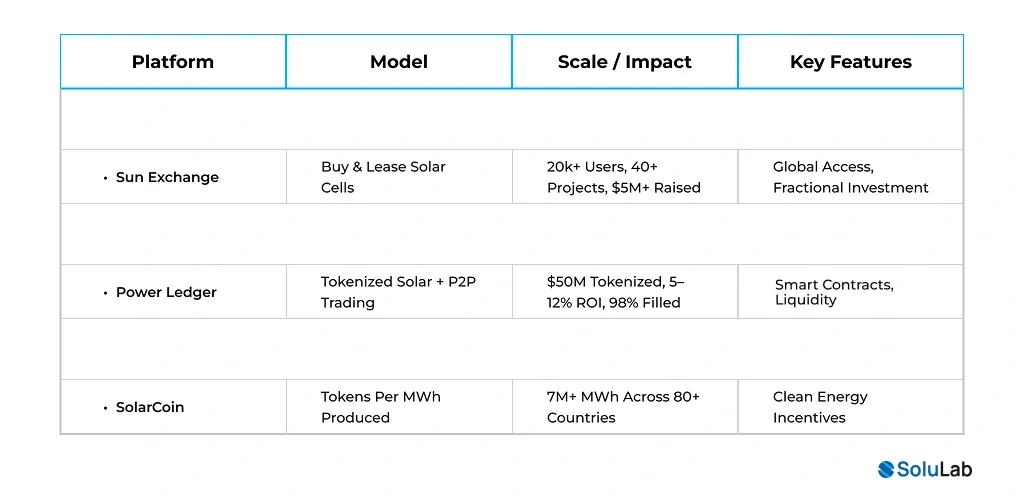
- Allows anyone to buy and lease individual solar cells (as low as $4-$10 per cell).
- Earns rental income from solar power used by schools, businesses, and NGOs.
- 20,000+ users from 170+ countries have funded 40+ projects.
- Major project: Expanded into Zimbabwe with a $1.4M solar + storage project
- Investors can track real-time performance and get paid in local currency or crypto.
Focus: Fractional solar token ownership, clean energy for rural areas, and education support.
2. Power Ledger
- Offers solar tokenization and peer-to-peer energy trading.
- Users can buy and sell energy or invest in tokenized solar assets via tokens.
- In the U.S., $50M worth of solar assets were tokenized, with 98% uptake.
- Investors have seen 5%–12% annual returns.
- Key features: Smart contract payouts and secondary market trading.
- Supports local energy markets and reduces grid dependence.
3. SolarCoin
- Rewards solar producers with renewable energy tokens: 1 SolarCoin per MWh generated.
- Over 7 million MWh tokenized across 80+ countries.
- Tokens can be traded or held as long-term assets.
- Designed to incentivize clean energy by offering bonus income.
- Open to both small and large solar producers globally.
How Does Solar Asset Tokenization Work?
Tokenizing solar assets means converting ownership rights of a solar energy project into digital tokens on the blockchain. This process makes green energy assets more liquid, accessible, and investor-friendly, whether you’re a renewable energy developer, a tech-savvy investor, or a corporation looking to diversify into sustainable ventures.
Here’s how the process unfolds:
Step 1: Selecting the Solar Asset
The first step is choosing the solar asset to be tokenized. It could be anything from a rooftop solar system to a utility-scale solar farm. The value of the asset is assessed based on capacity, projected energy generation, and potential revenue.
Step 2: Legal & Regulatory Framework
Before tokenization can begin, a legal structure is created, often through an SPV (Special Purpose Vehicle), to hold the asset. This ensures that each digital token is backed by a clearly defined legal claim, making the investment secure and compliant with local and international regulations.
Step 3: Creating Digital Tokens
Using blockchain technology, the asset is divided into digital tokens. Each token represents a fractional share of the solar project’s economic value, such as future revenue streams, energy output, or carbon offset credits.
Step 4: Enabling Smart Contracts
Smart contracts are integrated to automate key processes like revenue distribution, token transfers, governance, and compliance checks. Smart contracts now integrate Green Oracles, ensuring payouts are triggered automatically based on verified solar output. These programmable contracts help eliminate manual intervention and reduce reliance on intermediaries.
Step 5: Offering Tokens to Investors
Tokens are made available to investors through public or private offerings. With fractional ownership, investors no longer need to buy an entire solar project, making renewable energy more inclusive and attractive, even to small-scale backers.
Step 6: Ongoing Management & Payouts
After investment, token holders receive payouts from project revenues (like electricity sales or green credits). They can also track performance metrics, such as output data or environmental impact, on a real-time blockchain dashboard.
Step 7: Trading on Secondary Markets
Unlike traditional energy infrastructure investments, tokenized solar assets offer liquidity. Investors can trade tokens on licensed crypto or asset tokenization platforms, unlocking a new level of flexibility in clean energy investments.
Future Projections of Solar Tokenization
The future looks promising:
- Institutional interest in the tokenization of renewable energy is growing.
- Platforms like EnergiToken and WePower are creating compliant models for scale.
- As blockchain regulations mature, more countries are likely to adopt frameworks that make this easier.
- Blockchain platforms like Solana and Stellar are becoming infrastructure layers.
Tokenization of solar energy has the potential to become a common model by 2030 as demand for sustainable investments grows.
Conclusion
Tokenizing solar assets is more than a trend. It’s a practical, efficient, and inclusive way to fund and manage renewable energy. While it comes with legal and technical challenges, the long-term benefits make it a serious option for investors, developers, and clean energy advocates alike.
As a leading asset tokenization development company in the USA, SoluLab has catered to multiple projects with industry-grade solutions. Being ahead of the market, we always try to render the best of consulting as well as development services.
If you are also an enterprise looking to tokenize your solar assets or more, SoluLab is all set to propel your idea of growth. Contact today!
FAQs
Deepika is a content writer who blends storytelling with strategic thinking. She explores topics across digital innovation, emerging tech, and the evolving blockchain industry. She enjoys breaking down complex ideas into simple, engaging narratives in the growing global markets.