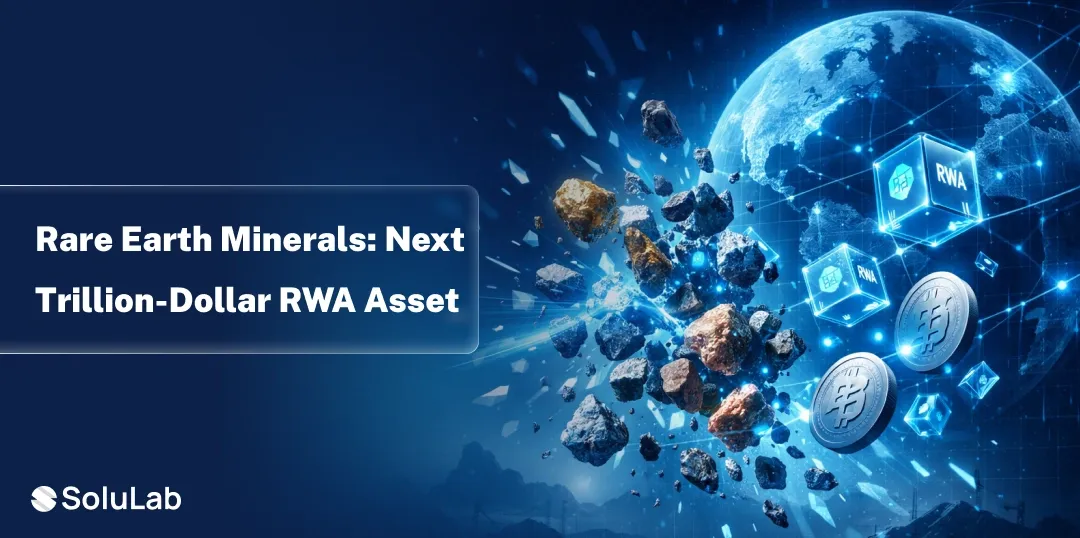
Real-World Asset (RWA) tokenization is moving beyond early experiments and entering a more practical phase. Enterprises are no longer asking whether asset tokenization solutions work; they are asking which assets make the most sense to tokenize next.
Rare earth minerals are quickly emerging as one of the most compelling answers.
These minerals sit at the center of global supply chains for electric vehicles, renewable energy, semiconductors, defense systems, and advanced manufacturing. At the same time, rare earth markets remain opaque, capital-intensive, illiquid, and difficult to access for most investors.This gap between real-world importance and financial accessibility is exactly where tokenization creates value. As asset tokenization matures, the tokenization of rare earth metals is increasingly viewed as a natural next step in the evolution of Real-World Asset (RWA) tokenization.
Key Takeaways
- Opaque and capital-intensive rare earth markets limit investor access despite rising global demand.
- Tokenization of rare earth metals enables fractional ownership while improving transparency and auditability.
- Enterprise-grade rare earth minerals tokenization services unlock cross-border capital participation with structured compliance.
What Is Rare Earth Minerals RWA Tokenization
Rare Earth Minerals RWA tokenization refers to the process of converting ownership or economic rights of physical rare earth minerals into blockchain-based digital tokens.
Each token represents a verifiable claim on a real-world asset. This could be:
- A share of mineral reserves
- A portion of processed material
- Rights to future production
- Revenue participation linked to mineral output
Unlike purely digital assets, these tokens are backed by tangible, real-world value. Blockchain is used as the infrastructure layer to manage ownership records, transfers, compliance logic, and reporting.
This approach sits within the broader category of asset tokenization, alongside the tokenization of precious metals, real estate, commodities, and financial instruments.
What makes rare earth minerals distinct is not the technology itself, but the economic and strategic nature of the underlying asset.
Why Rare Earth Minerals Are Ideal Assets for Tokenization
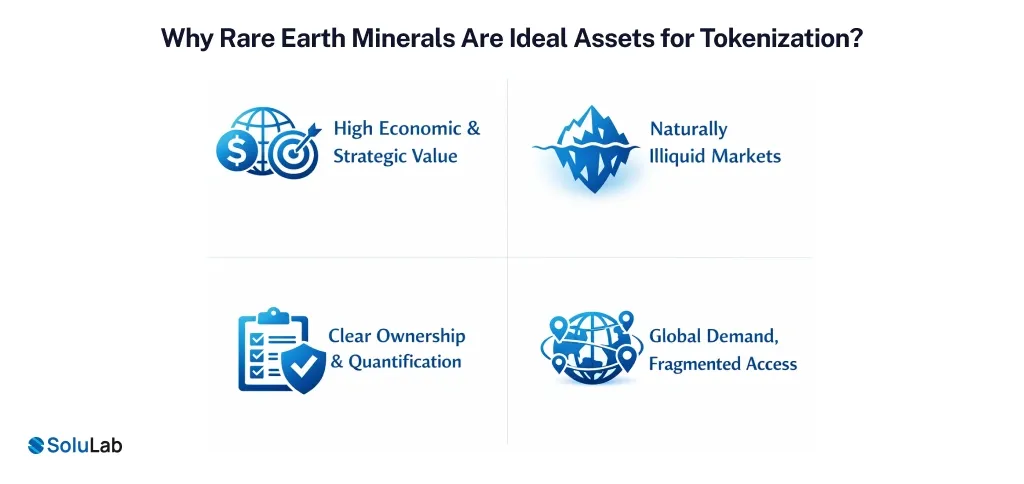
Not all assets are equally suited for RWA tokenization. Rare earth minerals stand out among the upcoming tokenization trends for several structural reasons.
1. High Economic and Strategic Value
Rare earth minerals such as lithium, cobalt, neodymium, and terbium are essential inputs for future-facing industries. Demand is driven by long-term macro trends like electrification, clean energy, and digital infrastructure. This gives tokenized rare earth assets a strong fundamental backing.
2. Naturally Illiquid Markets
Rare earth minerals are not easy to trade. Transactions are often bilateral, slow, and relationship-driven. This makes them a strong candidate for tokenization, which thrives on unlocking liquidity in traditionally illiquid asset classes.
3. Clear Ownership and Quantification
Minerals can be measured, audited, stored, and verified. This makes it easier to link digital tokens to real-world quantities, whether by weight, grade, or production volume. Clear asset definition is critical for credible real-world asset tokenization.
4. Global Demand, Fragmented Access
Demand for rare earth minerals is global, but access to investment opportunities is fragmented and geographically constrained. Tokenization enables cross-border participation while maintaining compliance and transparency.
Key Benefits of Tokenizing Rare Earth Minerals for Investors
Tokenization creates value on both sides of the market. For investors, the benefits go beyond simple exposure.
1. Fractional Ownership of High-Value Assets
Rare earth mineral investments have traditionally required large capital commitments. Asset tokenization allows fractional ownership, enabling investors to gain exposure without acquiring entire reserves or entering complex supply agreements.
2. Improved Liquidity and Market Access
Tokenized assets can be traded digitally, reducing friction and opening the door to secondary markets. While liquidity still depends on market maturity, tokenization provides the infrastructure needed for faster entry and exit compared to traditional models.
3. Transparency and Trust
Blockchain-based records provide immutable proof of ownership and transaction history. For investors, this reduces information asymmetry and builds confidence, especially in a sector where transparency has historically been limited.
4. Portfolio Diversification Through RWAs
Tokenized rare earth minerals offer diversification beyond equities, bonds, and traditional commodities. As part of broader use cases of tokenized real-world assets, they allow investors to hedge exposure to industrial growth and supply-chain risk.
5. Alignment With Long-Term Industrial Growth
Unlike short-term speculative assets, rare earth minerals are tied to real economic demand. Tokenization provides a structured way to participate in that growth without operational involvement in mining or processing.
Read more – Oil tokenization
How Rare Earth Minerals Tokenization Works in Practice
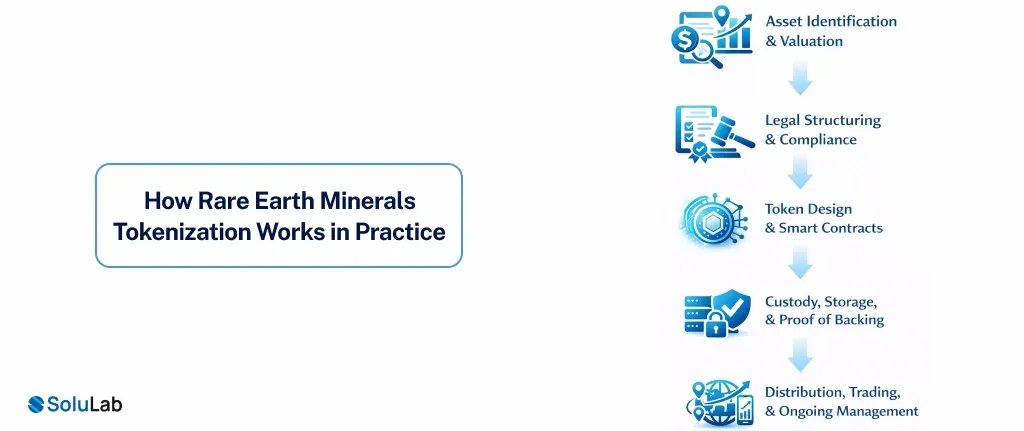
While implementations vary, most rare earth minerals tokenization services follow a similar operational framework.
1. Asset Identification and Valuation
The process starts with identifying the physical asset to be tokenized. This could be a mineral reserve, processed inventory, or future production rights. Independent valuation and verification establish the asset’s baseline value.
2. Legal Structuring and Compliance
Enterprises define the legal relationship between the token and the underlying asset. This includes ownership rights, profit participation, transferability, and jurisdiction-specific compliance requirements.
3. Token Design and Smart Contracts
Digital tokens are created to represent the asset. Smart contracts define how tokens are issued, transferred, and managed. They can also automate revenue distribution, royalties, or compliance checks.
4. Custody, Storage, and Proof of Backing
Physical minerals are stored with verified custodians or under controlled inventory systems. Regular audits and reporting ensure that the digital supply matches the physical backing.
5. Distribution, Trading, and Ongoing Management
Tokens are distributed to investors through private placements or regulated marketplaces. Ongoing asset tracking, reporting, and governance are handled through the tokenization platform.
Read more – Tax Form Tokenization
How to Develop a Rare Earth Minerals Tokenization Platform?
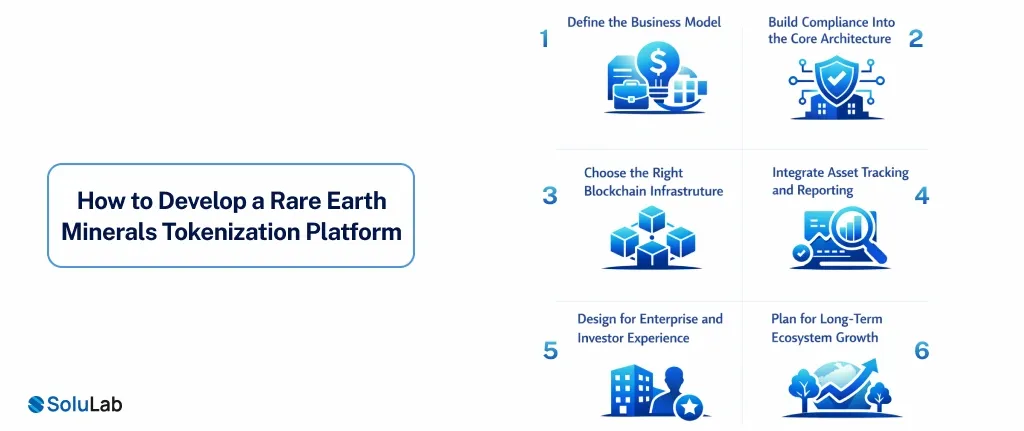
For enterprises looking to enter this space, development of RWA platforms is as much about trust and compliance as it is about technology.
1. Define the Business Model First
Start by clarifying what is being tokenized. Is it ownership, revenue share, future output, or inventory-backed value? The answer shapes everything from token design to regulatory positioning.
2. Build Compliance Into the Core Architecture
Rare earth minerals tokenization sits at the intersection of commodities, securities, and digital assets. Compliance with local and international regulations should be embedded into the platform from day one, not added later.
3. Choose the Right Blockchain Infrastructure
Scalability, security, and interoperability matter. Enterprises often prioritize permissioned or hybrid blockchain models that balance transparency with control.
4. Integrate Asset Tracking and Reporting
A credible tokenization platform must connect digital tokens with real-world asset data. This includes inventory tracking, audit reports, valuation updates, and performance dashboards.
5. Design for Enterprise and Investor Experience
The platform should be intuitive for non-technical users. Clear dashboards, simple transaction flows, and transparent reporting are essential for adoption.
6. Plan for Long-Term Ecosystem Growth
Successful platforms are built for scale. This includes support for multiple asset types, secondary market integrations, and future expansion into other forms of real-world asset tokenization, including the tokenization of precious metals or other industrial commodities.
Conclusion
Rare earth minerals sit at the center of electric mobility, renewable energy, defense systems, and semiconductor manufacturing. Yet the financial infrastructure around them remains outdated, opaque, and restricted to large institutional players.
This is not about turning commodities into speculation. It is about modernizing how strategic resources are financed, owned, and traded. For enterprises evaluating Real-World Asset (RWA) tokenization, rare earth minerals represent a powerful convergence of macroeconomic demand.
With 250+ experienced developers and deep expertise in tokenization platform development services: we help businesses transform physical mineral value into secure, tradable digital assets.
If you are ready to modernize how rare earth assets are financed and accessed, contact us today!
FAQs
Deepika is a content writer who blends storytelling with strategic thinking. She explores topics across digital innovation, emerging tech, and the evolving blockchain industry. She enjoys breaking down complex ideas into simple, engaging narratives in the growing global markets.