Key Takeaways
- Generative engine optimization for crypto is the work of making your token, exchange or protocol the source AI engines quote when users ask about it.
- AI engines cite what they can crawl, verify and corroborate. Your own site matters, but independent sources often matter more.
- Crypto is harder than most industries. AI engines treat financial questions cautiously, and regulators restrict what you can claim.
- Tokenomics hidden in images, contract addresses scattered across pages and inconsistent supply figures are the most common reasons AI gets crypto facts wrong.
- Answer-first pages with specific figures, tables and cited sources are the formats AI engines extract most readily.
- Wrong facts in an AI answer are not just a visibility problem. A misquoted contract address can send users to a scam.
- Measure with a repeatable prompt panel, because the same question can get a different answer each time it is asked.
Generative engine optimization for crypto, or GEO for crypto, means structuring your token, exchange, or protocol’s information so AI engines such as ChatGPT, Perplexity, Gemini, and Google AI Overviews can find it, trust it, and cite it.
The goal is not ranking on a results page. It is being the source the answer is built from, stated accurately.
The shift in how people look things up is well documented. Gartner predicted that by 2026 traditional search engine volume would fall 25%, as AI chatbots and virtual agents absorb queries that used to go to search engines.
Google kept its lead, but answers now appear inside search too. This guide covers how AI engines choose crypto sources, why crypto is harder, and what tokens and exchanges should publish to get cited.

What Is Generative Engine Optimization for Crypto?
GEO is the practice of making content easy for AI systems to retrieve, understand, and cite in generated answers. For crypto projects, that means your official facts, documentation, and third-party coverage need to be consistent, crawlable, and specific enough to quote.
1. How GEO Differs From Crypto SEO
Crypto SEO aims to rank a page on a results list. GEO aims to be one of the few sources an AI engine draws on when it writes an answer. The foundations overlap: crawlable pages, clear structure, credible links. The difference is what you are optimising for. SEO earns a click. GEO earns a citation, and increasingly the answer itself is the only thing the user reads.
3. Who This Applies To
Token issuers, centralised and decentralised exchanges, DeFi protocols, wallets and infrastructure projects. Anyone building through crypto token development or launching a trading venue faces the same question from users: what does AI tell people about us before they ever reach our site?
How Do ChatGPT and Other AI Engines Decide Which Crypto Sources to Cite?
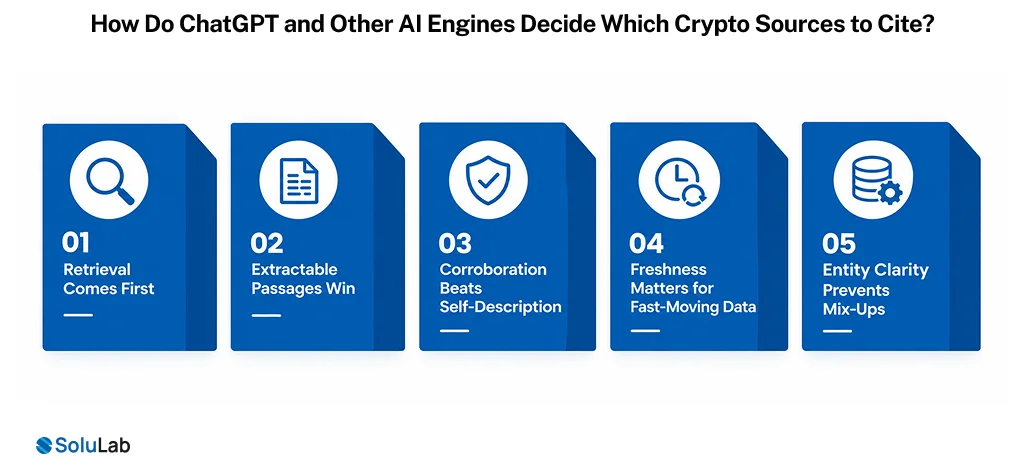
When an AI engine answers a question with live search, it retrieves candidate pages, extracts passages that answer the question, weighs how credible and consistent they are, and cites the ones it used. Each step is a filter your content has to pass.
1. Retrieval Comes First
If a crawler cannot reach or render your page, nothing else matters. OpenAI’s search crawler, Perplexity’s crawler, and Google’s crawler all need access. Note that blocking an AI company’s training crawler does not necessarily block its search crawler, and vice versa. Many crypto sites block both by accident through blanket firewall or bot rules.
2. Extractable Passages Win
AI engines lift passages, not whole pages. A paragraph that opens with a direct, specific answer is far more likely to be used than one that builds up to its point. This is the same retrieval logic that powers any RAG platform: content is split into chunks, and the chunk that answers the question cleanly gets selected.
3. Corroboration Beats Self-Description
AI engines weigh whether independent sources agree with you. Market data aggregators, audit firms, reputable crypto media, GitHub repositories, governance forums and community discussion all act as corroboration. A claim that appears only on your own site carries less weight than one repeated consistently elsewhere.
4. Freshness Matters for Fast-Moving Data
Prices, trading volume, total value locked, and listings change constantly. AI engines tend to cite sources that update, such as aggregators and your own live status pages, over static blog posts. Stale figures on your site can end up quoted long after they stopped being true.
5. Entity Clarity Prevents Mix-Ups
Many tokens share names or tickers across different chains. AI engines need unambiguous signals: full project name, ticker, chain, contract address and official domain, stated the same way everywhere.
Why Is GEO Harder for Crypto Than for Other Industries?
Because AI engines treat financial questions cautiously, regulators restrict marketing claims, and factual errors about crypto can cost users money. A generic GEO playbook ignores all three.
The audience is large enough to make the effort worthwhile. Statista projects cryptocurrency market revenue of $85.3 billion in 2026, with user penetration around 9.9% and close to 796 million users expected by 2027. A growing share of those users now ask AI engines before they visit an exchange or read a white paper.
1. AI Engines Hedge on Investment Questions
Ask an AI engine which token to buy and it will usually decline to recommend one, or wrap its answer in heavy caveats. That makes “best token to invest in” a poor GEO target. The winnable queries are informational: what a project does, how it works, whether it is audited, what fees an exchange charges, which chains it supports.
2. Regulation Limits What You Can Claim
Content written to attract citations is still marketing. Under the EU’s MiCA regulation, marketing communications for crypto-assets must be fair, clear and not misleading, and consistent with the white paper. The UK has applied its financial promotions regime to cryptoassets since October 2023. Promising returns or implying guaranteed yields in content designed to be quoted by AI is a compliance risk, not a growth tactic.
3. Wrong Facts Can Put Users at Risk
If an AI answer quotes an outdated or incorrect contract address, a user may send funds to the wrong place or to a scam copy of your token. Publishing canonical, machine-readable facts is a user safety measure as much as a visibility one.
4. Ticker Collisions and Impersonators
Scam tokens routinely copy the names and tickers of real projects. If your official information is inconsistent, AI engines may blend your project with an imitation. Consistent naming and verified listings reduce that risk.
5. Technical Sites That AI Cannot Read
Many crypto sites are single-page applications that render content only with JavaScript, or put key information inside dashboards and images. What a crawler cannot read, an AI engine cannot cite.
How Do Tokens Get Cited by ChatGPT?
By publishing one authoritative, crawlable source of truth, keeping it consistent everywhere else the token appears, and backing key claims with independent evidence. Six practices make the biggest difference.
1. Publish a Canonical Token Facts Page
One page stating the project name, ticker, chains, official contract addresses, total and circulating supply, launch date, team or foundation, and links to audits and documentation. Plain text, not images. Update it whenever anything changes, and date the update.
2. Put Tokenomics in Text and Tables
Allocation, vesting schedules, and emission rates often live only in a chart image. Crawlers cannot reliably read figures inside a PNG. Keep the chart for humans, and add the same numbers as a readable table directly beneath it.
3. Keep Aggregator Listings Accurate
Market data aggregators are among the sources AI engines rely on for crypto facts. Make sure your listings show the correct supply, contract addresses, links, and description, and that they match your own site exactly.
4. Make Audits Easy to Find and Quote
Publish audit reports on your domain with a short plain-language summary: who audited, when, what was found and what was fixed. “Is this token audited?” is one of the most common safety questions users ask AI. A professional smart contract audit only helps your visibility if the result is findable.
5. Write Documentation That Answers Questions Directly
Structure docs around the questions people actually ask: how the token is used, how staking works, what the risks are. Open each section with a direct answer, then explain. Clear, answer-first documentation is also a sign of a well-run cryptocurrency development project.
6. Build Independent Coverage
Launch coverage in reputable crypto media, active technical discussion on GitHub and forums, and exchange listing announcements all corroborate your facts. The same channels covered in our guides to pre-launch ICO marketing and IEO marketing now serve a second purpose: they feed the sources AI engines trust.
How Do Crypto Exchanges Get Cited by AI Engines?
Exchanges are usually cited for comparison questions: fees, supported assets, licensing, security, and availability by country. Clear, current, structured pages for each of those win the citations.
1. Fee Pages That State Numbers Plainly
Maker and taker fees, withdrawal fees by asset, deposit methods and fee tiers, in a readable table. AI engines comparing exchanges pull figures they can parse. A fee schedule hidden behind a login or inside a calculator widget is invisible.
2. Licensing and Jurisdiction Pages
Which regulators license you, in which countries you operate, and where you do not serve customers. “Is this exchange regulated in my country?” is a frequent question, and a precise, current answer on your own domain is the best defence against an AI guessing.
3. Security and Proof-of-Reserves Pages
Custody model, cold storage approach, insurance, incident history and any proof-of-reserves reporting with dates. Safety questions are among the first users ask about an exchange.
4. Supported Assets and Networks
A crawlable list of supported coins, tokens and networks, with deposit and withdrawal availability. Keep it synchronised with your actual product so AI answers do not send users to unsupported networks.
5. Plain Comparisons of Your Model
Explain clearly whether you are a centralised or decentralised venue, what custody users keep and what the trade-offs are. Our explainer on CEX vs DEX covers the distinctions AI engines are often asked about. Teams planning crypto exchange development should build these pages into the product from launch, not bolt them on later.
6. Help Centre Content That Resolves Real Questions
Support articles answering specific problems, such as a delayed withdrawal or an unsupported network deposit, are frequently cited because they are precise and practical.
What Content Formats Earn the Most AI Citations?
Specific, verifiable, well-structured content. Research into GEO gives a useful sense of which techniques move the needle.
A study from Princeton University and collaborators that introduced the term generative engine optimization found that adding citations, quotations from relevant sources and statistics could lift a source’s visibility in generative engine answers by up to 40%, with gains of up to 37% measured on Perplexity (GEO: Generative Engine Optimization). Vague, promotional or keyword-stuffed text did not perform nearly as well.
1. Answer-First Paragraphs
Open each section with a direct, specific answer in the first sentence or two. AI engines extract that passage. Build-up and scene-setting get skipped.
2. Figures With Sources
“Maker fee: 0.10%” beats “competitive fees.” “Audited in March 2026, two medium findings, both fixed” beats “fully audited.” Where a figure comes from a third party, link the source.
3. Tables for Anything Comparable
Fees, supply, vesting, supported networks and chain comparisons all belong in tables. Structured data is easier for AI engines to parse accurately than prose.
4. Definition Blocks
A one-sentence definition of your product, token or feature, written so it could be quoted on its own. These are frequently lifted verbatim.
5. FAQ Sections With Schema
Real user questions with short standalone answers, marked up with structured data. They map directly onto the conversational questions people ask AI engines.
6. Named, Credible Authors
Content attributed to named people with visible expertise signals accountability. Anonymous crypto content carries less weight, with users and AI engines alike.
How Do You Measure GEO Performance for a Crypto Brand?
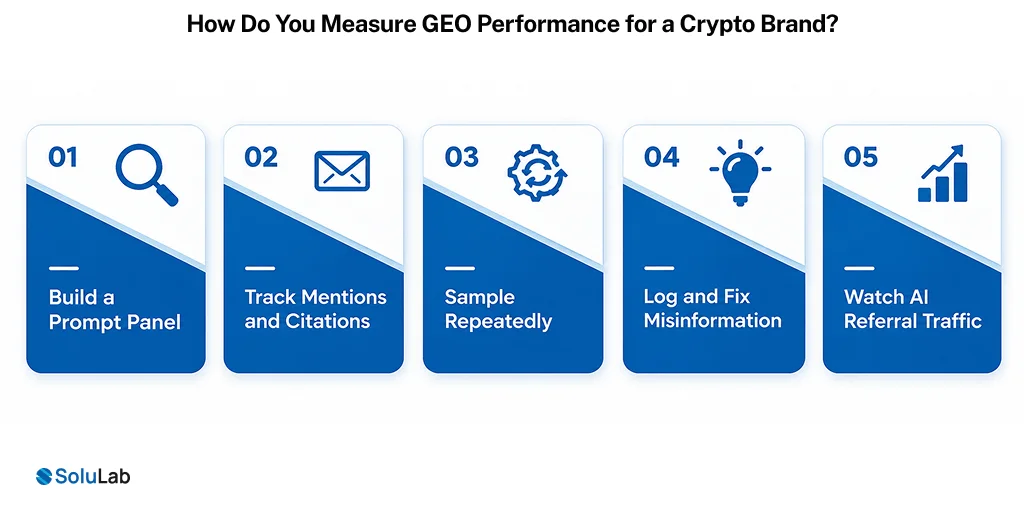
With a fixed set of real prompts, run regularly across several AI engines, and scored on whether you are mentioned, cited and described correctly. Traffic data alone misses most of what matters.
1. Build a Prompt Panel
List 30 to 100 questions your users actually ask: what your project is, whether it is safe, how its fees compare, which alternatives exist. Include category questions where you would hope to be named. Run the same panel on ChatGPT, Perplexity, Gemini, and Google AI Overviews.
2. Track Mentions and Citations
Being named in an answer is a mention. Having your page linked as a source is a citation. Being described correctly is accuracy. Track all three, because improving one does not guarantee the others.
3. Sample Repeatedly
The same prompt can produce different answers from one run to the next. Run each prompt several times per cycle and track the rate, not a single result. Doing this by hand gets tedious fast, and it is the kind of repetitive reporting that AI agents in sales and marketing already automate.
4. Log and Fix Misinformation
When an AI answer gets a fact wrong, trace which source it likely drew on, then correct that source: your own page, an aggregator listing or an outdated article. This is the highest-value GEO activity for most crypto brands, because it protects users as well as reputation.
5. Watch AI Referral Traffic
Analytics tools can separate visits referred from AI engines. Volumes are often small, but these visitors tend to arrive with a specific question already answered. We run the same kind of weekly prompt panel for our own brand across AI and blockchain buyer queries, and the pattern holds: accuracy problems surface long before traffic changes do.
What GEO Mistakes Should Crypto Projects Avoid?
Most mistakes come from treating GEO as a content volume game or a promotional channel. In crypto, both approaches backfire.
1. Promising Returns
Content that implies guaranteed yields or price outcomes is a regulatory risk and exactly the kind of claim AI engines hedge or avoid repeating. Describe mechanics, not predictions.
2. Blocking the Crawlers You Need
Blanket bot blocking, aggressive firewall rules and login walls stop AI engines from reading your official information, which leaves them to rely on whatever others have written about you.
3. Inconsistent Facts Across Sources
Different supply figures on your site, your docs, your aggregator listings and your white paper give AI engines conflicting evidence. Pick one canonical source and align everything to it.
4. Buying Fake Mentions
Paid placements disguised as independent coverage, bot-driven forum activity and link farms may inflate mentions briefly. They also damage trust with users, platforms and increasingly the AI systems that learn to discount them.
5. Letting Content Go Stale
Old blog posts with outdated fees, retired contract addresses or discontinued features keep getting quoted. Update or clearly mark outdated content.
6. Treating GEO Separately From the Product
Many GEO problems are product problems: fees only visible after login, networks listed inconsistently, audits not published. Fixing these is often part of DeFi development and exchange engineering, not just content work.
For a joined-up approach that covers both, our Web3 marketing services team works alongside engineering, and ChatGPT development services can map where the gaps are.

Conclusion
Generative engine optimization for crypto comes down to being the most accurate, most crawlable and best corroborated source about your own project. AI engines are becoming the first place many users ask about a token or exchange, and for financial questions they lean heavily on sources they can verify.
The work is less about volume and more about precision. Publish one canonical facts page. Put tokenomics and fees in text and tables. Keep aggregator listings aligned.
SoluLab, a generative AI development company, can help your business audit how AI engines describe your project today, restructure your product and content pages so they can be read and cited, and set up monitoring that catches errors before your users do.
FAQs
Neha is a curious content writer with a knack for breaking down complex technologies into meaningful, reader-friendly insights. With experience in blockchain, digital assets, and enterprise tech, she focuses on creating content that informs, connects, and supports strategic decision-making.