Key Takeaways
- VARA formally recognized Asset-Referenced Virtual Assets, or ARVAs, as a regulated category in May 2025. That’s now the legal backbone for tokenizing real estate, commodities, or funds in Dubai.
- Most RWA tokens qualifying as ARVAs need a VARA Category 1 Virtual Asset Issuance license, and getting that classification wrong early is the single most common reason projects stall out.
- VARA’s April 2026 Guidance on Virtual Asset Issuance flagged, for the first time, that a tokenized asset qualifying as a financial instrument may also fall under UAE Capital Markets Authority regulation. Two regulators, not one.
- Building the platform is genuinely the easier half. Legal structuring, custody arrangements, and documentation take longer than most teams budget for, and skipping any of it shows up later as a stalled license application.
Real-world asset tokenization globally is on track for real, measurable growth, part of the broader shift toward real-world asset tokenization that’s pulling institutional capital into UAE markets specifically.
VARA’s 2025 and 2026 rule updates gave the UAE something a lot of jurisdictions still don’t have: a defined regulatory category, ARVA, that tells issuers exactly where their token fits and what license it needs.
That clarity is a real advantage, but it comes with a catch. Building a platform here means treating legal structure, licensing, and custody as first-class engineering requirements, not paperwork bolted on after launch.
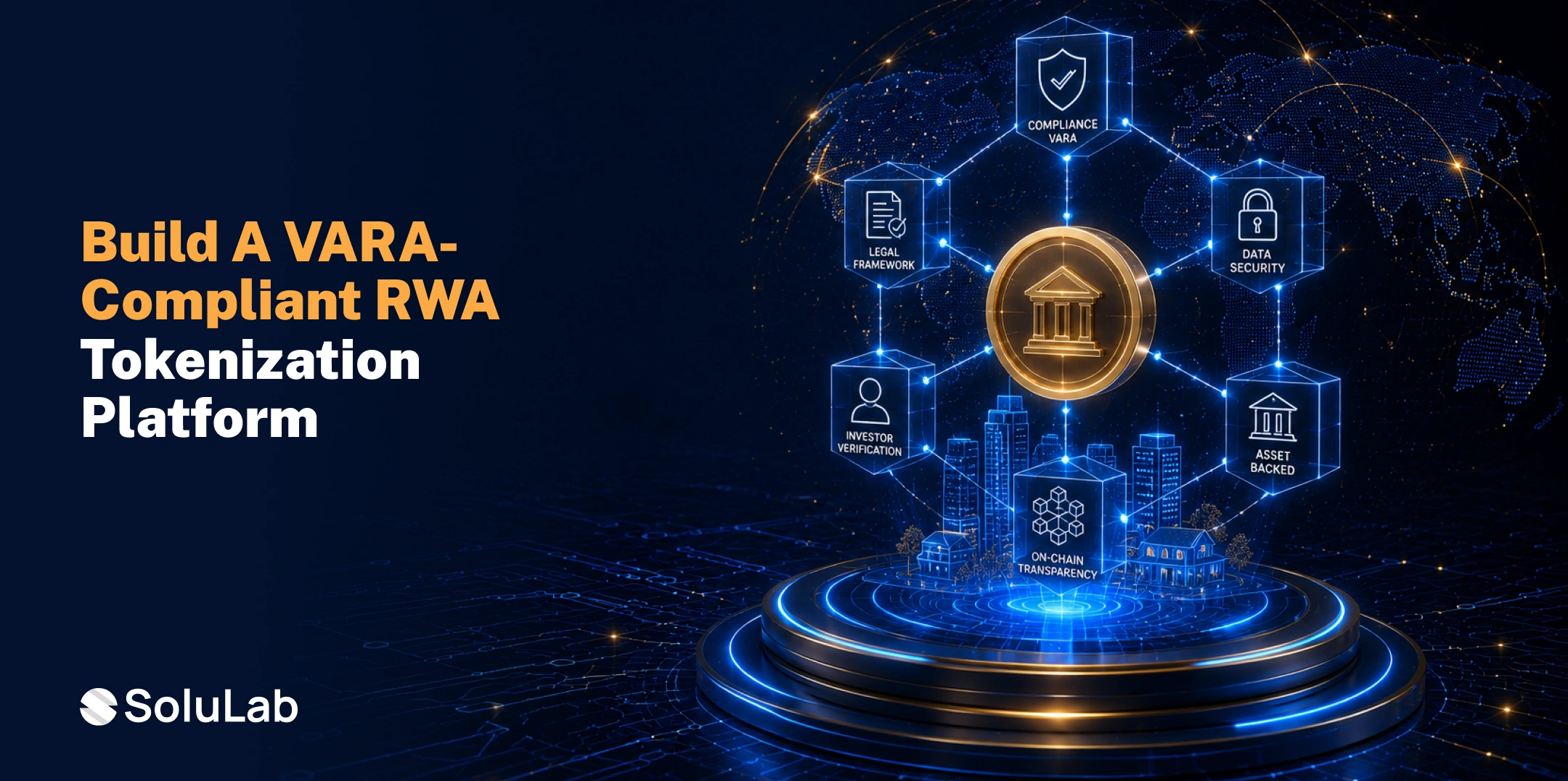
This guide walks through what VARA compliance actually means, how to figure out which license your token needs, the full build process, the infrastructure it requires, the documentation VARA expects, and a real estate example showing how the pieces fit together.
What is VARA Compliance?
VARA compliance means structuring and operating a virtual asset business, including RWA tokenization, according to Dubai’s Virtual Assets Regulatory Authority rulebooks. Building VARA-compliant blockchain solutions covers licensing, AML/KYC, custody, disclosure, and ongoing supervision, not just a one-time approval before launch.
Why VARA Compliance Matters for RWA Platforms?
VARA moved into what regulators themselves describe as a supervision-first posture: governance, capital discipline, and ongoing compliance now matter as much as the initial license, and enforcement has already caught multiple entities for weak controls or reporting gaps.
- A platform that treats VARA approval as a launch-day checkbox tends to discover, months in, that the checkbox was actually a continuous obligation. Dubai Land Department’s tokenized property pilot channeled more than AED 18.5 million between May 2025 and February 2026, then opened regulated secondary trading on roughly 7.8 million tokens.
- There’s also a distribution argument. Licensed platforms can legally reach retail and institutional investors inside one of the world’s more structured digital asset markets, something an unlicensed or gray-area platform simply can’t do at any real scale.
- And with VARA’s April 2026 Guidance now flagging that financial-instrument-like RWA tokens may fall under Capital Markets Authority oversight too, getting the classification right at the start avoids a much more expensive reclassification later.
How to Determine Whether Your RWA Token Requires VARA Approval or Licensing?
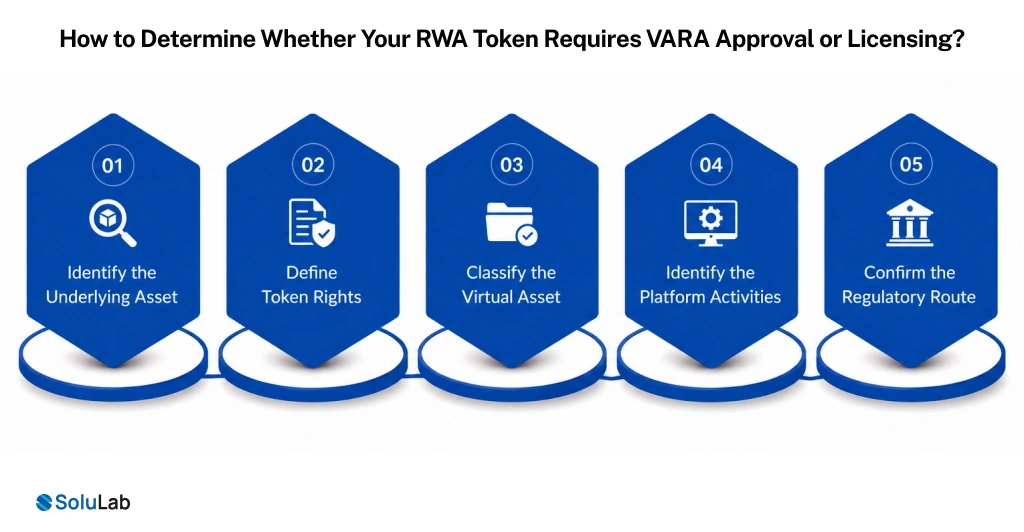
Most RWA tokens end up needing some form of VARA authorization, but confirming that, and which category applies, takes working through five specific questions before writing a line of code.
1. Identify the Underlying Asset
Start here, always. What’s actually being tokenized, who legally owns it right now, and is it already regulated by another UAE authority, like real estate falling under the Dubai Land Department?
- Confirm the asset type precisely
- Verify current legal ownership
- Check for other regulatory overlap
2. Define Token Rights
What does the token actually give someone? Ownership, redemption rights, income, a debt claim, a value reference, some other economic right entirely? This single decision shapes almost everything downstream.
- Map ownership versus economic exposure
- Define redemption and income rights
- Document any attached debt claims
3. Classify the Virtual Asset
Once the rights are clear, the token gets mapped against VARA’s applicable framework, typically the ARVA category if it references or represents a real-world asset.
- Compare token against VARA categories
- Confirm ARVA classification applies
- Flag ambiguous cases for legal review
4. Identify the Platform Activities
Licensing isn’t just about the token; it’s about what the business actually does with it. Issuance, brokerage, exchange, custody, transfer and settlement, investment or management services, or some other regulated activity entirely.
- List every regulated activity performed
- Separate issuance from ongoing operations
- Note activities needing separate licenses
5. Confirm the Regulatory Route
The prior four steps feed into one final call: which specific VARA license category applies, and whether CMA jurisdiction gets triggered alongside it. This is the step worth paying a specialist for.
- Confirm the applicable license category
- Check for CMA overlap explicitly
- Document the full regulatory rationale
How to Build a VARA-Compliant RWA Tokenization Platform?
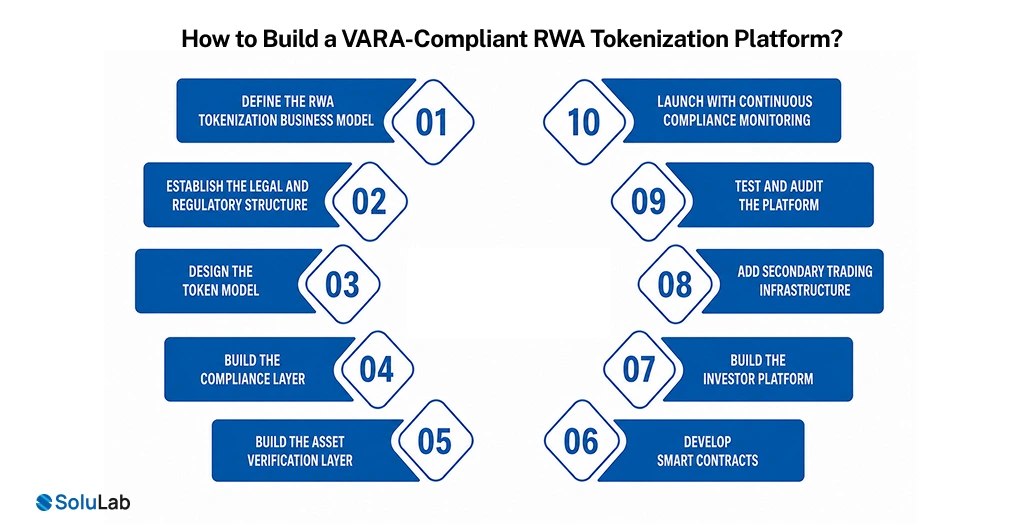
Ten stages separate an idea from a licensed, operating platform, and the order matters more than most teams expect going in.
1. Define the RWA Tokenization Business Model
Retail access, institutional infrastructure, and white-label licensing are genuinely different businesses that happen to share a label.
- Choose the target investor segment
- Decide direct-to-consumer or institutional
- Define revenue and fee structure
2. Establish the Legal and Regulatory Structure
This is where the VARA classification work above gets formalized into an actual legal entity and license application. Get it wrong here, and everything else waits.
- Establish the issuing entity structure
- File for the correct VARA license
- Draft token holder rights documentation
3. Design the Token Model
The legal wrapper becomes an actual technical specification at this stage.
- Choose token standard and network
- Define backing and enforcement logic
- Specify transfer and eligibility rules
4. Build the Compliance Layer
KYC, AML, and jurisdiction-specific eligibility checks need to run at onboarding and at every transfer, not just once at signup.
- Automate KYC and AML checks
- Enforce jurisdiction-based transfer restrictions
- Build audit-ready compliance reporting
5. Build the Asset Verification Layer
Someone, or something, has to continuously confirm the underlying asset still exists, is still owned as claimed, and still matches the token’s terms.
- Integrate custodian or registry verification
- Automate ongoing asset status checks
6. Develop Smart Contracts
Contract code enforces the backing claim and compliance rules automatically. Teams without deep in-house Solidity experience often bring in a specialized blockchain development services partner here rather than learning the edge cases mid-build, which tends to be a slower and costlier way to find them.
- Write core issuance and burn logic
- Add jurisdiction-based transfer restrictions
- Test extensively before any deployment
7. Build the Investor Platform
Whatever’s happening under the hood, this is what users actually judge the product by.
- Design onboarding and KYC flows
- Build portfolio and reporting dashboards
- Ensure mobile and desktop parity
8. Add Secondary Trading Infrastructure
Not every platform needs this on day one, but if regulated secondary trading is part of the plan, it has to be architected in from the start, not retrofitted later.
- Define secondary market rules
- Enforce eligibility on every transfer
- Plan liquidity and market-making approach
9. Test and Audit the Platform
Independent security review and compliance testing aren’t optional line items. They’re what stands between a working platform and a very public failure in front of a regulator.
- Commission an independent smart contract audit
- Validate compliance workflows against VARA rules
- Fix every flagged issue before launch
10. Launch With Continuous Compliance Monitoring
VARA compliance doesn’t end at licensing; it’s an ongoing obligation, and platforms that treat it as a one-time hurdle tend to get flagged in a supervisory review eventually.
- Monitor transactions for AML flags
- Maintain audit-ready records continuously
- Report per VARA’s ongoing requirements
Technical Infrastructure Required for a VARA-Compliant RWA Tokenization Platform
The technology stack underneath a compliant platform is genuinely different from a general-purpose crypto app, largely because compliance has to be enforceable in code, not just in policy documents. Teams building VARA-compliant crypto platforms tend to treat this stack as six interdependent layers rather than a single blockchain decision.
1. Consensus Mechanisms and Validator Network
Whether the platform runs on a public chain or a permissioned one, the underlying consensus mechanism needs to match the security and finality guarantees a regulated financial product actually requires.
2. Smart Contracts and Compliance Automation
This is where eligibility rules, transfer restrictions, and backing enforcement live, executing automatically instead of relying on a compliance officer catching every edge case manually.
3. Identity and Access Management
KYC-verified identity has to be tied cleanly to wallet addresses and platform access, since a token that can move to an unverified wallet defeats the compliance layer entirely.
4. Digital Asset Custody Infrastructure
Someone has to hold both the digital tokens and, in most RWA structures, coordinate with whoever holds the underlying real-world asset, and that coordination needs to be auditable end to end.
5. API Gateway and Integration Layer
Connecting to banking rails, registries, and reporting systems runs through this layer, and it’s usually where legacy system quirks cause the most unplanned delays.
6. On-Chain Asset Management and Data Storage
Ownership records, transaction history, and asset status all need a home that’s both tamper-resistant and accessible to auditors and regulators on request, not buried in a system nobody outside engineering can query.
What Documents Are Needed for RWA Tokenization in Dubai?
VARA’s application process expects a fairly specific documentation package, and missing pieces are one of the more common reasons applications stall.
- Business and corporate documents establishing the issuing entity and its ownership structure
- Asset ownership documents proving legal title to whatever’s being tokenized
- Legal opinions, often following VARA’s five-part framework for ARVA classification
- Token terms spelling out exactly what rights the token confers
- Investor agreements covering subscription, redemption, and transfer terms
- Risk disclosures, which VARA’s 2026 guidance now requires ranked by materiality, no generic boilerplate
- A whitepaper, which must be freely accessible without a registration wall under current guidance
- Custody agreements with whoever holds the underlying asset or the digital tokens
- Valuation documents supporting the asset’s stated worth
- AML/KYC policies governing onboarding and ongoing monitoring
- Technology and security policies covering the platform’s technical architecture and safeguards
Dubai RWA Tokenization Example: Real Estate
Real estate is the clearest way to see how these pieces actually connect, partly because real estate tokenization has moved further along in Dubai than almost any other asset class.
It starts with the property itself, a specific, identified asset with clean title. From there, legal and asset verification confirms ownership and checks for liens or disputes before anything gets tokenized.
The token structure gets defined next, usually through an SPV holding the property while tokens represent shares or economic interest in that SPV. Investor KYC runs before anyone can buy in, gating access to verified, eligible participants only.
Token issuance follows, minting the actual digital shares against the verified structure. Fractional investment is where the real accessibility shows up, letting investors buy a slice instead of the whole building.
Ownership and interest records get maintained on-chain, giving a shared, auditable source of truth. And reporting closes the loop, feeding VARA’s ongoing supervisory requirements and giving investors visibility into their holdings.
Skip a step in that chain, verification before issuance, say, and the whole structure gets legally shaky fast.
Conclusion
Building a VARA-compliant RWA tokenization platform genuinely is achievable with today’s regulatory clarity and available tooling, but the code was never the hard part. Getting the licensing classification right, structuring custody properly, and keeping documentation current are what separate a platform that operates smoothly from one stuck in supervisory review.
SoluLab, an RWA tokenization platform development company, can help your business work through exactly what a compliant build needs for your specific asset class and target market.
Talk to a SoluLab blockchain architect about licensing and compliance strategy.
FAQs
Neha is a curious content writer with a knack for breaking down complex technologies into meaningful, reader-friendly insights. With experience in blockchain, digital assets, and enterprise tech, she focuses on creating content that informs, connects, and supports strategic decision-making.