Key Takeaways
- Fine-Tuning Llama 4 on Proprietary Data using QLoRA gives enterprises a practical way to make AI understand their own data, workflows, policies, and domain language. Instead of relying on generic responses, businesses can build models that support real use cases like document review, compliance support, ticket classification, customer service, and internal knowledge search.
- QLoRA fine-tuning keeps customization more affordable by reducing memory and infrastructure needs. For teams exploring custom AI model development, SoluLab can show a path towards scalable path toward scalable enterprise-ready AI systems.
Introduction
Most enterprise teams have already seen the limit of a generic LLM. It can summarize a file, draft a quick response, or answer a broad question, but it usually misses the details that matter inside a company: policy logic, customer context, approval paths, product exceptions, and compliance boundaries. That gap can affect real decisions.
Fine-Tuning Llama 4 on Proprietary Data using QLoRA helps close that gap by shaping Llama 4 around a company’s own documents, workflows, and domain knowledge. The result is not just a more polished AI response. It is LLM development that can support teams with better context, fewer corrections, and more reliable business output.
This guide explains how QLoRA fine-tuning helps enterprises build AI systems that are accurate enough for real work, efficient enough to scale, and practical enough for business use.
Understanding Fine-Tuning Llama 4
Fine-Tuning Llama 4 is about making the model understand how a specific company works. Instead of relying only on broad public information, the model learns from selected business examples that reflect real tasks, internal language, and expected outcomes.
It is not about making the model perfect. It is about making it more useful in the places where generic AI usually struggles.
- It trains Llama 4 on selected enterprise examples instead of broad public data.
- It helps the model pick up internal policies, terminology, approval paths, and response formats.
- It can use support tickets, manuals, compliance files, sales playbooks, and knowledge bases as training material.
What is QLoRA and Why Does It Matter?
QLoRA for Llama 4 fine-tuning makes the most sense when an AI model needs to follow the way a business actually works. This could mean using the right tone, applying internal rules, classifying requests correctly, or responding in a format teams already use.
For many enterprises, the problem is not that the model does not answer. The problem is that the answer needs too much cleanup. It may miss the legal nuance, use the wrong product term, ignore an escalation step, or explain something in a way that does not match company standards.
That is where Llama 4 fine-tuning becomes useful. It helps the model understand technical terms, legal language, financial categories, product names, compliance expectations, and industry-specific expressions.
It is especially helpful for high-volume work such as ticket classification, policy Q&A, document summaries, contract review, workflow routing, product support, and compliance response tasks.
Industries like finance, healthcare, legal, insurance, and manufacturing often need this level of control. In these sectors, a generic answer is rarely enough. The model has to follow internal logic, business rules, and compliance expectations more closely.
LoRA vs QLoRA for Enterprise Use
- LoRA trains small adapter layers.
LoRA allows enterprises to customize model behavior by training only small adapter layers instead of updating every parameter in the model. - QLoRA adds memory efficiency.y
QLoRA builds on LoRA by using quantization, which lowers memory requirements and makes fine-tuning more cost-efficient for enterprise pilots. - Both are PEFT techniques.
LoRA and QLoRA are part of PEFT techniques, which help reduce the cost, time, and infrastructure needed for model customization. - QLoRA is often better for a cost-conscious enterprise.s
LLM Fine-tuning with LoRA & QLoRA gives companies options, but QLoRA is especially useful when budgets and infrastructure must be controlled. - Full fine-tuning is not always necessary.y
Many enterprise use cases do not need full-model fine-tuning. QLoRA can deliver strong results with lower operational and financial overhead.
When Should Enterprises Use QLoRA Fine-Tuning?
QLoRA for Llama 4 fine-tuning works well when the model must follow specific rules, formats, classifications, tones, or business workflows. Enterprises can fine-tune Llama 4 to understand technical terms, legal language, financial categories, product names, and industry-specific expressions. High-volume tasks such as ticket classification, policy Q&A, document summarization, contract review, and workflow routing are strong candidates.
If prompts produce inconsistent answers or require too much manual correction, Llama 4 fine-tuning can create more stable model behavior. Businesses in finance, healthcare, legal, insurance, and manufacturing often need models that follow internal logic and compliance expectations closely.
How Do Supervised Fine-Tuning and QLoRA Work Together?
Supervised Fine-Tuning and QLoRA work together by training the model on examples that include instructions, inputs, and desired outputs. A strong training example teaches the model the right format, tone, classification method, explanation style, and next-step recommendation.
Enterprises can train Llama 4 on resolved support tickets so the model learns how to classify issues and recommend correct actions. Fine-tuned models can learn how to summarize clauses, identify risky language, compare policies, and follow internal review frameworks. Because QLoRA trains lightweight adapters, enterprises can improve model behavior without large-scale retraining costs.
What Are the Business Benefits of Fine-Tuning Llama 4 with QLoRA?
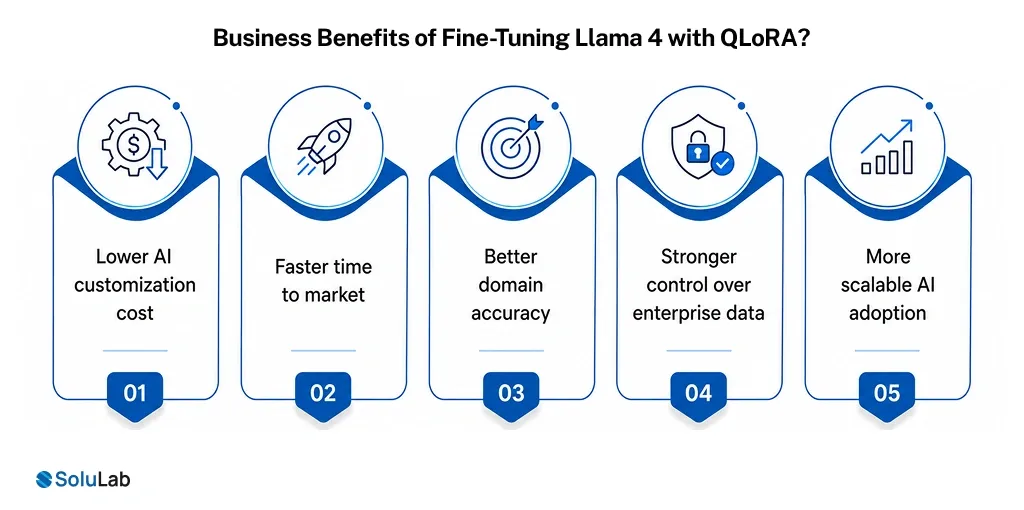
The reason enterprises look at fine-tuning LLaMA using QLoRA is not just to make the model perform better on a benchmark. That is only one part of the story. The bigger reason is practical: teams want AI integration solutions that are easier to trust, less expensive to customize, and more useful in daily business workflows.
1. Lower AI customization cost
QLoRA reduces the memory and compute required for fine-tuning, which makes custom AI model development more realistic for enterprises that want to test use cases before investing heavily.
2. Faster time to market
Because QLoRA keeps training lighter, teams can move from an idea to a working proof of concept faster, instead of waiting through long and expensive AI model development cycles.
3. Better domain accuracy
A fine-tuned model can pick up company-specific terms, document formats, policies, workflows, and customer language that a generic LLM would usually miss or misunderstand.
4. Stronger control over enterprise data
Enterprises get more control over how proprietary data is selected, prepared, trained, deployed, monitored, and governed across AI workflows.
5. Scalable AI adoption
Once a QLoRA pipeline is ready, the same foundation can support different adapters for separate teams, departments, regions, or business use cases.
Enterprise Use Cases for Domain-Specific Llama 4 Models
Domain-specific Llama 4 models can support a wide range of enterprise AI use cases.
Finance
Compliance support
Fine-tuned Llama 4 models can help classify compliance requests, summarize policy documents, and support internal regulatory response workflows.
Risk analysis
Financial teams can train models on internal risk frameworks so outputs follow company-approved terminology and review standards.
Customer service
Banks and fintech companies can use domain-specific LLMs like Llama 4 models to answer customer questions while respecting compliance and escalation rules.
Research workflows
Analysts can use fine-tuned models to summarize reports, compare documents, and extract insights from internal financial research.
Healthcare
Automated Administrative workflows
Healthcare organizations can use fine-tuning LLaMA using QLoRA to support patient query routing, payer communication, and internal policy search.
Documentation support
Fine-tuned models can help summarize administrative documents, prepare workflow notes, and reduce repetitive staff workload.
Privacy controls
Healthcare AI must be designed with strong governance, role-based access, data masking, audit trails, and human review.
Operational consistency
Domain-specific models can help healthcare teams respond consistently across departments while staying aligned with internal procedures.
Legal and Compliance
Scalable Contract Review
Legal teams can fine-tune Llama 4 on contract playbooks, clause libraries, review notes, and risk frameworks.
Clause classification
A fine-tuned model can identify indemnity clauses, termination clauses, liability language, and non-standard terms based on internal rules.
Faster Policy comparison
Compliance teams can use custom models to compare policies, summarize changes, and flag potential gaps for review.
Legal analysis
Fine-tuned models can handle first-level analysis, so legal professionals spend more time on judgment-heavy tasks.
Retail and eCommerce
Personalized Customer Support
Retailers can fine-tune models on real support conversations, return policies, product FAQs, and order workflows.
Improve Product Recommendations
Custom models can understand customer intent, product attributes, and shopping patterns to support more relevant product discovery.
Smoother Return Handling
Fine-tuned models can classify return requests, explain policy conditions, and guide customers through the next best action.
Consistent Brand Tone
Retail AI assistants can be trained to respond in a tone that matches the company’s customer experience standards.
Manufacturing and Logistics
Faster Tech Support
Manufacturers can fine-tune Llama 4 on equipment manuals, maintenance logs, safety procedures, and troubleshooting documents.
Reduced Downtime
Field teams can use AI assistants to identify likely issues, retrieve repair guidance, and follow approved maintenance steps.
Improved Supply Chain Reporting
Logistics teams can summarize vendor documents, shipment records, exception reports, and operational updates more efficiently.
Easier Knowledge Access
Fine-tuned models help employees find practical answers from complex technical documentation without searching across multiple systems.
Real Estate and Construction
Easy Reveiw To Property Documents
Real estate firms can fine-tune models on leases, property reports, investor documents, project files, and compliance records.
Improved Investor communication
Custom models can help prepare investor updates, answer common questions, and summarize property performance in a consistent format.
Manageable Construction Documentation
Teams can use fine-tuned models to summarize project updates, review contracts, and organize technical documentation.
Practical Workflow Automation
Enterprise LLM solutions can reduce manual review effort across leasing, project reporting, investor relations, and compliance workflows.
Step-by-Step Process for Fine-Tuning Llama 4 Using QLoRA
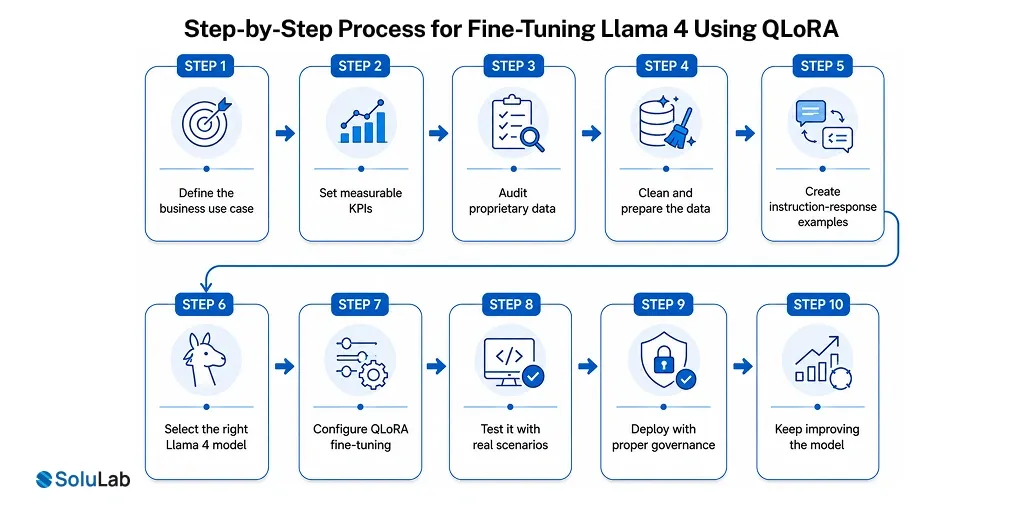
A Llama 4 fine-tuning project works best when it starts with a real business problem, not with the model itself. Many teams make the mistake of jumping straight into training, but the better approach is to first understand what the model should actually improve and where proprietary data can add value.
Step 1: Define the business use case
Start with one clear workflow. It could be support automation, legal review, compliance classification, internal knowledge search, or document summarization. Keep it specific. Discuss with an expert AI consultant for better decision making.
Step 2: Set measurable KPIs
Before training begins, decide what success should look like. This may include better response accuracy, fewer manual reviews, faster ticket resolution, or lower cost per task.
Step 3: Audit proprietary data
Look at the data you already have: documents, tickets, policies, call transcripts, reports, and workflow records. Not all of it will be useful, and that is fine.
Step 4: Clean and prepare the data
Remove duplicate files, outdated content, sensitive details, and confusing examples. QLoRA fine-tuning performs better when the data is clean and focused.
Step 5: Create instruction-response examples
Turn raw business data into examples that show what the user asks, what context matters, and how the model should ideally respond.
Step 6: Select the right Llama 4 model
Choose the best LLM model based on the task, budget, latency needs, security requirements, and deployment environment. The biggest model is not always the smartest choice.
Step 7: Configure QLoRA fine-tuning
Set up 4-bit quantization, LoRA adapters, learning rate, batch size, adapter rank, training epochs, validation data, and evaluation checkpoints.
Step 8: Test it with real scenarios
Do not only test easy prompts. Use messy user queries, edge cases, compliance-sensitive inputs, unclear requests, and examples from actual business workflows.
Step 9: Deploy with proper governance
AI Production deployment should include monitoring, logging, access control, human review, feedback loops, version control, and clear rules for data retention.
Step 10: Keep improving the model
A fine-tuned model is not something you launch once and forget. Products change, policies change, customers change, and the model should improve with them.
Common Mistakes Enterprises Should Avoid
- Using too much raw data
More data does not always improve performance. A smaller set of clean, relevant examples can produce better results than messy enterprise data. - Fine-tuning before validating the use case
Enterprises should confirm whether fine-tuning is needed or whether RAG, prompts, automation, or workflow redesign can solve the problem. - Ignoring evaluation quality
A model that works in a demo may fail with real users, unclear requests, compliance-sensitive questions, or high-pressure workflows. - Skipping data governance
Proprietary data requires clear rules for privacy, access control, masking, retention, audit logs, and regulatory compliance. - Treating fine-tuning as a one-time project
Enterprise AI models need monitoring, feedback, retraining, and improvement because business conditions change over time.

Conclusion
Fine-Tuning Llama 4 on Proprietary Data using QLoRA is useful because most enterprises do not need another generic AI tool. They need a model that understands their documents, workflows, internal language, policies, and business rules. That is where QLoRA becomes practical. It helps teams customize Llama 4 without putting too much pressure on infrastructure or budget. Companies can test, adjust, and deploy custom models in a more controlled way.
A fine-tuned model can improve accuracy, reduce repetitive manual work, support compliance teams, and make daily workflows faster. More importantly, it helps businesses build AI systems that reflect how their teams actually work and how their customers expect to be served.
Build a Custom Llama 4 Model with SoluLab!
Looking for expert AI development services? SoluLab helps enterprises build secure, scalable, and domain-specific AI systems using Fine-Tuning LLaMA4 with QLoRA. Our experts enable businesses to build AI assistants, copilots, automation tools, document intelligence systems, and enterprise search solutions.
FAQs
Shipra Garg is a tech-focused content strategist and copywriter specializing in Web3, blockchain, and artificial intelligence. She has worked with startups and enterprise teams to craft high-conversion content that bridges deep tech with business impact. Her work translates complex innovations into clear, credible, and engaging narratives that drive growth and build trust in emerging tech markets.