
Key Takeaways
- An LLM eval suite is a repeatable set of automated tests, human reviews, and safety checks that measure whether a model is actually ready for production, not just impressive in a demo.
- Demo performance and production performance are two different things. A model can nail a curated set of sample prompts and still fail on the messy, unpredictable inputs real users send.
- A solid eval suite combines four layers: automated benchmarks, task-specific tests, human evaluation, and safety or bias checks, run together rather than one at a time.
Metrics worth tracking include accuracy, hallucination rate, latency, cost per query, and consistency across repeated runs of the same prompt. - Evaluation isn’t a pre-launch formality. Models drift as prompts, data, and even the underlying provider’s model version change, so the eval suite needs to run on a schedule, not just once.
Most teams find out their LLM has a problem the hard way. A customer posts a screenshot. A support ticket flags something odd. A stakeholder asks, mid-demo, why the chatbot just invented a return policy that doesn’t exist anywhere in the company handbook. By then, you’re not fixing a bug quietly. You’re doing damage control.
Building an eval suite before launch flips that order. It gives you a structured way to find where a model breaks, where it gets inconsistent, and where it simply isn’t good enough yet, back when you still have the luxury of time to fix it.
Here’s the thing: an eval suite isn’t a single test or a checklist you run once and forget. It’s an ongoing measurement system, and in practice, it’s what most teams really mean when they say LLM evaluation framework.
Teams that treat it that way tend to ship AI products that hold up.
Teams that skip it usually end up firefighting after launch instead. This guide walks through what a real eval suite includes, which metrics actually matter, and a practical process for building one from the ground up.
What Is an LLM Eval Suite?
An LLM eval suite is a structured set of tests, metrics, and review processes that measure how well a language model performs against criteria you defined ahead of time, both before it goes live and after. Some teams call it an llm evaluation framework instead, and either name points at the same ai model testing methodology, built for a system that doesn’t behave like normal software. LLM outputs are probabilistic, not fixed, so the same input can produce a slightly different answer depending on when you ask.
A good eval suite usually checks four things at once. Does the model produce correct, relevant answers? Does it stay inside safety and policy boundaries? Does it hold up across edge cases instead of just the happy path someone picked for the demo? And does it hit cost and latency targets once real traffic shows up, not just in a controlled test run?
Teams that skip this, or run it informally with a handful of manual spot checks over coffee, usually find out the hard way that their model evaluation metrics were never actually measured against anything real.
Why You Need to Evaluate an LLM Before Production
The Cost of Finding Failures Late
A bug in traditional software usually breaks the same way every time. Predictable. Reproducible. You can point at the exact line of code. An LLM failure doesn’t play by those rules. It might work fine for 95% of prompts and then quietly fabricate an answer for the other 5%, and that 5% is almost never random. It’s usually the exact edge case a real, messy user base finds within the first week of launch.
Demos Don’t Reflect Production Traffic
Demo prompts get rehearsed. Someone on the team picks the ten questions that make the model look sharp, runs through them a few times, and calls it good. Production doesn’t work that way.
Demo prompts are curated, clean, and rehearsed
Production prompts are messy, ambiguous, and thrown at the system by people trying to break it
Users phrase the same request a dozen different ways, and half of them make no grammatical sense
Real traffic comes loaded with typos, slang, and half-finished context
Business and Compliance Risk Add Up Fast
Gartner has found that at least 30% of generative AI projects get abandoned after proof of concept, and the leading causes read like a checklist for exactly what an eval suite is supposed to catch: poor data quality, weak risk controls, unclear business value.
A structured eval suite directly addresses two of those three. It’s the mechanism that actually proves data quality and manages risk before a project reaches a go or no-go decision, instead of everyone just hoping for the best. This matters even more in regulated industries; our GenAI in MedTech case study shows how a documented eval process shaped what compliance was willing to sign off on.
Model Drift Is Real, Even Without Code Changes
Providers update the underlying model. Prompt templates get tweaked by whoever’s on call. The documents a retrieval system pulls from change without anyone flagging it. A model that passed evaluation in January can behave noticeably differently by June, even when your own codebase hasn’t been touched at all.

Core Components of an LLM Eval Suite
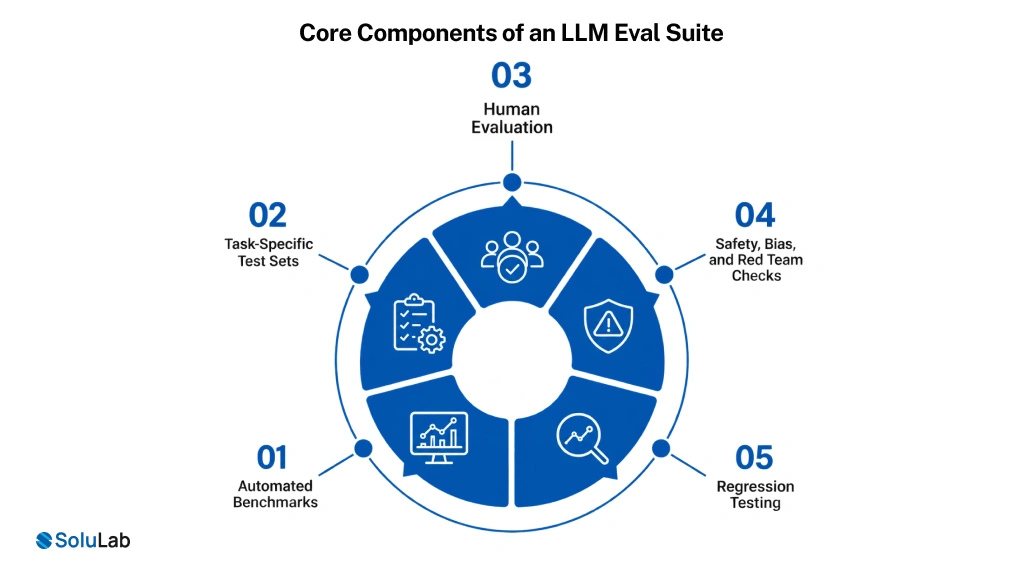
Here are some core components of an LLM Eval Suite:
Automated Benchmarks
These run a fixed set of test cases against the model and score the responses automatically, usually against a reference answer or a rubric. Nothing fancy. This is the layer most people mean by llm benchmarking: fast, cheap to repeat as many times as you want, and genuinely good at catching regressions the moment a prompt or model changes.
Task-Specific Test Sets
Generic benchmarks tell you how a model performs in the abstract. Task-specific tests, built from your own product’s actual use cases, tell you something more useful: how it performs at the exact job you’re paying for it to do. When that test set is curated and locked down as a stable reference, this is usually what people mean by golden dataset evaluation.
Human Evaluation
Some things are hard to score with a script. Tone. Helpfulness. Whether the answer actually resolved what the user was asking, versus technically answering the question while missing the point entirely. Human reviewers, especially ones who already understand the product, catch what automated scoring walks right past.
Safety, Bias, and Red Team Checks
This layer overlaps with AI red teaming. It’s about testing whether the model can be pushed into unsafe, biased, or policy-violating outputs under real pressure, not just how it behaves when everyone’s being polite.
Regression Testing
Fix one bug, and there’s a decent chance you’ve quietly broken something that used to work. This is the whole point of llm regression testing: it’s the check that catches that trade before it ships. Run it every time a prompt, model version, or retrieval source changes.
How to Build an LLM Eval Suite Step by Step
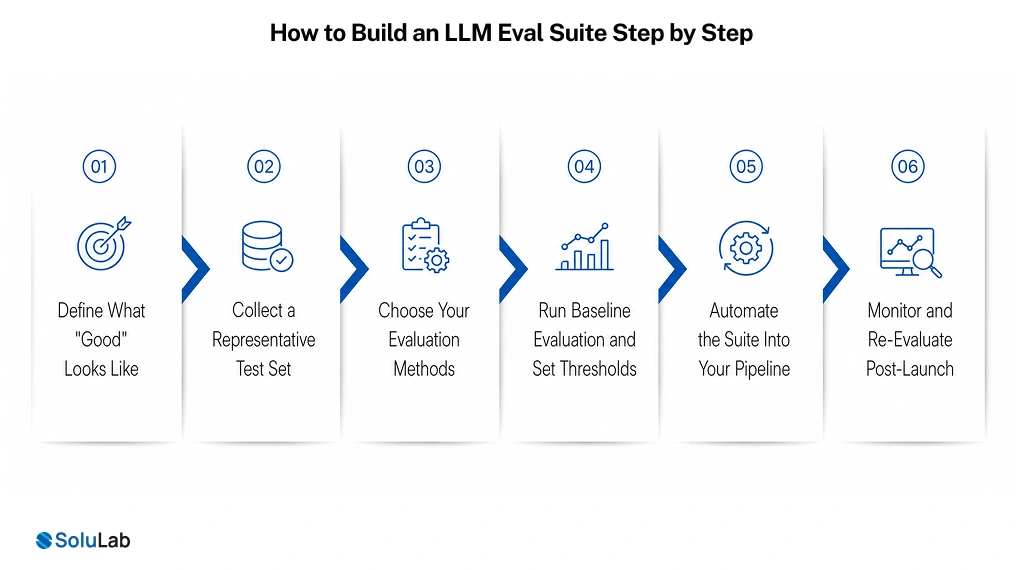
Here’s a step-by-step guide on how to build an LLM eval suite:
1. Define What “Good” Looks Like
Before you write a single test, write down what success actually means for your use case. Specific and measurable, not aspirational. “The chatbot should be helpful” sounds fine in a meeting, but nobody can score it consistently, which means nobody will.
- List the top 10 tasks the model must handle
- Define a pass/fail or scoring rubric per task
- Get sign-off from product and legal stakeholders
2. Collect a Representative Test Set
Pull real, anonymized examples from support tickets, past user queries, or whatever domain documents you have lying around. Not the prompts your team assumes users will send. There’s usually a wide gap between the two, and closing it is really the whole answer to how you build an eval dataset that means something.
- Gather 100 to 500 real or realistic prompts
- Include edge cases and adversarial phrasing on purpose
- Cover every major intent your product handles
3. Choose Your Evaluation Methods
Match the method to whatever you’re actually trying to measure. Factual accuracy wants a reference-based check. Tone and helpfulness want a human, or at least an LLM-as-a-judge setup, meaning a second model scores the first one’s answers, that a human still spot-checks.
- Automated scoring for objective tasks
- Human review for subjective quality
- LLM-as-a-judge for scale, spot-checked by humans
4. Run Baseline Evaluation and Set Thresholds
You need a starting number before you can improve anything. Score where the model stands today, then decide the minimum bar it has to clear before anyone talks about shipping.
Score the current model against your test set
Set minimum acceptable thresholds per metric
Flag any category scoring below the bar
5. Automate the Suite Into Your Pipeline
A manual eval process is the first thing to get skipped when a deadline gets tight. An automated one doesn’t care how tight the deadline is. It runs anyway, and wiring it into your release process is exactly the kind of work MLOps consulting services teams get brought in to operationalize.
- Wire evaluation into your CI/CD pipeline
- Trigger a run on every prompt or model change
- Alert the team automatically on score drops
6. Monitor and Re-Evaluate Post-Launch
Launch isn’t the finish line, no matter how it feels on the day. Real users will find failure modes your test set never imagined, because that’s just what real users do.
- Sample live conversations on a regular cadence
- Add newly discovered failures to the test set
- Re-run the full suite after any model update
Teams building this out for the first time often lean on outside AI consulting services to figure out which use cases carry the most risk and deserve the deepest test coverage first, rather than guessing.
Key Metrics to Track When Evaluating an LLM
Accuracy: how often the model’s answer matches the correct or expected response for factual tasks.
- Hallucination rate: how often the model states something false or unsupported like it’s a settled fact. The simplest way to test for hallucinations is running known-answer prompts through the model and flagging anything that doesn’t match a verified source.
- Consistency: how much the output actually varies across repeated runs of the exact same prompt.
- Latency: how long the model takes to respond under realistic load, not the single test query someone ran once.
- Cost per query: token usage and infrastructure cost at real production volume, not the lab-scale number everyone quotes.
- Refusal accuracy: whether the model correctly turns down unsafe or out-of-scope requests without also refusing things it shouldn’t.
Deloitte’s Q4 2024 State of Generative AI in the Enterprise research found that reliability and accuracy concerns remain one of the top barriers organizations cite when deciding how far to scale their GenAI initiatives, right up there with cost.
That’s about as direct an argument as you’ll get for treating accuracy and hallucination testing as launch-blocking work, not something you check after the fact once someone complains.
LLM Evaluation vs Traditional Software Testing
Is evaluating an LLM really that different from standard QA? Yes, in a few ways that actually matter.
| Aspect | Traditional Software Testing | LLM Evaluation |
| Output type | Deterministic, same input = same output | Probabilistic, same input can vary |
| Pass/fail clarity | Usually binary | Often scored on a scale or rubric |
| Test design | Based on code paths and logic branches | Based on real-world prompts and intents |
| Key risks | Bugs, crashes, incorrect logic | Hallucination, bias, unsafe outputs, drift |
| Retesting trigger | Code changes | Code changes, prompt changes, model updates |
| Who’s involved | QA engineers | QA, ML engineers, domain experts, reviewers |
The scale of the GenAI market makes this distinction more than academic. Statista data puts the global generative AI market at roughly $20.47 billion in 2023, climbing to nearly $66.89 billion by 2025. That’s a lot of production traffic riding on models that, in plenty of organizations, are still getting tested more like traditional software than like the probabilistic systems they actually are.
Common Mistakes to Avoid When Evaluating LLMs
Here are some common mistakes to avoid:
- Relying on a single metric. A model can score well on accuracy and still fail on latency, cost, or tone. No one number tells you the whole story, no matter how good it looks in a slide.
- Skipping human review entirely. Automated scoring is fast, sure, but it misses the kind of nuance a human reviewer catches in about five seconds, especially someone who actually knows the product.
- Evaluating once and never again. Providers update their models, prompts get tweaked on a Tuesday afternoon, and a test run from three months back stops meaning much without ongoing llm regression testing behind it.
- Ignoring cost and latency until after launch. A model that gives great answers but takes six seconds and burns through your token budget isn’t production-ready. It just looks like it is in a demo.
- Treating evaluation as separate from red teaming. Safety and quality checks work better together, run by people who talk to each other, not as two workstreams that never compare notes.

Conclusion
An eval suite isn’t extra overhead bolted onto an LLM project for compliance’s sake. It’s the difference between finding a problem in a controlled test run and finding it out from an angry customer or a compliance review six months later.
Teams that treat evaluation as an ongoing habit, not a box to check before launch, are the ones whose AI products actually hold up once real traffic shows up.
Building that habit from scratch takes real work: choosing the right mix of automated and human evaluation, then keeping it running as models and prompts keep changing underneath you.
SoluLab, an LLM development company, can help your business design and run an eval suite built around your model, your use cases, and how much risk you’re actually willing to carry, from the first test case through post-launch monitoring.
FAQs
Neha is a curious content writer with a knack for breaking down complex technologies into meaningful, reader-friendly insights. With experience in blockchain, digital assets, and enterprise tech, she focuses on creating content that informs, connects, and supports strategic decision-making.