Key Takeaways
- Custom AI development services enable enterprises to build tailored predictive analytics systems, improving forecasting accuracy and decision-making across business functions.
- Governed ML systems ensure compliance, transparency, and risk control, especially critical for regulated industries and enterprise-scale deployments.
- AI-driven predictive analytics helps organizations optimize operations, reduce costs, and identify new revenue opportunities through data insights.
- Scalable AI infrastructure is essential for enterprise adoption, including model monitoring, data pipelines, and continuous performance evaluation.
- Enterprises increasingly rely on custom AI solutions over off-the-shelf tools to meet specific business, compliance, and integration requirements.
Enterprise analytics has moved beyond dashboards.
For years, reporting systems were designed to explain what already happened, quarterly summaries, financial breakdowns, and performance comparisons. But modern business environments operate in real time. Liquidity shifts quickly. Fraud patterns evolve continuously. Revenue volatility compresses planning cycles.
In this landscape, organizations rely on AI development services to build predictive systems that anticipate risk, demand, and opportunity, not just describe them.
This shift has accelerated the adoption of AI-powered analytics and enterprise-grade predictive analytics platforms. Machine learning models now influence capital allocation, liquidity planning, fraud detection thresholds, and executive forecasting.
But prediction introduces responsibility.
When AI directly impacts financial planning and strategic decision-making, enterprises must ensure systems are explainable, monitored, and compliant. Accuracy alone is not enough. Forecasting systems must be governed, auditable, and institution-ready.
The evolution from reporting to prediction is not merely technical. It is structural.
And it demands AI systems engineered for enterprise control.
What Are AI Development Services for Enterprise Analytics Platforms?
In enterprise environments, AI is not an experiment. It is infrastructure.
AI development services for analytics platforms encompass the design, implementation, and operationalization of machine learning systems within governed enterprise frameworks. This extends far beyond building models in isolation.
A mature approach to AI/ML development services typically includes:
- Enterprise data pipeline architecture
- Feature engineering and semantic layer design
- Model development and validation
- Integration with predictive analytics platforms
- Deployment automation and lifecycle monitoring
- Embedded AI governance & compliance controls
Structured machine learning development services incorporate enterprise ML system design principles from the beginning. This means models are not deployed informally. They pass validation workflows. Data sources are version-controlled. Feature logic is documented. Drift detection mechanisms are active.
Off-the-shelf analytics tools may provide automation features. However, enterprises operating in regulated or high-stakes environments require deeper architectural flexibility and governance integration.
AI embedded in business analytics must function as a managed asset not a side project.
That distinction defines enterprise-grade AI.
Why AI Governance and Compliance Are Core to Enterprise ML Systems?
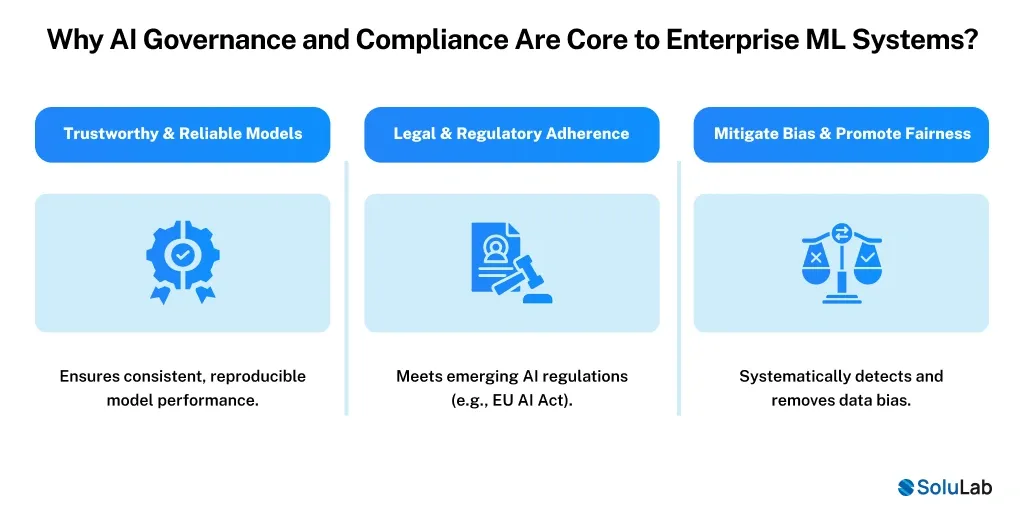
As predictive systems expand across departments, governance becomes foundational.
Modern enterprises face increasing expectations around AI governance & compliance. Risk committees require transparency. Executives demand explainability. Regulators expect documentation. Investors want stability in forecasting methodologies. Predictive systems influence:
- Credit exposure
- Liquidity buffers
- Revenue projections
- Fraud detection thresholds
- Strategic capital allocation
When these systems drift, misclassify, or operate without traceability, the impact is immediate.
This is why enterprise AI governance solutions are no longer optional.
A governed ML system includes:
- Clearly assigned model ownership
- Formal validation checkpoints before deployment
- Data lineage tracking
- Bias testing frameworks
- Drift monitoring and retraining schedule
- Structured audit logs
- Documented risk-tier classification
Enterprises increasingly invest in responsible AI implementation services to ensure predictive systems align with internal policy and regulatory standards. Similarly, robust AI compliance solutions for enterprises embed oversight directly into architecture rather than layering compliance after deployment.
Governance is not friction.
It is what allows predictive systems to scale confidently. Without governance, AI remains fragile. With governance, AI becomes institutional.

What Does Enterprise ML System Design Require?
Designing a model is straightforward.
Designing an enterprise machine learning system that can scale across departments, survive audits, and operate reliably for years is a different challenge entirely.
True enterprise ML system design begins with structure.
It requires layered architecture, operational discipline, and embedded governance from day one.
Data Architecture Built for Traceability
Every predictive analytics platform depends on reliable data foundations.
Enterprise-grade systems implement:
- Controlled ingestion pipelines
- Schema validation and anomaly detection
- Version-controlled datasets
- Role-based access controls
- Lineage tracking from source to output
This ensures that when a forecast influences financial planning, leadership can trace it back to specific datasets and transformation logic.
Without traceability, explainability becomes fragile.
Standardized Feature Engineering and Semantic Layers
In unstructured environments, teams often rebuild the same business logic repeatedly liquidity ratios, rolling revenue averages, customer segmentation scores.
Enterprise ML system design introduces:
- Centralized feature stores
- Versioned transformation pipelines
- Documented business logic definitions
- Reusable semantic layers
This reduces inconsistency across predictive models and strengthens governance across AI for business initiatives.
Operationalizing Models Through MLOps
A model that cannot be operationalized cannot scale.
This is where structured MLOps consulting services become critical. MLOps introduces:
- Experiment tracking and reproducibility
- Model registries with version control
- Automated testing before deployment
- Continuous monitoring of prediction performance
- Drift detection and retraining workflows
MLOps transforms machine learning from a one-time build into a continuously managed capability.
It is the operational backbone of mature AI/ML development services.

Explainability as a System Requirement
Enterprises do not deploy black-box systems in high-impact environments.
Modern explainable AI services embed transparency directly into forecasting systems through:
- Feature importance analysis
- Sensitivity testing
- Confidence interval reporting
- Scenario simulation comparisons
Executives may not require mathematical detail. But they require clarity around drivers and assumptions. Explainability is not optional in enterprise ML system design. It is structural.
Architecture Blueprint for Governed Predictive Analytics Platforms
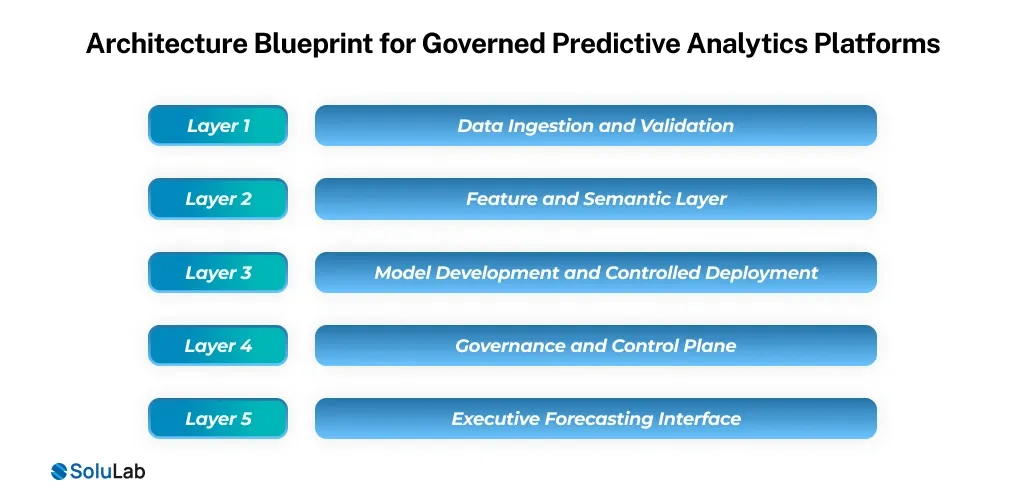
Once governance principles and system design requirements are clear, architecture becomes the execution layer.
A governed predictive analytics platform embeds intelligence across structured layers rather than treating AI as an isolated component.
Below is the architectural view that supports scalable AI-powered analytics.
Layer 1: Data Ingestion and Validation
Raw data flows from core systems, CRM platforms, transaction engines, ERP systems, and external feeds.
Before models access it, the data passes through:
- Schema enforcement
- Data quality scoring
- Missing value checks
- Anomaly detection
- Secure access controls
This reduces “garbage in” risk and supports audit readiness.
Layer 2: Feature and Semantic Layer
This layer standardizes transformations used across the enterprise.
Instead of fragmented logic, teams rely on governed definitions that power:
- Liquidity forecasting
- Risk scoring
- Revenue prediction
- Operational demand modeling
This layer is foundational for scalable enterprise reporting automation AI systems.
Layer 3: Model Development and Controlled Deployment
Here, professional machine learning development services integrate with platform engineering.
Key components include:
- Version-controlled development environments
- Logged training runs
- Model registries
- Approval workflows before production release
Deployment is not automatic. It is governed.
Layer 4: Governance and Control Plane
This layer manages oversight across the entire AI lifecycle.
It includes:
- Model ownership documentation
- Risk-tier classification
- Validation sign-offs
- Drift alerts
- Bias testing records
- Audit log repositories
This is what turns AI experimentation into enterprise AI governance solutions.
Layer 5: Executive Forecasting Interface
Finally, insights reach leadership through structured dashboards.
Modern predictive analytics platforms enable:
- Scenario simulation
- Driver-level explainability
- Historical forecast comparison
- Exportable compliance documentation
This closes the loop between data science services and executive decision-making.
AI Governance and Compliance in Regulated Enterprise Environments
As AI systems influence regulated decision-making, oversight intensifies.
Enterprises today face mounting expectations around AI governance & compliance, particularly in industries such as banking, fintech, insurance, and large-scale enterprise finance.
Predictive models increasingly fall under:
- Model risk management frameworks
- Data protection regulations
- Internal audit standards
- Board-level oversight
Compliance cannot be retrofitted.
It must be engineered.
AI Compliance Solutions for Enterprises
Robust AI compliance solutions for enterprises integrate directly into AI architecture through:
- Structured model documentation templates
- Independent validation checkpoints
- Access control enforcement
- Data privacy safeguards
- Secure development environments
- Ongoing revalidation schedules
This alignment ensures predictive systems remain defensible under scrutiny.
Responsible AI as an Engineering Discipline
True responsible AI implementation services extend beyond policy statements.
They embed measurable safeguards such as:
- Fairness testing across customer segments
- Transparent feature selection
- Sensitivity analysis
- Defined human override processes
- Clear escalation protocols for anomalies
Responsible AI strengthens trust internally and externally.
Governance as Strategic Enablement
Enterprises that invest in mature governance frameworks gain:
- Faster executive adoption of AI
- Reduced audit friction
- Stronger cross-functional trust
- Lower long-term technical debt
Governed AI scales more smoothly than loosely controlled experimentation. In enterprise environments, governance is not overhead. It is infrastructure.
Where Custom AI Development Delivers Enterprise Impact?
Not every AI initiative justifies enterprise-level investment.
Custom AI development delivers the most value in environments where prediction directly influences financial, operational, or regulatory outcomes.
In these cases, structured AI development services and mature enterprise ML development company capabilities become strategically important.
Below are the areas where governed AI produces measurable impact.
Credit and Risk Forecasting
Credit modeling has evolved beyond traditional scorecards.
Modern predictive systems analyze behavioral data, transactional patterns, and contextual signals to forecast risk exposure more accurately. However, when these forecasts influence capital buffers or lending decisions, governance becomes essential.
Custom AI systems in credit environments require:
- Bias testing across borrower segments
- Documented feature engineering logic
- Formal validation and stress testing
- Transparent approval workflows
- Drift monitoring tied to market shifts
This is where disciplined machine learning development services intersect with risk frameworks.
Accuracy improves resilience. Governance ensures defensibility.
Liquidity and Treasury Forecasting
Treasury functions increasingly rely on dynamic predictive systems to model cash flow volatility and funding requirements.
AI-powered models process historical transactions, seasonality patterns, macroeconomic indicators, and behavioral data in real time. But liquidity forecasting directly impacts capital allocation decisions.
Custom predictive systems integrated within predictive analytics platforms provide:
- Scenario simulation
- Confidence interval modeling
- Traceable assumptions
- Version-controlled forecast history
This level of control supports executive-level decision-making.
Fraud and Anomaly Detection
Fraud evolves continuously.
Static rules struggle to adapt. AI enhances detection by identifying non-obvious patterns across high-dimensional datasets.
However, fraud detection systems must balance speed with fairness.
Governed AI implementations ensure:
- Continuous model performance monitoring
- Segment-level fairness testing
- Transparent override mechanisms
- Secure data pipelines
Professional AI/ML development services ensure fraud models remain effective without introducing regulatory exposure.
Revenue and Demand Forecasting
Revenue projections shape hiring plans, investment strategy, and investor communication.
AI-driven forecasting models enhance accuracy, but sudden prediction shifts can create uncertainty unless drivers are explainable.
Custom systems embedded within enterprise reporting automation AI frameworks allow leadership to:
- Compare forecast versions
- Simulate alternate scenarios
- Understand feature-level impact
- Align cross-department projections
In these environments, AI becomes strategic infrastructure, not a technical enhancement.
Why Custom AI Matters?
Off-the-shelf analytics tools provide convenience.
But enterprises operating in regulated or high-stakes contexts often require:
- Architectural flexibility
- Deep integration with legacy systems
- Embedded governance controls
- Compliance-ready documentation
- Long-term scalability
This is where partnering with a mature enterprise ML development company becomes critical.
The difference lies not only in building models.
It lies in engineering institutional intelligence.
Risks of Unstructured AI and ML Development
AI initiatives rarely fail because of weak algorithms. They fail because of weak systems. Enterprises that pursue isolated machine learning projects without structured governance expose themselves to operational, regulatory, and financial risk.
Model Drift and Silent Performance Degradation
Predictive models degrade quietly.
Behavioral patterns evolve. Market conditions shift. Data distributions change.
Without automated drift detection and structured retraining workflows often delivered through disciplined MLOps consulting services, models remain in production long after their assumptions expire.
The impact may only become visible when forecasts diverge materially from reality.
Governance Gaps and Compliance Exposure
When governance is retrofitted instead of engineered, documentation becomes incomplete.
Critical questions remain unanswered:
- Which dataset trained the model?
- Who approved deployment?
- What validation thresholds were applied?
- When was the last revalidation conducted?
Robust AI governance & compliance mechanisms prevent reactive compliance scrambling.
Shadow Models and Organizational Sprawl
Without centralized oversight, enterprises accumulate fragmented models across departments.
Multiple liquidity forecasts.
Conflicting revenue projections.
Independent fraud engines.
This erodes trust in analytics outputs and increases technical debt.
Strong enterprise ML system design standardizes workflows and centralizes model inventories, preventing uncontrolled proliferation.
Security and Data Sensitivity Risks
AI systems access sensitive financial and behavioral data.
Improperly secured development environments or weak access controls increase exposure.
Professional AI compliance solutions for enterprises incorporate:
- Role-based access permissions
- Secure training environments
- Encrypted pipelines
- Documented data handling procedures
Security is inseparable from enterprise AI.
Compounding Technical Debt
The most underestimated risk of loosely managed machine learning development services is long-term maintainability.
Undocumented features, inconsistent validation standards, and manual deployment processes accumulate quickly.
Eventually, rebuilding becomes more expensive than building correctly from the start.
Custom AI is powerful. Unstructured AI is fragile.
How to Choose the Right Enterprise ML Development Company?
As enterprises transition from experimentation to infrastructure, selecting the right partner becomes strategic.
Not all providers of AI development services are equipped to build governed, scalable enterprise systems.
Here is how decision-makers should evaluate potential partners.
Governance-First Approach
A capable enterprise ML development company embeds governance into architecture.
Ask:
- How are validation workflows structured?
- Is model documentation standardized?
- How is drift monitored continuously?
- Are bias testing frameworks operationalized?
Governance must be engineered not promised.
Depth in Enterprise ML System Design
Building isolated models is not enough.
Look for expertise in:
- Enterprise ML system design
- Feature store implementation
- Model registry architecture
- Lifecycle automation through MLOps
- Integration with predictive analytics platforms
Strong MLOps consulting services capabilities signal operational maturity.
Compliance and Responsible AI Alignment
Providers offering responsible AI implementation services and AI compliance solutions for enterprises should demonstrate:
- Structured documentation templates
- Audit-ready logging systems
- Transparent explainability tooling
- Defined revalidation schedules
Compliance must be embedded in the pipeline, not treated as an external audit task.
Systems Integration Capability
Enterprise AI rarely operates in isolation.
Evaluate the ability to integrate with:
- Core banking or ERP systems
- Executive dashboards
- Enterprise reporting automation AI platforms
- Legacy data infrastructure
True AI/ML development services require both data science and enterprise engineering capability.
Lifecycle Support and Long-Term Partnership
Enterprise AI is not a one-time deployment.
A mature custom AI development company supports:
- Continuous monitoring
- Scheduled retraining
- Performance audits
- Cross-model risk tracking
- Governance updates as regulations evolve
The right partner thinks in years, not launch cycles.
From AI Pilot to Enterprise-Scale Predictive Analytics Infrastructure
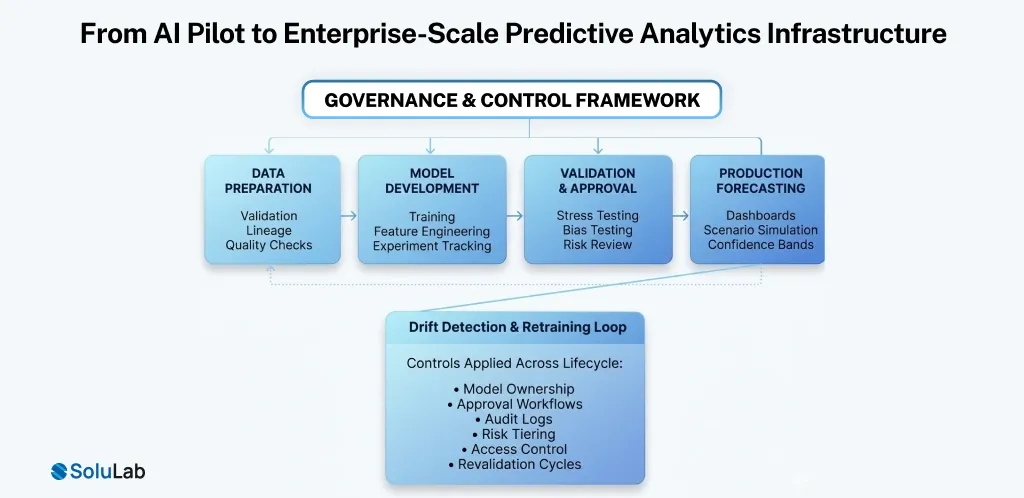
Most AI initiatives do not fail during development.
They stall during scaling.
A pilot forecasting model improves accuracy. A fraud classifier reduces false positives. A demand prediction engine outperforms legacy spreadsheets.
But months later, the system still operates in isolation, disconnected from executive oversight, governance frameworks, and enterprise reporting infrastructure.
Scaling AI requires structural discipline.
Start With Governance Before Expansion
Before expanding predictive systems across departments, enterprises should confirm:
- Clear model ownership is assigned
- Validation workflows are operational
- Drift detection mechanisms are active
- Documentation standards are enforced
- AI governance & compliance controls are embedded
Scaling loosely governed AI multiplies risk.
Scaling governed AI multiplies trust.
Implement a Phased Enterprise Rollout
Enterprise AI rarely succeeds through immediate, organization-wide deployment.
A structured rollout reduces exposure:
Phase 1: Targeted Use Case
- Narrow forecasting objective
- Controlled dataset
- Defined performance baseline
Phase 2: Governance Hardening
- Introduce validation sign-offs
- Implement MLOps automation
- Align with AI compliance solutions for enterprises
- Formalize documentation standards
Phase 3: Operational Integration
- Embed into predictive analytics platforms
- Connect to enterprise reporting automation AI dashboards
- Enable scenario simulation and executive visibility
Phase 4: Portfolio-Level Oversight
- Centralized model inventory
- Cross-model risk tier classification
- Continuous drift monitoring
- Scheduled revalidation cycles
This structure transforms experimental AI into institutional infrastructure.
Embed Continuous Lifecycle Management
AI systems evolve.
Markets change. Data shifts. Behavioral patterns adapt.
Enterprise-grade systems often implemented through top MLOps consulting companies embed lifecycle controls such as:
- Automated drift detection
- Performance threshold alerts
- Retraining workflows
- Governance audit trails
The lifecycle model reinforces a simple truth: AI is not deployed once. It is governed continuously.
Treat AI as Core Infrastructure
The final transition is conceptual.
AI for small businesses is not a feature enhancement. It is infrastructure that influences capital allocation, risk exposure, and executive planning.
Infrastructure demands:
- Maintenance cycles
- Compliance alignment
- Architectural resilience
- Transparent documentation
- Long-term scalability
Organizations that approach predictive systems as infrastructure build a durable advantage. Those who treat AI as experimentation often rebuild within a few years.

When AI Becomes Infrastructure?
Enterprise analytics has moved beyond reporting.
Predictive systems now shape liquidity planning, credit exposure, fraud controls, and revenue strategy. In this environment, intelligence without governance introduces fragility.
AI consulting services provide architectural control. Enterprise ML system design ensures scalability. AI governance & compliance frameworks create defensibility.
The enterprises that lead in AI will not be those with the most complex models.
They will be those who engineer governed, explainable, and compliant predictive systems from the beginning.
Intelligence creates insight.
Governed intelligence creates institutional advantage.
FAQs
Shipra Garg is a tech-focused content strategist and copywriter specializing in Web3, blockchain, and artificial intelligence. She has worked with startups and enterprise teams to craft high-conversion content that bridges deep tech with business impact. Her work translates complex innovations into clear, credible, and engaging narratives that drive growth and build trust in emerging tech markets.