
Key Takeaways
- The Problem -Single-purpose crypto apps are bleeding users to platforms that deliver more value per session. Fragmentation kills retention, and switching costs are shifting toward all-in-one ecosystems.
- The Solution-A well-architected crypto super app consolidates wallet, exchange, DeFi, and payments into one cohesive product, reducing friction while increasing lifetime value.
- How Solulab Helps -We design multi-functional crypto platforms from the ground up, with no duct-tape architecture or brittle integrations, and they are built to scale from day one.
If you’re building in crypto and you’re still thinking in terms of dApps, you’re already one cycle behind. Not because the market is small, it isn’t. The global cryptocurrency market is projected to reach $97.7 billion by 2028, growing at a CAGR of over 11%. And buried inside that number is a shift that most teams are still catching up to: users don’t want five separate crypto apps anymore.
They want one. One wallet, one exchange, one lending desk, one NFT marketplace, one payment layer. All of it, under a single login.
That’s the crypto super app opportunity. And the window is open right now, but not forever. Any top crypto development company building these products today is the one that understood the architecture early, chose the right stack, and didn’t overcomplicate the build.
This article is for founders and CTOs who want to get there without burning a year and a half of runway, figuring it out the hard way.
Why Crypto Super Apps Are Replacing Single-Purpose Crypto Products?
Think about what a typical active crypto user juggles right now.
- A hardware wallet for cold storage.
- A separate DEX for trading.
- Another app for staking.
- A different platform for NFTs.
- An on-ramp service to convert fiat.
Most users have four to six apps running in parallel, and every one of them asks for KYC, gas fees, seed phrase backups, and a learning curve.
That fragmentation is costing product companies and users. Hard.
The application of blockchain technology at this stage of the market isn’t just about adding Web3 features; it’s about reducing the friction that makes everyday crypto usage feel like work. Super apps collapsed this in mobile banking.
Grab and WeChat did it across Southeast Asia. The same consolidation is happening in crypto, and the top blockchain trends for 2025–2026 consistently point to aggregation and multi-service platforms as the category with the most durable growth.
For founders evaluating this space, the decision isn’t whether to build a super app. It’s whether to build now, while the category is still forming, or later, when the incumbents have locked in users.
What Is a Crypto Super App?
A crypto super app is a single mobile or web application that combines multiple crypto services into one unified experience. We’re talking about a wallet, a spot and derivative exchange, a DeFi dashboard, an NFT marketplace, a fiat on/off ramp, cross-chain bridging, lending, staking, and sometimes even social or identity features – all accessible from the same account, the same interface, and the same key management system.
What is a crypto super app in practice is a product architecture challenge as much as a feature question. The features aren’t particularly exotic on their own, as wallets exist, DEXs exist, and NFT platforms exist.
The hard part is integrating them so they feel like one product rather than five apps wrapped in a skin. That requires deliberate architectural thinking from day one, not a patchwork of integrations bolted together as the product grows.
The most referenced examples, like Binance App, Coinbase Wallet, and OKX, each started narrower and expanded. But the teams building now have the advantage of learning from that evolution and architecting for the full scope upfront. A Crypto super app by 2026 standards will become a platform that feels as natural to use as a mobile banking app, which means the UX bar should be high, and the infrastructure needs to hold up under millions of concurrent sessions
Key Benefits of Building a Crypto Super App for Modern Web3 Products
The benefits of crypto super apps are clearest when you look at retention and monetization data side by side.
A standalone crypto wallet keeps users for an average of 4–6 months before churn sets in. A multi-service platform like one with staking, trading, and lending in the same session keeps users significantly longer because every new feature is a reason to come back.
Binance’s own data from 2023 showed that users who use three or more platform features have a 3x higher 12-month retention rate than single-feature users. That’s not a coincidence; that’s architecture producing business outcomes.
Beyond retention, the benefits of crypto super apps compound on the revenue side.
- A user who trades also stakes.
- A user who stakes also borrows against their position.
- A user who borrows converts fiat through your on-ramp.
Each feature creates a natural next action, and each natural next action generates a fee. The monetization flywheel on a well-built super app is genuinely different from what a single-product crypto business can achieve.
There’s also a cost efficiency argument for enterprises. Enterprise blockchain solutions that consolidate multiple services under one infrastructure are cheaper to maintain, audit, and scale than running separate codebases, separate security reviews, and separate compliance programs for each product.
The benefits of crypto super apps ultimately come down to this: you’re not building five products. You’re building one platform that earns, like, 5 products.
Real-World Crypto Super App Use Cases Across Industries
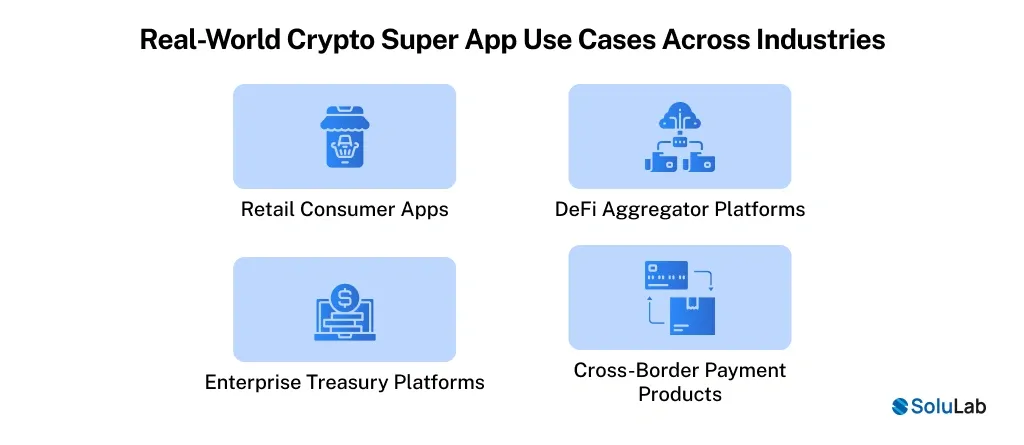
The crypto super app use cases that are generating revenue right now span more categories than most teams expect.
1. Retail Consumer Apps
Combining a non-custodial wallet, spot trading, and a fiat on-ramp serves the 400+ million global crypto users who are still navigating between apps to complete a single transaction flow. Consolidating that into one product is a genuine UX improvement with measurable conversion benefits.
2. DeFi Aggregator Platforms
Pulling yield from multiple protocols, showing users the best staking rates across chains, and executing through a single interface. Products like Zapper and DeBank proved this model, as the gap is in combining this with trading and fiat access.
3. Cross-Border Payment Products
Stablecoin-based remittance with a built-in exchange layer. Particularly relevant for Southeast Asia, Sub-Saharan Africa, and Latin America, where corridor fees from traditional remittance services run 5–8%. Blockchain development use cases in this category are among the fastest-growing segments, per the World Economic Forum’s 2024 Financial Inclusion Report
4. Enterprise Treasury Platforms
Multi-sig wallets, DeFi yield on idle corporate treasury, compliance reporting, and stablecoin payments in one interface. The application of blockchain technology in treasury management is moving from pilot to production for mid-market and enterprise companies.
What Makes or Breaks a Crypto Super App When You’re Building for Scale?
Most super app launches fail not because the features were wrong, but because one of these three things wasn’t handled before go-live.
1. Key Management
Non-custodial super apps that hand users full control of their private keys are technically correct but practically fragile, as most users lose access within 12 months. Custodial models that don’t meet regulatory standards get shut down or frozen. The right answer lives in the middle: MPC wallets and social recovery mechanisms that balance user control with recoverability. And teams that skip this conversation in architecture review pay for it in support tickets, user loss events, and regulatory problems.
2. Liquidity.
A DEX inside a super app is worthless without liquidity depth. Thin order books produce bad fills, bad fills produce bad reviews, and bad reviews produce churn. Crypto super app architecture needs to account for liquidity sourcing, whether that’s through aggregators like 0x or 1inch, through direct market maker relationships, or through a hybrid model, before the trading module goes into production.
3. Compliance.
Crypto regulation is moving fast across the US, EU, and Asia-Pacific. A crypto super app development company that builds without a KYC/AML infrastructure baked in isn’t saving you money; it’s adding regulatory risk that shows up later as a much higher cost.
Core Features of a Crypto Super App Built for Scale and Adoption
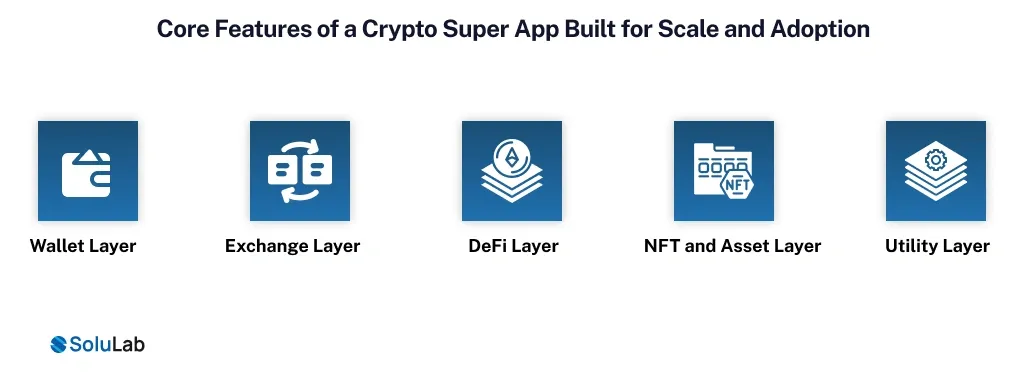
The features of crypto super apps that matter, the ones users actually keep apps for organizing into five layers
1. Wallet Layer
- Multi-chain non-custodial or MPC wallet
- Hardware wallet support (Ledger, Trezor)
- Social recovery and backup mechanisms
- Portfolio view across all connected wallets
2. Exchange Layer
- Spot trading with the order book or AMM model
- Derivatives and perpetuals (for regulated markets)
- Cross-chain swaps via bridge aggregators
- Fiat on/off ramp via card or bank transfer
3. DeFi Layer
- Staking and yield aggregation across protocols
- Lending and borrowing with collateral management
- Liquidity pool participation
- Real-time APY comparison across chains
4. NFT and Asset Layer
- Minting, buying, and selling across major marketplaces
- In-app NFT gallery and portfolio tracking
- Royalty management for creators
5. Utility Layer
- Push notifications and price alerts
- In-app Web3 browser
- dApp connectivity (WalletConnect, MetaMask-compatible)
- Social features, referrals, and rewards
The features of crypto super apps that separate high-retention products from abandoned ones are almost always in the utility layer, the small things that make daily use feel effortless. Notifications, one-tap actions, smart suggestions based on portfolio composition

How Everything Works Together in Crypto Super App Architecture?
Crypto super app architecture is a three-layer problem: the blockchain layer, the middleware layer, and the application layer. Each has to be built with the other two in mind, or you end up with a platform that works fine in demo but breaks under production load.
1. Blockchain Layer
Smart contracts for DeFi features, token standards (ERC-20, BEP-20), bridge contracts for cross-chain interoperability, and on-chain governance if the product has a token. EVM-compatible chains like Ethereum, BSC, and Polygon are the most practical choices because the audit tooling and developer ecosystem are mature.
2. Middleware Layer
This is where most complexity lives. Node infrastructure (via Alchemy or QuickNode for reliability and uptime), indexing via The Graph or custom indexers for fast data retrieval, price oracles (Chainlink for production-grade reliability), and KYC/AML providers (Jumio, Sumsub, Chainalysis).
The middleware layer is what makes the app feel fast and responsive, as slow middleware might be the reason most crypto apps feel laggy even when the on-chain components are working correctly.
3. Application Layer
Mobile (React Native or Flutter for cross-platform), web frontend (React or Next.js), and backend APIs (Node.js or Go for performance under concurrent load). This is where UX decisions get made and where the gap between a good crypto product and a great one lives.
A good blockchain development services architect addresses all three layers in the same conversation, not sequentially or in isolation.
How to Select the Best Tech Stack for Your Crypto App?
The best tech stack for crypto apps isn’t a single answer, it depends on which chains you’re supporting, what volume you’re designing for, and whether the product is custodial or non-custodial.
But for a full-featured crypto super app in 2026-2027, the stack that experienced teams consistently converge on looks like this:
| Layer | Technology | Why |
| Smart Contracts | Solidity (EVM chains) | Largest audit ecosystem, EVM compatibility across BSC, Polygon, and ETH |
| Node Infrastructure | Alchemy / QuickNode | 99.9% uptime SLAs, multi-chain support, faster than self-hosted |
| Indexing | The Graph | Decentralized, performant, production-tested at scale |
| Price Oracles | Chainlink | Industry standard, tamper-resistant, cross-chain |
| Mobile Frontend | React Native | Single codebase for iOS/Android, large talent pool |
| Web Frontend | Next.js | SEO-friendly, fast, good Web3 library ecosystem |
| Backend | Node.js / Go | Go for high-concurrency exchange components; Node for API layers |
| Database | PostgreSQL + Redis | Relational for transaction records; Redis for session and caching |
| KYC/AML | Sumsub / Chainalysis | Global coverage, API-first, compliance-ready documentation |
The best tech stack for crypto apps is the one your team can build, audit, and maintain, not the most technically impressive one.
Essential Security Features and Compliance for Crypto Super Apps
Security features for crypto apps are not optional line items to be scoped out when the budget gets tight. They are the product.
The numbers here are sobering. According to Chainalysis’s 2024 Crypto Crime Report, over $1.7 billion was lost to DeFi hacks in 2023 alone, and the majority were smart contract exploits that a proper pre-launch audit would have caught. Users who lose funds don’t write angry reviews; they sue, they post threads that go viral, and they never come back.
The security features for crypto apps that need to be built in from sprint one, not added before launch:
- Smart contract audits — CertiK, Hacken, or Trail of Bits for production contracts. Never ship unaudited.
- Multi-party computation (MPC) key management — Distributes private key shards so no single point of failure exists, custodial or non-custodial.
- Two-factor authentication — Hardware key support (YubiKey), authenticator apps, and biometric fallback.
- Anti-phishing measures — Domain monitoring, SSL/HSTS enforcement, and anti-spoofing email headers.
- Transaction signing confirmation — Human-readable transaction summaries before any on-chain action executes.
- Chainalysis or Elliptic integration — Real-time wallet screening against OFAC, sanctions lists, and known exploit addresses.
Compliance varies by jurisdiction, but the baseline in most markets is KYC at onboarding, AML transaction monitoring, and VASP registration, where applicable. Our Blockchain consulting services that address regulatory architecture before product design are leaving a significant risk on the table.
Challenges in Crypto App Development Every Founder Should Know
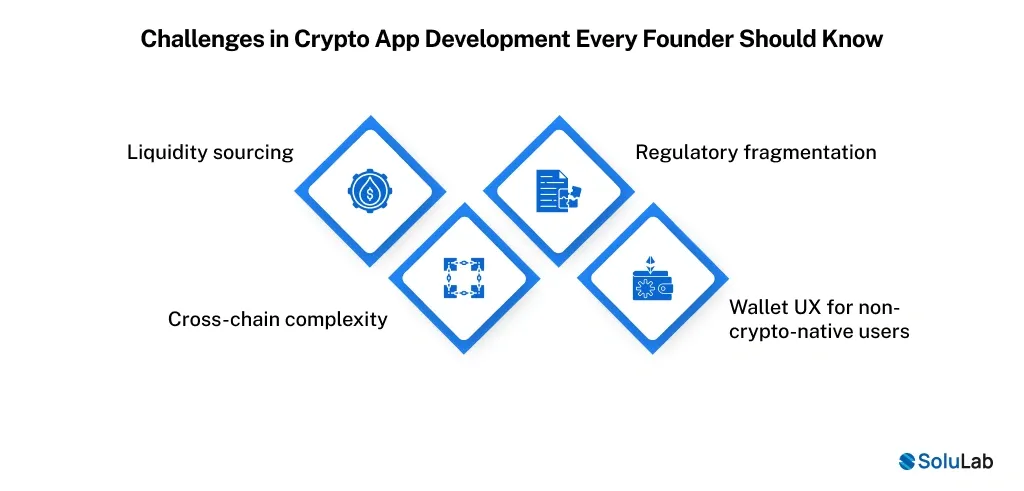
The challenges in crypto app development that actually delay or derail products aren’t usually technical. They’re architectural and organizational.
1. Liquidity sourcing
Building a DEX or exchange feature without a liquidity strategy produces a ghost market. This needs to be solved before the trading module goes live, not after.
2. Regulatory fragmentation
Different rules in different markets mean the compliance architecture needs to be modular enough to turn features on or off by jurisdiction. A US user, an EU user, and a Singapore user may not have access to the same features, and the product needs to handle that cleanly.
3. Cross-chain complexity
Every additional chain in the product adds surface area for bridge exploits, oracle manipulation, and smart contract risk. The challenges in crypto app development multiply non-linearly as chains are added. So, start with two or three chains and expand based on user demand rather than pre-building for every chain.
4. Wallet UX for non-crypto-native users
The mainstream market doesn’t understand seed phrases or gas fees. Abstraction layers that hide this complexity are necessary for consumer products, but add technical depth that needs to be scoped carefully.

Step-by-step guide on How to Develop a Crypto Super App That Scales
How to develop a crypto super app is a phased process, and the phasing is deliberate, not a waterfall model, but a staged build where each phase ships a working product before the next is started.
Phase 1 — Architecture and Compliance Design (Weeks 1–4)
Chain selection, wallet architecture (custodial, non-custodial, or MPC), regulatory mapping by target market, tech stack decision, and third-party service selection. This is where blockchain consulting investment pays the highest return.
Phase 2 — Core Wallet and Exchange (Weeks 5–16)
Non-custodial wallet with multi-chain support, spot trading with DEX aggregator integration, and fiat on-ramp via a regulated partner (MoonPay, Transak, or Stripe Crypto). KYC/AML flows built in from day one. This is the MVP, as something that can be tested with real users.
Phase 3 — DeFi and Staking Layer (Weeks 17–24)
Staking integrations, yield aggregation, lending protocol connectivity, and cross-chain bridge integration. A third-party security audit should be running in parallel with this phase.
Phase 4 — NFT and Advanced Features (Weeks 25–32)
NFT marketplace integration, social features, notification systems, and a web3 browser. Mainnet deployment with staged rollout.
Phase 5 — Optimization and Scale (Ongoing)
Indexing improvements, response time optimization, new chain support, and feature expansion based on actual user behavior data.
How to develop a crypto super app correctly means never skipping Phase 1 to save time because everything built in Phases 2 through 5 sits on the decisions made there.
How Much Does It Cost to Build a Crypto Super App?
The cost breakdown of crypto app development is the question every founder eventually asks, and the honest answer is it depends, but here’s a real range based on scope.
| Build Scope | Estimated Cost | Timeline |
| MVP – Wallet + Spot Exchange + Fiat On-Ramp | $60000–$120,000 | 4–6 months |
| Mid-Tier – Above + DeFi Layer + Staking + KYC | $130,000–$250,000 | 6–9 months |
| Full Super App – All Features + NFT + Cross-Chain + Audit | $260,000–$350,000+ | 9–15 months |
The cost to build a crypto super app is most reliably estimated after a proper architecture scoping session, not before. Vague estimates provided before the scope is defined are almost always low, and the overruns show up at the worst possible time: when the product is partially built and replacing the development partner would cost even more.
Key cost drivers in the cost breakdown of crypto app development are security audits ($15,000–$50,000 per audit cycle), third-party API licensing (node providers, oracle services, KYC vendors), multi-chain support (each additional chain adds 15–25% to smart contract scope), and ongoing compliance maintenance as regulations evolve.
The blockchain development cost for a well-architected super app is high, but the cost of launching a poorly architected one is higher every time. Working with experienced blockchain solution providers in USA can also help mitigate hidden costs through proper scoping.
Finding the Right Crypto Super App Development Company for Your Project
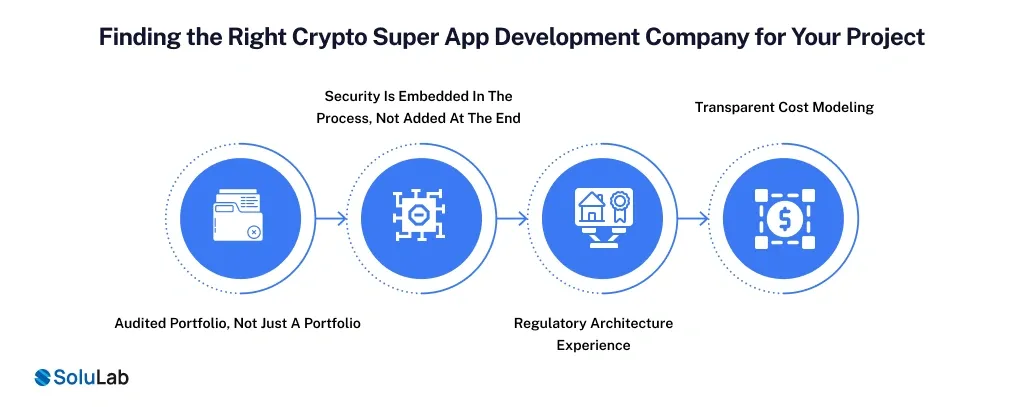
Picking the right crypto super app development company is where most enterprises and funded startups underinvest in due diligence and overpay later for rebuilds and fixes.
The markers that actually matter when evaluating a blockchain company for crypto development:
1. Audited portfolio, not just a portfolio.
Any team can show you a demo. Ask for the CertiK or Hacken audit reports on their prior production contracts. If they’ve never shipped audited work, that’s a signal.
2. Security is embedded in the process, not added at the end.
A credible crypto development company builds audit cycles into the sprint structure. If a partner is quoting you a launch timeline without an audit phase, ask why.
3. Regulatory architecture experience.
KYC/AML integration is not a form field. It’s a compliance program embedded in the product. Make sure the team has done it before in your target markets.
4. Transparent cost modeling.
The cost to build a crypto super app should be broken down by phase, with risk ranges explained. Flat quotes without scope documentation are a red flag.
Blockchain companies that do this well bring consulting depth into the engagement, not just execution capacity. A good blockchain development services partner tells you when your architecture needs to change before it becomes a production problem, not after.
The crypto exchange development solutions space is crowded with vendors who can write Solidity. The ones worth partnering with are the ones who understand why certain architectural decisions cost you users, revenue, or regulatory standing and raise those concerns before the build starts. So, work with SoluLab to get a bit more clarity.

Conclusion
The crypto super app category is real, the demand is there, and the infrastructure to build these products has never been more mature. But the teams that win won’t be the ones who build the most features; they’ll be the ones who architected for security, compliance, and scale before they wrote the first line of production code.
The cost to build a crypto super app is significant. But the cost of building one poorly through an exploit, a regulatory shutdown, or a fragile architecture that can’t handle growth is almost always higher. The difference between those two outcomes lies in the decisions made in the first four weeks of an engagement.
If you’re serious about crypto super app development and want to understand what a real build scope and cost looks like for your product, start with the blockchain solution providers in USA for a conversation now!
FAQs
With over 3 years of experience, I specialize in breaking down complex Web3 and crypto concepts into clear, actionable content. From deep-dive technical explainers to project documentation, I help brands educate and engage their audience through well-researched, developer-friendly writing.