![How Much Does It Cost To Create a Base Token? [2026 Guide]](https://www.solulab.com/wp-content/uploads/2025/02/Create-a-Base-Token.webp)
Key Takeaways
- Base blockchain offers lower gas fees and faster execution than the Ethereum mainnet.
- Base token development costs usually start at $2,000 and can exceed $80,000, depending on the features and compliance requirements.
- ERC-20 token standards make Base ideal for DeFi services, meme coins, utility tokens, and the tokenization of real-world assets.
- AI-native development strategy helps improve token security, monitoring, analytics, and automation.
- The CLARITY Act is pushing crypto projects toward better compliance, transparency, and token classification.
Base blockchain has become one of the strongest ecosystems for launching scalable crypto products because it combines Ethereum-grade security with lower gas fees and faster transaction execution. From DeFi services and meme coins to real world asset tokenization, startups are actively exploring Base token development to build utility-driven blockchain ecosystems without heavy infrastructure costs.
The growing demand for Base tokens is also connected to AI-native applications, digital asset ownership, and enterprise-grade tokenization models. Whether businesses want to create a Base token for
- fundraising,
- governance,
- payments,
- asset tokenization services,
Understanding the technical architecture, compliance requirements, and Base token development cost is essential before launch.
A well-built token works like engineered steel beneath a skyscraper: invisible, but carrying everything above it.
What Is a Base Token?
A Base token is a cryptocurrency token deployed on the Base blockchain using the ERC-20 token standards.
However, in this era, ERC-3643 introduces a permissioned transfer architecture. This is where token movement depends on identity verification layers rather than manual compliance reviews. This allows Base token ecosystems to automate investor restrictions directly at the smart contract level.
These tokens can represent:
- Utility access
- Governance rights
- Digital payments
- Real world asset tokenization
- Gaming assets
- Community rewards
- Equity-backed digital assets
Because Base is Ethereum-compatible, developers can use familiar smart contract frameworks while getting lower fees and better scalability.
Popular use cases include:
- Utility Tokens: Used inside platforms for payments, rewards, and feature access.
- Governance Tokens: Allow token holders to vote on protocol upgrades and treasury decisions.
- Meme Coins: Community-driven tokens built around internet culture and social engagement.
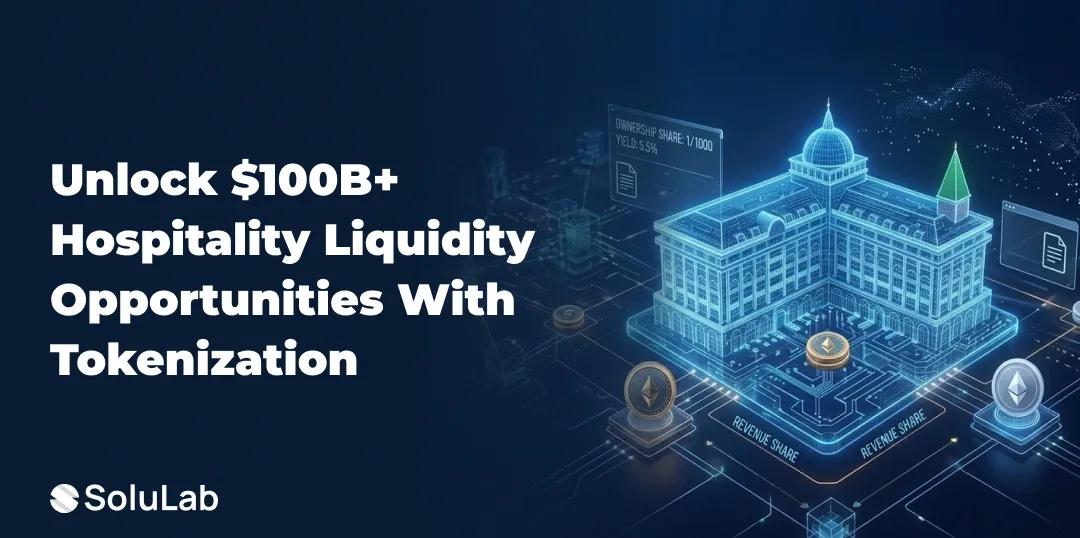
- RWA Tokenization: Used for the tokenization of assets such as real estate, invoices, gold, or private equity.
- AI-Native Applications: AI-powered ecosystems often use Base tokens for automated workflows, access control, and machine-to-machine payments.
Base Token Development Cost in 2026
The cost to create a Base token depends on features, compliance requirements, security layers 2, and infrastructure complexity.
Here’s a simple breakdown:
| Development Scope | Estimated Cost |
| Basic ERC-20 Token | $2,000 – $5,000 |
| Meme Coin Development | $5,000 – $12,000 |
| DeFi Token with Staking | $10,000 – $25,000 |
| AI-Native Token Ecosystem | $20,000 – $45,000 |
| Asset Tokenization Platform | $15,000 – $30,000+ |
The final cost usually depends on how much logic and automation your token carries.
A simple token is like printing tickets, while a complete token ecosystem is more like building an airport around those tickets.
7 Major Factors Affecting Base Token Development Cost
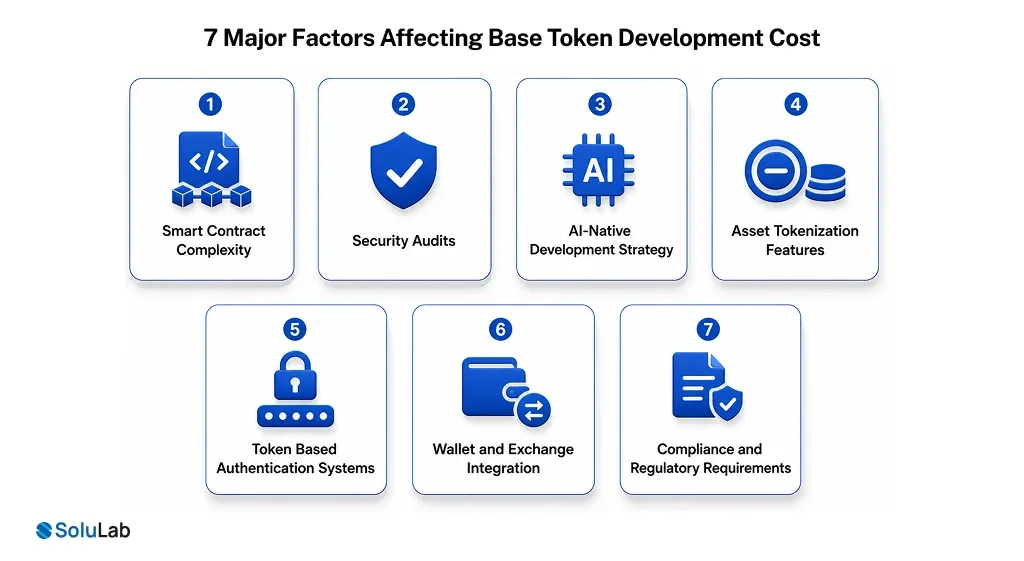
1. Smart Contract Complexity
Complex smart contracts require more audits and testing, which increases cost. Choosing the correct token standard affects scalability, interoperability, and future integrations.
| Smart Contract Standard | Purpose | Common Use Cases | Key Technical Advantages |
| ERC-20 | Standard for fungible cryptocurrency tokens | Utility tokens, governance assets, DeFi services, payment ecosystems | High wallet compatibility, smooth exchange listings, strong interoperability across DeFi protocols and crypto wallets |
| ERC-721 | Standard for non-fungible digital assets | NFT marketplaces, gaming ecosystems, digital collectibles | Unique token ownership, metadata support, secure asset authentication |
| ERC-1155 | Multi-token standard supporting fungible and non-fungible assets in one contract | Gaming economies, hybrid token ecosystems, asset tokenization platforms | Lower gas fees, batch transaction support, efficient smart contract management |
| ERC-3643 | Compliance-focused token standard for regulated digital assets | Real world asset tokenization, security tokens, institutional investment platforms | KYC enforcement, transfer restrictions, identity-linked ownership, regulatory compliance support aligned with frameworks like the CLARITY Act |
2. Security Audits
Security is not optional in blockchain projects.
A single smart contract vulnerability can drain millions within minutes.
Professional token development companies perform:
- Smart contract audits
- Penetration testing
- Wallet security reviews
- Access control verification
- Liquidity lock checks
Security audits alone may cost between $3,000 and $20,000, depending on project size.
3. AI-Native Development Strategy
Many blockchain startups now combine AI-native solutions with token ecosystems.
AI can help with:
- Fraud detection
- Trading automation
- Risk scoring
- Customer support
- Smart analytics
- Automated treasury management
An AI-native architecture adds development layers such as:
- AI model integration
- API infrastructure
- Data pipelines
- Real-time monitoring
This increases development costs but creates stronger long-term utility.
4. Asset Tokenization Features
Projects focusing on digital asset tokenization require more legal and technical infrastructure.
For example:
- Real estate tokenization
- Invoice financing
- Gold-backed tokens
- Carbon credit tokenization
These projects need:
- KYC integration
- AML verification
- Investor dashboards
- Compliance modules
- Fractional ownership logic
RWA tokenization projects usually cost more because they connect blockchain systems with real-world legal ownership.
5. Token Based Authentication Systems
Many blockchain applications now use token based authentication for secure access management.
This allows users to:
- Access apps through wallets
- Verify ownership
- Control permissions securely
- Reduce password dependence
Adding authentication systems increases backend development requirements.
6. Wallet and Exchange Integration
If you plan to launch a Base token publicly, exchange and wallet compatibility become essential.
Most projects integrate with:
- MetaMask
- Coinbase Wallet
- WalletConnect
- Crypto exchange platforms
Liquidity setup, DEX deployment, and trading infrastructure add additional development costs.
7. Compliance and Regulatory Requirements
Regulation is becoming a bigger part of crypto development.
The proposed CLARITY Act in the United States focuses on:
- Defining digital asset classifications
- Separating securities from commodities
- Increasing disclosure requirements
- Protecting retail investors
For blockchain startups, this means compliance planning is now part of token development itself.
Projects offering RWA tokenization or investment-based tokens often need:
- Legal review
- KYC systems
- AML compliance
- Jurisdiction screening
- Investor verification
Compliance costs may range from $5,000 to over $50,000, depending on geography and business model.
Read more – Tokenization of base metals
Why Base Blockchain Fits Real World Asset Tokenization?
Real world asset tokenization requires blockchain infrastructure capable of handling ownership records, compliance workflows, and frequent asset transfers without creating high operational costs.
Base blockchain supports these requirements because of its scalable Layer-2 architecture and Ethereum interoperability.
Technical Requirements for RWA Tokenization
A complete asset tokenization platform usually includes:
- Smart contracts for ownership representation
- Investor verification modules
- Compliance engines
- Stablecoin settlement systems
- Custody integrations
- Secondary marketplace functionality
For example, in real estate tokenization, each digital token may represent fractional ownership of a property asset. Smart contracts automatically distribute rental income, maintain ownership records, and manage investor transfers.
Why Base Blockchain Reduces RWA Costs?
Lower Settlement Costs
Frequent ownership transfers become economically feasible because Base transaction fees remain significantly lower than Ethereum mainnet.
Faster Asset Transfers
Transaction finality improves investor experience during secondary trading.
Better Smart Contract Efficiency
Complex token logic, such as:
- Dividend distribution
- Revenue sharing
- Compliance restrictions
- Vesting schedules
can execute more efficiently on Layer-2 infrastructure.
AI-Native Asset Monitoring
AI-native applications can monitor tokenized assets continuously for:
- Valuation changes
- Investor concentration risks
- Transaction anomalies
- Liquidity movement
- Compliance breaches
This becomes increasingly important as institutions enter the digital asset tokenization market.
How to Create a Base Token With Less Cost and MVP Features
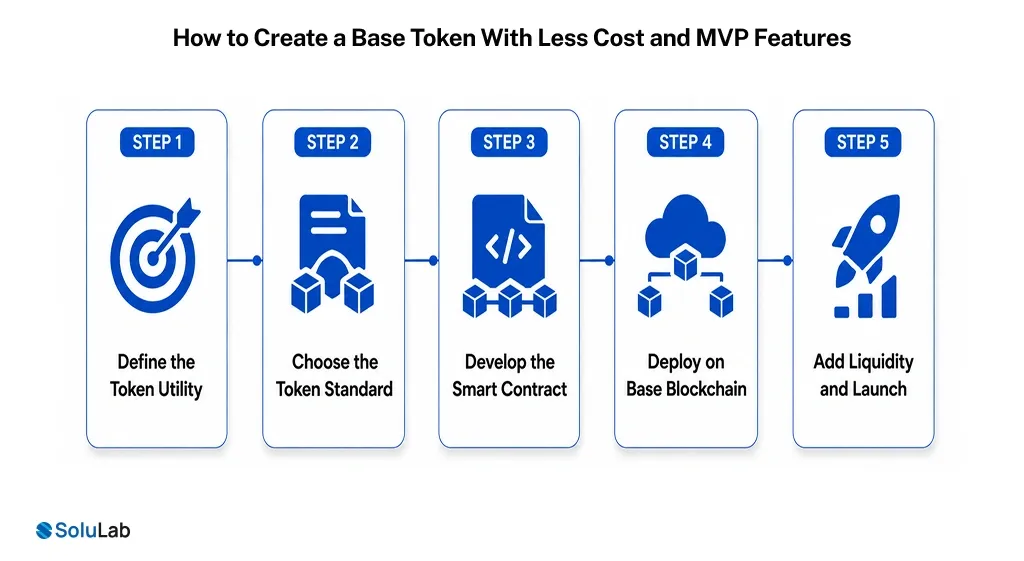
There are several ways to create, but you need technical support. So, partnering with a token development company is a better choice, which follows the process below.
Step 1: Define the Token Utility
Start with one question: Why should people use your token?
Your utility may include:
- Payments
- Governance
- Rewards
- Access control
- Asset ownership
- AI-native applications
Without utility, most tokens struggle to survive beyond initial hype.
Step 2: Choose the Token Standard
Most Base tokens use the ERC-20 token standard because it is compatible with the Ethereum infrastructure.
ERC-20 tokens support:
- Wallet compatibility
- DEX trading
- Smart contract interoperability
- DeFi integration
Step 3: Develop the Smart Contract
This is where blockchain developers write the token logic.
The contract controls:
- Supply
- Transfers
- Fees
- Governance
- Security restrictions
Professional crypto development services also test contracts extensively before deployment.
Step 4: Deploy on Base Blockchain
Once tested, the token is deployed to the Base blockchain.
Deployment costs on Base are much lower than Ethereum mainnet, which makes it attractive for startups.
Step 5: Add Liquidity and Launch
After deployment, projects usually:
- Create liquidity pools
- List on decentralized exchanges
- Start marketing campaigns
- Build communities
- Launch staking or rewards
This phase often decides whether the token gains traction or disappears quietly.

Conclusion
The construction of smart contracts, security audits, gas costs, marketing, and exchange listings are some of the expenses associated with creating a Base token. A completely customized, audited, and market-ready token may cost $10,000 or more, but a basic Base token can be purchased for as low as $500 to $2,000. The intricacy of your project, security requirements, and marketing initiatives all affect the ultimate cost.
To guarantee security, scalability, and success in the cryptocurrency market, it’s critical to carefully evaluate your budget and professional help while launching your Base token.
Token World, a crypto launchpad platform wanted a secure and scalable platform for token sales while staying compliant and transparent. SoluLab a blockchain development company stepped in to create a tailored launchpad with features like submission forms, review systems, secure transactions, dashboards, multi-language support, and blockchain integration. This solution helped Token World simplify processes, meet regulations, build trust, and handle high traffic effectively, enabling smooth and successful token launches worldwide.
FAQS
Deepika is a content writer who blends storytelling with strategic thinking. She explores topics across digital innovation, emerging tech, and the evolving blockchain industry. She enjoys breaking down complex ideas into simple, engaging narratives in the growing global markets.