Everyone wants to build a Generative AI solution in 2026—but few founders know what it will actually cost. One team gets an AI MVP built for $40,000, while another spends over $250,000 on a similar idea and still struggles to achieve product-market fit.
The challenge isn’t just Generative AI development; it’s understanding how model selection, infrastructure, integrations, data pipelines, and scaling requirements impact the final budget. With worldwide AI spending projected to reach $2.59 trillion in 2026, up 47% year-over-year, businesses are investing aggressively in AI innovation.
But without a clear cost roadmap, it’s easy to overspend and underdeliver. In this guide, we’ll break down the real cost of building a Generative AI solution and what factors influence your investment.
Key Takeaways
- Generative AI development costs vary widely, ranging from $20,000 for simple MVPs to $50,000+ for enterprise-grade AI platforms and multi-agent systems.
- Project complexity, AI model selection, integrations, data requirements, and infrastructure are the biggest factors influencing overall development costs.
- Using pre-trained models and RAG architectures can significantly reduce costs compared to building or fine-tuning custom foundation models.
- Hidden expenses such as API usage, cloud hosting, monitoring, maintenance, and compliance should be factored into long-term budgeting.
- Partnering with an experienced Generative AI development company can help businesses optimize costs, accelerate deployment, and maximize ROI from AI investments.
Understanding the Cost Spectrum of Generative AI Development
Generative AI adoption is accelerating across industries, but development costs can vary significantly based on project scope, complexity, infrastructure, and deployment requirements. Understanding the cost of implementing generative AI helps businesses plan their budgets, evaluate ROI, and choose the right development approach.
1. Proof of Concept (PoC) or MVP
Estimated Cost: $25,000 – $35,000
Ideal for validating feasibility, testing use cases, and measuring potential ROI before large-scale investment.
Includes:
- OpenAI or open-source LLM integration
- Basic fine-tuning or prompt engineering
- API integrations
- Limited dataset usage
- Cloud hosting setup
This stage focuses on rapid experimentation and business validation.
2. Production-Ready Generative AI Solution
Estimated Cost: $40,000 – $50,000
Designed for businesses ready to deploy AI solutions into real-world workflows and customer-facing applications.
Includes:
- Advanced model customization and fine-tuning
- RAG (Retrieval-Augmented Generation) implementation
- Scalable cloud infrastructure
- Enterprise system integrations (CRM, ERP, CMS, etc.)
- Security, compliance, and monitoring features
- User interface and workflow automation development
This stage prioritizes performance, scalability, reliability, and measurable business outcomes.
3. Enterprise-Grade AI Platform
Estimated Cost: $50,000 +
Built for large organizations requiring highly customized, secure, and scalable AI ecosystems across multiple departments or business units.
Includes:
- Custom model training and optimization
- Multi-agent AI architecture
- Large-scale data pipelines and governance frameworks
- Advanced security and compliance controls
- MLOps and continuous model management
- Multi-cloud or hybrid-cloud deployment
- Enterprise-wide integrations and analytics
What Affects Generative AI Development Cost in 2026?
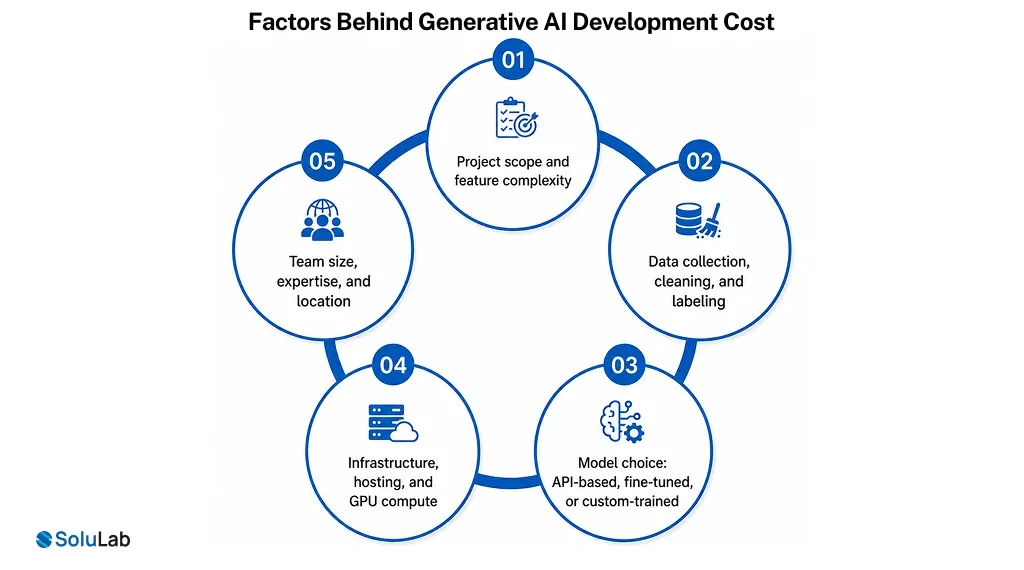
AI development costs in 2026 depend on multiple factors, including project complexity, data quality, infrastructure requirements, and team expertise. Understanding these variables helps businesses plan budgets and avoid unexpected expenses.
1. Project scope and feature complexity
The broader the project scope and feature set, the higher the development effort, timeline, and investment required.
- Advanced AI-powered functionalities
- Multiple system integrations required
- Complex user workflow automation
2. Data collection, cleaning, and labeling
Data preparation is often one of the most time-consuming stages and plays a major role in the overall cost to develop a generative AI application.
- Large-scale data collection efforts
- Dataset cleaning and validation
- Annotation and labeling processes
3. Model choice: API-based, fine-tuned, or custom-trained
The selected model approach significantly influences performance, customization capabilities, and the generative AI software development cost.
- Third-party API model access
- Domain-specific model fine-tuning
- Custom model training requirements
4. Infrastructure, hosting, and GPU compute
AI solutions require robust infrastructure to support training, deployment, security, and ongoing model operations.
- Cloud hosting and deployment
- GPU-intensive computing resources
- Ongoing monitoring and scaling
5. Team size, expertise, and location
Development costs vary based on the experience level, specialization, and geographic location of the professionals involved in the project. This directly impacts the generative AI platform development cost.
- AI engineers and developers
- Data science specialists involved
- Regional hiring cost differences
Generative AI Cost Breakdown by Project Type
| Project Size | Estimated Cost | Best For | Typical Features |
| MVP or proof of concept | $25,000 – $45,000 | Startups and early validation | Basic LLM integration, prompt engineering, limited data usage |
| Small-scale application | $25,000 – $35,000 | Department-level automation | Chatbots, content generation, workflow automation |
| Mid-sized business solution | $40,000 – $50,000 | Growing businesses | Custom workflows, RAG implementation, API integrations |
| Large-scale AI platform | $50,000+ | Enterprises with complex operations | Fine-tuned models, advanced security, multi-user access |
| Enterprise-grade platform | $50,000+ | Large organizations | Custom AI architecture, governance, compliance, analytics |
| Custom-trained foundation model | $50,000+ | Organizations requiring proprietary AI | Large-scale training, dedicated infrastructure, MLOps |
Strategic Budget Planning for Generative AI Projects
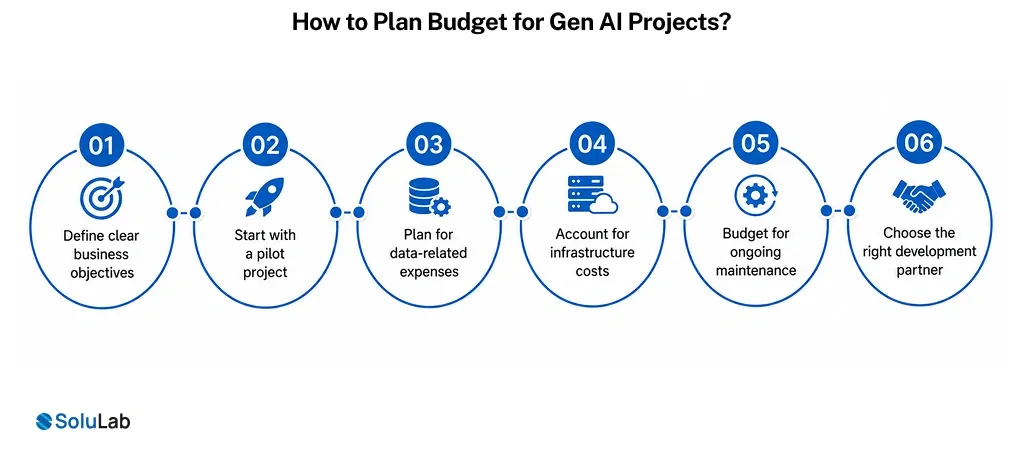
Generative AI projects require careful financial planning to balance innovation, scalability, and long-term value. A strategic budget helps organizations control costs while maximizing business impact and ROI.
1. Define clear business objectives
Start by identifying measurable goals and expected outcomes before allocating resources to development and deployment.
- Align AI with business goals
- Set measurable success metrics
- Prioritize high-value use cases
2. Start with a pilot project
A proof of concept (POC) implementation helps validate assumptions, reduce risks, and estimate future investment requirements.
- Test feasibility before scaling
- Minimize initial investment risks
- Validate expected business outcomes
Read More: How to Build AI PoC?
3. Plan for data-related expenses
Data preparation, management, and governance costs should be included from the beginning of the project.
- Budget for data collection
- Include labeling and cleaning
- Ensure data quality standards
4. Account for infrastructure costs
AI workloads require ongoing investments in cloud resources, storage, and computing power.
- Estimate cloud resource usage
- Include GPU computing expenses
- Plan long-term hosting costs
5. Budget for ongoing maintenance
Generative AI systems need continuous monitoring, updates, and optimization after deployment.
- Monitor model performance regularly
- Schedule updates and improvements
- Allocate support and maintenance
6. Choose the right development partner
Working with experienced generative AI development companies can reduce implementation risks and improve project efficiency.
- Evaluate industry expertise carefully
- Review previous AI projects
- Compare engagement and pricing
Some Generative AI Use Cases and Applications with Cost
Generative AI is changing industries by automating content creation, enhancing customer experiences, and streamlining operations. However, costs vary based on complexity, integrations, data requirements, and deployment scale.
| Use Case | Application | Estimated Cost |
| AI chatbot and virtual assistant | Customer support, lead generation, FAQ automation | $25,000 – $30,000 |
| AI content generation platform | Blog writing, marketing copy, social media content | $30,000 – $40,000 |
| Generative AI in retail | In generative AI in retail get personalized recommendations, virtual shopping assistants | $50,000+ |
| Enterprise knowledge assistant | Internal search, employee productivity, document retrieval | $40,000 – $50,000+ |
| AI healthcare assistant | Clinical documentation, patient communication, workflow automation | $40,000 – $50,000+ |
| Multi-agent AI platform | End-to-end business process automation | $50,000+ |
Emerging Trends Impacting Generative AI Costs in 2026
Generative AI development costs are evolving as new technologies reshape how applications are built, deployed, and scaled. Understanding these trends helps businesses make smarter investment decisions in 2026.
1. Explosion of agentic workflows
Businesses are increasingly adopting AI agents that can perform tasks autonomously, creating new cost considerations around orchestration, monitoring, and scalability.
- Autonomous task execution capabilities
- Advanced workflow orchestration systems
- Increased operational efficiency gains
2. The rise of multi-model routing
Organizations are combining multiple AI models to optimize performance and costs by selecting the most suitable model for each task.
- Dynamic model selection mechanisms
- Improved cost-performance optimization
- Enhanced response quality outcomes
3. AI-native engineering
Development teams are building products with AI at their core rather than adding AI as a feature, changing infrastructure and development requirements.
- AI-first product development approach
- Integrated application architecture
- Faster software delivery cycles
Partnering with an experienced generative AI development firm can help businesses navigate these emerging trends while controlling costs and maximizing long-term value.
How SoluLab Can Help in Developing a Generative AI Solution?
Many businesses want generative AI capabilities but struggle with:
- high infrastructure costs
- lack of AI expertise
- complex model deployment
SoluLab helps organizations design and build custom LLM-powered applications, including AI copilots, AI chatbots, enterprise knowledge assistants, and automation tools.
As an AI-led development company, we integrate AI across our engineering workflows, enabling faster development cycles and significantly lower development costs.
Our LLM services include:
- custom LLM development
- LLM fine-tuning
- enterprise AI copilots
- RAG-based AI systems
- AI integration with business platforms
For example, SoluLab built CyberHulk, an AI-powered marketing SaaS platform that unified campaign management, lead generation, analytics, and workflow automation.
By integrating multiple marketing tools into one system, CyberHulk helped businesses reduce manual effort, improve lead quality, and make faster, data-driven growth decisions across channels.
If you’re exploring generative AI for your business, our team can help you evaluate the right architecture, cost, and development approach.
Conclusion
Building a Generative AI solution is a strategic investment that can drive innovation, efficiency, and long-term business growth. The total cost depends on several factors, including the complexity of the solution, AI model selection, data requirements, integrations, infrastructure, and ongoing maintenance.
Whether you’re developing an AI-powered MVP, a RAG application, a chatbot, or a multi-agent system, careful planning is essential to maximize ROI and control costs.
If you’re looking to build a scalable and future-ready AI solution, SoluLab, a Generative AI development company, can help you design, develop, and deploy customized AI solutions tailored to your business goals.
FAQs
Neha is a curious content writer with a knack for breaking down complex technologies into meaningful, reader-friendly insights. With experience in blockchain, digital assets, and enterprise tech, she focuses on creating content that informs, connects, and supports strategic decision-making.