The generative AI market is growing at a tremendous rate, with expectations to cross $160 billion by 2026. This has given rise to the increasing demand for building ChatGPT-like applications. Top businesses around the world now hire ChatGPT Developers to create solutions that execute repetitive business tasks with minimal human intervention.
While it is easy to integrate ChatGPT-like applications into business operations, considering the ChatGPT development cost is crucial to begin the process.
The cost of ChatGPT application Development can vary depending on the business requirement. This guide provides detailed insights into ChatGPT application Development, key factors to consider, and the cost to be paid.
Key Takeaways
- Development costs ChatGPt like application vary widely, based upon the required features, models, and infrastructure.
- Choosing the right AI approach is crucial for creating a scalable solution.
- The success of a ChatGPT-like application depends upon the security, user-centric design, and choosing experience AI development company for building a solution.
- SoluLab is a leading ChatGPT App Development Company help business with custom ChatGPT application development based on the requirements.
What Are The Features Supported By ChatGPT-Like Application?
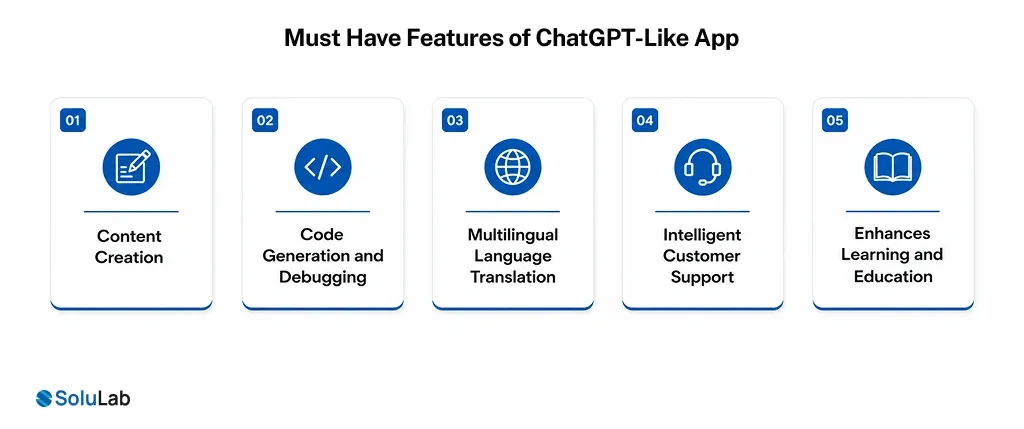
1. Content Creation
ChatGPT-like application can help businesses to create well-structured content from blog posts, product descriptions, reports, or technical explanations. Businesses can use it to produce relevant and engaging content to improve productivity in seconds.
2. Code Generation and Debugging
ChatGPT application development helps businesses create new code or optimize it for different programming languages. It can also figure out bugs and errors recommends corrections, which contributes to smoother and faster software development.
3. Multilingual Language Translation
ChatGPT-like applications can help businesses with multilingual translation. It delivers natural and conversational results for global business communications and generates outcomes for international audiences.
4. Intelligent Customer Support
AI-powered chatbots can deliver instant, human-like customer support. These AI assistants can handle custom queries and escalate complex issues when needed. This improves customer satisfaction while reducing response times and operational costs.
5. Enhances Learning and Education
ChatGPT-like applications act as virtual tutors for students. It helps them with course material and answers their queries. Educators can also use AI to organize course content, making learning more interactive, personalized, and accessible for students of all skill levels.
What Are The Factors That Influence ChatGPT App Development Cost?
The cost of building a ChatGPT-like application depends on numerous factors and business requirements. The most common factors include:
AI Model Selection
The choice between commercial APIs, open-source models, or custom Large Language Models plays a major role in determining development costs, scalability, and ongoing operational expenses.
Application Features and Complexity
Advanced capabilities such as document analysis, voice interaction, multilingual support, workflow automation, and AI agents require additional development effort, increasing the overall project investment.
User Interface and Experience
A responsive, intuitive interface with features like conversation history, file uploads, personalized dashboards, and mobile compatibility enhances user engagement but also adds to design and development costs.
Infrastructure Requirements
Cloud hosting, GPU instances, databases, monitoring tools, and auto-scaling infrastructure are essential for ensuring reliable performance, especially for applications serving large numbers of concurrent users.
Data Preparation and Fine-Tuning
Preparing proprietary data, implementing Retrieval-Augmented Generation (RAG), generating embeddings, and fine-tuning models improve AI accuracy while increasing development time and costs.
Security and Compliance
Enterprise AI applications require robust security measures such as encryption, identity management, audit logging, and compliance with regulations like GDPR, HIPAA, or SOC 2 to protect sensitive business data.
Third-Party Integrations
Connecting the AI application with CRM platforms, ERP systems, payment gateways, collaboration tools, and other business software expands functionality but requires additional development, testing, and maintenance efforts.
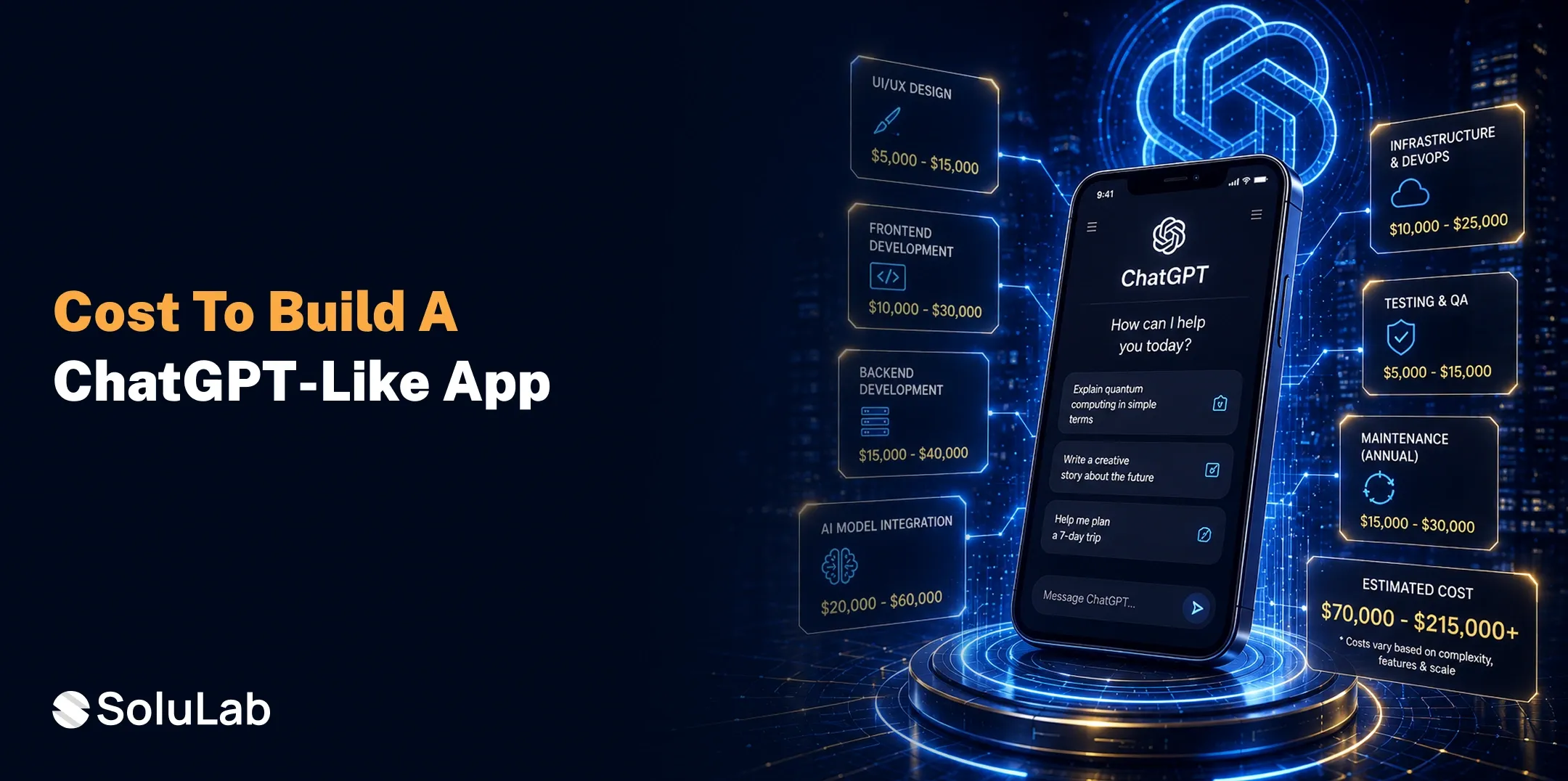
What is The Cost to Build a ChatGPT-like Application in 2026?
Every AI project is unique, but most ChatGPT-like applications fall into one of four categories based on complexity and functionality.
- Basic AI Chatbot Application
If a business is looking for an affordable solution, it can start with a basic AI chatbot application. This is efficiency for small businesses wanting to automate customer interactions in less budget.
These ChatGPT-like applications can handle FAQs, provide instant responses, and improve customer engagement. The ChatGPT app development cost for the basic version can range from $25,000 to $60,000, with a development timeline of 6–10 weeks, making it the fastest way to launch an AI-powered assistant.
- Mid-Level ChatGPT Clone Application
A mid-level ChatGPT clone application is ideal for businesses that need more advanced conversational AI capabilities. It supports context-aware interactions, document analysis, Retrieval-Augmented Generation, multilingual communication, and seamless API integrations.
The mid-level ChatGPT-like application can deliver a better user experience and scale with business growth. The development process can take 3–5 months, with an estimated ChatGPT clone app cost between $60,000 and $150,000, depending on customization and AI integrations.
- Enterprise AI Assistant
An Enterprise AI Assistant is designed for organizations that require secure, intelligent, and scalable AI solutions across departments.
These applications integrate with CRM and ERP platforms, automate workflows, support role-based access, and provide advanced analytics with enterprise-grade security.
The Enterprise AI assistant app development can take 6–10 months and cost between $150,000 and $500,000+.
- Custom LLM Platform
A Custom LLM Platform is built for enterprises seeking complete control over their AI ecosystem. This approach offers maximum customization, security, and scalability but requires significant investment.
Large Language Model development typically takes 10–18 months, with costs ranging from $500,000 to over $1 million, depending on project scope and infrastructure requirements.
ChatGPT Clone vs Custom AI Development: Which One Is Best For The Business
Choosing between a ChatGPT clone and custom AI development is one of the biggest decisions when planning an AI application. The right choice depends on your budget, business goals, and long-term AI strategy.
| Factor | ChatGPT Clone (API-Based) | Custom AI Development |
| Development Cost | Lower initial investment | Higher upfront investment |
| Time to Market | 2–5 months | 6–18 months |
| Data Ownership | Limited control | Complete ownership |
| Customization | Basic to moderate | Fully customizable |
| Scalability | Easy with API providers | Highly scalable with custom infrastructure |
| Privacy & Security | Depends on the API provider | Greater privacy and security |
| Infrastructure | Minimal management | Requires dedicated infrastructure |
| Model Training | Uses pre-trained models | Supports custom LLM training and fine-tuning |
| Best For | Startups, MVPs, SMEs | Large enterprises and regulated industries |
| Long-Term Cost | Ongoing API usage fees | Higher setup cost but lower API dependency |
| Key Advantage | Fast, affordable, and easy to launch | Full control, flexibility, and domain-specific intelligence |
Hire ChatGPT developers who understand enterprise AI. Discuss your project with our experts and accelerate your AI transformation journey.
Book Your Call Here
What Is The Core Architecture of a ChatGPT-like Application?
Core Architecture of ChatGPT application development involves multiple layers, each layer with significant functions. This involves:
- Frontend Layer
The frontend layer is where users interact with your AI application through chat windows, mobile apps, web dashboards, or voice interfaces. Features like file uploads, conversation history, notifications, and user profiles create an intuitive experience, making AI chatbot development more engaging while improving user adoption and customer satisfaction.
- Backend Layer
The backend layer powers the application’s core operations by managing authentication, user sessions, API routing, business logic, and data processing. Built using modern frameworks with REST or GraphQL APIs, it ensures secure communication between users and AI models, enabling scalable and reliable ChatGPT application development.
- Large Language Model (LLM) Layer
The Large Language Model (LLM) layer is the intelligence engine behind every AI assistant. With a Generative Pre-trained Transformer, this layer can handle prompt engineering, response generation, and language understanding. This contributes to delivering context-aware conversations for Generative AI development.
- Retrieval-Augmented Generation
Retrieval-Augmented Generation enhances AI accuracy by retrieving relevant information from company documents. Instead of relying only on pre-trained knowledge, RAG combines semantic search with LLMs. This helps to to reduce hallucinations, improve factual accuracy, and deliver reliable answers in enterprise AI applications.
- Vector Database
A vector database stores document embeddings that enable AI systems to understand meaning rather than exact keywords. Top ChatGPT development companies use technologies like Pinecone, Weaviate, Milvus, and Qdrant to support semantic search. This tech support makes Large Language Model development faster, smarter, and more accurate.
- Cloud Infrastructure
Cloud infrastructure provides the computing power needed to run scalable AI applications efficiently. It helps to ensure high availability and performance. Platforms like AWS, Microsoft Azure, and Google Cloud simplify AI application development for businesses of all sizes.
Technology Stack Supported By The ChatGPT-like Applications
Selecting the right AI technology stack for ChatGPT-like application development directly. The top ChatGPT development companies prefer using the following stack to build ChatGPT-like applications:
| Technology Layer | Popular Technologies | Purpose |
| Frontend | React, Next.js, Vue.js, Flutter, React Native | Builds responsive web and mobile interfaces for seamless user interactions. |
| Backend | Python (FastAPI, Django), Node.js, Go, Java | Handles business logic, API management, authentication, and data processing. |
| AI Frameworks | LangChain, LlamaIndex, Haystack, Semantic Kernel | Simplifies LLM orchestration, prompt engineering, RAG implementation, and AI workflows. |
| Large Language Models (LLMs) | GPT-4/5, Claude, Gemini, Llama, Mistral | Powers natural language understanding, content generation, and intelligent conversations. |
| Databases | PostgreSQL, MongoDB, Redis | Stores user data, application records, sessions, and conversational history securely. |
| Vector Databases | Pinecone, Weaviate, Milvus, Qdrant | Enables semantic search and Retrieval-Augmented Generation (RAG) using document embeddings. |
| Cloud Platforms | AWS, Microsoft Azure, Google Cloud | Provides scalable infrastructure, GPU resources, storage, networking, and AI deployment services. |
| DevOps & Deployment | Docker, Kubernetes, Terraform, GitHub Actions | Automates deployment, containerization, scaling, monitoring, and continuous integration/continuous delivery (CI/CD). |
Industries Where You Can Use a ChatGPT-like Application
ChatGPT-like application helps to increase business productivity across numerous sectors. With these applications, employees can execute repetitive tasks without trouble and without wasting time.
- Customer Support
If your support team spends hours answering the same customer questions, a ChatGPT-powered chatbot can take over. It provides instant responses, resolves common issues, and escalates complex cases to human agents, helping you reduce response times while improving customer satisfaction around the clock.
- Sales and Marketing
For sales and marketing teams, AI works like an extra team member. Businesses can use it to write email campaigns, generate ad copy, qualify leads, and summarize customer conversations. This allows the employees to focus on closing deals rather than wasting time on repetitive manual tasks.
- Human Resources
A ChatGPT-like application can answer policy questions, screen resumes, schedule interviews, and support new hires. This can make the HR operations faster while improving the overall employee experience.
- Healthcare
Healthcare providers can use AI to simplify administrative work. From summarizing patient records and assisting with documentation to scheduling appointments, Generative AI Integration Services can help medical teams save time. This allows the team to focus more on patient care.
- Financial Services
ChatGPT applications can help in handling customers, summarizing financial information, and answering routine banking queries. This improves operational efficiency and also provides the security and accuracy expected in financial services.
- Legal Services
ChatGPT-like application can be used by legal teams to review contracts and legal documents. This helps the legal teams complete routine work much faster without compromising quality.
- Education
Educational institutions can hire AI developers to build a ChatGPT-like app to support students and teachers. It can help students with queries, learning materials, and complex topics. Educators can also use it to share more engaging and personalized learning experiences.
- Retail and eCommerce
Retail businesses can use AI-powered solutions for product management and to provide personalized shopping experiences. This improves customer engagement while increasing conversions and reducing support costs.
- Real Estate
Real estate companies use the Fine-Tune GPT Models to automate property inquiries, qualify potential buyers, schedule site visits, and provide property recommendations. This helps agents spend less time on repetitive communication and more time closing deals.
- Manufacturing
Manufacturers can use AI assistants to support employees with standard operating procedures, maintenance documentation, equipment troubleshooting, and internal knowledge management. This reduces downtime, improves operational efficiency, and makes technical information easier to access.
Factors To Consider While Choosing an AI App Development Company
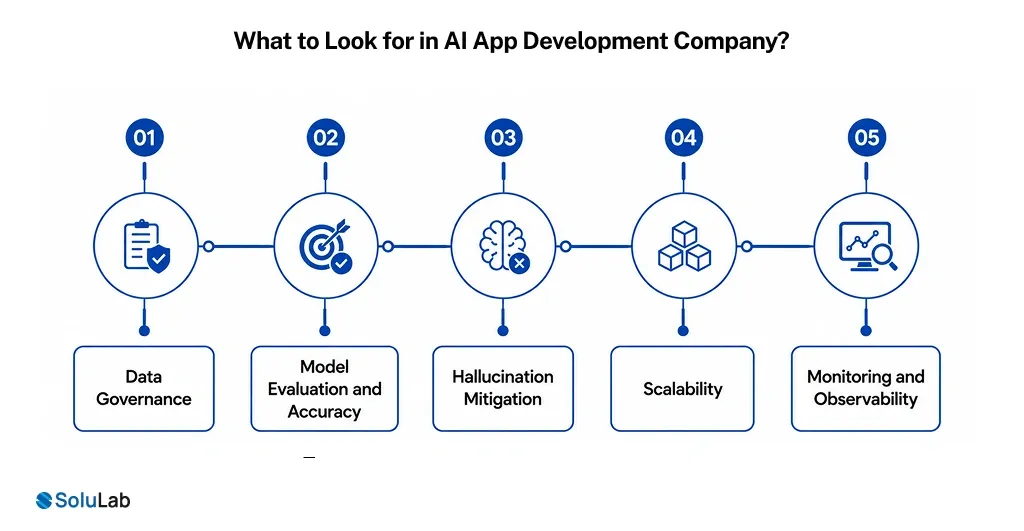
Building a GPT model requires more than integrating an LLM. Organizations must ensure the system is reliable, secure, and scalable enough for production use. Key considerations include:
- Data Governance
Organizations need clear policies regarding data collection, storage, access, and retention. Sensitive information should be protected through encryption and strict access controls. The data handling practices must comply with relevant regulations.
- Model Evaluation and Accuracy
Generative AI systems should be continuously evaluated using benchmarks that measure factual accuracy and user satisfaction. Regular testing helps identify weaknesses and improve performance over time.
- Hallucination Mitigation
Large Language Models can occasionally generate incorrect or fabricated information. Techniques such as Retrieval-Augmented Generation, prompt engineering, response validation, and human review help reduce these inaccuracies.
- Scalability
Enterprise AI solution must handle growing numbers of users without sacrificing performance. Auto-scaling infrastructure, efficient caching strategies, and optimized API usage are essential for maintaining responsiveness.
- Monitoring and Observability
AI systems should include comprehensive monitoring for application performance, infrastructure health, error rates, and user feedback. Continuous monitoring enables teams to detect and resolve issues quickly.
Cost Optimization Strategies For Businesses for ChatGPT-like Application Development
Organizations can reduce AI development costs without compromising quality by following several best practices:
- Start with Pre-trained Models
Use existing LLM models for ChatGPT Application Development. This will help to avoid the significant expense of training models from scratch.
- Adopt a Modular Architecture
Choose the modular architecture to scale, maintain, and upgrade individual components easily. This will help to make changes without impacting the overall architecture.
- Use Retrieval Instead of Fine-Tuning
Opt for RAG models. This helps to deliver excellent results at a lower cost than full model fine-tuning.
- Optimize API Usage
Optimize the API usage to reduce unwanted API calls and caches. Choose the right model for each task to lower operating expenses.
- Scale Infrastructure Gradually
Use auto-scaling cloud infrastructure instead of overprovisioning resources.

Conclusion
The cost to build a ChatGPT-like application in 2026 depends on numerous factors. While basics solution can start from $25000, their customized cost range can go up to $1 million. Business building ChatGPT like application can start with identifying the objective for long-term value. However, it is crucial to manage all the factors that influence the development cost.
Choose SoluLab as your Trusted Partner for ChatGPT App Development!
At SoluLab, #1 ChatGPT development company, we help startups and enterprises move from AI ideas to production-ready products through strategy, design, development, deployment, and continuous optimization.
Our expertise spans custom Generative AI development, AI agents, Retrieval-Augmented Generation, LLM fine-tuning, and enterprise AI integration with CRM, ERP, and existing business systems.
Backed by 250+ technology experts, 1,500+ successful projects, and 500+ global clients, we build secure, scalable, and ROI-driven AI applications that grow with your business. Whether you’re launching an AI chatbot, virtual assistant, or enterprise copilot, we’re here to turn your vision into reality.
FAQs
Shipra Garg is a tech-focused content strategist and copywriter specializing in Web3, blockchain, and artificial intelligence. She has worked with startups and enterprise teams to craft high-conversion content that bridges deep tech with business impact. Her work translates complex innovations into clear, credible, and engaging narratives that drive growth and build trust in emerging tech markets.