Developing AI-powered employee tracking software applications has been a strategic concern of businesses dealing with a hybrid and remote workforce. The traditional monitoring tools merely pay attention to the attendance or the work on the screen, and these provide minimal information and cause suspicion among the workers.
AI transforms this model because it allows smart tracking, which analyzes work patterns, productivity trends and work indicators more objectively and purposefully. In fact, 96% of businesses currently employ time-tracking software. When the employees are aware of the monitoring, productivity improves 7% and focus and accountability are gained.
As distributed workforces develop, organizations require more than a manual reporting system and inflexible dashboards. The artificial intelligence-based solutions are able to analyze large amounts of information on the spot, identify inefficiencies, anticipate workload issues and facilitate equitable performance appraisal.
Key Takeaways
- The problem: Businesses lose 20–30% productivity due to poor visibility into employee performance and manual tracking systems.
- The solution: AI-powered employee tracking software uses behavioural analytics, real-time dashboards, and predictive insights to improve productivity without micromanagement.
- How SoluLab helps: SoluLab, a global leader in AI development, specializes in transforming complex monitoring needs into high-ROI digital products, ensuring your software is an asset, not an administrative burden.
Understanding Employee Tracking Software
Employee monitoring software refers to a computer-based software that assists companies in tracking how work is done when in the office, remote work or even hybrid hours. It records information, including time spent on work, use of the application, attendance, and project progress, and transforms it into understandable reports. Surveillance is not the point, but visibility.
When properly implemented, an employee time tracking solution enables managers to gain insight into workloads, recognize and assist employees in a more efficient way. In the case of teams, it creates a sense of clarity regarding expectations, equitable performance review, and proper payroll. According to studies global employee activity monitoring software market was valued at USD 81.78 million in 2025 and is projected to reach USD 118 million by 2034, exhibiting a CAGR of 5.5%.
The AI employee tracking system allows making data-driven decisions, enhancing productivity, and supporting healthier working habits in teams within growing organizations to scale responsibly and sustainably in the long term.
AI Technologies Used in Employee Tracking Software
The employee tracking software is an artificial intelligence tool that uses new technologies to evaluate work trends, enhance productivity, and provide objective information in a transparent, accurate, and scalable manner to suit the needs of contemporary organizations.
- Machine Learning: Machine learning is used to process data on employee activity to help define productivity patterns, uncover inefficiencies and constantly enhance performance insights as work behaviours and historical patterns change.
- Natural Language Processing (NLP): Natural Language Processing can be used to analyze text-based information in emails, chats and task updates to determine the efficiency of communication, the quality of collaboration and the distribution of work without the need to manually review such information.
- Computer Vision: Computer vision allows analyzing visual information, such as checking attendance or surveillance at work, and is typically applicable to workplaces where compliance and safety measures are highly enforced and necessary.
- Predictive Analytics: Predictive analytics predicts future outcomes, risks of burnout or attrition based on past employee data, and assists managers in making proactive decisions before productivity or morale drops.
- Generative AI in Reporting and Insights: Generative AI transforms complex employee data into a format that is easy to understand in the form of a report, summary, and recommendation and allows HR teams and managers to make quicker and more data-driven decisions.
Why Your Business Needs an Employee Time Tracking Software?
Time tracking software is used to enable businesses to effectively track the working hours of employees, enhance productivity, enhance transparency in billing, and make sound decisions based on the data, transforming the performance and cost management of the team in any contemporary workplace.
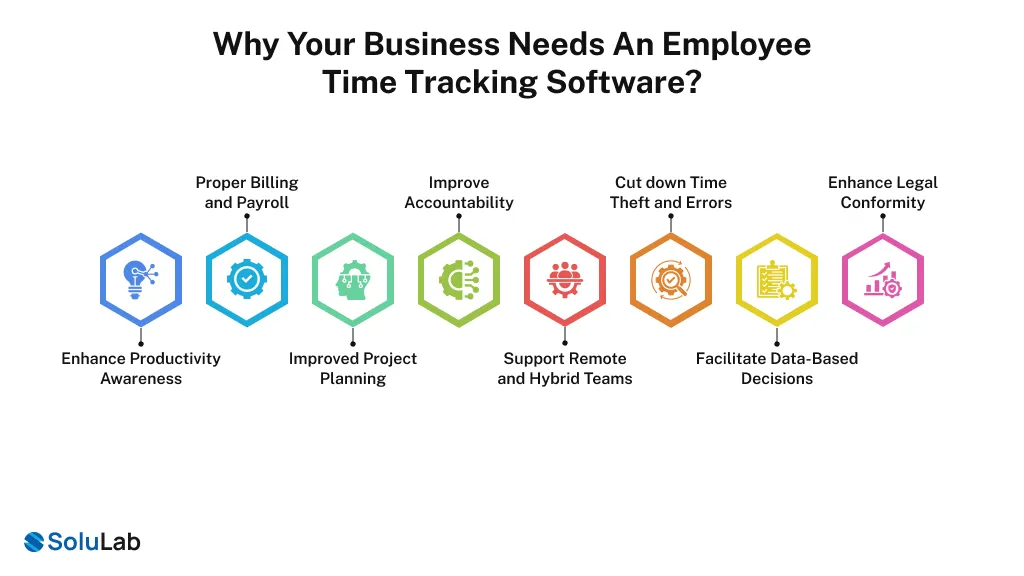
- Enhance Productivity Awareness: Time tracking shows how the employees actually spend their time working on different tasks, which can help the teams work on what is the most important aspect of work to maximize productivity.
- Proper Billing and Payroll: Automated time records remove errors in the manual entry, hence equitable payroll and accurate client work billing to curb disputes and financial irregularities.
- Improved Project Planning: Time tracking information assists managers in allocating resources in a realistic approach, planning tasks, and establishing realistic deadlines, which enhances project results and eliminates overruns.
- Improve Accountability: Work hours are transparently documented, and employees become more responsible and focused, which leads to a culture of accountability and high performance.
- Support Remote and Hybrid Teams: Time tracking Cloud-based systems help keep teams on track regardless of their location, providing managers with information about the number of hours worked and fairly distributing the workload in a remote location.
- Cut down Time Theft and Errors: Automated tracking stops incorrect self-reported hours and removes buddy punching, and businesses reduce unnecessary labour costs and make sure that only the actual work is recorded.
- Facilitate Data-Based Decisions: Monitored time data provides practical insights into workflow patterns that will be used to make smarter decisions regarding staffing, process enhancements and strategic priorities.
- Enhance Legal Conformity: PA’s proper record of work hours will help in ensuring that the labour laws of overtime, breaks and reporting are adhered to in order to keep the companies out of the legal wrangles and fines.
Step-by-Step Guide to Building AI-Powered Employee Tracking Software?
An AI-powered employee tracking system can assist companies to keep track of productivity, profile work habits, and intelligently optimize teams, the way you would desire to Build Employee Monitoring Software or remote Employee Monitoring Software with ethical intelligence.
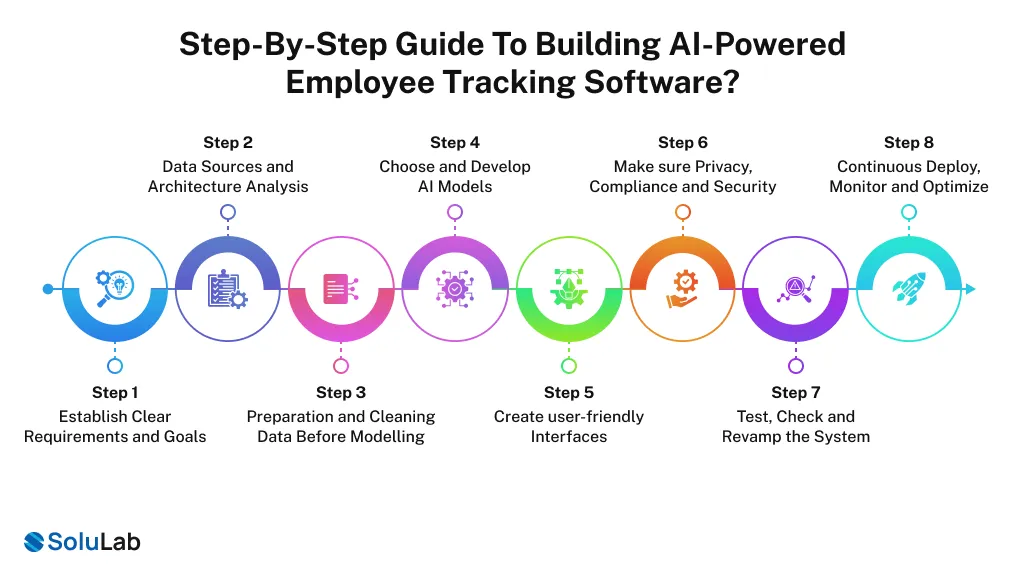
Step 1. Establish Clear Requirements and Goals
Begin by defining your desired results with your system; is it productivity, task management, attendance, or predictive behaviour analysis and how it will aid in business results. Specific goals lead to development and minimize scope creep.
Step 2. Data Sources and Architecture Analysis
Determine the source of employee information: the HR system, time logs, applications, and collaboration tools or attendance forms, and create a safe data format, which can be processed in real-time and in batches.
Step 3. Preparation and Cleaning Data Before Modelling
Before feeding raw data into AI models to be analyzed, cleaning, normalization, labelling, and anonymization are required to enhance accuracy, minimize biases, and ensure privacy.
Step 4. Choose and Develop AI Models
Choose machine learning or analytical models that would be used with pattern recognition, anomaly detection, and performance forecasting and also train them using quality data to get reliable insights.
Step 5. Create user-friendly Interfaces
Develop a user-friendly dashboard for managers and a self-service for employees to ensure that insights can be acted upon and comprehended, and not merely complex analytics.
Step 6. Make sure Privacy, Compliance and Security
Introduce robust encryption, access management and ethical standards to ensure employee privacy and regulatory demands, which are paramount to employee surveillance software over distance.
Step 7. Test, Check and Revamp the System
Do intensive testing (functionality, security, and performance) and test against actual user feedback to achieve reliability in a wide variety of working conditions.
Step 8. Continuous Deploy, Monitor and Optimize
Introduce in stages, track utilization and performance, train AI models using new data, and streamline processes to remain in step with changing business requirements.
Conclusion
The development of AI-based tracking software to monitor the activities of employees is no longer only about monitoring activity but about making smarter choices, boosting efficiency, and the establishment of transparent and data-driven workplaces. AI can assist companies to comprehend work patterns, optimize resources, and assist workers without trespassing on ethical or privacy concerns when designed properly.
To enable organizations to develop in an efficient and scaled way, organizations that want to invest in a custom-built AI solution, along with professional AI development services, may guarantee a faster and more accurate deployment and sustainable workforce management in an increasingly remote-first world.
SoluLab, an AI development company help businesses build employee tracking software from scratch to monitor employees’ workflows. Book a free consultation call today!
FAQs
Neha is a curious content writer with a knack for breaking down complex technologies into meaningful, reader-friendly insights. With experience in blockchain, digital assets, and enterprise tech, she focuses on creating content that informs, connects, and supports strategic decision-making.