Key Takeaways
- AI nutrition apps use machine learning, computer vision, and NLP to replace one-size-fits-all diet advice with plans built around a person’s actual biometrics, preferences, and goals.
- What separates a real competitor from a glorified calorie counter usually comes down to four things: AI meal recommendations, food image recognition, a nutrition chatbot, and a progress dashboard people actually check.
- Budget somewhere between $40,000 for a lean MVP and $50,000+ for an enterprise-grade platform, depending on how much of the AI stack you build custom.
- Regulatory compliance, data security, and human review of AI-generated health advice aren’t nice-to-haves. They’re the difference between an app people trust and one they delete after a bad recommendation.
People don’t quit diet apps because they lack willpower. They quit because the plan they were handed on day one stops making sense by week three.
An AI nutrition app is built to solve exactly that problem, learning from what a user actually eats, how they respond, and what changes over time, instead of asking them to follow a static PDF forever.
However, the global diet and nutrition apps market is projected to hit $4.6 billion by 2030, growing at a 13.4% CAGR.
This guide covers what these apps do, which features are worth your budget, how development actually unfolds, what it costs, and where most health-tech teams trip up.
What Is an AI Diet Planner App?
An AI diet planner app is a mobile or web application that uses artificial intelligence technolhgies machine learning, computer vision, and natural language processing to build and continuously adjust personalized nutrition plans.
Rather than applying the same meal plan to every user, it pulls in body metrics, medical history, food preferences, activity data, and sometimes wearable feeds, then recommends meals, logs intake, and flags nutritional gaps as they happen.
That’s a real departure from the spreadsheet-style trackers most of us grew up with. Done well, an app like this starts to function less like a calorie log and more like a digital dietitian, the same shift already underway across AI healthcare software more broadly, where static tools are giving way to systems that adapt to the person using them.
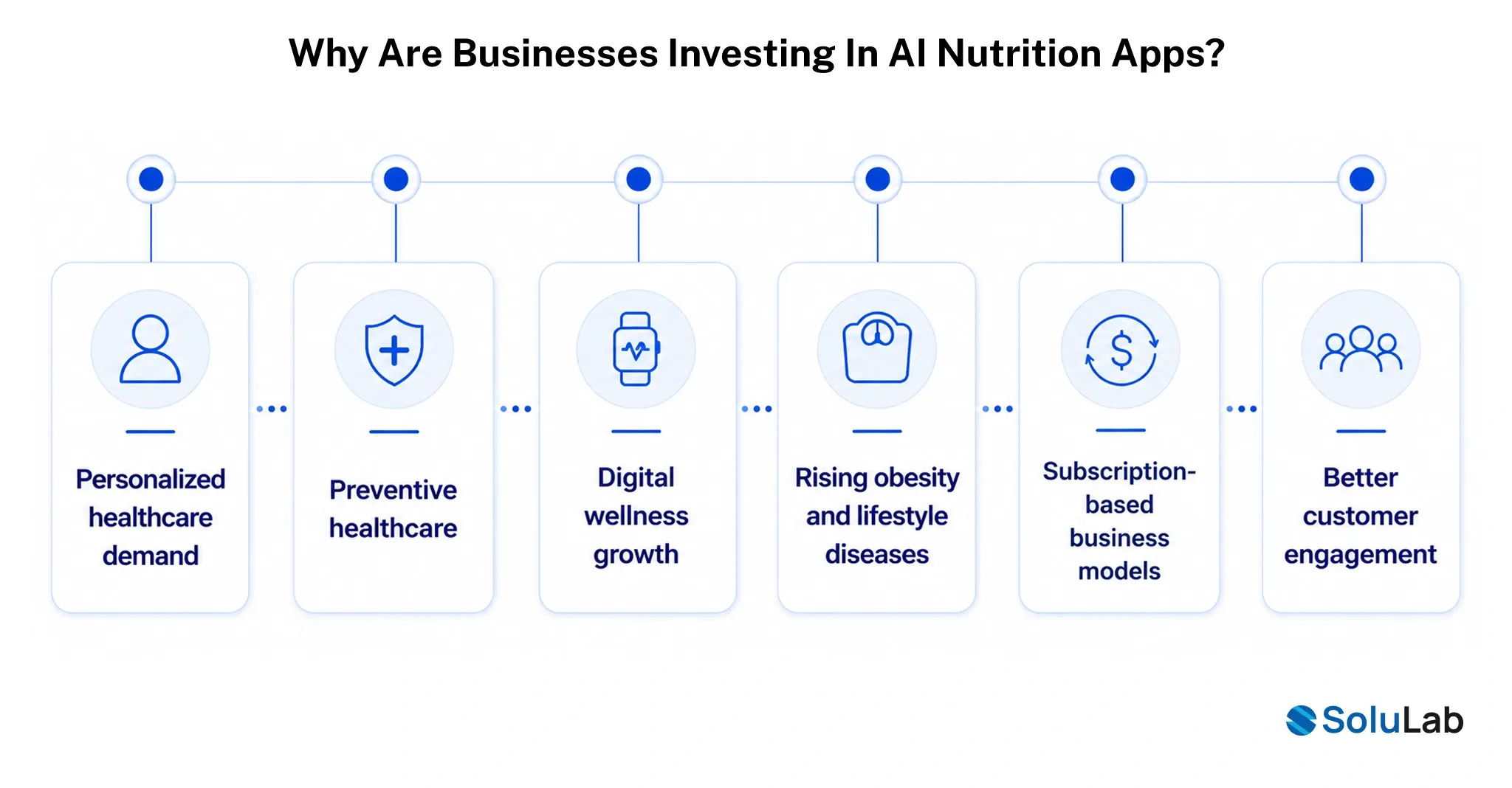
Why Are Businesses Investing in AI Nutrition Apps?
Health and wellness have become one of the steadier categories in consumer tech, and AI is the reason nutrition specifically is pulling in fresh investment right now.
- Personalized healthcare demand. Users have gotten used to tools tailored to their own numbers, not advice written for the average person who doesn’t exist.
- Preventive healthcare. For a business, a nutrition app is a cheap way to help someone manage risk factors before they become an expensive diagnosis.
- Digital wellness growth. Fitness trackers and wellness apps have already made daily health tracking normal. Nutrition apps just ride that same habit.
- Rising obesity and lifestyle diseases. WHO data puts the number of adults living with obesity at over 890 million as of 2022, and that alone keeps demand for dietary tools high.
- Subscription-based business models. Diet management isn’t a one-time purchase; it’s ongoing, which makes nutrition apps a natural fit for recurring revenue.
- Better customer engagement. Adaptive suggestions and chat-based coaching keep people opening the app long after static content would’ve lost them, a pattern that shows up across AI in healthcare applications generally, not just nutrition.
Key Features of a Successful Diet and Nutrition App
The gap between a forgettable diet app and one people actually keep almost never comes down to a single killer feature. It’s depth across a handful of them.
- AI meal recommendations. Suggestions shift based on goals, restrictions, and what a user has actually chosen before, not a fixed plan handed out on day one.
- Personalized diet plans. Built around real biometrics and medical context instead of a generic calorie template stretched across every user.
- Calorie tracking. Logs intake automatically and checks it against daily targets without the user doing math.
- Food image recognition. Snap a photo, get calories and macros back in seconds. This one feature alone cuts a lot of the friction that makes people abandon manual logging.
- Nutrition analysis. Breaks meals down into macro- and micronutrients so deficiencies or excesses surface before they become a problem.
- Progress dashboard. Shows weight, macros, and habit trends in one place so users can actually tell whether the plan is working.
- Recipe recommendations. Suggests recipes based on what’s in the fridge, dietary restrictions, and nutrition targets.
- Voice assistant. Hands-free logging and quick nutrition questions are often built on top of an AI-powered chatbot that handles the back-and-forth coaching between meals.
AI Diet Planner vs. Traditional Meal Planner
The real difference isn’t automation for its own sake; it’s what each approach assumes about you. A traditional planner assumes your needs are fixed once the plan is set. An AI planner assumes they won’t stay fixed for long.
| Aspect | AI Diet Planner App | Traditional Meal Planner |
| Personalization | Continuously adapts to biometrics, feedback, and behavior | Static plan set once, rarely updated |
| Data sources | Wearables, health records, food logs, user feedback | Manual user input only |
| Meal logging | Photo recognition, voice input, barcode scanning | Manual text entry |
| Adjustments | Real-time, based on progress and new data | Requires manual rework by user or dietitian |
| Scalability | Serves thousands of users with individualized plans | Limited by dietitian or coach availability |
| Cost per user | Low marginal cost after initial build | Higher ongoing cost for human coaching |
| Engagement tools | Chatbot coaching, push nudges, progress dashboards | Printed or PDF plans, occasional check-ins |
Step-by-Step Guide on How to Develop an AI Nutrition App
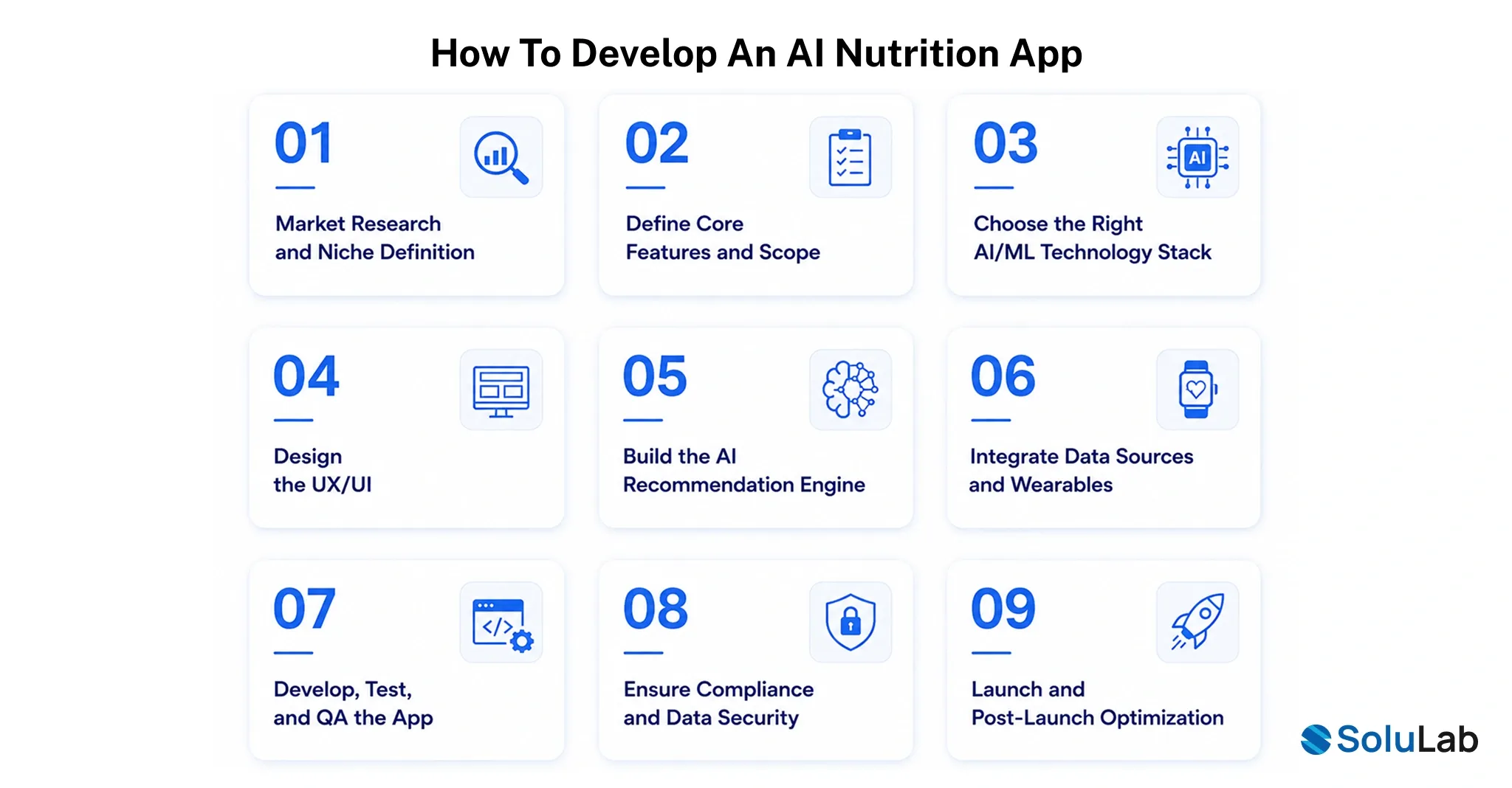
Building an AI app has less to do with writing code on day one and more to do with getting the sequence right, since each stage boxes in what’s possible at the next. Here’s how it actually plays out.
1. Market Research and Niche Definition
Figure out who this is really for before anything gets built. A generic calorie tracker is fighting MyFitnessPal for scraps. A specific niche has room to win.
- Study competitor gaps directly
- Define a specific target audience
- Validate demand with real users
2. Define Core Features and Scope
Lock the feature list to what actually solves the problem for that niche, not everything a competitor happens to ship.
- Prioritize must-have features first
- Separate MVP from later phases
- Map features to user goals
3. Choose the Right AI/ML Technology Stack
This is where accuracy, scale, and how painful maintenance will be later all get decided, which is why a lot of teams bring in a dedicated machine learning development partner at this stage rather than winging it.
- Select ML frameworks carefully
- Choose cloud infrastructure early
- Plan for model retraining
4. Design the UX/UI
Health apps live or die on how fast a meal gets logged. If it takes more than a couple of taps, people stop bothering.
- Design for quick logging
- Keep dashboards visually simple
- Prototype and test with users
5. Build the AI Recommendation Engine
This is the part that actually makes the app worth using, the engine that turns raw user data into meal suggestions that feel personal instead of generic.
- Train models on nutrition datasets
- Build rules for dietary restrictions
- Test recommendation accuracy rigorously
6. Integrate Data Sources and Wearables
Wearable and health-record data make recommendations sharper, no question. It also adds compliance surface area, so plan for that cost up front rather than discovering it mid-build.
- Connect fitness tracker APIs
- Sync with health record systems
- Standardize incoming data formats
7. Develop, Test, and QA the App
Build in sprints, and don’t let AI output skip QA just because it’s “the AI’s job.” A wrong nutrition suggestion carries more weight than a broken button ever will.
- Develop frontend and backend in parallel
- Run AI accuracy and bias tests
- Conduct real-device QA cycles
8. Ensure Compliance and Data Security
Health data rules aren’t paperwork you deal with before launch. They shape how the whole system is architected from the start.
- Encrypt all health data
- Build for HIPAA/GDPR compliance
- Limit third-party data sharing
9. Launch and Post-Launch Optimization
Launch is the start, not the finish line. The recommendation engine only gets genuinely good once it’s learning from real usage instead of test data.
- Monitor engagement and retention metrics
- Retrain models on real usage
- Ship updates based on feedback
Cost to Build an AI Nutrition & Diet Planning App
Cost of AI app development swings mostly on two things: how much of the AI is custom-built versus off-the-shelf, and how many integrations the app needs to support. Here’s a realistic range by tier.
| App Tier | Key Features | Estimated Cost Range | Typical Timeline |
| MVP | Calorie tracking, basic meal plans, simple dashboard | $20,000 – $30,000 | 3 – 4 months |
| Mid-tier | AI recommendations, food image recognition, wearable sync | $45,000 – $50,000+ | 5 – 7 months |
| Enterprise-grade | Full AI engine, chatbot, multi-platform, advanced compliance | $50,000+ | 8 – 12 months |
Treat these as planning numbers, not a quote. Region, team composition, and how much of the AI model is licensed versus built in-house can all move these figures quite a bit, so it’s worth validating scope with a development partner before locking a budget.
Future Trends in AI-Based Health and Nutrition Applications
The next wave of these apps is moving away from “track and suggest” toward something closer to predictive, biology-aware guidance. A few things worth keeping an eye on:
- Food-as-medicine models. Healthcare providers and insurers are paying more attention to nutrition apps as a tool for managing chronic conditions like diabetes and cardiovascular disease, not just general wellness.
- Continuous glucose monitor integration. Real-time glucose data is starting to shape meal suggestions directly, so an app can flag which foods spike a specific person’s blood sugar instead of relying on a population average that doesn’t apply to them.
- Genomic and microbiome-based nutrition. Some apps are starting to factor in genetic and gut microbiome data, going well past what dietary history alone can tell you.
- Agentic AI nutrition coaches. Expect apps to move from passive suggestions to actually planning meals, building grocery lists, and adjusting schedules with barely any input from the user.
- Deeper wearable ecosystem integration. Rings, watches, and continuous monitors are converging into single health platforms, and nutrition apps are increasingly just one node in that bigger system.
Best Practices for Building AI Nutrition Apps
AI-generated nutrition advice touches real health decisions, so the bar for how carefully it’s built has to be higher than for a typical consumer app.
- Human review for medical advice. Anything that touches a medical condition should pass through a qualified professional before it reaches the user, not just the model.
- Personalized recommendations. Base suggestions on verified user data, not assumptions, and give users a way to correct the model when it gets something wrong.
- Secure health data. Encrypt everything at rest and in transit, and don’t collect more than the app actually needs.
- Continuous model updates. A static model goes stale fast. Retrain regularly on real usage data, and pair that with ongoing generative AI development support so the underlying models don’t fall behind.
- User feedback loops. Give people a simple way to flag a bad suggestion, and actually feed that signal back into the model instead of letting it sit in a support ticket.
- Regulatory compliance. Design for HIPAA, GDPR, or whatever applies regionally from the architecture stage, not as a scramble before launch.
- Real-time monitoring. Track model performance and catch anomalies, like an unsafe calorie recommendation, before they reach users at scale.
Examples of AI Nutrition and Diet Planning Apps
Looking at what’s already live is more useful than a feature wishlist, since it shows which ideas actually hold up in production.
1. Numan
Numan, a digital healthcare provider, has been piloting an AI health assistant built specifically for conditions like obesity, with an emphasis on personalized, stigma-aware guidance rather than generic advice.
- Rolled out in beta phases
- Focused on obesity management
- Built around clinical safety
2. NutriCare
NutriCare’s AI-driven health monitoring system tracks users’ macro- and micronutrient intake and surfaces specific gaps or surpluses instead of just a daily calorie total.
- Tracks macro and micronutrients
- Flags nutritional gaps directly
- Built for ongoing monitoring
3. Samsung Food Plus
Samsung Food Plus pairs AI-personalized meal plans with computer vision that can recognize tens of thousands of ingredients from a single photo.
- Recognizes thousands of ingredients
- Generates dynamic weekly meal plans
- Integrates with smart kitchen appliances
Why Choose SoluLab for AI Nutrition App Development?
A nutrition app is asking people to hand over real health data, so it takes more than a generic app-building team to earn that trust. It takes AI engineering experience specific to healthcare-grade accuracy and compliance.
SoluLab’s work spans AI development, from recommendation engines to conversational health assistants, and that track record is documented across
For example, MedTech partnered with a SoluLab team to build a clinical decision support platform that analyzes fragmented patient data integrated with EHR systems.
The solution delivers accurate diagnostics, guideline-based treatment recommendations, and automated clinical documentation, helping clinicians reduce errors and improve patient outcomes.
Book a free consultation call today to get similar results for your business.

Conclusion
An AI nutrition and diet planning app comes down to one question: do the recommendations feel personal enough to trust, day after day? Everything else, the UI, the integrations, the onboarding flow, exists to support that one thing.
Get the AI recommendation engine right, respect the user’s data, and give people a reason to open the app tomorrow, too. That’s the whole game.
SoluLab, an AI development company can help you build AI nutrition app, or hire AI developers from SoluLab to start building.
FAQs
Neha is a curious content writer with a knack for breaking down complex technologies into meaningful, reader-friendly insights. With experience in blockchain, digital assets, and enterprise tech, she focuses on creating content that informs, connects, and supports strategic decision-making.