Intellectual property theft drains over $600 billion from the global economy every year. And that’s not inefficiency, that’s a systemic breakdown in how the world protects what it creates.
According to the Global Innovation Policy Center, this loss isn’t caused by a lack of innovation, but by outdated infrastructure. And if you’re a founder, CTO, or head of IP, you don’t need a report to confirm it. You live it every day.
- Registrations that take years instead of weeks.
- Royalties that leak through opaque intermediaries.
- Infringements discovered months after the damage is done.
This is where the shift is happening. Blockchain technology is now taken seriously as infrastructure; it is being tested by governments, procured by enterprises, and evaluated in boardrooms as a serious foundation for IP protection.
To understand why blockchain in intellectual property is becoming unavoidable, we need to look at the real problems teams face when protecting and monetizing IP today and what actually works going forward.
Key Takeaways
- The problem: Intellectual property systems are slow, centralized, and misaligned with how digital assets are created and shared today. As ownership is easy to dispute, licensing leaks revenue, and enforcement weakens across borders, leaving companies exposed and creators underpaid.
- The solution: Blockchain enables immutable ownership proof, automated licensing via smart contracts, and globally verifiable IP records. By removing intermediaries and manual processes, a blockchain-powered IP protection platform brings clarity, speed, and trust to IP management.
- How SoluLab helps: SoluLab helps you design and build custom blockchain-based IP systems, from registration to licensing and royalties. Our expert consultants focus on defining scope and risk early, ensuring the solution is scalable, compliant, and cost-efficient from day one.
Why Do Current IP Protection Models Fail in the Age of Blockchain Technology?
Intellectual property, like patents, trademarks, copyrights, and trade secrets, is often the most valuable thing a company owns. For startups, it’s the moat. For enterprises, it frequently sits at the top of the balance sheet, even if it’s underprotected.
But the systems meant to protect IP are failing in very specific, measurable ways:
1. Patent Timelines are Broken
U.S. patent approvals average 22–30 months (USPTO, 2024). By the time protection is formalized, the market has often moved on.
2. Royalty Leakage is Systemic
The global music industry alone loses an estimated $2.65 billion annually to untracked or disputed rights (CISAC, 2023).
3. Cross-border Enforcement is Expensive and Slow
Different national registries don’t talk to each other, and proving ownership internationally often means coordinating lawyers across multiple jurisdictions.
4. IP protection is Reactive, not Proactive
Most companies learn about infringement after damage is done.
These aren’t fringe problems. They’re the core operational failures that Blockchain in IP Management is specifically designed to address. The applications of blockchain in intellectual property map almost perfectly onto these pain points – immutable ownership records, automated royalty distribution, global verifiability, and real-time monitoring.
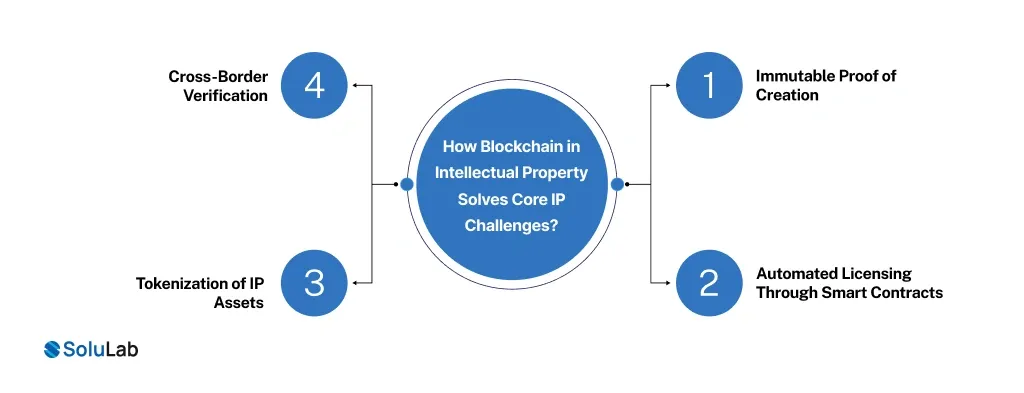
How Blockchain in Intellectual Property Solves Core IP Challenges?
Blockchain technology works by creating a distributed ledger where the data is stored across thousands of nodes, cryptographically linked, and practically impossible to alter once written.
That combination is unusually powerful for IP protection.
1. Immutable Proof of Creation
When you register an IP asset on-chain, it gets a cryptographic hash and a timestamp that’s recorded simultaneously across the entire network. No third party required. No waiting for a certificate. This is the foundation of blockchain for copyright protection – the ownership record simply exists, permanently, and is independently verifiable by anyone.
2. Automated Licensing Through Smart Contracts
Smart contracts development executes licensing terms automatically when pre-defined conditions are met. A song with streamed royalty gets paid without an intermediary taking 20–40% for administration. The applications of blockchain in intellectual property around licensing alone could recover hundreds of millions in annual leakage for content-heavy businesses.
3. Tokenization of IP Assets
This is where the strategic opportunity opens up. The blockchain role in tokenizing intellectual property means a patent, a brand, or a creative work can be turned into a tradeable digital asset, and Fractional ownership becomes possible. You can raise capital against IP without selling it outright. Assets that were previously illiquid become liquid, and that changes how IP is valued on a balance sheet.
4. Cross-Border Verification
Because blockchain records are globally accessible, proving ownership in another jurisdiction becomes straightforward. One record, publicly verifiable, in any country, and no diplomatic coordination required.
These are live blockchain development use cases, not just theoretical. Companies are shipping real products built around these exact capabilities, which is an important signal for any executive evaluating the space right now.
How Blockchain Solutions are Boosting Copyright Protection Across Global IP Systems?
Governments aren’t waiting for the private sector to lead here. As the national-level adoption of blockchain for copyright protection is already underway:
1. China
The Beijing Internet Court has accepted blockchain-based evidence since 2018. By 2024, over 3 million IP cases have been filed using on-chain proof (China Law Translate, 2024).
2. European Union
The EUIPO is actively piloting blockchain IP registries under its 2025 IP Strategy, with a focus on reducing trademark disputes across member states.
3. United States
The U.S. Copyright Office completed a blockchain pilot in 2023 exploring decentralized registration systems for digital content (Copyright.gov, 2023).
4. UAE
Dubai’s creative economy authority launched a blockchain IP registry specifically for digital artists and content creators in 2024.
5. India
The DPIIT is exploring Blockchain in IP Management as part of its Digital India modernization roadmap.
Blockchain for copyright protection is now a policy conversation, not just a technology one. Where regulation follows adoption, early movers shape the rules, and that’s a real competitive advantage for companies investing in this infrastructure now.
Blockchain Architecture for Intellectual Property Systems and IP Management
For CTOs and technical decision-makers evaluating this seriously, here’s what a production-grade blockchain-powered IP protection platform actually looks like under the hood:
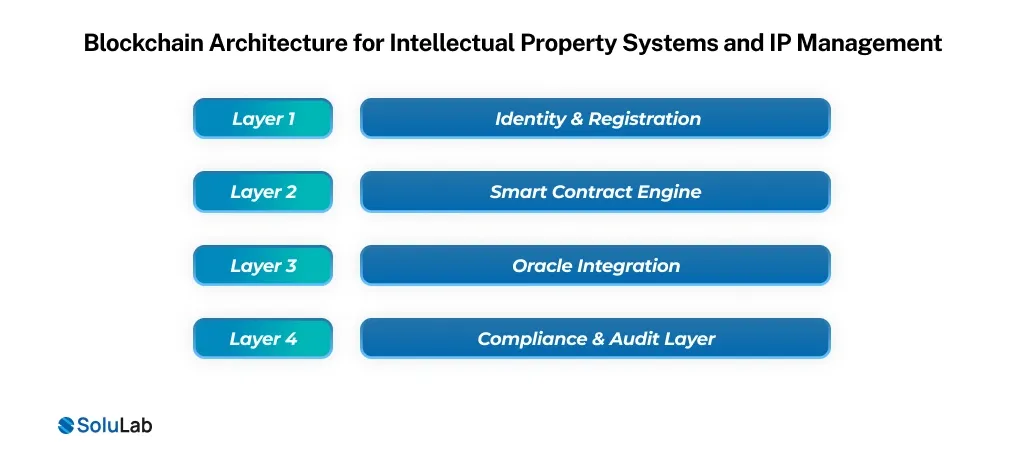
Layer 1 — Identity & Registration
Every IP asset gets a unique Decentralized Identifier (DID) tied to a multi-signature wallet address. Think of it as a digital deed that is immutable, portable, and globally verifiable.
Layer 2 — Smart Contract Engine
Licensing terms, royalty splits, and usage permissions are encoded in smart contracts. Ethereum works best for public verifiability and tokenization; Hyperledger Fabric is better for enterprise privacy and permissioned access.
Layer 3 — Oracle Integration
Real-world data (streaming counts, usage metrics, infringement alerts) flows on-chain through oracle networks like Chainlink. This closes the loop between the ledger and actual product usage in the real world.
Layer 4 — Compliance & Audit Layer
GDPR-compliant data handling, jurisdiction-specific reporting, and integration with legal systems. This is the layer most platforms underestimate, and it’s exactly where enterprise requirements live.
Well-designed Blockchain Solutions for IP cover all four layers. Most generic platforms fall short at Layers 3 and 4, which is where the enterprise-specific requirements actually sit.
Understanding this architecture also shapes blockchain development costs, each layer has distinct build complexity and maintenance overhead.
Use Cases of Blockchain in Intellectual Property Management
The applications of blockchain in intellectual property span more industries than most people initially assume:
1. Music & Entertainment
Smart contract royalty platforms like Royal.io and Audius let artists monetize directly, cutting out intermediaries who take cuts without adding equivalent value. Every stream triggers an automatic payment.
2. Patents & R&D
Pharmaceutical companies timestamp research milestones on-chain, creating an immutable trail that supports patent applications and defends against prior art challenges, often the most expensive part of a patent dispute.
3. Fashion & Luxury
LVMH’s AURA platform uses blockchain to verify product authenticity from raw material to consumer. This is fundamentally an IP protection play at scale, counterfeiting prevention through verifiable provenance.
4. Software & Digital Media
The blockchain role in tokenizing intellectual property means developers can tokenize and license code contributions directly. Platform intermediaries no longer control distribution economics.
5. Academic Research
Universities are using blockchain to attribute discoveries, solving IP ownership disputes in collaborative research environments that are far more common than institutions like to admit.
6. Brand Trademarks
Real-time infringement monitoring combined with on-chain evidence collection makes enforcement faster and substantially cheaper than traditional legal routes.
These are live blockchain development use cases, and the blockchain role in tokenizing RWAs, including IP specifically, is what’s unlocking new business models in each of these sectors, not just better record-keeping.
Real-World Applications of Blockchain in Intellectual Property Protection
1. IBM + IPwe
IBM partnered with IPwe to tokenize patents on a blockchain network. Over 300 million patents were mapped, creating a liquid marketplace for assets that previously had no accessible secondary market (IBM Newsroom, 2021).
2. Spotify (via Mediachain)
Spotify acquired Mediachain specifically to solve music attribution and royalty management through blockchain technology. The underlying tech was designed as a universal IP registry for creative content.
3. LVMH (AURA Blockchain Consortium)
A consortium including Louis Vuitton, Prada, and Cartier, built on Ethereum. Tracks product provenance end-to-end, functioning as a brand IP defense mechanism deployed at a global scale.
4. KodakOne
Kodak launched a blockchain-based image rights management platform that lets photographers register, license, and monetize their work through a single, auditable system.
5. WIPO
The World Intellectual Property Organization is integrating blockchain technology into its global IP databases, aiming to make cross-border IP verification accessible without the current bureaucratic overhead (WIPO Technology Trends Report, 2024).
These aren’t experiments. Some make their infrastructure decisions for the largest organizations in the world, and they’re why blockchain in intellectual property has shifted from “interesting idea” to competitive necessity in enterprise planning cycles.
Legal and Compliance Challenges for Blockchain-Powered IP Protection Platforms
This is the part most vendors skip and exactly where projects get derailed. A few things that matter:
1. Jurisdiction Gaps
Blockchain records are borderless; IP law is jurisdiction-specific. A blockchain-powered IP protection platform needs a legal wrapper around its smart contracts, not just good code. China is the most advanced example of jurisdiction-ready blockchain IP; most other countries are still catching up. Building without accounting for this is building on a shaky foundation.
2. GDPR & Right to Erasure
Immutability is blockchain’s strength, and it conflicts directly with GDPR’s right to be forgotten. The standard solution is off-chain storage of personal data with on-chain hashing. The data lives off-chain; the proof of existence lives on-chain. Any serious blockchain development company needs to understand this tradeoff before writing a single line of smart contract code.
3. Smart Contract Auditing
A bug in a licensing contract can cascade into serious downstream consequences, including locked royalties, disputed transfers, and legal exposure. Firms like Certik, Trail of Bits, and Halborn do this professionally. It’s not optional.
4. Token Classification
If your tokenized IP generates revenue sharing for token holders, you may be dealing with SEC oversight. Get that legal opinion before you build. An Enterprise blockchain solution assessment always includes this risk mapping; skipping it is how projects get shut down after launch.
Building with a qualified Enterprise Blockchain Development Company that has IP-specific experience, alongside a law firm that understands the crypto-IP intersection, isn’t optional.
It’s how you build something that actually holds up.
Cost and Timeline to Build a Blockchain-Powered IP Protection Platform
Here’s a realistic breakdown with actual production estimates:
| Component | Estimated Cost (USD) | Timeline |
|---|---|---|
| IP Registration Module | $25,000 – $60,000 | 6–10 weeks |
| Smart Contract Licensing Engine | $40,000 – $90,000 | 8–14 weeks |
| Tokenization Layer | $30,000 – $70,000 | 6–12 weeks |
| Oracle + Real-Time Monitoring | $20,000 – $45,000 | 4–8 weeks |
| Compliance & Audit Layer | $15,000 – $35,000 | 3–6 weeks |
| Full MVP | $130,000 – $300,000 | 5–7 months |
A Blockchain PoC (Proof of Concept) runs 4–6 weeks at $15,000–$40,000, the right way to validate the approach before committing to a full build.
For companies earlier in their journey, starting with a scoped Blockchain Development Services engagement covering architecture design, tech stack selection, and a phased roadmap is usually the smarter first step than jumping straight to a full build.
Why Choose a Blockchain Development Company for Intellectual Property Solutions?
Here’s what actually separates a specialist Blockchain App Development Company from a generalist dev shop when IP is involved:
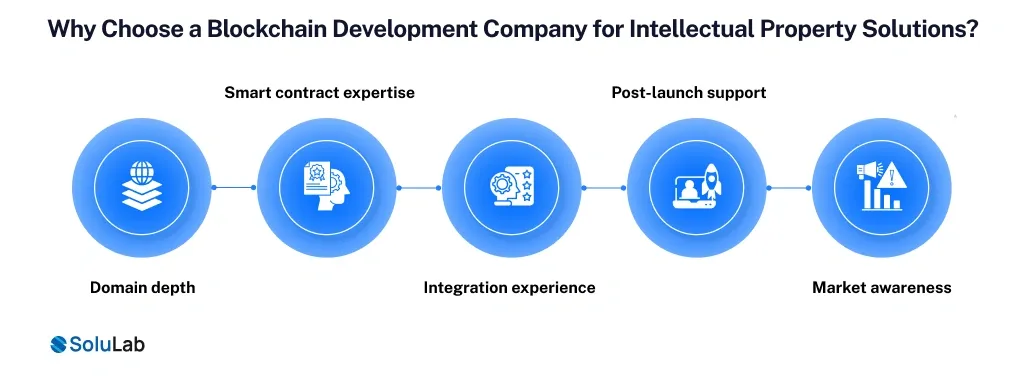
1. Domain depth
IP law intersects with blockchain in non-obvious ways. You need a team that’s shipped this before, not one learning on your budget.
2. Smart contract expertise
When you hire Blockchain Developers with audited production codebases in their portfolio, you’re reducing risk on your most sensitive code. The quality gap between experienced and inexperienced here is significant.
3. Integration experience
Your IP platform will likely need to connect with legal databases, IPFS for file storage, existing ERPs, Oracle networks, and compliance tools. That’s integration work, not just chain work.
4. Post-launch support
Protocols upgrade, regulations shift, networks fork. Good Blockchain Solutions partners stay with you through that, not just through launch day.
5. Market awareness
Staying current on Top Blockchain Trends matters, especially with IP tokenization standards, cross-chain interoperability protocols, and evolving regulatory frameworks moving as fast as they are in 2026.
When you Hire Blockchain Developers through SoluLab, you’re getting a team with cross-industry blockchain development use cases across media, pharma, fashion, and enterprise software, not demo apps.
We also offer Enterprise Risk Detection Platforms as part of our IP monitoring layer, so infringement detection is proactive, not reactive.
The Future of Blockchain in Intellectual Property Protection and IP Management
The blockchain technology future in intellectual property protection is converging around three clear directions:
1. AI + Blockchain Convergence
AI detects potential infringements in real time; blockchain provides the immutable evidence trail to act on them. Together, AI and blockchain create proactive IP defense, not reactive enforcement after damage is done. This pairing is already appearing in early Enterprise blockchain solutions deployments across media and pharmaceutical companies.
2. Cross-Chain Interoperability
Right now, IP registered on Ethereum isn’t automatically verifiable on Hyperledger or Polygon. Projects like Polkadot and Cosmos are building the interoperability layer that changes this. When it matures, blockchain in intellectual property becomes meaningfully more powerful, one registration that is verifiable across any network.
3. Regulatory Maturation
The EU’s MiCA framework, WIPO’s blockchain working group, and similar government-level efforts globally suggest that by 2027, clearer legal standards for on-chain IP will unlock enterprise adoption at a scale we haven’t seen yet (World Economic Forum, 2024). The blockchain technology future in intellectual property protection is a policy story as much as a technology one.
The companies moving now are building on infrastructure that’s becoming more legally recognized, more technically interoperable, and more competitively expected, every quarter.
The blockchain technology future in intellectual property protection isn’t waiting.
Conclusion
The IP challenges that matter, like slow registration, royalty leakage, cross-border enforcement gaps, and counterfeiting, don’t have small solutions. They need infrastructure that matches how IP actually moves in a global, digital economy.
Blockchain technology provides that infrastructure. Whether you’re protecting a startup’s core product, managing thousands of creative licenses, or defending a global patent portfolio, the architecture exists, and it works. The regulatory environment is moving to support it, and the largest companies in the world are already running production systems on it.
And Blockchain in IP Management is no longer a question; we should explore this question. For companies with significant IP on the line, it’s a question of how fast we can move one. The difference between companies that acted in 2024–2025 and those waiting until 2027 will show up in their IP protection outcomes, their revenue recovery, and their competitive positioning.
Solulab builds these systems. Our Expert Blockchain Consultants have worked across industries, jurisdictions, and blockchain networks. We bring the technical depth, the legal awareness, and the production experience to build an IP infrastructure that holds up, commercially, technically, and if it ever needs to, in court.
Blockchain in intellectual property is a real competitive lever, and let’s make sure it’s yours.
Let’s build yours!
FAQs
With over 3 years of experience, I specialize in breaking down complex Web3 and crypto concepts into clear, actionable content. From deep-dive technical explainers to project documentation, I help brands educate and engage their audience through well-researched, developer-friendly writing.