Key Takeaways
- Blockchain integration connects your existing systems (ERP, CRM, payment rails) to an established chain like Ethereum, Polygon, or Hyperledger. Faster and cheaper for most businesses, and that’s true more often than most vendors will admit.
- Building from scratch means designing a custom blockchain or a custom smart contract layer built only for your use case. Costs more. Gives you full control in exchange.
- Most companies don’t need a brand-new chain. A large share of enterprise blockchain projects succeed by integrating into a network that already has years of security history behind it.
- Speed, budget, and compliance with existing standards? That points toward integration.
- Your business logic, data privacy rules, or transaction volume don’t fit any existing chain’s design? That’s when custom development earns its cost.
- Skip the long RFP process. A short discovery workshop usually gets you a clear answer for your specific case faster.
Pick blockchain integration if you want to add trust, traceability, or automated payments to systems you already run, and you’d rather launch in weeks than months. Blockchain is projected to generate $3.1 trillion in business value by 2030.
Pick custom blockchain development only when your business has needs an existing chain genuinely can’t meet: a proprietary consensus rule, a closed regulated network, transaction volumes public chains can’t handle at your target cost.
In our project reviews, most companies asking, “Should we build our own chain” don’t actually need one. They need custom blockchain development in the sense of smart contracts and applications built on top of a chain that already exists, not a new protocol from zero.
What Blockchain Integration Actually Means?
Blockchain integration connects your existing software (such as an ERP, payment gateway, supply chain tool, or CRM) to an existing blockchain network. You’re not writing a new consensus algorithm. You’re not standing up a new network from nothing. You’re building the bridge: APIs, smart contracts, data pipelines that let your existing systems read from and write to the chain.
It’s a bit like adding a payment processor to an online store. Nobody builds a new banking network for that. You connect to Stripe or PayPal through an API, then configure the rules that matter for your business, and you’re live.
How the Blockchain Integration Process Works?
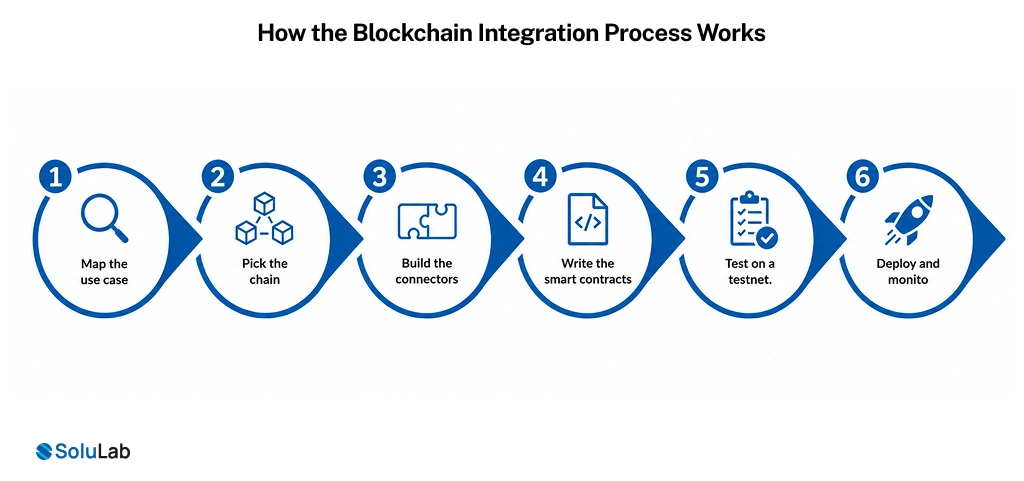
Here’s roughly how it plays out on a real project.
- Map the use case: Figure out exactly what needs to live on-chain (ownership records, payment triggers, audit trails) and what just stays in your existing database. Most of your data probably stays put.
- Pick the chain: a public network like Ethereum or Polygon, a permissioned one like Hyperledger Fabric or Corda, or a Layer 2. Cost, speed, and privacy needs drive this choice.
- Build the connectors. APIs, oracles, middleware. The unglamorous plumbing that syncs your legacy systems with the chain, and honestly, this is where most of the engineering hours go.
- Write the smart contracts: encode the specific business rules, say a release-on-delivery payment or a token issuance rule, as contracts on the chosen chain.
- Test on a testnet. Run the whole flow on a sandbox network before real funds or real records touch it.
- Deploy and monitor: go live on mainnet with logging, alerting, and a rollback plan already in place, not one you’re improvising after something breaks.
Most SoluLab clients complete this blockchain integration process in 8 to 14 weeks for a first production use case, depending on how many legacy systems need to connect.
What Building a Custom Blockchain From Scratch Actually Means
Building from scratch means designing the network itself. The consensus mechanism, the node structure, the ledger rules, and often a native token too. This is closer to building your own banking network than plugging into one that already exists. It’s the right call when no existing chain’s rules fit your business. It is not the right call just because “our own blockchain” sounds good on a slide.
How the Custom Blockchain Development Process Works
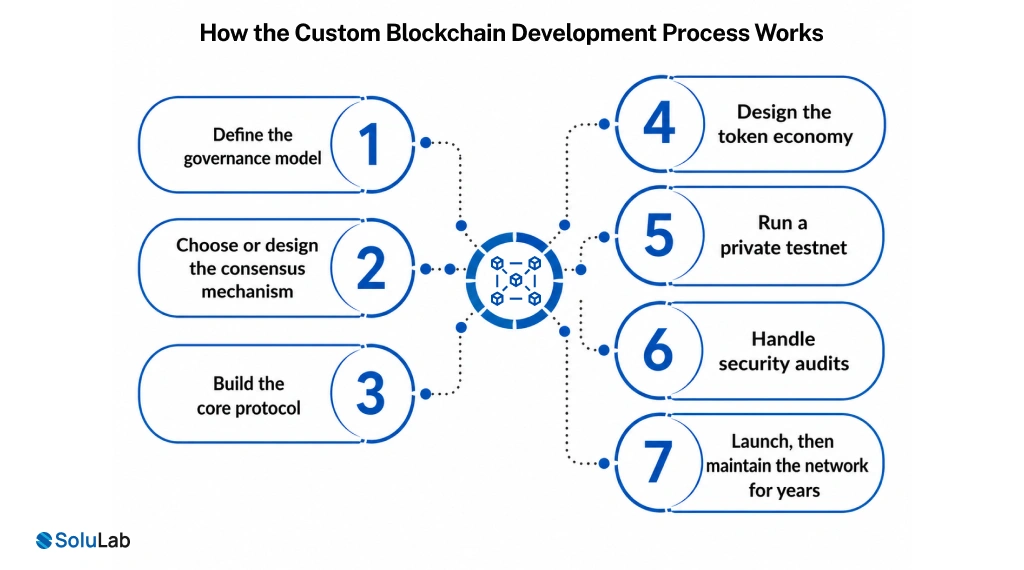
- Define the governance model: Who runs nodes? Who validates transactions? How do disputes get resolved? Answer these before writing a line of code.
- Choose or design the consensus mechanism: Proof of Authority, Proof of Stake, or something custom, depending on your trust model and performance needs.
- Build the core protocol: Node software, networking layer, ledger logic, all from the ground up. This is the part that separates a real custom chain from a rebranded fork.
- Design the token economy: If applicable, including issuance, incentives, and supply rules.
- Run a private testnet: With real participants for months, not weeks. Edge cases at scale don’t show up in week one.
- Handle security audits: A custom chain needs its own independent audit. You can’t borrow the security track record of an established network because you don’t have one yet.
- Launch, then maintain the network for years: Including node operator support and protocol upgrades that never really stop.
This custom blockchain development path typically runs 6 to 12 months for a working network, and that assumes you walked in with a clear governance model. Most teams don’t. Unclear governance, more than any technical hurdle, is why custom chain projects stall out.
Blockchain Integration vs Custom Development: Side-by-Side
| Factor | Blockchain Integration | Building From Scratch |
| Typical timeline | 8-14 weeks | 6-12 months |
| Relative cost | Lower; see blockchain development cost for a detailed breakdown | 3-10x higher, ongoing maintenance included |
| Security track record | Inherits the security and audit history of an established chain | Needs its own independent audit and ongoing hardening |
| Control over rules | Limited to what the chosen chain’s smart contracts allow | Full control over consensus, governance, and protocol rules |
| Best for | Payments, traceability, tokenization, loyalty programs, supply chain records | Regulated consortium networks, proprietary consensus needs, extreme throughput requirements |
| Team needed | Smart contract developers, integration engineers | Protocol engineers, cryptographers, node infrastructure specialists |

Cost and Timeline: What Each Path Really Requires
Blockchain Integration Costs
- Discovery and architecture
- Smart contract development for the defined use case. Usually the largest line item here, but still a fraction of what a custom chain runs.
- API and middleware development to connect legacy systems, which quietly eats more budget than teams expect.
- Testnet QA and mainnet deployment.
- Ongoing gas fees and node hosting, if you’re on a permissioned chain.
Custom Blockchain Development Costs
- Protocol design and architecture: weeks of work from senior blockchain engineers before anything gets built.
- Core node software development. The largest, most time-intensive line item on the whole project.
- Independent security audit. Non-negotiable, and usually repeated after any major change to the protocol.
- Node infrastructure and network operations, which run for as long as the network does. This never turns into a one-time cost.
- Governance tooling and documentation for validators or consortium members.
Here’s a quick gut check we use with clients. Ask your finance team, “Who validates this network, and why them?” If nobody has a clean answer yet, you’re not ready to scope a custom build, full stop. A short blockchain consulting engagement can get you that answer before you commit real budget either way.
Which Option Fits Your Business?
Choose Blockchain Integration When
- You need to launch this quarter, not next year.
- Your use case fits standard patterns: payments, provenance tracking, tokenized assets, automated settlements.
- Your budget is fixed and has to stay predictable, no surprises in month eight.
- Compliance requirements are already satisfied by an established, audited network.
- You want to pilot the idea before committing to a bigger platform investment.
Choose Custom Blockchain Development When
- Regulators require a closed, permissioned network that only approved parties can join. No exceptions here.
- Your transaction volume or data privacy rules genuinely don’t fit any existing chain’s design.
- You’re building a platform other companies will build on top of, and network-level control is part of the product itself.
- You have the budget and the appetite for multi-year protocol maintenance.
- A real feasibility study, not a hunch, has confirmed no existing chain meets your requirements.
Not sure which list you fall into? That’s normal, and it’s fine. A short blockchain migration assessment exists for exactly this reason: to answer the question before you spend real engineering budget finding out the hard way.
Common Mistakes Businesses Make in This Decision
- Choosing custom development for prestige, not necessity: a new chain sounds impressive in a board deck. It rarely earns back its cost against a well-integrated existing network. We’ve sat in those meetings.
- Underestimating integration complexity with legacy systems: old ERPs and databases often need more middleware work than the blockchain layer itself does.
- Skipping the security audit on integration projects: smart contracts on an established chain still need their own audit. The chain’s security doesn’t cover your custom contract logic, only its own.
- Ignoring long-term maintenance costs: a custom chain needs ongoing node operations, protocol upgrades, and validator support for as long as it runs. That’s not a one-line item in year one’s budget.
- Not testing at a real-world scale before launch. A testnet handling ten transactions a day tells you almost nothing about performance at ten thousand.

Conclusion
Blockchain integration and building from scratch solve different problems, not the same problem at different price points. Integration gets you live in weeks, on infrastructure that’s already been battle-tested.
Building from scratch gives you full control over the network itself, but it costs more, takes longer, and needs ongoing maintenance for years. Most businesses only need the first one. The right call depends on your compliance rules, your transaction volume, and your legacy systems, not on which option sounds more impressive.
SoluLab, a blockchain development company, can help your business figure out which path actually fits, then build it. Get in touch to talk through your use case.
FAQs
Neha is a curious content writer with a knack for breaking down complex technologies into meaningful, reader-friendly insights. With experience in blockchain, digital assets, and enterprise tech, she focuses on creating content that informs, connects, and supports strategic decision-making.