Key Takeaways
- Blockchain in e-commerce gives online sellers a shared, tamper-resistant record for payments, orders, and product histories. Fewer manual checks, fewer disputes.
- Blockchain payment solutions can settle cross-border transactions in minutes instead of days, and for a fraction of what card networks charge.
- Supply chain traceability is the most mature, most provable use case right now, especially in food, fashion, and luxury retail.
- Smart contracts, loyalty tokens, and Web3 storefronts are still early. A handful of retailers are already using them to stand out.
- None of this is free. Integration cost, regulatory uncertainty, and a real skills gap are why most pilots stall before they scale.
Blockchain in e-commerce means using a distributed ledger to record and verify transactions, product data, and supply chain events, without parking all of it in one company’s database. For an online retailer, that shows up as faster payments, product histories that are hard to fake, and far fewer arguments about who touched an order and when.
Shoppers rarely notice the ledger itself. What they notice is a checkout that doesn’t get flagged for fraud. A package that arrives with a verifiable origin story instead of a marketing claim. A loyalty point that actually works across brands instead of dying in an app nobody opens twice. That’s the real pitch here: less friction, more trust, and a paper trail that doesn’t depend on any single company keeping its own records clean.
This piece covers where blockchain is already earning its keep in e-commerce, where it’s still more pilot than product, and what a founder or operator should weigh before spending real budget on it.
What Is Blockchain in E-commerce, Exactly?
Blockchain technology is a distributed, append-only ledger. Every transaction becomes a “block,” linked to the one before it, and copied across a network instead of sitting on one company’s server. No single party can quietly go back and edit history. That single property is why it’s useful anywhere trust between strangers matters: buyers and sellers, brands and suppliers, merchants and payment processors.
In e-commerce and blockchain conversations, this tends to show up as one of four things.
- Payment rails that settle peer-to-peer, often in stablecoins or tokenized fiat.
- Product and shipment records that follow an item from factory to doorstep.
- Smart contracts that release payment, trigger a refund, or unlock a reward the moment a condition is met, no human approval needed.
- Digital identity and authenticity certificates, useful for anything from limited-edition sneakers to prescription drugs.
None of this requires a store to accept crypto. Most blockchain applications in e-commerce run quietly in the background, verifying and recording. The customer sees an ordinary checkout page.
Why the Timing Matters Now
E-commerce has outgrown a lot of the plumbing it was built on. Global online retail revenue is projected to reach $3.86 trillion in 2026 and climb toward $4.91 trillion by 2030, according to Statista’s e-commerce market outlook. That’s an enormous amount of transaction volume running through systems originally sized for a much smaller, more centralized internet.
Scale exposes specific weak points. Payment fraud grows right alongside transaction volume. Cross-border sellers eat currency conversion fees and settlement windows that stretch for days. Counterfeit goods quietly erode brand trust, and fashion, electronics, and beauty feel it the most. Supply chains that once ran through two or three intermediaries now often run through eight or ten. Each hop is a place a record can get lost, altered, or simply never captured.
Enterprise appetite reflects that pressure. A Deloitte blockchain survey found that 86% of business leaders believe the technology will help push corporate processes toward being fully touchless, and 91% expect a measurable return on their blockchain investment within five years. Separately.
Gartner analysts projected that 20% of major global grocers would adopt blockchain for food safety and traceability, a prediction that’s already played out in programs like Walmart’s farm-to-shelf tracking system for leafy greens. This isn’t speculative anymore. It’s operational infrastructure at some of the world’s largest retailers, and mid-market e-commerce brands are starting to borrow the same playbook at a smaller scale.
Blockchain Payment Solutions: A Faster Way to Move Money
Payments are where blockchain’s impact on e-commerce is most immediate. Traditional card processing routes a transaction through the issuing bank, the card network, the acquiring bank, and the payment gateway. Each stop takes a cut and adds a little latency. Cross-border orders make it worse, often tacking on currency conversion fees and settlement delays of three to five business days.
Blockchain payment solutions cut most of that out. A transaction settles directly between buyer and merchant wallets, recorded on the ledger, with no card network sitting in the middle. In practice, merchants tend to see:
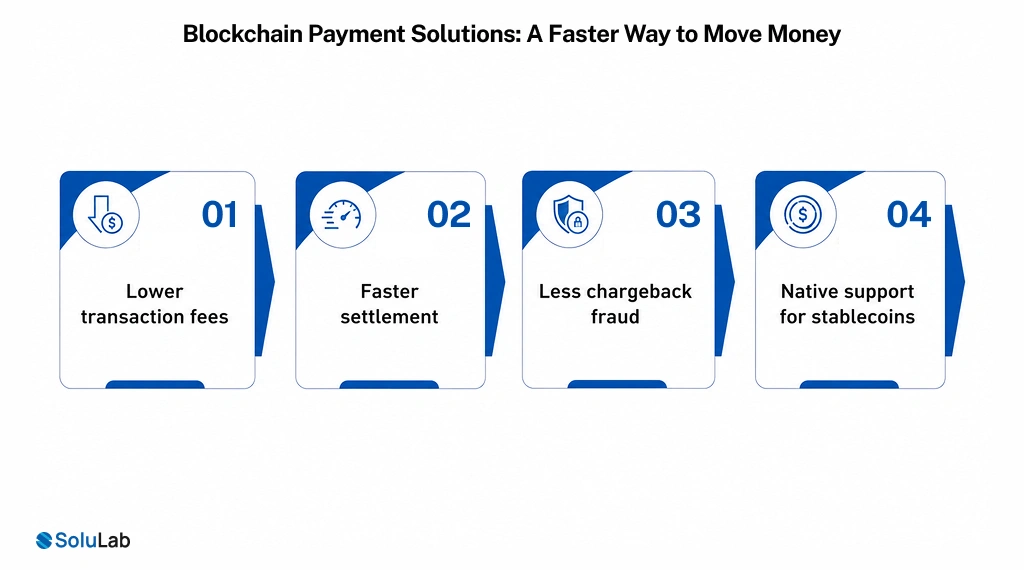
- Lower transaction fees, which matter most on thin-margin international orders.
- Faster settlement, often minutes instead of days.
- Less chargeback fraud, since blockchain transactions are final and traceable rather than reversible after the fact.
- Native support for stablecoins, digital dollars without the price swings of Bitcoin or Ethereum.
Deloitte’s financial services research projects that stablecoin-enabled retail purchases in the US could exceed $200 billion by 2030, pushed along by crypto-backed cards, merchant-issued digital currency, and the early rise of agentic commerce. Separately, Deloitte’s Q2 2025 CFO Signals survey found that roughly a quarter of North American CFOs expect their organizations to use cryptocurrency for business functions within two years. Among companies with revenue over $10 billion, that number jumps to 40%.
Blockchain in Supply Chain: Tracking Products from Factory to Doorstep
If payments are the fastest-growing use case, blockchain in supply chain management is the most mature one. The ROI here is easy to point to, because the underlying problem- knowing exactly where a product came from and who handled it, is one every retailer already deals with by hand, usually badly.
Here’s what a blockchain-backed supply chain typically captures:
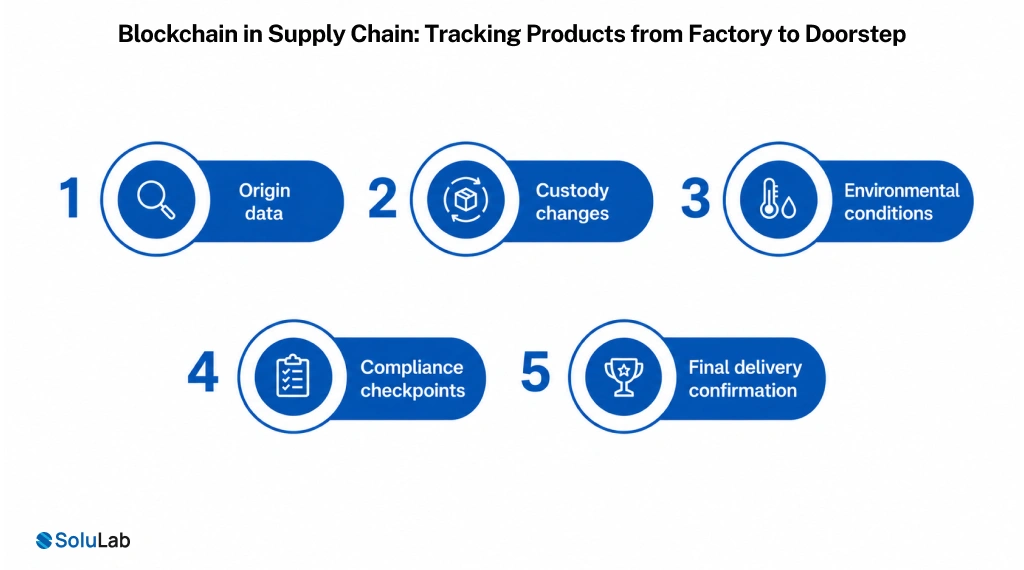
- Origin data: raw material source, farm, factory, or mine.
- Custody changes: every hop between a supplier, freight partner, warehouse, or distributor.
- Environmental conditions: temperature and humidity logs for perishables or pharmaceuticals.
- Compliance checkpoints: certifications, inspections, customs clearance.
- Final delivery confirmation: proof the item arrived in the condition it left the factory.
Because every entry is timestamped and can’t be quietly edited later, brands can prove authenticity instead of just claiming it. Luxury sellers use this to fight counterfeiting. Food retailers use it to trace contamination sources in hours instead of days, which shrinks recall scope dramatically. Fashion brands use it to back up sustainability claims with an actual paper trail rather than a page on their website.
This is also where blockchain for retail connects most directly to consumer trust. Shoppers increasingly want to know where something came from before they buy it, and a verifiable record answers that better than any product-page copy ever could.
Fraud Prevention, Data Security, and Customer Trust
E-commerce fraud goes well beyond stolen card numbers. Account takeovers, fake reviews, counterfeit listings, return fraud- all of it chips away at margin quietly, month after month. Blockchain won’t eliminate fraud on its own, but it strips out a lot of the ambiguity fraud depends on.
A few concrete mechanisms worth knowing:
- Immutable transaction logs make it far harder to dispute a legitimate order after the fact.
- Decentralized identity verification means a single database breach doesn’t expose every customer at once.
- Product authentication tokens, often paired with QR codes or NFC tags, let a customer verify an item is genuine before or after buying it.
- Smart contract escrow holds payment until delivery conditions are confirmed, protecting both sides of a marketplace transaction.
For merchants weighing the benefits of blockchain in e-commerce against the cost of building it, fraud reduction is usually the line item that makes the math work. One prevented counterfeit-goods lawsuit, or a meaningfully lower chargeback rate, can offset a good chunk of integration cost inside the first year.
Smart Contracts, Loyalty Programs, and Web3 E-commerce
Beyond payments and logistics, a smaller but growing set of retailers is experimenting with Web3 e-commerce features: tokenized loyalty points, NFT-backed product ownership, community-run storefronts.
Smart contracts sit underneath most of it. They’re self-executing agreements written directly into code, and they fire automatically once a condition is met, with no one waiting on manual approval. A few examples that actually show up in retail:
- A loyalty point that’s really a token, redeemable across a brand’s whole product line, or even a partner brand’s, instead of being trapped inside one app.
- A resale royalty that pays the original brand every time a product changes hands secondhand, verified automatically through the blockchain record.
- A pre-order contract that releases funds to the manufacturer only once a shipment milestone is confirmed, so buyers aren’t paying for goods that never show up.
This is still the least mainstream part of the future of blockchain in e-commerce, and some skepticism toward the Web3 commerce hype from a few years back is fair. But the underlying mechanic, automated transactions that trigger on real conditions, holds up once teams stop chasing the token and start solving the actual operational problem.
Benefits and Trade-offs Worth Weighing
None of this is a reason to bolt blockchain onto every part of a storefront. It’s infrastructure, and like any infrastructure decision, it comes with real costs sitting right next to the upside.
Benefits worth taking seriously:
- Lower payment processing costs on cross-border and high-volume transactions.
- A real drop in fraud and counterfeit exposure.
- Sustainability and ethical-sourcing claims that can actually be verified.
- Faster dispute resolution, since the transaction history isn’t up for debate.
- A foundation for automated, condition-based workflows through smart contracts.
Trade-offs to plan around:
- Integration cost and timeline, particularly on legacy e-commerce platforms.
- Regulatory uncertainty around stablecoins and digital assets, which shifts a lot by country.
- A genuine skills gap. Most in-house engineering teams haven’t built on blockchain before, and hiring for it is competitive right now.
- Network effects. A supply-chain ledger only works if your suppliers actually show up on it too, not just your own systems.
Start with whichever use case has the clearest, most measurable payoff, usually payments or traceability, instead of trying to blockchain-enable the whole storefront on day one.
The Future of Blockchain in E-commerce
A few trends are worth watching. Retail and e-commerce is expected to be one of the fastest-growing verticals for blockchain adoption over the next several years, driven mostly by payments infrastructure and traceability demand rather than speculative crypto plays.
Stablecoin-based checkout will likely become standard at large retailers well before it’s common among smaller merchants, simply because the integration and compliance lift is real and takes time.
Agentic commerce, where AI shopping agents transact on a buyer’s behalf, is also starting to lean on blockchain-based payment rails for verification and settlement. Automated agents need a transaction record that doesn’t require a human to review it after the fact. Worth keeping an eye on if you’re thinking about where checkout is headed over the next three to five years.

Conclusion
Blockchain in e-commerce isn’t one feature you bolt onto a storefront. It’s infrastructure that touches payments, supply chain visibility, fraud prevention, and, increasingly, loyalty and ownership models too.
The businesses getting real value out of it right now aren’t chasing every trend at once. They’re picking one clear problem, usually cross-border payment cost or supply chain traceability, and solving it properly before moving on to the next thing.
SoluLab, a blockchain development company that has built payment rails, traceability systems, and Web3 storefronts for retail and consumer brands, can help you figure out which use case actually pays off for your business, then build it right. If you’re not sure where to start.
Book a free discovery call and we’ll help map the fastest path from idea to a working pilot.
FAQs
Neha is a curious content writer with a knack for breaking down complex technologies into meaningful, reader-friendly insights. With experience in blockchain, digital assets, and enterprise tech, she focuses on creating content that informs, connects, and supports strategic decision-making.