Key Takeaways
- BFSI institutions are moving from tokenization pilots to operating models built around issuance, settlement, custody, and collateral.
- Fixed income remains the clearest entry point, but real-world asset tokenization is spreading into credit, funds, equities, and real estate.
- Compliance, custody, and interoperability are becoming the hard requirements behind every serious Asset Tokenization Platform for BFSI.
- Institutional use of blockchain is becoming more selective, more regulated, and more tightly connected to existing financial infrastructure.
- The strongest BFSI Asset Tokenization Trends 2026 are not about hype. They are about rails, controls, and market access.
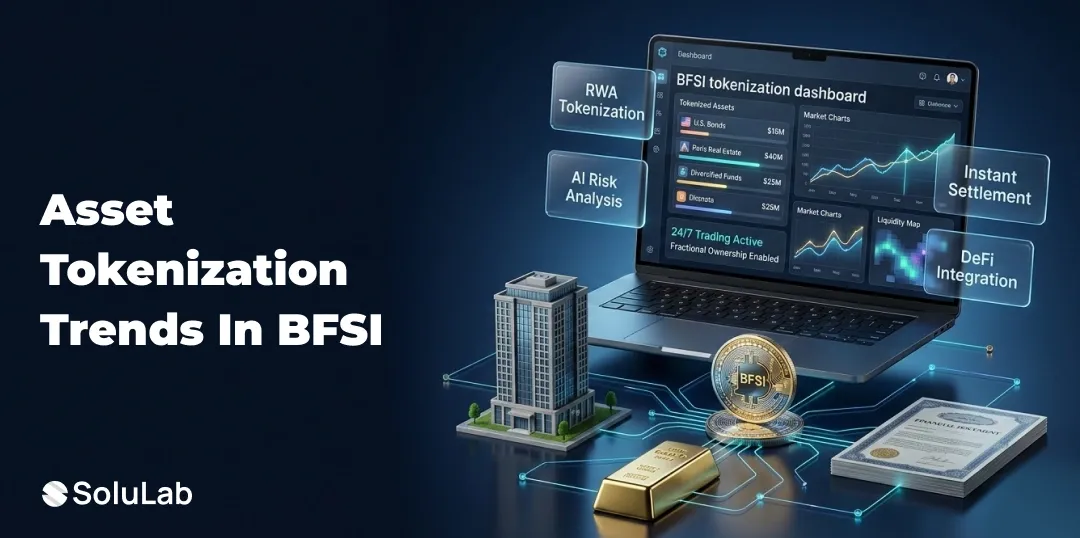
Tokenization is now moving into product, treasury, custody, and market infrastructure discussions. As per the reports, $26.71 billion are distributed in real-world asset value on-chain, and this includes roughly $10.00 billion in tokenized U.S. Treasuries, $6.15 billion in tokenized credit, $1.08 billion in tokenized stocks, and $296.85 million in tokenized real estate.
While the tokenization is still early and broader adoption is being held back by interoperability gaps, legacy-system friction, and legal uncertainty. This guide explores the top asset tokenization trends in BFSI for 2026.

Top Asset Tokenization Trends in BFSI for 2026
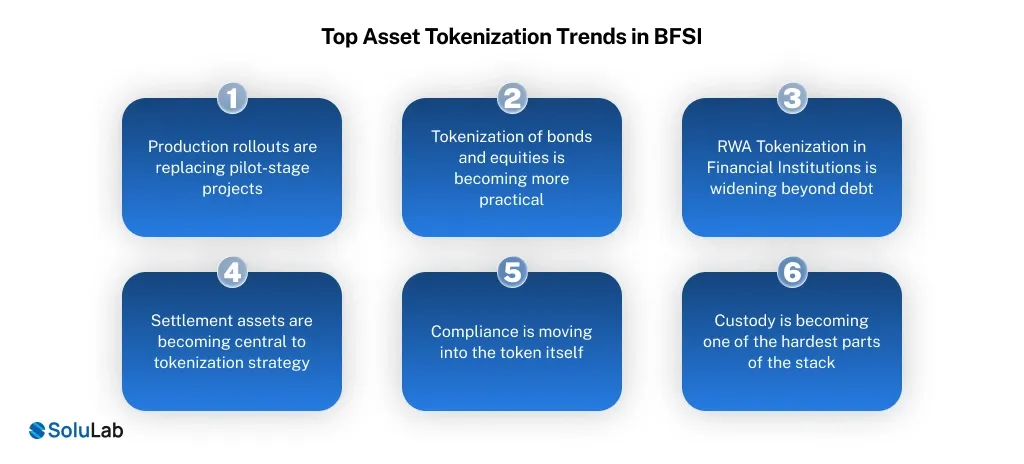
A useful trend list should show where banks, insurers, and financial institutions are actually putting time, budget, and operational focus.
1. Production rollouts are replacing pilot-stage projects
Banks are moving beyond proofs of concept and into live settlement, collateral, and issuance programs with clearer operational goals.
This is one of the clearest BFSI Asset Tokenization Trends 2026. The ECB said its 2024 exploratory work involved more than 50 trials across nine jurisdictions and transactions worth about €1.6 billion. It also said the Eurosystem will offer tokenized central bank money settlement for DLT-based transactions through its Pontes project from September 2026. In India, the RBI launched a pilot for tokenized certificates of deposit using wholesale CBDC infrastructure. The signal is straightforward: Asset Tokenization in the Banking Sector is moving closer to live market plumbing.
2. Tokenization of bonds and equities is becoming more practical
Fixed income still leads the conversation, but equities and fund-linked securities are starting to move into the same discussion.
The World Economic Forum said fixed-income tokenization had already made notable advances across sovereign, corporate, and municipal bonds in its 2025 report. IOSCO also pointed to evidence that tokenized bond issuance can come with lower underwriting fees, narrower yield spreads, and tighter bid-ask spreads than comparable conventional bonds. Equities are smaller, but they are no longer theoretical: RWA.xyz now tracks tokenized stocks at about $1.08 billion in total value. That makes Tokenized Securities in Banking one of the most credible near-term use cases in Tokenization in the Financial Services Industry.
3. RWA Tokenization in Financial Institutions is widening beyond debt
Financial firms are now are building tokenization strategies across several asset classes at once.
That shift matters because Real World Asset Tokenization BFSI is starting to look more like a portfolio strategy than a single-product experiment. RWA.xyz currently tracks about $6.15 billion in tokenized credit and nearly $296.85 million in tokenized real estate. For BFSI firms, that widens the conversation toward private credit, real estate-backed products, fund interests, receivables, and structured exposures. Tokenized real estate in BFSI may still be smaller than debt, but it is becoming part of platform planning, product design, and distribution thinking.
4. Settlement assets are becoming central to tokenization strategy
Tokenized assets do not scale well if the settlement side remains fragmented, risky, or operationally unclear.
The ECB has been explicit on this point. It said tokenized central bank money is necessary to provide a risk-free settlement asset in tokenized markets and noted that DLT-issued marketable assets held in central securities depositories have been accepted as collateral in Eurosystem credit operations since the end of March 2026. ICMA’s Project Guardian fixed-income workstream also published guidance on DvP settlement and highlighted settlement assets such as wholesale CBDC, tokenized bank liabilities, and regulated stablecoins. In practical terms, Blockchain in BFSI Tokenization is no longer only about issuance. It is about the full settlement chain.
5. Compliance is moving into the token itself
Banks need tokenization that carries controls inside the operating flow.
Permissioning, investor eligibility, transfer restrictions, and automated policy enforcement are becoming central to Digital Asset Tokenization in Finance. MAS said Project Guardian has developed frameworks to support foundational infrastructure for asset tokenization and to design open, interoperable networks. IOSCO’s 2025 report also emphasizes legal recognition, settlement finality, operational risk, and technology-specific vulnerabilities as core issues for tokenized financial assets. The practical takeaway is simple: compliance-by-design is becoming a requirement, not a premium feature.
6. Custody is becoming one of the hardest parts of the stack
Issuing a token is easier than safeguarding it, administering it, and fitting it into regulated custody workflows.
Custody solutions for tokenized assets are moving to the center of the BFSI tokenization conversation. ICMA’s 2025 Project Guardian addendum included lessons learned from custody arrangements for DLT-based debt securities. IOSCO also flagged key-management risks, private-key compromise, and operational vulnerabilities across DLT networks and smart contracts. For banks and asset managers, custody is where legal ownership, control, security, and client protection all meet.
7. Legacy integration is winning over full replacement plans
Most institutions are not rebuilding their entire core stack for tokenization. They are connecting new rails to existing systems.
Interoperability has become one of the most important BFSI Blockchain Trends 2026. The BIS says broader adoption is still constrained by limited interoperability between DLT platforms and legacy systems, while the source of many current projects remains permissioned networks with centralized governance. In other words, Asset Tokenization in Banking and Financial Services is moving forward through hybrid architecture: core banking, custody, collateral, reporting, and settlement systems stay in place while tokenized layers are added where the business case is strongest.
8. Tokenized funds and blockchain-based portfolio operations are gaining ground
Tokenization is starting to change how funds are issued, recorded, and managed, not only how securities are traded.
This is a major development for Blockchain-based asset management. Franklin Templeton’s Franklin OnChain U.S. Government Money Fund reported about $843.74 million in net assets as of March 31, 2026. BNY and Goldman Sachs also launched a tokenized money market fund ownership solution in July 2025. MAS Project Guardian work on tokenized funds has gone further, including a proof of concept from Fidelity International and Citibank that combined a tokenized money market fund with embedded digital FX. This is where Asset Tokenization Use Cases in BFSI start to move from capital-markets talk to treasury and portfolio operations.
9. Decentralized finance in banking is becoming more selective
Banks are testing DeFi controlled versions that preserve governance, identity, and risk controls.
J.P. Morgan describes “Institutional DeFi” as a model that combines DeFi innovation with the safeguards of current finance. Under Project Guardian, J.P. Morgan’s work on tokenized portfolios focused on portfolio assembly, automated rebalancing, and interoperability across blockchains. IOSCO cites Project Guardian-related analysis suggesting that DLT programmability can reduce cash drag and lower client costs by around 24 basis points in some portfolio-management scenarios. For BFSI firms, the message is clear: Decentralized finance (DeFi) in banking is becoming narrower, more structured, and more institutional.
10. The Asset Tokenization Platform for BFSI is becoming a full operating stack
The market is moving away from single-purpose pilots and toward platforms that handle issuance, controls, settlement, custody, and reporting together.
This is the trend that ties the rest together. MAS Project Guardian is publishing framework-level guidance. ICMA publishes DvP and custody playbooks for digital bond markets. The ECB is putting settlement and collateral support behind tokenized market activity. Banks are also seeing that platforms need orchestration across asset classes, rules, permissions, and rails. That is why Asset Tokenization Platform for BFSI conversations now include identity, transfer logic, settlement assets, custody, compliance, and data integration from day one.

Conclusion
The next phase of Asset Tokenization in Banking and Financial Services will favor firms that make three decisions early.
First, which asset classes deserve live tokenization now. Second, which operating model can satisfy compliance, custody, and settlement requirements. Third, whether the business needs a narrow use case or a broader real-world asset tokenization platform that can support several products over time, the market is growing, but the infrastructure still needs discipline. That is what makes 2026 a serious planning year for Tokenization in finance.
FAQs
Shipra Garg is a tech-focused content strategist and copywriter specializing in Web3, blockchain, and artificial intelligence. She has worked with startups and enterprise teams to craft high-conversion content that bridges deep tech with business impact. Her work translates complex innovations into clear, credible, and engaging narratives that drive growth and build trust in emerging tech markets.