Key Takeaways
- You don’t need to learn to code to build an AI product, but you do need enough to hold your development partner accountable.
- A committed technical lead (in-house or fractional) matters more than a full-time technical co-founder for most early-stage AI products.
- Outsourcing works when you know how to write a spec, run a sprint demo, and verify an estimate against real scope.
- Most AI project failures trace back to unclear success metrics and weak data foundations, not the technology itself.
- Cost overruns are usually a spec problem, not a vendor-honesty problem. Fix the spec and the estimate gets easier to trust.
Not knowing how to code is not the same as not knowing how to build. A non-technical founder can absolutely ship an AI startup, and a growing number already have.
What actually decides whether the product ships on time and on budget is whether the founder can ask the right questions, read an AI development estimate without flinching, and tell the difference between a partner who explains trade-offs and one who hides behind jargon.
This guide walks through what that looks like in practice: when you genuinely need a technical co-founder versus when a strong outsourcing relationship will do, how to vet a development partner before you sign anything, how to manage sprints without a computer science degree, and what an AI product actually costs.
Why Non-Technical Founders Keep Building AI Startups Anyway?
Founders without engineering backgrounds have run consumer and enterprise companies for decades. What’s changed with AI is the perception that you now need a PhD-level understanding of machine learning just to get started.
- You don’t. Large language models, RAG pipelines, and pre-trained vision APIs have pushed a lot of the deep technical lifting into tools a good engineering partner already knows how to use.
- That said, the data on AI projects generally should sober anyone up before they start writing checks. Independent research from RAND Corporation, cited widely alongside Gartner’s own tracking, put enterprise AI project failure rates above 80%, roughly double the failure rate of standard software projects.
- Gartner’s April 2026 survey work found that a majority of teams that experienced failure blamed it on expecting the system to do too much, too fast, without the groundwork in place. That’s not a technology problem. It’s a scoping and expectations problem, and it hits non-technical and technical founders alike.
- The upside: founders who define success metrics before writing a line of code do dramatically better. Projects with agreed, quantified success criteria succeed at roughly four times the rate of those without one. That single habit, deciding what “working” means before you build, is something any founder can own regardless of technical background.
A Quick Reality Check on Founder Backgrounds
Contrary to the old assumption that only engineers build tech companies, research comparing founder backgrounds has found that a technical co-founder correlates with stronger outcomes mainly in enterprise-focused products, where buyers demand deep technical performance.
Consumer-facing products show a much weaker relationship between founder technical background and startup success. The common thread across the research: startups that pair non-technical judgment with a committed technical lead, whether that’s a CTO, a fractional CTO, or a trusted development partner, perform on par with fully technical founding teams.
Do You Actually Need a Technical Co-Founder for an AI Startup?
The honest answer is: usually not, at least not on day one. What you need is someone accountable for technical decisions, and that person doesn’t have to hold equity or sit in your cap table.
Three situations where a technical co-founder genuinely helps:
- You’re building deep AI IP. If your moat is a proprietary model, novel training data, or a hard research problem, you need technical ownership from the start.
- Investors expect it. Some enterprise-focused VCs still screen for a technical co-founder before writing a check, particularly for infrastructure or dev-tools plays.
- You plan to hire an engineering team fast. Scaling a team without any technical leadership internally gets expensive and chaotic quickly.
Three situations where you’re better off without one, at least for now:
- You’re validating a business idea first. A fractional CTO or development agency can get you to a working MVP faster than a co-founder search that might take six months.
- The AI capability is commoditized. If you’re wrapping an existing LLM API with your own workflow and data, you’re buying engineering execution, not inventing new science.
- You want to keep more equity. Every percentage point you give a co-founder is a point you don’t get back. Paying a development partner in cash instead of equity is often the cheaper long-term move.
If you go the outsourcing route, read the guide on hiring AI developers before you approach any agency, so you know what a fair engagement actually looks like.
Core AI Components Every Non-Technical Founder Should Know
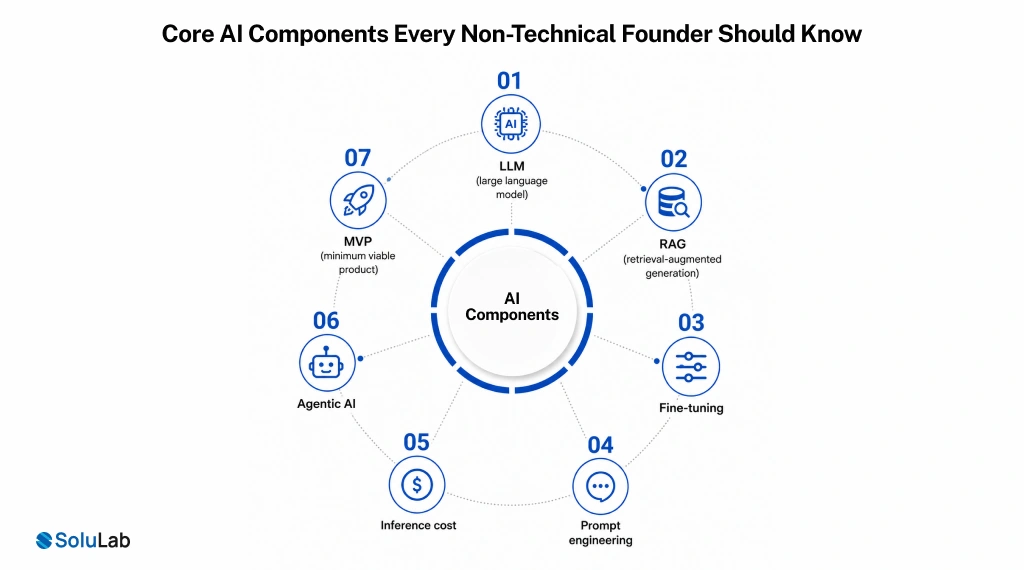
Here’s a working glossary that covers most founder-vendor conversations.
- LLM (large language model): the underlying AI model, like GPT or Claude, that generates text, answers questions, or reasons through tasks.
- RAG (retrieval-augmented generation): a technique that lets an AI model pull from your own documents or database before answering, instead of relying only on what it learned during training. This is how most “AI that knows our company’s data” products actually work.
- Fine-tuning: further training a model on your specific data so it performs better on your use case. More expensive and slower than RAG; usually only worth it for narrow, high-volume tasks.
- Prompt engineering: designing the instructions given to an AI model to get consistent, useful output. Cheap to iterate on, and often the first thing a good partner should try before reaching for anything heavier.
- Inference cost: what it costs, per request, to run your AI model. This is an ongoing operating cost, not a one-time build cost, and founders frequently forget to budget for it.
- Agentic AI: AI systems that can take multi-step actions on their own, like booking
something or updating a record, rather than just answering a question. - MVP (minimum viable product): the smallest version of your product that lets you test the core value proposition with real users.
How to Build an AI Product Without Technical Knowledge
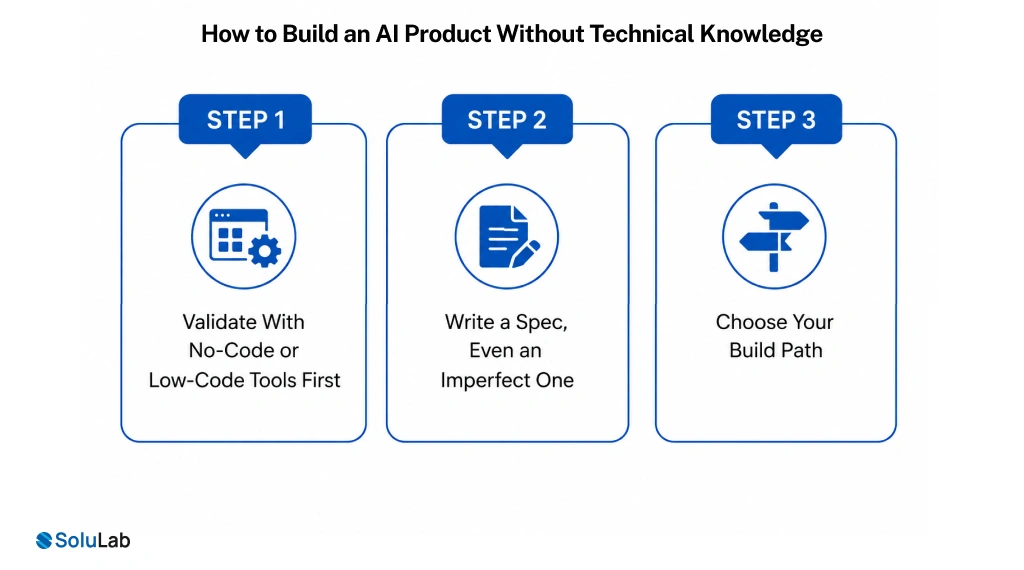
There’s a practical path here, and most successful non-technical founders follow some version of it.
Step 1: Validate With No-Code or Low-Code Tools First
Before committing real budget, test your assumption with existing AI tools, workflow builders, or a thin wrapper around an LLM API. This tells you whether people want the outcome you’re promising before you pay to engineer a full product around it.
Step 2: Write a Spec, Even an Imperfect One
You don’t need engineering fluency to write a product spec. You need clarity on the problem, the user, the core workflow, and what “done” looks like for version one.
A rough spec written by a founder who understands the business beats a polished one written by a developer who’s guessing at intent. If you want structure, the how-to on AI development checklist for seed-stage startups walks through exactly what a first spec should cover.
Step 3: Choose Your Build Path
- Hire a development agency or consulting partner for a fixed-scope MVP. Best when you need speed and don’t want to manage individual contractors.
- Bring on a fractional CTO to guide architecture decisions while you outsource the actual build. Best when the product is technically ambitious.
- Hire freelance developers directly and manage them yourself. Cheapest option on paper, but it puts the most technical-decision burden on you.
How to Vet an AI Development Partner Without a Technical Background
This is where most non-technical founders lose money, not in the build itself, but in choosing the wrong partner and not catching it early.
Questions to Ask Before You Sign Anything
- “Walk me through how you’d approach this without using AI at all, then tell me where AI actually adds value.” A partner who can answer this understands your problem, not just the technology trend.
- “What’s your recommended architecture, and why not a simpler one?” Overengineering is the most common way agencies pad a bill.
- “What happens to inference costs as our user base grows?” If they can’t answer, they haven’t built anything at real scale.
- “Can I see the code and models at the end of this engagement, in a format I can hand to another team?” This settles who owns the code and models, which should always be you, in writing, before work starts.
- “What did a similar project actually cost a past client, and what changed the estimate?” Vague answers here are a warning sign.
Red Flags When Hiring an AI Development Agency
- A quote with no breakdown by feature, sprint, or deliverable.
- Reluctance to name the actual models, frameworks, or hosting stack they’ll use.
- No mention of data privacy, security, or where your data is processed.
- Promises of a fully custom-trained model when your use case clearly calls for a simpler RAG or prompt-based approach.
- No willingness to start with a smaller paid discovery phase before the full build.
How to Verify a Development Estimate Without Technical Knowledge
Ask for the estimate broken into weeks of work per feature, not a single lump sum. Then compare it against a second quote from a different partner for the same spec.
Two independent estimates on the same document tell you more than any amount of vendor charm. This is also the fastest way to spot a developer overcharging you: if one quote is triple another for the same scope, ask why, specifically, before assuming either number is right.
What an AI Product Actually Costs
Cost is where non-technical founders feel most exposed, because there’s no internal benchmark to check a number against. A few grounding facts help.
Deloitte’s 2026 State of AI in the Enterprise research, based on a survey of over 3,200 business and IT leaders, found that only about a third of organizations are using AI to meaningfully transform products or processes, while the rest are still redesigning workflows or applying AI at a surface level.
On the startup side, Statista-sourced research consistently shows that roughly seven in ten startups fail between years two and five, and cash flow problems, not bad ideas, are the most commonly cited cause. An AI product with an unbudgeted, growing inference bill is a classic way that shows up. Build your AI development cost model around three buckets, not one:
- One-time build cost: the MVP itself, typically the number founders fixate on.
- Ongoing inference and hosting costs scale with usage and are ignored until the first real spike in traffic.
- Iteration cost: what it takes to fix, retrain, or extend the product after user feedback comes in, which is nearly always underestimated.
For a full breakdown by feature type and build approach, see the AI development cost breakdown and the dedicated guide to AI MVP development cost, which walks through real ranges by product complexity.
A Note on “AI Vibe Coding”
A newer trend, sometimes called AI vibe coding for startups, lets founders generate working prototypes using AI coding assistants with little or no traditional development. It’s a legitimate way to test an idea fast and cheap.
It is not, on its own, a substitute for a production-grade build with proper architecture, security review, and scalability planning. Treat it as your validation phase, not your launch plan.
Managing Developers and Running Sprints as a Non-Technical Founder
Once you’ve hired, the job shifts from vetting to managing, and this is where a lot of non-technical founders either thrive or quietly lose control of their own project.
How to Run a Sprint Demo When You’re Not Technical
- Ask the team to demo the feature as a user would use it, not as code on a screen.
- Compare what you see against the original spec line by line, out loud, in the meeting.
- Ask “what didn’t get finished, and why” every single sprint, even when things look fine.
- Write down every open question immediately; don’t let vague answers slide because the demo looked polished.
Signs Your AI Project Is Going Off Track
- Sprint demos keep showing “almost done” on the same feature for three or more cycles in a row.
- The team can’t explain a technical decision in terms you can understand, even after you ask them to simplify.
- Costs are rising, and nobody can point to what specifically is driving the increase.
- You haven’t seen real user data or model output quality metrics in weeks, only internal progress updates.
If two or more of these show up at once, it’s worth pausing for a short technical audit rather than pushing forward and hoping it resolves itself.
When Should a Non-Technical Founder Hire a CTO?
There’s no universal trigger point, but three signals tend to show up together right before it’s time.
- You’re making technical trade-off decisions weekly, and you don’t trust your own judgment on them anymore.
- Your engineering spend has grown past what a part-time relationship can responsibly oversee.
- Investors or enterprise customers are asking pointed technical due diligence questions you can’t answer confidently yourself.
At that point, a fractional CTO for AI startup arrangement is usually the right next step before a full-time hire, since it gives you technical leadership without the cost or the equity commitment of a co-founder.
Full-time technical leadership tends to make sense once you’re managing more than a handful of engineers or you’re deep enough into a regulated space, like health or fintech, that technical governance becomes a daily requirement rather than an occasional need.
Conclusion
Building an AI product without an engineering background isn’t a workaround anymore. It’s a normal, well-trodden path, as long as you treat the non-technical parts of the job seriously: defining success up front, writing a clear spec, vetting partners with real questions, and staying close enough to the build that you’d notice if it started drifting.
The founders who struggle aren’t the ones without a CS degree. They’re the ones who hand off the whole problem and stop asking questions.
If you’re ready to move from idea to a scoped, costed AI build, SoluLab, an AI development company, can help. From MVP scoping and a named technical stack through to a working, production-ready product.
FAQs
Neha is a curious content writer with a knack for breaking down complex technologies into meaningful, reader-friendly insights. With experience in blockchain, digital assets, and enterprise tech, she focuses on creating content that informs, connects, and supports strategic decision-making.