Key Takeaways
- Bard is Gemini. Google retired the Bard brand in February 2024, and old Bard URLs redirect to Gemini. So any Google Bard vs ChatGPT comparison that treats Bard as a live product describes software that no longer ships.
- The gap narrowed, then changed shape. At first, Bard in 2023 was clearly behind ChatGPT. In 2026 the two trade places by task rather than one leading outright.
- Ecosystem is the real differentiator. Gemini wins where the work already lives in Google Workspace. ChatGPT, however, wins where the work lives in a custom application, Microsoft stack, or developer tooling.
- For a business build, the chatbot barely matters. Instead, you’re choosing an API, a pricing model, a data-handling posture, and a migration risk profile, not a consumer app.
Google Bard no longer exists. In February 2024, Google retired the Bard name and the product became Gemini. So the real Google Bard vs ChatGPT question in 2026 is Gemini versus ChatGPT. Both have also moved several model generations since: Gemini now runs the 3.x family, and ChatGPT runs GPT-6 Astra.
On this page: what happened to Bard and how Gemini and ChatGPT compare today. Then which fits which use case, what it costs to build on either, and how to choose for a production system.
If you landed here from a search for Google Bard vs ChatGPT, you’re not out of date. People still search the phrase every month. However, most pages ranking for it still describe a 2023 product, and this one doesn’t. For the build side of the question, our ChatGPT development company page covers what integration actually involves.
What Happened to Google Bard in the Race With ChatGPT?
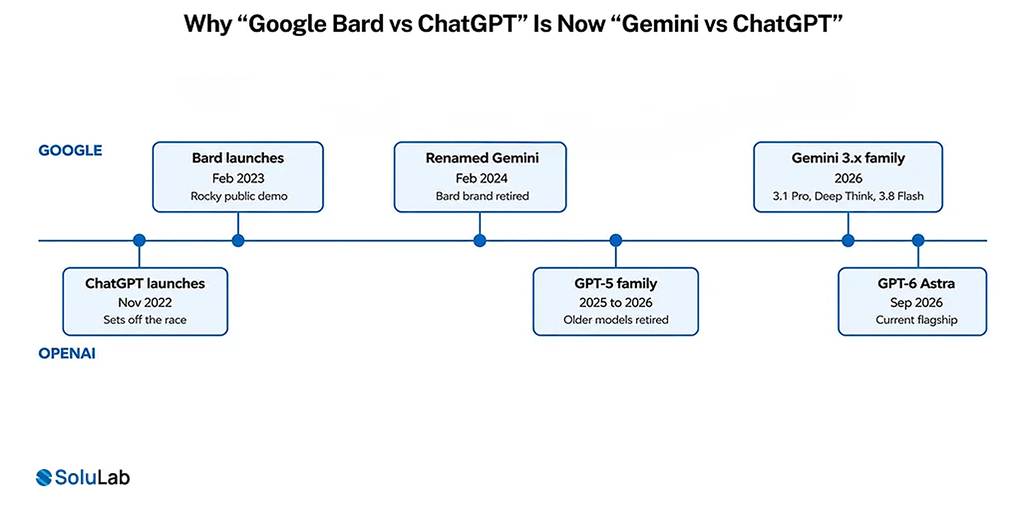
Google renamed Bard to Gemini in February 2024, one year after launching it. Today the chatbot, the model family and the API all carry the Gemini name. Nothing was discontinued, though. Old Bard links redirect, and the product has shipped continuously since under the new brand.
In short, the reason was consolidation. Bard was the interface and Gemini was the model powering it. So Google decided one name across the chatbot, the models and the Workspace features was clearer than three. At the same time, Duet AI in Workspace was folded into Gemini branding. For a full overview of what Gemini can do today, see our guide to Google Gemini.
One thing is worth knowing if you’re evaluating older content. Bard’s reputation was shaped by a factual error in its first public demo in early 2023. However, that reputation stuck to the name far longer than it reflected the product. In other words, judging Google’s current models by Bard’s launch is like judging a company by its beta.
Google Bard vs ChatGPT: what the comparison looks like in 2026
Here’s the honest version of the Google Bard vs ChatGPT head-to-head, using current products rather than the 2023 ones most comparison pages still describe.
| Dimension | Bard (2023, retired) | Google Gemini (2026) | ChatGPT (2026) |
| Status | Brand retired Feb 2024 | Active, Gemini 3.x family | Active, GPT-6 Astra flagship |
| Current models | PaLM 2, then Gemini Pro 1.0 | Gemini 3.1 Pro, 3 Deep Think, 3.8 Flash, 3.5 Flash-Lite | GPT-6 Astra, GPT-5.6 Sol / Terra / Luna |
| Free tier | Free only | Free tier plus paid Google AI plans | Free and Go tiers on GPT-5.6 Luna |
| Strongest at | Nothing, by current standards | Long documents, multimodal, video generation via Omni | Coding, agentic and multi-step work, computer use |
| Native ecosystem | Google Search | Gmail, Docs, Sheets, Drive, Android, Search AI Mode | Microsoft Azure, AWS Bedrock, Codex, plugin ecosystem |
| Enterprise API route | None | Gemini API, Vertex AI | OpenAI API, Azure OpenAI, Bedrock |
| Video generation | No | Yes, via Gemini Omni | No native video generation |
Two things stand out. First, both vendors ship faster than most buying cycles. Google shipped several Flash models across 2026, and OpenAI released GPT-6 Astra in September 2026. As a result, whatever you benchmark today will have a successor before your project ships. Second, the choice now depends more on which ecosystem your data sits in than on which model wins a benchmark this quarter. For a wider view of the field, see our roundup of top AI models.

Which is better, Gemini or ChatGPT?
Neither wins outright. Instead, the answer depends on the task, and the differences are real enough to matter.
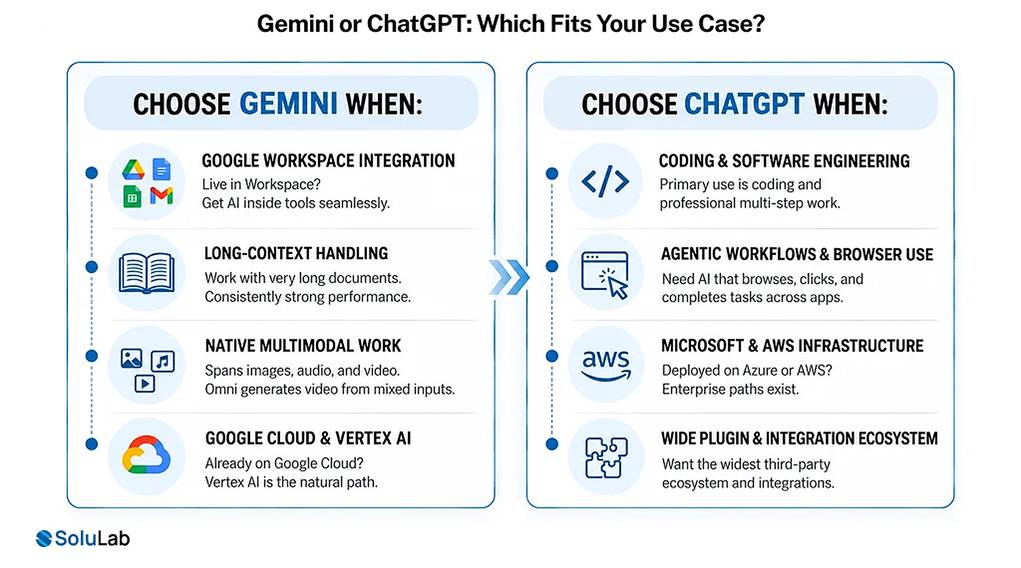
Choose Gemini when:
- Your team lives in Google Workspace and you want AI inside Gmail, Docs, and Sheets without a separate tool.
- You work with very long documents. Also, Gemini’s long-context handling has been a consistent strength across generations.
- You need multimodal work spanning images, audio, and video. For example, Gemini Omni generates video from mixed inputs, which ChatGPT does not do natively.
- You already run on Google Cloud and Vertex AI is your path of least resistance.
Choose ChatGPT when:
- Coding and software engineering are the primary use. In particular, GPT-6 Astra was positioned specifically around software engineering, computer use, and multi-step professional work.
- You need agentic workflows that browse, click, and complete tasks across applications.
- You’re on Microsoft or AWS infrastructure, where Azure OpenAI and Bedrock give you enterprise deployment paths.
- You want the widest third-party plugin and integration ecosystem.
It’s close to a coin flip when: the use case is general writing, summarisation, research or customer-facing Q&A. At that level both are good enough, so switching costs, pricing and data policy should decide it, not quality.
Does the free version of either one matter for business use?
For evaluation, yes. For production, no. Free tiers run smaller models, carry rate limits, and come with data terms written for consumers rather than enterprises. For example, ChatGPT’s free and Go tiers run GPT-5.6 Luna rather than the flagship, and Gemini’s free tier works the same way.
So the practical use of a free tier is a two-week bake-off. First, give both the same twenty real prompts from your actual workflow and score the outputs blind. Then you’ll learn more than any published benchmark will tell you.
What does it cost to build on Gemini or ChatGPT?
API pricing is per token, split between input and output, and it changes often. As a reference point, GPT-6 Astra is listed at $10 per million input tokens and $50 per million output tokens, with cached input priced lower (OpenAI API pricing). By comparison, Gemini 3.1 Pro is listed at $2 per million input tokens and $12 per million output tokens for prompts up to 200,000 tokens. Above that, however, it rises to $4 and $18 (Gemini API pricing).
However, token pricing is rarely the real cost driver. In our builds, three other things dominate:
- Output length. Output tokens cost several times what input tokens cost. As a result, a prompt that produces verbose answers costs more than a long prompt producing short ones.
- Retry and evaluation traffic. For instance, development, testing, and guardrail checks generate volume that never appears in your usage forecast.
- Model churn. Both vendors retire models on a schedule, and OpenAI retired the entire GPT-4 and o-series line during 2026. So if your prompts are tuned to a specific model version, migration is real engineering work, not a config change.
That third point is the one most teams underestimate. Therefore, budget for a migration at least once a year, whichever vendor you pick.

Should you build on one model or stay portable?
Stay portable if you can afford the abstraction layer. But commit to one if speed matters more than optionality.
Single-vendor builds are faster and let you use vendor-specific features like Gemini’s video generation or OpenAI’s Codex tooling. Portable builds, by contrast, route through an abstraction layer. That way you can swap models when pricing shifts, a model gets retired, or a competitor pulls ahead on your task.
Our default recommendation for production systems is simple: abstract the model call from day one, even if you only ever plug in one provider. The cost is a few days of engineering. Otherwise, you end up rewriting prompt logic under time pressure the week a model gets deprecated. For teams building their own model rather than consuming an API, building a private LLM is a third path worth understanding first. Our LLM development team covers that route.
For a wider view than a two-way Google Bard vs ChatGPT comparison allows, see our comparison of all LLMs.
How do you choose between Gemini and ChatGPT for a business build?
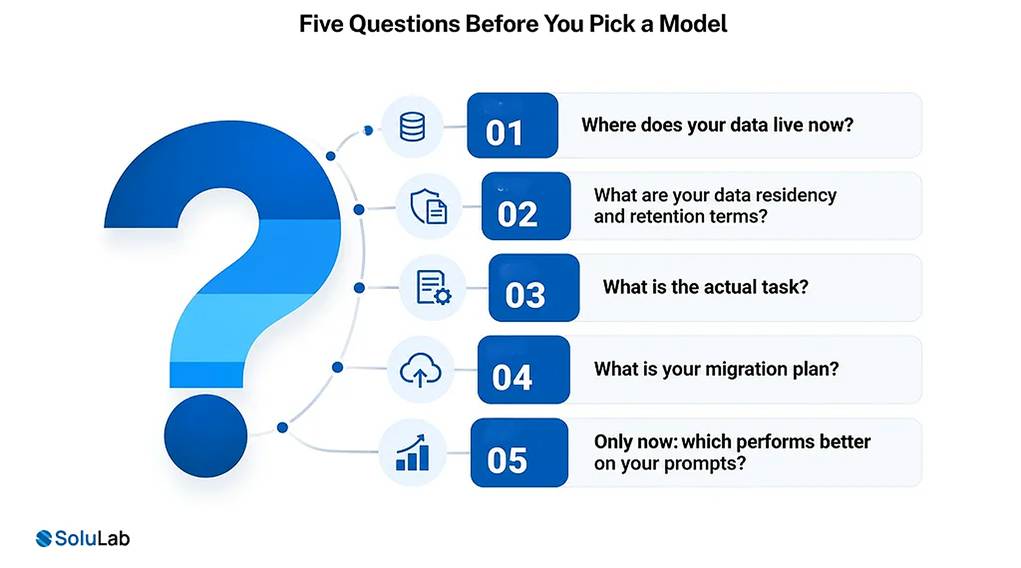
Five questions, in order. Model quality comes last, not first.
- Where does your data live now? Workspace pulls toward Gemini, while Microsoft or AWS pull toward OpenAI. Fighting your own infrastructure is the most expensive way to pick a model.
- What are your data residency and retention terms? So read the enterprise agreement, not the marketing page. This eliminates one option more often than performance does.
- What is the actual task? Coding and agents favour ChatGPT today. Meanwhile, long documents and multimodal work favour Gemini. General text is a tie.
- What is your migration plan? Both vendors deprecate models. So a vendor without a clear sunset policy is a risk regardless of current quality.
- Only now: which performs better on your prompts? Test on your data, blind-scored. After all, public benchmarks measure tasks that aren’t yours.

Where SoluLab fits
We build production systems on both. As a result, we have no incentive to tell you one vendor wins. In fact, we’ve migrated clients in both directions when pricing or capability shifted.
Most of our work sits above the model: retrieval layers over client data, evaluation harnesses that catch quality regressions, and abstraction that makes a model swap a configuration change. In short, the model choice matters far less than most vendor comparisons imply, while the surrounding engineering matters far more.
For ChatGPT and OpenAI-based integrations specifically, see our ChatGPT development company page. For broader GenAI strategy and delivery, see generative AI development.
Frequently asked questions
Shipra Garg is a tech-focused content strategist and copywriter specializing in Web3, blockchain, and artificial intelligence. She has worked with startups and enterprise teams to craft high-conversion content that bridges deep tech with business impact. Her work translates complex innovations into clear, credible, and engaging narratives that drive growth and build trust in emerging tech markets.