Key Takeaways
- Only 28% of AI use cases fully succeed and meet ROI expectations, and 20% fail outright, according to Gartner’s April 2026 survey for a seed-stage runway. That failure rate is existential, not just disappointing.
- Success is driven mostly by process, not budget: Gartner found it comes down to integrating AI into existing workflows and getting real executive buy-in, not team size or funding stage.
- Validate the business problem and check your real data readiness before comparing vendors or models; most wasted AI spend traces back to skipping these two steps.
- Scope one workflow for the MVP, not a department-wide rollout, and pick a build path (in-house, freelance, or partner) based on actual trade-offs, not the assumption that hiring is always cheapest.
- Plan for compliance, testing, and a post-launch review date from day one, and be willing to kill a feature that isn’t moving the metric it was built for.
Most seed-stage AI projects do not fail because the model was bad. They fail because nobody defined what “working” meant before the build started. Gartner’s 2026 survey of infrastructure and operations leaders found that only 28% of AI use cases fully succeed and meet ROI expectations, while 20% fail outright (Gartner, April 2026). For a seed-stage company with 12 to 18 months of runway, that kind of failure rate is not an inconvenience. It is existential.
This checklist walks founders, CXOs, and startup owners through the decisions that need to happen before, during, and right after an AI build, so the product you ship actually earns its budget line. If you are choosing between hiring in-house, contracting freelancers, or working with an AI development company, the framework below will help you make that call with evidence instead of guesswork.
Why Seed-Stage AI Development Needs Its Own Playbook?
Enterprise AI advice does not transfer cleanly to a 6-person startup. Deloitte’s 2026 State of AI in the Enterprise report, based on a survey of 3,235 leaders, found that two-thirds of organizations report productivity gains from AI adoption. However, progress is concentrated in companies with mature data infrastructure and dedicated AI teams, resources that most seed-stage startups simply do not have yet.
At the same time, the failure patterns Gartner documents are not about company size. The survey found that success is attributed primarily to integrating AI into existing workflows and systems, as well as securing full support from business executives, rather than team headcount or funding stage. That is good news for founders: the things that separate a successful AI build from a wasted one are largely process decisions, not budget decisions.
Gartner has also flagged where over-ambition specifically bites teams. Its analysts predict that over 40% of agentic AI projects will be canceled by the end of 2027, due to escalating costs, unclear business value, or inadequate risk controls (Gartner, June 2025). For a seed-stage founder tempted to pitch “autonomous AI agents” to investors, that stat is worth sitting with before scoping v1.

The Seed-Stage AI Development Checklist
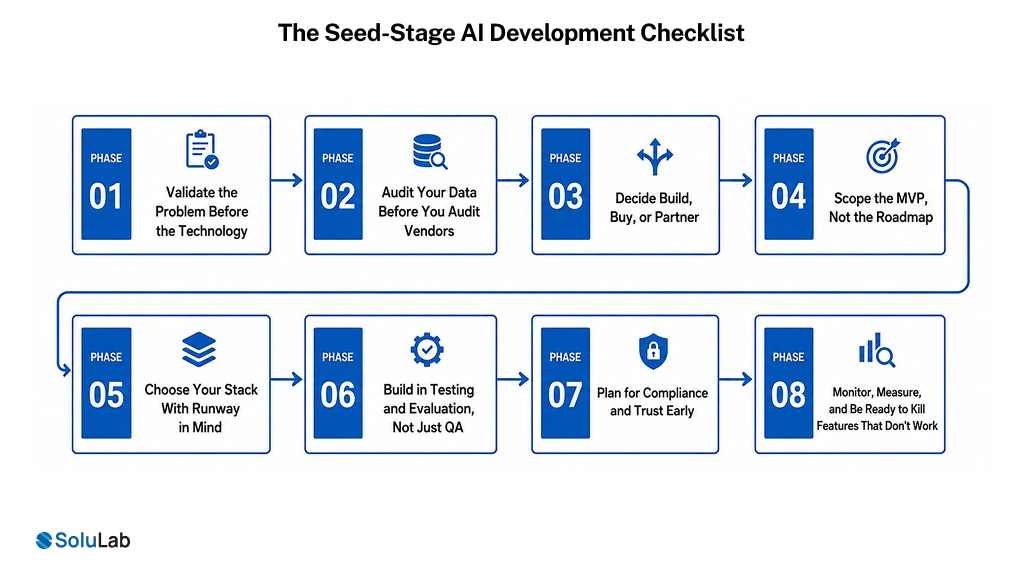
Phase 1: Validate the Problem Before the Technology
- Write down the specific business outcome the AI feature needs to move (retention, conversion, support cost, time-to-value). If you cannot state it in one sentence, the project is not ready to scope.
- Confirm the problem recurs often enough to justify automation. A task your team does twice a month rarely needs a model.
- Talk to five target users about the workflow you plan to automate before writing a spec. Founders routinely discover that the “AI problem” they assumed existed is actually a data-entry problem or a UX problem.
- Decide what “good enough” looks like numerically (accuracy threshold, latency ceiling, cost per query) so later testing has something to measure against.
Phase 2: Audit Your Data Before You Audit Vendors
Data readiness is one of the most common reasons AI projects stall before they reach production. Before evaluating any model or vendor:
- Inventory what data you actually own versus what you assumed you had access to.
- Check for gaps, duplicates, and inconsistent labeling; seed-stage startups usually discover their “clean” dataset is 30 to 40% unusable on first pass.
- Decide early whether you need synthetic data, third-party data licensing, or a narrower use case that fits the data you already have.
- Document data ownership and privacy obligations now. Retrofitting compliance after launch is dramatically more expensive than designing for it up front.
Phase 3: Decide Build, Buy, or Partner
This is the decision most founders get wrong, usually by defaulting to “we’ll hire an ML engineer” without comparing the real trade-offs. Below is a framework for the three realistic paths.
| Approach | Best for | Typical timeline | Main risk |
|---|---|---|---|
| Build in-house | Startups with a technical co-founder and a narrow, well-understood use case | 3 to 6 months to a usable MVP | Slow iteration, single point of failure if the engineer leaves |
| Hire freelancers | One-off prototypes or short-term proof of concept | 4 to 8 weeks | Inconsistent quality, no long-term ownership of the codebase |
| Partner with an AI development company | Startups that need to move fast without over-hiring or burning runway on trial and error | 4 to 12 weeks for MVP scope | Requires a partner with genuine AI delivery experience, not “agent washing” |
Firms like SoluLab specialize in exactly this seed-stage scenario: helping founders validate concepts, build MVPs, and launch AI solutions without over-engineering the first version or burning through the seed round on infrastructure the product doesn’t need yet. For founders weighing this route, AI consulting services engaged before full development are usually the cheapest way to avoid scoping mistakes, since a partner who has shipped dozens of MVPs will spot the gaps in a spec that a first-time founder can’t.
Phase 4: Scope the MVP, Not the Roadmap
- Pick one workflow, not five. Seed-stage AI products that try to automate an entire department at launch almost always slip both budget and timeline.
- Decide upfront whether the MVP needs a custom model, a fine-tuned open-source model, or simply a well-prompted call to an existing LLM. Most seed-stage products do not need a custom model on day one.
- If the product involves autonomous decision-making or multi-step workflows, evaluate whether true AI agent development is warranted, or whether a simpler rules-plus-LLM hybrid gets you 80% of the value at a fraction of the cost and risk.
- Set a hard ship date for the MVP and resist scope creep between kickoff and that date.
Phase 5: Choose Your Stack With Runway in Mind
- Compare hosted API costs against self-hosted model costs at your expected usage volume, not at today’s low traffic. Costs that look trivial in a demo can scale non-linearly with real usage.
- Decide on your inference provider and fallback provider before launch, so a single outage does not take your product down.
- Budget for evaluation and monitoring tooling from day one; teams that skip this almost always end up debugging silently degrading model quality in production.
If you’re mapping this out for the first time, SoluLab’s breakdown of the modern AI tech stack is a useful reference before you lock in vendors; the layer causing the most friction later is rarely the one that looked risky in the planning stage.
Phase 6: Build in Testing and Evaluation, Not Just QA
- Define a test set of real (or realistic) inputs before writing a single prompt or training a single model.
- Run adversarial and edge-case testing, not just happy-path testing. Most embarrassing AI product failures are edge cases that were never tested.
- Set up a human review process for a sample of live outputs post-launch, especially in the first 60 days.
Phase 7: Plan for Compliance and Trust Early
- Identify which regulations apply to your data and your users (data residency, industry-specific rules, upcoming AI-specific regulations in your target markets).
- Write a plain-language explanation of what your AI does and does not do; this protects you with both users and investors during diligence.
- Decide what happens when the model is wrong. A visible correction or feedback path is often the difference between a user who trusts your product and one who churns after the first bad output.
Phase 8: Monitor, Measure, and Be Ready to Kill Features That Don’t Work
- Track the business metric from Phase 1, not just technical metrics like latency or token cost.
- Set a review date (30, 60, 90 days) to decide whether the feature is earning its keep.
- Be willing to sunset an AI feature that is not moving the metric it was built for. Sunk cost is the enemy of a lean seed-stage team.
Common Mistakes Seed-Stage Startups Make
- Chasing the model before the use case. Founders often start with “we should use AI agents” instead of “our users are stuck on X.” The technology should follow the problem, not the reverse.
- Underestimating data cleanup time. Teams routinely budget zero time for this and then lose four to six weeks to it mid-project.
- Treating the MVP like the final product. An MVP exists to test a hypothesis cheaply. Building it like a production-scale enterprise AI development system wastes runway that should go toward learning from real users.
- Skipping the build-versus-partner comparison. Many founders assume hiring is always cheaper than partnering with an outside team. Once you factor in recruiting time, onboarding, and the learning curve of a first-time AI hire, working with an established enterprise AI development partner or specialized MVP team is frequently faster and no more expensive over a 6-month horizon and if you’re set on hiring, it’s worth comparing that timeline against how long it actually takes to hire AI developers with real production experience, not just model familiarity.
- No plan for what happens after launch. Gartner’s April 2026 research found that many AI initiatives fail because leaders assumed AI would immediately automate complex tasks, cut costs, or fix long-standing operational issues, and when results didn’t appear quickly, confidence dropped, and projects stalled. Seed-stage teams need to plan for iteration, not a single perfect launch.
Conclusion
The startups that get real value from AI in 2026 are not the ones with the biggest models or the most ambitious agentic roadmaps. They are the ones that validated the problem, got the data right, scoped an honest MVP, and picked a build path that matched their actual resources rather than their aspirations. This is exactly the kind of disciplined groundwork that separates lasting AI for startups success stories from expensive false starts. The checklist above is not a formality to rush through before “the real work” starts. It is the work.
If you are a founder trying to decide whether to build this in-house, hire freelancers, or bring in a team that has already shipped AI products for startups at your stage, that decision is worth a real conversation before you write a spec. SoluLab, top AI development company in USA, works with founders through exactly this stage, from validating the use case to shipping a production-ready MVP, and can tell you honestly if AI is even the right call for your product yet. Book a discovery call to walk through your specific use case before you commit budget to it.
FAQs
Neha is a curious content writer with a knack for breaking down complex technologies into meaningful, reader-friendly insights. With experience in blockchain, digital assets, and enterprise tech, she focuses on creating content that informs, connects, and supports strategic decision-making.