Key Takeaways
- AI agents reduce audit time by continuously reviewing smart contracts throughout development.
- AI-powered audits catch recurring vulnerability patterns faster than manual reviews alone.
- Human auditors remain essential for validating business logic, economic attacks, and protocol-specific risks.
- Continuous monitoring provides stronger protection than one-time pre-launch audits.
- The best security strategy combines AI automation, manual expertise, and real-time threat monitoring.
- Choosing the right auditing partner depends on methodology, monitoring capabilities, and post-deployment support.
Two numbers should scare every DeFi team right now: 2 and 80. Smart contract hacks drained over $2 billion industry-wide last year. Yet protocols running active monitoring cut their average loss per incident by more than 80%. That gap is not luck. It is a process.
JPMorgan’s own risk division saved over $500 million in a single year by catching issues before they piled up. That is the energy we are bringing here with AI-powered smart contract development. So, how AI smart contract auditing actually works, and what it costs. Your dev team needs this now, not after the exploit makes headlines.
Why Do Enterprises Need AI Smart Contract Auditing Today?
Code deployed on a blockchain technology does not get a second draft. Once it is live, it is live. Bugs cannot be patched quietly, unlike a normal app update. Fixing them generally means complex migrations or proxy patterns, and both carry their own risk. This is exactly why a proper smart contract audit matters before launch, not after.
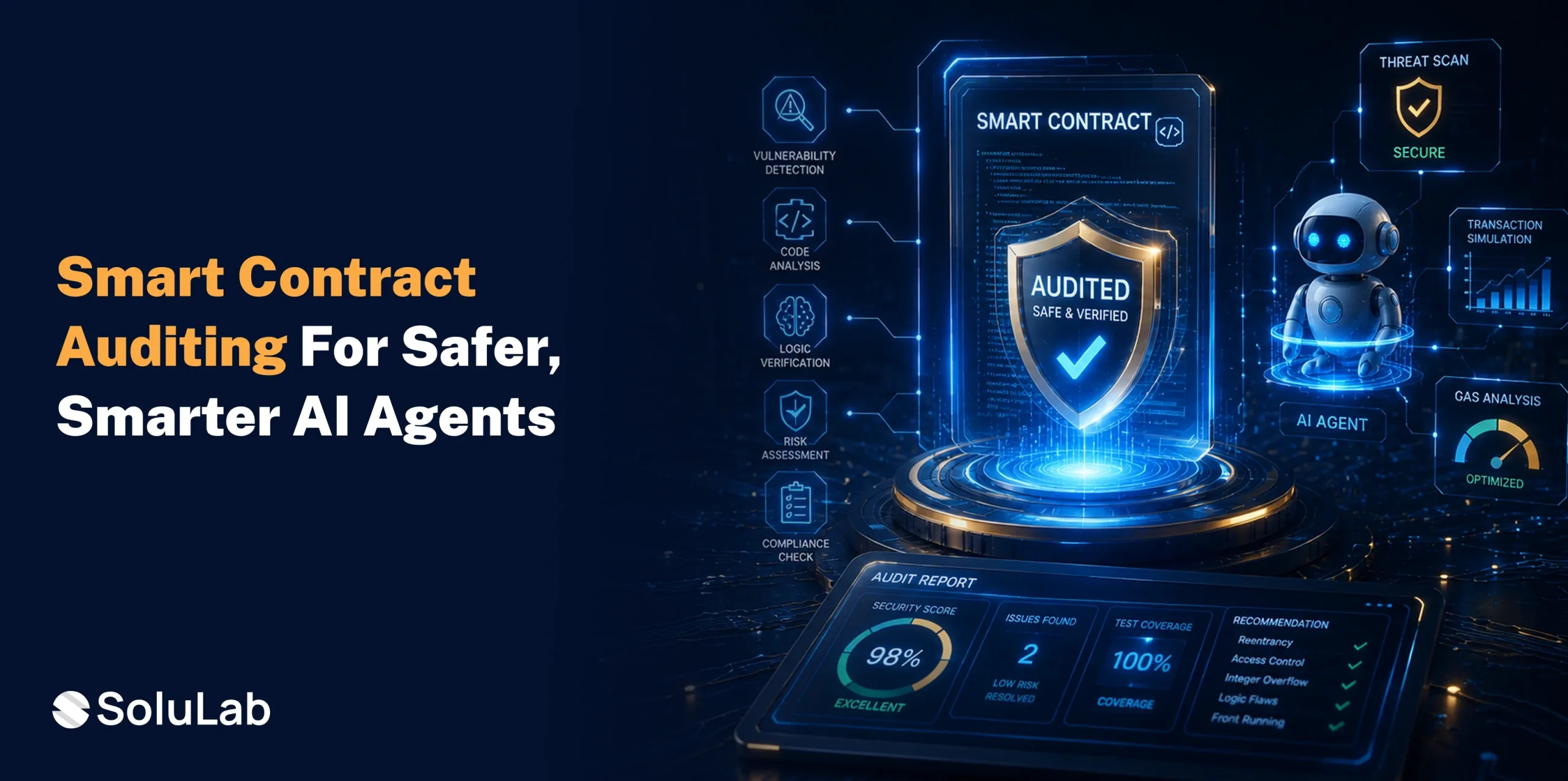
However, a single audit is not enough anymore. Risk keeps moving even after your code goes live, much like water always finds a crack. Continuous review, not a one time checklist, is what keeps funds safe. That is the whole idea behind smart contract auditing for AI agents built for ongoing review, not a single pass.
The Immutability Problem
Smart contracts hold real money the moment they deploy. A missed edge case can drain a treasury in minutes. Traditional human review takes one to three weeks per mid-sized protocol. Meanwhile, attackers do not wait for your audit queue.
AI Smart Contract Auditor vs Traditional Review
An AI Smart Contract Auditor does not replace your security engineer. It works alongside them. Machine models scan thousands of lines in minutes, flagging patterns a tired human eye might miss at 2 AM. If your team ships code daily, manual-only review simply cannot keep pace.
This is where AI smart contract audit tooling earns its keep. Automated scanners like Slither and MythX run static analysis, symbolic execution, and fuzzing together. Smart contract security with AI behind it catches common vulnerability classes fast and consistently, every single commit.

How Does an AI-Powered Smart Contract Audit Actually Work?
Good tooling does not just scan code once and stop. It follows a pipeline, stage by stage, checking itself along the way.
The Multi-Stage Agentic Pipeline
Modern platforms use AI agents for smart contract audit work organized as a crew, not a single bot. Generally, the flow looks like this:
- Parse the contract’s intent into a structured schema
- Generate or review Solidity code against that schema
- Wrap the contract with interfaces for safe interaction
- Run automated compilation and gate checks before release
Each stage hands off clean data to the next one. If a stage fails a gate check, the pipeline loops back and refines the output. Nothing moves downstream until it passes.
Scoring Quality Like a Real Auditor Would
An AI-powered smart contract audit needs more than a pass or fail stamp. It needs a rubric, the same way a human reviewer grades against a checklist.
| Dimension | Weight | What It Checks |
| Business Logic Fidelity | 35% | Does the contract do what the spec actually says? |
| Functional Completeness | 25% | Are all required features present and callable? |
| Variable Fidelity | 15% | Do state variables match intended types and scope? |
| State Machine Correctness | 15% | Do transitions follow the correct sequence? |
| Code Quality | 10% | Is the code clean, gas aware, and readable? |
This scoring stays deterministic. Scores get recomputed the same way every time, so results do not drift between runs. That consistency matters if you are comparing vendors or tracking your own codebase over months.
Why AI Smart Contract Security Audit Still Needs a Human Gate?
An AI smart contract security audit is fast, but speed is not the whole story. AI tools generally win on known vulnerability classes and repetitive checks. However, novel business logic errors and complex economic attacks still need a trained human eye. The strongest setups pair automated scanning with an audit approval checkpoint before anything ships to production.
What Should You Look for in Smart Contract Auditing Services?
Not every vendor offers the same depth. Before you sign a contract, ask what is actually included.
Smart Contract Audit Checklist
A solid smart contract audit checklist generally covers the items below.
- Reentrancy and access control gaps
- Integer overflow and underflow risks
- Oracle manipulation and price feed trust
- Upgrade path and proxy pattern review
- Gas optimization and denial of service exposure
- Post launch monitoring and alert routing
If a vendor skips post-launch monitoring, that is a gap worth asking about directly.
Smart Contract Audit Costs
Budgeting matters for smart contract audit cost, and prices vary a fair amount across the market. AI augmented engagements from specialist firms typically run $15,000 to $60,000, depending on codebase complexity. Continuous monitoring platforms, meanwhile, run on subscriptions from roughly $500 to $10,000 or more per month. Open source scanners cost nothing upfront, but they need skilled staff to interpret results correctly.
| Service Type | Typical Cost Range | Best Fit |
| Open source scanning (Slither, Aderyn) | Free | Early development, quick checks |
| AI augmented audit engagement | $15,000 to $60,000 | Pre launch, funding rounds |
| Continuous monitoring subscription | $500 to $10,000+/month | Post launch, live protocols |
| Full manual audit | Higher, scope dependent | High value, novel logic |
Smart contract auditing platforms worth researching include Sherlock, OpenZeppelin, Trail of Bits, and CertiK. Continuous monitoring names like Forta and Hypernative round out the stack. Each one takes a different approach. Match the platform to your risk profile, not just its reputation.
Where Is AI Smart Contract Development Heading Next?
Auditing does not sit apart from development anymore. The two are merging into one continuous loop.
AI for Smart Contract Development in the Enterprise
AI for smart contract development now touches the earliest planning stages, not just the final code review. Teams describe intended behavior in plain language, and models draft an initial contract structure from that spec. This speeds up smart contract development considerably, though the output still needs review before deployment.
AI-powered smart contract development works best when paired tightly with auditing from day one, not bolted on afterward. Treating smart contract in blockchain development as one continuous pipeline, rather than separate phases, cuts down on late stage surprises.
If your team is evaluating vendors, look closely at how they scope smart contract audit development work. Ask what smart contract audit development services are bundled versus billed separately. Some providers fold monitoring into the base package. Others charge for it as an add on, so read the fine print.
Choosing Between Development Partners and Platforms
Enterprises comparing smart contract development services should weigh a few things. Track record matters, and so does transparency of methodology.
- How a vendor handles upgrades post-launch matters too. Reviewing lists of top smart contract companies helps narrow the field. However, do your own diligence too, since rankings change often.
- For platform selection, compare top smart contract platforms on gas costs, tooling maturity, and developer community size.
- Ethereum still leads on tooling depth, though newer chains compete hard on speed and cost. Blockchain smart contract development choices made early tend to stick around for years, so weigh them carefully.
Additionally, ask any prospective partner how they handle upgrades after launch.
- Some contracts use proxy patterns, letting logic get swapped without moving user funds. Others stay fully immutable by design, trading flexibility for a stronger guarantee.
- Generally, financial protocols lean toward upgradeable patterns paired with strict multisig control.
- If a vendor cannot explain their upgrade governance clearly, treat that as a warning sign. Moreover, ask how incident response actually works on a Saturday.
- A platform with round-the-clock monitoring is worth more than one with flashy dashboards alone.
What This Means for Your Roadmap?
If you are planning a launch this year, build review into your timeline early. Do not treat auditing as the last box before mainnet. Generally, teams that bring auditors in during design catch far fewer surprises later. Book your AI scan on every commit, and schedule a deeper human pass before any major release. In case your protocol handles a significant value, budget for monitoring from day one. Do not treat it as an afterthought.
The Bottom Line
Security in DeFi is not a milestone you hit once and forget. It is closer to tending a garden than building a wall, something you keep checking, season after season. AI agents make that ongoing work realistic at enterprise scale, catching what a single audit would miss six months later. Pair automated scanning with human judgment. Budget for continuous monitoring from day one. Treat every deployment as the start of a review cycle, not the end of one. That is how enterprise teams keep both their code and their reputation intact.
To make all this work, we at the SoluLab, AI development team, verify your goals and discuss the practical implementation roadmap, and then build the right smart contract platform to ensure the bridging of manual and automation.
FAQs
Deepika is a content writer who blends storytelling with strategic thinking. She explores topics across digital innovation, emerging tech, and the evolving blockchain industry. She enjoys breaking down complex ideas into simple, engaging narratives in the growing global markets.