
Key Takeaways
- AI is turning into a real research partner, not just a writing aid. Think literature scans, hypothesis testing, first-draft reporting.
- Labs mostly use AI to spot patterns in raw data. The scientific judgment that comes after still belongs to people.
- Reports take less time to write but need more trust up front, since AI can cite, structure, and cross-check sources far faster than a human team.
- Messy data and unclear ownership of AI-generated findings hold teams back more than the technology ever does.
- Picking the right AI research partner beats picking the flashiest tool. Integration and data governance decide whether anything actually gets used.
- Pair AI with a clear review process and you get faster output without quietly trading away research quality.
Research teams are drowning in volume. Papers pile up faster than anyone can read them, and lab data gets messier the more instruments get connected. That’s the problem AI is solving right now, not some distant future use case.
Gartner forecasts that 40% of enterprise applications will carry task-specific AI agents by the end of 2026, up from under 5% a year earlier, and research and R&D teams are very much part of that shift.
This post walks through how AI development solutions are actually showing up in research reports and lab work today, what’s changing fast, and how you bring it into your own workflow without losing scientific rigor along the way.

Why Research Teams Are Rethinking Their Workflow Around AI
A few years back, “using AI in research” meant running spellcheck, maybe a basic summarizer if you were feeling adventurous. That’s not what it means now.
- Research teams lean on AI for tasks that used to eat entire workweeks: scanning hundreds of papers for relevant findings, pulling structured data out of stubborn PDFs, drafting the first version of a report section so someone isn’t staring at a blank page on a Monday.
- The shift isn’t happening because AI suddenly got flashier. It’s happening because scientific output has outpaced what any human team can manually process.
- A single research group might need to track dozens of new papers a week across one narrow subfield alone, and that’s before anyone accounts for internal data, competitor filings, or the latest regulatory update nobody had time to read.
- AI research trends increasingly point toward tools that don’t just summarize text but understand context well enough to flag contradictions between studies, the kind of thing a rushed manual review might miss entirely.
- That capability alone is reshaping how research groups plan their quarters. The bottleneck used to be “how fast can we read.” Now it’s “how fast can we verify.”
How AI Is Changing the Way Research Reports Get Written
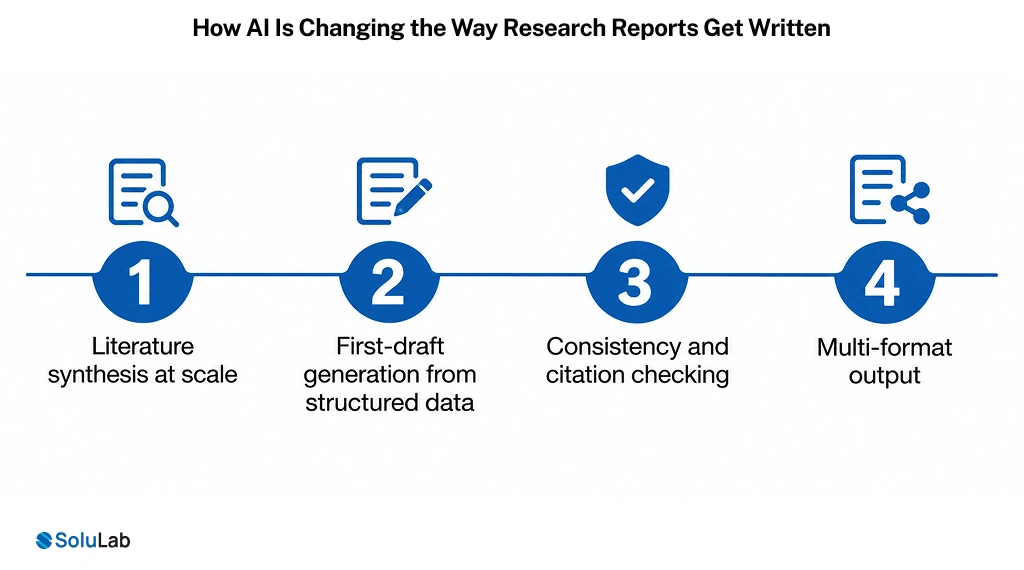
Writing a research report used to follow a slow, predictable arc: gather sources, draft an outline, write, revise, cite, revise again, repeat until deadline. AI-powered solutions compress several of those steps, though it doesn’t eliminate the judgment calls that actually matter.
1. Literature synthesis at scale
Instead of manually screening abstracts one by one, researchers feed a query into an AI tool and get back a structured synthesis with source links attached. It’s faster, sure, but it also tends to surface studies a plain keyword search would’ve buried on page twelve.
2. First-draft generation from structured data
Once findings are organized, AI can turn a table of results into readable prose. Not a final draft, more like a scaffold a researcher edits, tightens, and fact-checks, which still beats writing everything from scratch at midnight.
3. Consistency and citation checking
AI tools now catch when a report’s claims drift from its cited sources, or when the same term gets used two different ways across sections. That kind of catch used to fall to a tired editor working past 11 p.m., squinting at footnotes.
4. Multi-format output
The same underlying research can generate a technical report, an executive summary, and a slide deck, without three separate writing passes. That matters more than it sounds like it should, because most research only gets read if it reaches the right audience in the right format.
Inside the Lab: Where AI Is Actually Being Used Day to Day
Reports are only half the story. Labs are quietly automating tasks that used to require a dedicated technician, or a graduate student pulling an all-nighter they’d rather forget.
According to Deloitte’s State of AI in the Enterprise 2026 report, R&D is one of the functions where leaders see agentic AI’s highest potential impact, right alongside supply chain and knowledge management. That’s not really a coincidence. Lab work generates exactly the kind of messy, high-volume data AI models handle well: sensor readings, imaging output, spectrometry results, experiment logs that used to sit scattered across disconnected spreadsheets.
Here’s where labs are seeing the clearest gains:
1. Pattern detection in raw experimental data
AI models flag anomalies in datasets far faster than manual review, especially in imaging-heavy fields like materials science or diagnostics, where a subtle shift is easy to miss by eye.
2. Hypothesis generation from existing results
Some labs now run AI over their own historical data to suggest which follow-up experiments are actually worth prioritizing. It cuts down on trial-and-error cycles that used to eat months.
3. Protocol documentation and compliance tracking
AI-assisted logging keeps experiment records structured and audit-ready, which matters enormously in regulated fields like pharma or food science, where a missing timestamp can stall an entire filing.
4. Equipment and resource scheduling
Predictive models help labs plan instrument time and reagent orders around actual usage patterns rather than rough guesses that always seem to run short.
None of this replaces a scientist’s judgment about what a result means. It just clears away the administrative fog that used to slow everything down before that judgment call could even happen.
Building an AI-Ready Research Workflow
Adopting AI in a research setting isn’t a plug-and-play exercise, whatever the vendor pitch deck says. Teams that get real value out of it tend to follow a similar sequence, even when they never wrote it down as a formal process.
1. Audit what’s actually slowing your team down
Before picking a tool, map out where time genuinely disappears. Literature review? Data cleaning? Report formatting nobody enjoys doing? The answer shapes what you should adopt first.
2. Start with a narrow, high-friction task
Teams that try to overhaul everything at once tend to stall out within a few weeks. A narrower starting point, like automating citation checks, builds trust before you expand the scope.
3. Set review checkpoints, not blind trust
AI output in a research context should always pass through a human review step before it informs a decision or gets published anywhere. That’s not a weakness in the tool. It’s just how good science has always worked, AI or no AI.
4. Standardize your data before scaling AI usage
Most AI research tools only perform as well as the data feeding them. Inconsistent file formats, missing metadata, siloed lab systems- any of these will cap what a tool can deliver, no matter how advanced its model is underneath.
5. Track outcomes, not just adoption
Measure whether reports get done faster with equal or better accuracy, not just whether the team is technically “using AI” now. Adoption without a measurable outcome attached is just a vanity metric dressed up as progress.
Getting this sequence right often means bringing in outside expertise rather than guessing your way through it. AI research and development services can help teams skip the trial-and-error phase entirely and design a workflow suited to their specific data and compliance needs from day one.
The Data and Infrastructure Layer Behind AI Research Tools
None of the trends above happen without serious investment in the underlying infrastructure, and that investment is accelerating fast. Gartner projects worldwide end-user spending on AI models and platforms will hit $64 billion in 2026, up 63.4% from $39 billion in 2025, with generative AI model spending alone growing 117%.
Why does that matter for a research team that just wants a working tool? Because that spending is what’s funding the improvements in accuracy, context length, and domain-specific tuning that make AI usable for scientific work in the first place. A model that hallucinates a citation is worse than useless in a lab report. Infrastructure spending is precisely what’s closing that gap, slowly but steadily.
Statista’s market outlook backs this up too, projecting the global AI market to climb well past $1 trillion by the early 2030s as adoption spreads from tech-first industries into regulated, data-heavy fields like pharma, manufacturing, and academic research. For research leaders, that’s worth taking seriously: the tools on the market a year from now will look meaningfully different from what’s available today, and emerging AI technologies built specifically for scientific workflows are already narrowing the gap between generic chatbots and genuinely lab-grade research tools.
Common Mistakes Teams Make When Adopting AI for Research
Not every AI research rollout goes smoothly. Most of the failures trace back to a fairly small, repeatable list of mistakes.
1. Treating AI output as final rather than draft
Teams that skip the review step end up publishing errors an editor would’ve caught in five minutes, then blame the tool instead of the process that let it slip through.
2. Ignoring data governance until it’s a problem
Research data often includes proprietary or sensitive information. Feed it into an ungoverned AI tool, and you create compliance risk that’s genuinely expensive to unwind later.
3. Chasing the newest tool instead of the right fit
A general-purpose chatbot isn’t built for lab compliance tracking, and a compliance tool isn’t built for creative hypothesis generation. Matching the tool to the task matters far more than picking whatever name is trending this month.
4. Underestimating the change-management effort
Researchers who’ve spent years trusting their own manual review process don’t automatically trust an AI summary just because it’s fast. Rollouts that skip training and transparency tend to see quiet resistance, not open adoption.
What’s Next: Emerging AI Research Trends to Watch Beyond 2026
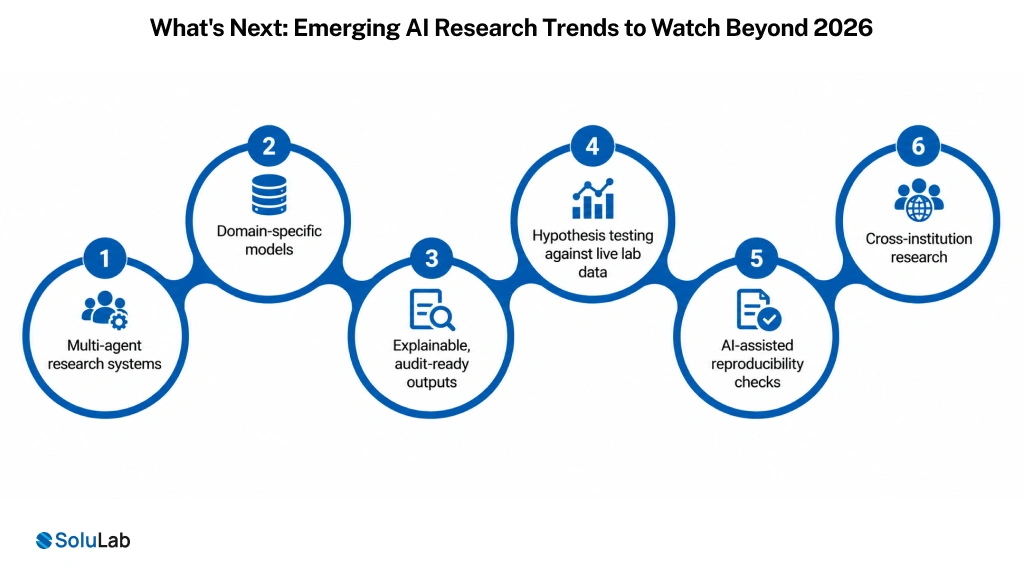
A handful of directions look worth tracking closely as the space matures past this year’s headlines.
1. Multi-agent research systems
Instead of one model doing everything, research teams are starting to run coordinated agent setups: one agent scans literature, another checks statistical validity, a third drafts the report. They hand off work to each other without needing a human in the loop at every step, which is a real shift from the single-chatbot workflows most teams use today.
2. Domain-specific models
General-purpose models are good generalists, but accuracy in a specialized field like genomics or materials science depends on training data that actually reflects that field’s language, edge cases, and conventions. Expect more labs to adopt smaller, sharper models built for their specific discipline rather than a broad tool trying to do everything at once.
3. Explainable, audit-ready outputs
Regulated industries won’t accept a black-box result feeding into a regulatory filing or a clinical decision. Explainability is moving from a nice-to-have feature to a baseline requirement, especially anywhere a report needs to survive a compliance audit down the line.
4. Hypothesis testing against live lab data
Rather than running AI over historical datasets after the fact, some labs are experimenting with models that flag promising directions while an experiment is still running, shortening the loop between collecting data and deciding what to try next.
5. AI-assisted reproducibility checks
Reproducibility has been a quiet crisis across several scientific fields for years. AI tools that can flag statistical inconsistencies or methodology gaps before publication are gaining traction as a first line of defense, catching issues a rushed peer review might overlook.
6. Cross-institution research
Federated and privacy-preserving approaches let multiple institutions train or query models on combined insights without ever pooling raw, sensitive data in one place. That’s a meaningful unlock for fields like healthcare research, where data-sharing restrictions have long slowed collaborative work, and the future of AI research conversations are increasingly built around exactly this kind of collaboration without compromise.
Choosing the Right AI Research Partner
Not every organization has the internal bandwidth to build and maintain AI research tooling from scratch, and that’s exactly where an outside partner earns its keep. The right partner brings more than a tool license. They bring experience integrating AI into existing lab systems, handling compliance-sensitive data properly, and training research staff to verify AI output rather than take it at face value.
When evaluating top AI research companies or consulting partners, look past the polished demo and ask about their track record with data governance, their approach to model accuracy in specialized domains, and whether they stick around for ongoing support as your data and needs evolve. A partner that actually uses solid AI research trend analysis tools internally, rather than relying on generic off-the-shelf software, tends to spot integration issues before they turn into expensive problems.
For teams ready to move past isolated experiments, it’s often worth choosing to hire AI research consultants who’ve done this integration work before, instead of building that institutional knowledge from zero through costly trial and error.

Conclusion
AI in research reports and labs isn’t some distant trend anymore. It’s already changing how literature gets reviewed, how lab data gets analyzed, and how findings turn into reports people actually read instead of skim once and forget. The teams getting the most value out of this aren’t chasing every new tool that launches. They’re building a clear workflow, keeping humans in the review loop, and choosing partners who understand both the science and the technology behind it.
SoluLab, an AI development company, helps research teams and labs design and integrate AI-driven workflows that fit their specific data, compliance needs, and research goals, so the technology ends up supporting rigorous science instead of working around it.
Neha is a curious content writer with a knack for breaking down complex technologies into meaningful, reader-friendly insights. With experience in blockchain, digital assets, and enterprise tech, she focuses on creating content that informs, connects, and supports strategic decision-making.