Key Takeaways
- AI-powered KYC for tokenization verifies an investor’s identity, screens them for sanctions and money-laundering risk, checks their eligibility, and writes the result to an on-chain identity, so only approved wallets can hold the token.
- AI handles document reading, liveness and deepfake checks, name matching and wallet risk scoring. People still decide edge cases, enhanced due diligence and anything a regulator expects a human to sign off.
- Deepfakes now appear in about 1 in 5 biometric fraud attempts, according to Entrust’s 2026 Identity Fraud Report, which is why static document checks alone no longer hold up.
- Standards such as ERC-3643 link each token to verified identity claims, so investor screening keeps working after issuance, not just at sign-up.
- New rules raise the bar: the EU’s AML Regulation applies from 10 July 2027 and names crypto-asset service providers as obliged entities.
AI-powered KYC for tokenization uses machine learning to verify investor identities, screen them against sanctions, PEP, and adverse-media lists, assess wallet and transaction risk, and confirm eligibility, such as accredited-investor status. Verified results are stored as on-chain identity claims, so a tokenized asset can enforce who may hold or receive it automatically.
That last step is what makes tokenization different from ordinary fintech onboarding. In a bank, KYC happens once at the front door. In tokenized markets, the token itself has to know whether the next buyer is allowed to own it, every single time it moves.

What Is AI-Powered KYC for Tokenization?
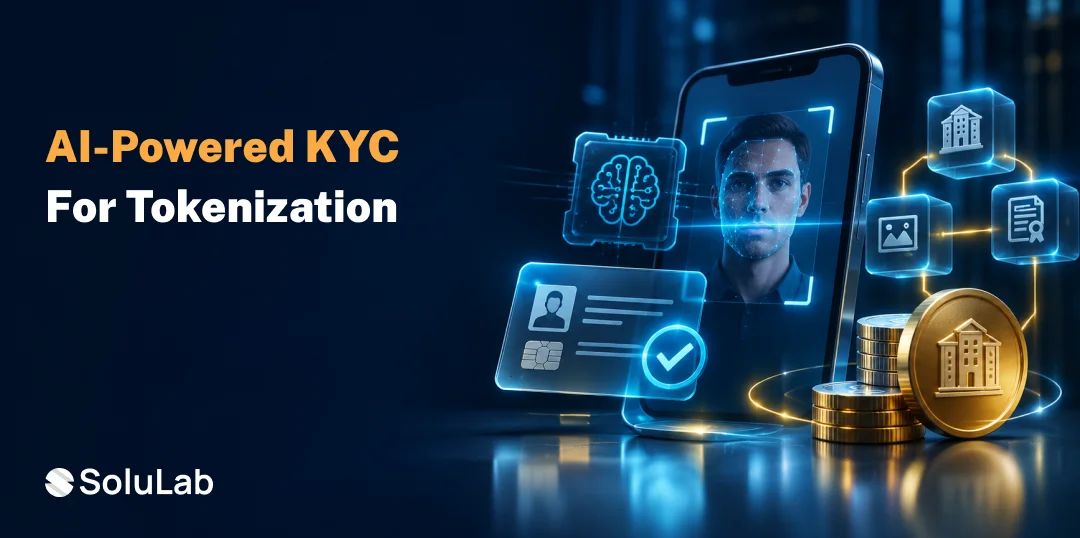
AI-powered KYC for tokenization is the use of AI models to run identity verification, AML screening and investor due diligence for people and companies buying tokenized assets, then link the result to their wallet. It replaces manual document review with automated checks and keeps compliance enforceable on chain.
1. How It Differs From Standard KYC
Standard KYC proves who a customer is. Tokenization adds two more questions: is this investor allowed to buy this specific asset, and is the wallet they’re using clean? A property token sold to accredited US investors only, or a fund token restricted to professional investors in Singapore, needs eligibility rules that general KYC doesn’t cover. Our overview of AI in KYC covers the general side; this guide focuses on what changes for tokenized assets.
2. Where AI Fits and Where People Stay
AI is good at reading documents, comparing faces, spotting forged images and matching names across messy lists at scale. It’s weaker at judging source-of-wealth stories, unusual corporate structures or anything that needs regulatory judgment. The working model in most regulated programmes is AI for the first pass and the evidence pack, and a compliance officer for the decision on anything flagged.
Why Does Tokenization Need AI Investor Screening?
Tokenization needs AI investor screening because tokenized assets reach more investors, across more jurisdictions, faster than traditional placements, while fraud tools have moved on. Without automated KYC verification, manual review can’t keep pace with global, 24/7 onboarding, and it can’t reliably catch AI-generated identities.
1. Investor Volume and Global Reach
Fractional ownership is the point of most tokenization projects. A building that once had ten investors might now have ten thousand, in forty countries, each with different rules. Reviewing each one by hand turns compliance into the bottleneck that stops the raise.
2. Synthetic Identities and Deepfakes
Entrust’s 2026 Identity Fraud Report, covering September 2024 to September 2025, found that deepfakes appeared in about 1 in 5 biometric fraud attempts, deepfaked selfies rose 58%, injection attacks rose 40%, and digital forgeries made up 35% of document fraud. A human glancing at a passport photo won’t catch most of that. AI-based identity verification with active liveness and injection detection can.
3. Compliance That Travels With the Token
Once a token is issued it can change hands on secondary markets. If eligibility checks only happen at sign-up, a token can end up with a sanctioned or ineligible holder after a single transfer. Tokenized asset compliance needs screening that runs at every transfer, which only works when the checks are automated.
How Does AI-Powered KYC Work in a Tokenization Platform?
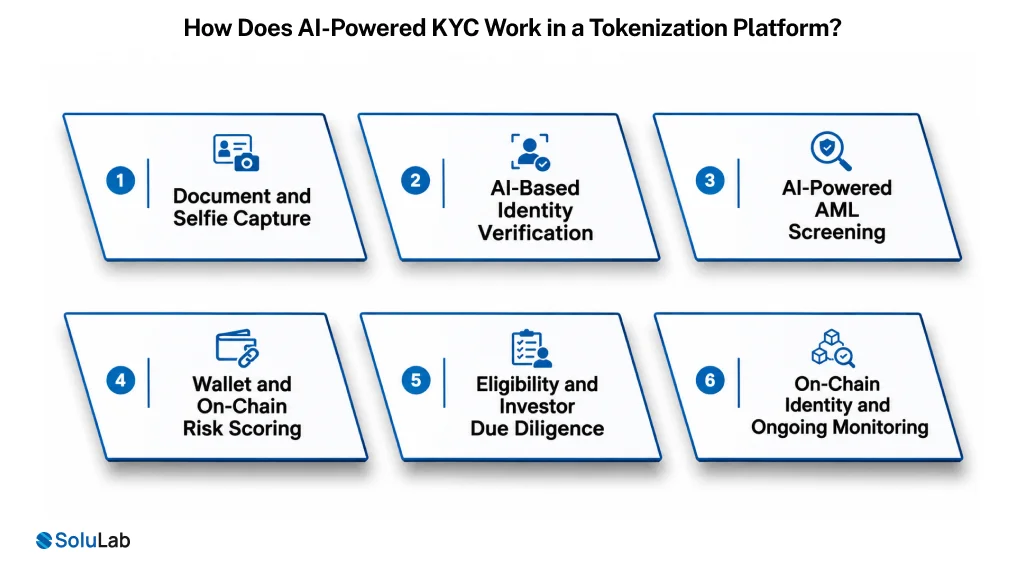
AI-powered KYC in a tokenization platform runs in six stages: capture, identity verification, AML and sanctions screening, wallet risk scoring, eligibility checks, and on-chain identity registration, followed by ongoing monitoring. Each stage produces evidence a regulator can audit.
1. Document and Selfie Capture
The investor uploads an ID document and takes a selfie or short video. AI checks image quality in real time and asks for a retake before a blurry photo wastes a reviewer’s time.
2. AI-Based Identity Verification
OCR reads the document, models check security features, fonts and MRZ data for tampering, and face matching compares the selfie with the ID photo. Liveness and injection detection confirm a real person is present rather than a replayed video or a deepfake fed into the camera stream.
3. AI-Powered AML Screening
Names are screened against sanctions lists, politically exposed persons and adverse media. AI reduces the false-positive problem that plagues rule-based screening by weighing transliterations, dates of birth and context, so analysts review real matches instead of every “Mohammed Ali”.
4. Wallet and On-Chain Risk Scoring
For crypto-native investors, the wallet matters as much as the person. Blockchain analytics score the wallet’s history for links to sanctioned addresses, mixers, hacks or darknet markets, and flag funds that need a source-of-funds check.
5. Eligibility and Investor Due Diligence
The platform checks whether the investor may buy this asset: accreditation or professional-investor status, jurisdiction, holding limits and any lock-up rules. For companies, AI extracts beneficial owners from registry documents and flags anyone at or above the ownership threshold for checks.
6. On-Chain Identity and Ongoing Monitoring
Approved results are written as identity claims linked to the investor’s wallet, without putting personal data on chain. Standards such as ERC-3643 check those claims on every transfer. Screening then reruns on a schedule and on events, such as a sanctions-list update or an unusual transaction.
Which AI Techniques Power Investor Screening?
Investor screening combines several AI techniques: computer vision for documents and faces, NLP for name matching and adverse media, graph analytics for wallets and ownership chains, and anomaly detection for ongoing monitoring. No single model does the job; the value comes from combining their signals into one risk score.
| Task | AI technique | What it catches |
| Document checks | Computer vision, OCR | Forged or altered IDs, template fraud |
| Face match and liveness | Biometric models, liveness detection | Impostors, deepfakes, replay and injection attacks |
| Sanctions and PEP screening | NLP, fuzzy name matching | True matches hidden among transliterations |
| Adverse media | NLP, entity extraction | Fraud, corruption or crime reported in the news |
| Wallet risk | Graph analytics, blockchain intelligence | Links to sanctioned or illicit addresses |
| Beneficial ownership | Document AI, entity resolution | Hidden owners in layered company structures |
| Ongoing monitoring | Anomaly detection | Behaviour that doesn’t fit the investor’s profile |
Many of the same models power AI-based fraud detection on crypto exchanges, where the attack patterns overlap heavily.
How Do Regulations Shape Automated KYC and AML Compliance?
Regulations decide what automated KYC and AML compliance must prove, not which tools you use. Regulators accept AI-assisted checks when the process is risk-based, documented, explainable, and reviewed by people. Three recent changes matter most for tokenization teams.
1. EU AML Regulation From July 2027
The EU’s Anti-Money Laundering Regulation, (EU) 2024/1624 applies from 10 July 2027 across all member states. It names crypto-asset service providers as obliged entities, changes the beneficial-ownership test to 25% or more, lowers the customer due diligence threshold for occasional transactions to €10,000, and aligns remote onboarding with the eIDAS 2.0 digital identity framework.
2. Accredited Investor Verification in the US
On 12 March 2025, SEC staff issued a no-action letter clarifying how issuers can verify accredited investors in Rule 506(c) offerings. A minimum investment of at least $200,000 for individuals, or $1 million for entities, plus written representations that the investor is accredited and isn’t financed by a third party, can count as reasonable verification if the issuer has no contrary knowledge. AI can automate collecting and checking those representations, but the legal judgment stays with counsel.
3. The FATF Travel Rule
The FATF Travel Rule requires virtual asset service providers to share originator and beneficiary information on qualifying transfers. Tokenization platforms that act as intermediaries need that data flow built in, which is easier when verified identities are already linked to wallets.

How Do Fund and Real-World Asset Tokenization Use AI KYC?
Fund and real-world asset (RWA) tokenization use AI KYC to onboard large numbers of eligible investors quickly while enforcing who can hold each token. The checks change with the asset: fund tokens need investor-category and subscription rules, while property and commodity tokens need jurisdiction and holding-limit rules.
1. Tokenized Funds
Fund tokenization brings subscription and redemption on chain, but transfer agents still need full investor records. AI pre-fills subscription documents from verified IDs, checks investor category and flags anyone who needs enhanced due diligence, cutting days from each subscription cycle.
2. Real Estate and Private Markets
In real-world asset (RWA) tokenization, many small investors replace a few large ones. On a real estate tokenization platform we built for a Dubai property firm, AI-assisted KYC and AML onboarding, risk scoring, and transaction monitoring replaced paper processes, and the platform cut transaction costs by 40% and made fundraising 5x faster.
3. Private Credit and Alternative Assets
For a Singapore alternative-assets firm, our tokenized RWA platform used GenAI to review onboarding documents and check eligibility, with compliance rules enforced in ERC-3643 smart contracts. Active investors grew 2.1x, and operational overhead fell by 80%.
Should You Build or Buy an AI-Powered KYC Solution?
Most tokenization platforms should integrate proven KYC and AML providers and build the orchestration, eligibility rules and on-chain identity layer themselves. Building identity verification models from scratch rarely pays off, but the rules that decide who can hold your token are your competitive edge and your liability.
1. What to Buy
Document verification, liveness detection, sanctions and PEP data, and blockchain analytics are mature markets with specialist providers. Buying them gives you coverage of thousands of ID types and live list updates you couldn’t maintain yourself.
2. What to Build
Build the orchestration that routes each investor through the right checks for their jurisdiction and asset, the eligibility engine, the case-management view for your compliance team, and the link between verified identities and on-chain claims. That’s where tokenization-specific logic lives, and it’s what AI-powered KYC solution development should focus on.
3. How It Fits the Platform
KYC can’t be an afterthought bolted onto a token contract. It has to be designed with the issuance, transfer and redemption logic from day one, which is why we scope it as part of tokenization platform development, not as a separate project.
What Are the Risks of AI in KYC and Investor Screening?
The main risks of AI in KYC are biased or unexplainable decisions, over-reliance on automation for judgment calls, privacy exposure from storing identity data, and models falling behind new fraud techniques. Each can be managed with human review, explainable scoring, data minimisation and regular model testing.
1. Bias and Explainability
Face-matching and risk models can perform differently across demographics. Regulators expect you to explain why an investor was rejected, so every automated decision needs a readable reason and a route to human review.
2. Privacy and Data on Chain
Personal data should never go on a public blockchain. Store identity documents off chain with encryption and retention limits, and put only claims or hashes on chain. That keeps you aligned with GDPR’s right to erasure while the token still enforces eligibility.
3. A Moving Target
Fraud techniques change monthly. Models need regular retraining and red-team testing against new deepfake and injection methods, and vendor contracts should commit providers to the same.
How Much Does AI-Powered KYC for Tokenization Cost?
The cost of AI-powered KYC for tokenization has two parts: per-check vendor fees for identity verification, screening and wallet analytics, and a one-time build cost for orchestration, eligibility rules and on-chain identity. The build is usually scoped with the wider platform, and vendor fees scale with investor volume.
The biggest cost drivers are the number of jurisdictions you onboard from, whether you accept companies as well as individuals, how many investor categories each asset allows, and how much enhanced due diligence your risk policy demands. Teams that design KYC alongside the token contract avoid the expensive rework of retrofitting it later, which is the main reason we treat it as part of asset tokenization development services rather than a bolt-on. For identity infrastructure beyond tokenization, see our guide to blockchain KYC solutions.

Conclusion: Make Compliance Part of the Token
AI-powered KYC for tokenization isn’t about replacing compliance teams. It’s about letting them handle ten thousand investors with the same care they once gave ten, and making sure the token itself keeps checking eligibility long after the first sale. Get the identity layer right at the design stage and secondary trading, new jurisdictions and new asset classes become configuration, not rework.
If you’re planning a tokenized fund, property or private credit offering, our team can help you design the KYC, investor screening and on-chain identity layer alongside the token itself. Talk to SoluLab’s asset tokenization development services team to scope an AI-powered onboarding flow for your first issuance.
FAQs
Neha is a curious content writer with a knack for breaking down complex technologies into meaningful, reader-friendly insights. With experience in blockchain, digital assets, and enterprise tech, she focuses on creating content that informs, connects, and supports strategic decision-making.