The growing customer expectations, lack of efficiency in operations, old systems, and the growing regional competition are compelling businesses to reinvent their operations.
Companies find it hard in their attempts to make decisions slowly, due to unrelated data and the high cost of services. This is precisely the reason why AI-Powered App Development in Kuwait is getting momentum.
In fact, over 72 percent of Kuwaiti enterprises have invested in at least one AI-driven initiative.
Businesses are not necessarily opting to have further manual processes; they are moving towards smart applications that are capable of automating processes, personalizing customer experience,s and providing real-time information.
AI-based applications are assisting all kinds of businesses to lower costs, increase accuracy, and react more quickly to changes in the market. Simply put, AI solutions for enterprises in Kuwait are no longer an option.
They will become the viable solution to scaling smarter, competing regionally, and keeping pace with the overall digital transformation objectives of Kuwait.
Key Takeaways
- The Problem: The challenges that Kuwait enterprises experience include increased competition, old systems, fragmented information, and increasing customer demands. Paper-based workflow and poor analytics slow down decision-making, add to the cost, and limit scale to an increasingly digital GCC market.
- The Solution: The development of apps by artificial intelligence facilitates automation, predictive analytics, personalization, and real-time insights. Smart applications help streamline operations, improve customer interactions, lower the cost of operations, and reinforce business strategies based on data in line with the national objectives of digital transformation.
- How SoluLab Helps: SoluLab provides yet offers enterprise-level AI application development that has secure architecture, scalable cloud integration, and industry-specific AI models. SoluLab assists Kuwait companies in creating smart and future-proof digital systems that can yield real ROI, starting with strategy through deployment.
The Growing Role of AI-Powered App Development in Kuwait
Kuwait is already slowly establishing itself as a digital hub in the region, and AI-based app creation is taking center stage. Within the Kuwait Vision 2035, the country seeks to diversify its economy and stop relying on oil as it invests in digital infrastructure, smart governance, and innovation in the area of the private sector.
Based on the official government sources, the priorities of Vision 2035 include modernization of technologies, digital public services, and knowledge-based industries as the long-term bases of growth.
This is being changed and accelerated by smart government initiatives. The AI solutions created by others, such as the Central Agency for Information Technology, are government services by incorporating secure digital networks, mobile services, and cloud solutions. All these activities demand AI-enabled applications to enhance automation, citizen interaction, and operational effectiveness.
Meanwhile, start-up ecosystem and enterprise technology investments are growing. According to reports prepared by organizations like MAGNiTT on regional investments, there is an increasing trend of venture activity in the GCC, and the fintech and digital commerce sectors in Kuwait are not an exception.
Why AI-Powered Apps Are Becoming Essential for Kuwaiti Enterprises?
Artificial intelligence-based applications are rapidly transitioning beyond an optional novelty to a business requirement as Kuwaiti companies become modern, competitive in the region, and align with national strategic objectives in digital transformation.
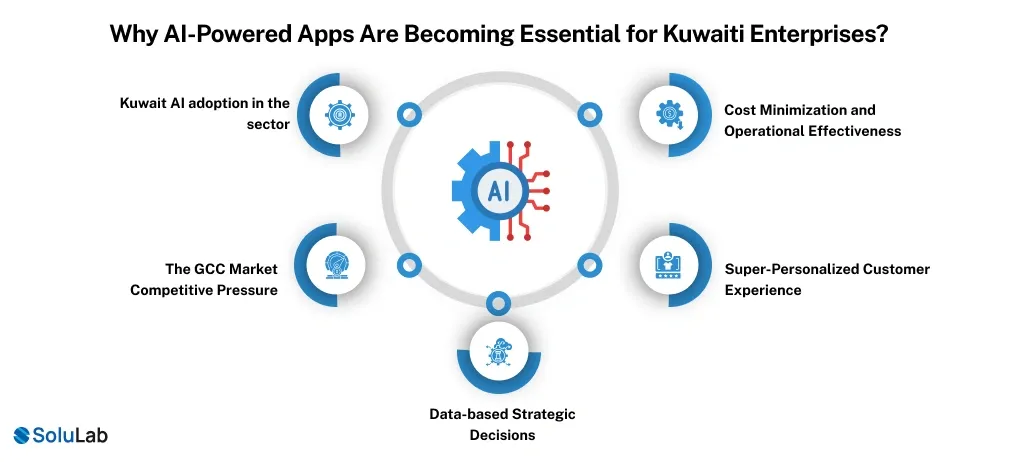
1. Cost Minimization and Operational Effectiveness
AI automates manual processes, minimizes human mistakes, and enhances productivity. According to McKinsey, AI has the potential to provide 2030 per cent operational cost savings in particular business operations.
2. Super-Personalized Customer Experience
AI examines the behavioral patterns to provide offers, support, and recommendations in real-time. According to a report published by Salesforce, 73% of customers believe in personalized experiences, which is why intelligent apps are essential to retention.
3. Data-based Strategic Decisions
Intelligent analytics transforms business data into predictive intelligence. As said by PwC, data-driven organizations are more likely to report a threefold improvement in decision-making threefold.
4. The GCC Market Competitive Pressure
The GCC countries are spurring the use of AI. According to the estimates of PwC, by 2030, AI might bring about 320 billion dollars to the economy of the Middle East, which would lead to increased competition in the region.
5. Kuwait AI Adoption in the Sector
Leading adopters are banking, oil and gas, healthcare, and retail. According to Deloitte, when applied exclusively, AI-driven predictive maintenance can help to decrease equipment downtime by up to 40 percent in the energy industries.

AI Adoption in Kuwait Across Industries
The enterprises in Kuwait are quickly combining artificial intelligence into the everyday workflow as they no longer experiment and integrate AI throughout banking, energy, healthcare, retail, and governmental services to enhance efficiency, accuracy, and decision-making.
- Banking & Fintech: Banks in Kuwait are implementing AI to detect fraud, credit scoring,e and risk analytics. According to a study conducted by PwC, artificial intelligence has the potential to add up to 320 billion to the economy of the Middle East by 2030, driving financial institutions to enterprise AI development in Kuwait initiatives.
- Oil and Energy: AI predictive maintenance and asset monitoring are changing the oil operations. As claimed by McKinsey, predictive maintenance will help in minimizing maintenance expenses by 10-40% and downtime by up to 50 percent,t which is vital in the energy-intensive GDP of Kuwait.
- Healthcare: Hospitals turn to AI-driven diagnostics, patient triage, and data analytics. Accenture’s study indicates that AI applications have the potential to generate up to $150 billion in yearly healthcare savings worldwide by 2026, which is a reason to promote the development of AI software.
- Retail & E-commerce: Retailers apply AI in demand prediction and recommender systems. According to McKinsey, personalization holds the potential to increase revenues by 5-15 per cent and enhance marketing capabilities by 10-30 per cent to speed up the adoption of AI in the expanding digital commerce sector of Kuwait.
- Government & Public Services: The smart government is compatible with Kuwait Vision 2035, which suggests the use of digital portals and AI-based automation. The World Bank observes that the adoption of digital government enhances efficiencies in services by up to 30% to help in modernizing the entire nation through AI-led approaches.
Read More: How Businesses in the Middle East Are Scaling with Enterprise AI Integration?
What Types of AI-Powered Apps Are Gaining Traction in Kuwait?
The digital acceleration of Kuwait is compelling companies to implement intelligent applications that will automate their operations, advance customer interaction, and boost decision-making processes within the banking, oil, retail, healthcare, and government sectors.
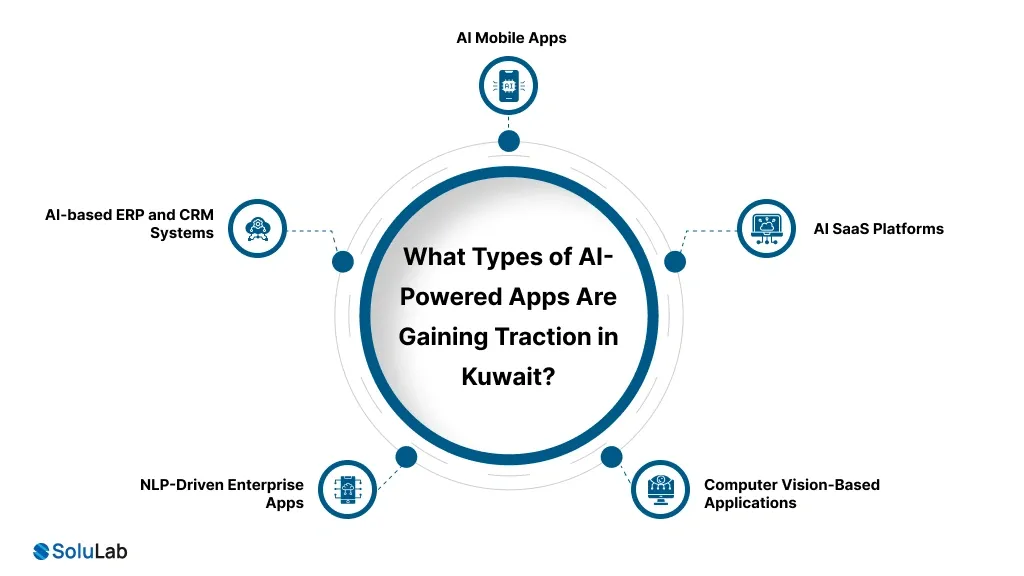
1. AI Mobile Apps: Chatbots, personalization, and fraud alerts are broadly applied AI-powered mobile apps in the banking, retail, and public services. PwC also forecasts that AI would bring in a boost to the Middle East economy of 320 billion by 2030 (Source: PwC Middle East AI Report), speeding up the demand in Kuwait.
2. AI SaaS Platforms: AI SaaS applications in the clouds assist companies to implement predictive analytics, workflow automation,n and customer insights at minimal infrastructure expenses. According to Gartner, more than 80 percent of enterprises will adopt generative AI API or models in 2026 (Source: Gartner 2023 Forecast).
3. Computer Vision-Based Applications: Computer vision is applied in oil facilities, logistics, and retail surveillance to enhance safety and operational surveillance. According to McKinsey, AI-enabled predictive maintenance may decrease time by up to 40 percent ( Source: McKinsey Global Institute).
4. NLP-Driven Enterprise Apps: NLP is used to drive Arabic chatbots, sentiment analysis, and document automation. IBM reports that up to 30% productivity improvement is reported by the businesses that apply AI-driven automation ( Source: IBM Global AI Adoption Index).
5. AI-based ERP and CRM Systems: Current ERP and CRM systems combine AI to make predictions, score leads, and plan demand. It is estimated by IDC that AI expenditures in the world will surpass 300 billion dollars by 2026 and will impact AI solutions in enterprises in Kuwait, and enterprise AI development in Kuwait strategies.
Future Outlook: AI Investment Trends in Kuwait (2026 and Beyond)
The AI environment in Kuwait is shifting towards large-scale integration into its enterprise, with the next decade (2026) predicted to offer increased innovation in all industries, infrastructures, and government and commercial technology collaborations.
- Generative AI in Enterprise Apps Rises: Businesses are integrating generative AI into customer service, content generation, reporting, and internal operations, which helps businesses make faster decisions, personalize the user experience, and decrease productivity departmentally by a significant margin.
- AI + IoT Integrations: AI and IoT are changing industries, such as oil, logistics, and smart buildings, where interconnected objects are creating real-time data, which is analyzed by intelligent systems to provide predictive information and optimize operations.
- Edge AI Adoption: Companies are implementing AI models on devices and local servers to lower latency and enhance data privacy and mission-critical business needs in energy, healthcare, and industrial settings.
- Greater Government-Private AI Cooperation: Intensified government-company cooperation is expanding the field of AI research, regulations, and national-scale digital projects in line with the long-term Kuwait economic diversification plan.

Conclusion
Kuwait enterprises are investing in AI-based app development since it directly helps in efficiency, innovation, and long-term competitiveness.
Not only is AI building a reputation as a fundamental business tool, but it is also contributing to the enhancement of customer experiences and allowing business leaders to make evidence-based decisions.
As the Kuwait businesses are becoming faster and the transformation in industries is happening at an unmatched speed, those companies that embrace smart applications today are setting themselves to achieve higher growth in the future.
The change is not merely regarding technology but also developing smarter business models that are scalable. SoluLab, an AI development company, can help businesses build enterprise AI solutions to skip the manual work and focus on strategising and high-priority tasks. Book a free discovery call today!
FAQs
Neha is a curious content writer with a knack for breaking down complex technologies into meaningful, reader-friendly insights. With experience in blockchain, digital assets, and enterprise tech, she focuses on creating content that informs, connects, and supports strategic decision-making.