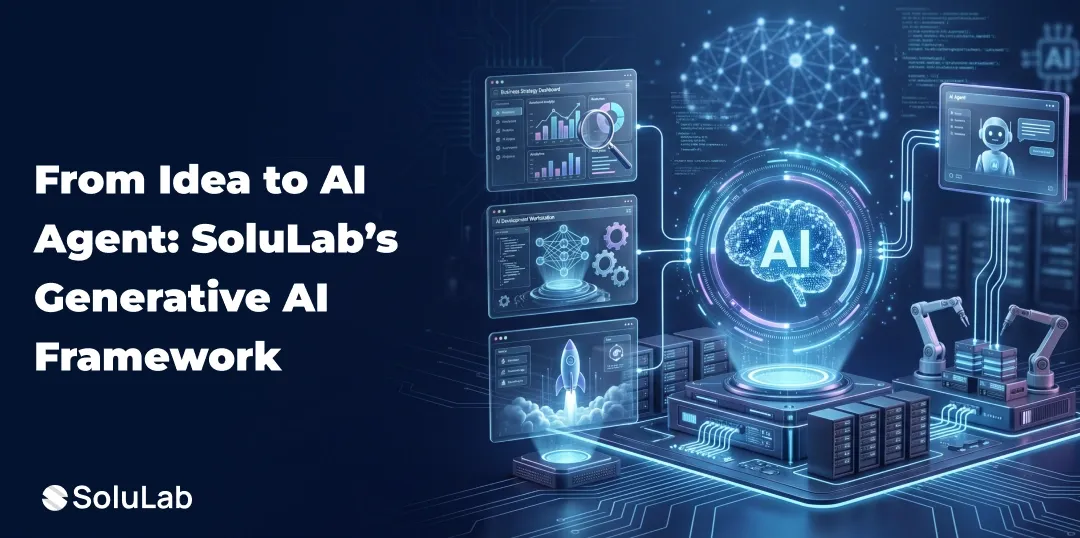
AI is changing the way businesses are operating, and AI agent platforms are leading the charge. However, the development of these platforms is not easy, as it goes beyond just coding expertise.
However, using the generative AI Adoption Framework to design, build, and implement AI agents in a systematic way to achieve actual business value. This organized process means that AI models can be aligned with the organizational objectives, scaled, and adapted to the changing data.
Through expert integration in AI models, end-to-end AI development assistance, as well as safe and tailored answers, SoluLab assists startups and enterprises to accelerate adoption and streamline operations.
As AI-based automation is reported to have quality efficiency improvements of up to 40 percent, a framework-based strategy is essential to success. Continue reading to know how you can build AI agent platforms using the generative AI adoption framework.
Key Takeaways
- Enterprises struggle to implement AI agents at scale due to fragmented systems, unclear workflows, and adoption challenges.
- Many AI initiatives stall because tools are disconnected, agent intelligence is limited, and ROI remains uncertain.
- SoluLab uses a Generative AI Adoption Framework to design AI agent platforms that are AI-native by architecture, integrating LLMs, autonomous workflows, and real-time analytics.
- Businesses adopting this framework see 3× faster deployment, improved operational efficiency, and higher user engagement.
Why a Generative AI Framework Matters for AI Agent Platforms?
The structured generative AI adoption framework in business is critical in developing AI Agent Platforms producing results, true productivity, and quantifiable value in competitive markets.
The latest McKinsey Global Survey reveals that 65% of organizations regularly use generative AI in at least one business function, up from 65% in early 2024. Here’s why a generative AI adoption framework matters for AI agent platforms:
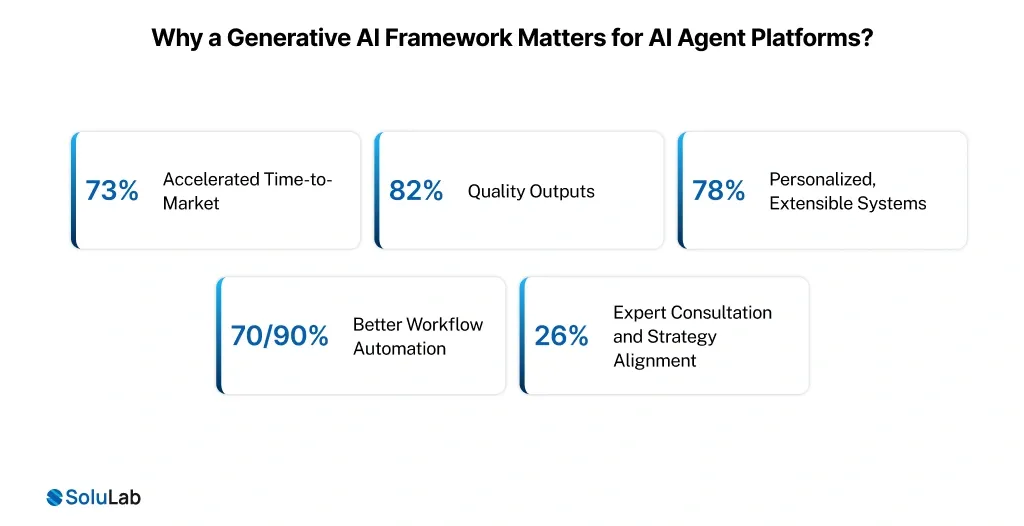
- Accelerated Time-to-Market: Organized structures accelerate the development and integration by minimizing uncertainty as well as streamlining the process. Those companies that are taking advantage of AI claim a speed of up to 73 percent faster time-to-market due to automating routine operations and predicting results more efficiently, allowing them to experience a shorter time to prototype and launch.
- Quality Outputs: Generative AI systems enhance the reliability of outputs by introducing best practices, testing pipelines, and feedback policies into the process of development. Research indicates that AI-based tools increase productivitymassivelye, and 58 per cent to 82 per cent of organizations report a tangible quality and cycle times increase when applying organized AI processes.
- Personalized, Extensible Systems: Frameworks are guaranteed to be scalable and easily adapt to dynamic needs, a necessity of AI agents for enterprises. The increase in world attention to generative AI has made numerous companies apply these systems to various operations currently, and 78% of them state that they use AI in various business departments, which proves the effectiveness of scalable strategic models.
- Better Workflow Automation: Generative AI automation systems are more efficient by eliminating manual bottlenecks and integrating intelligent orchestration of work. Studies indicate that AI automation will be able to spur greater efficiency improvements, including 70 to 90 percent of customer queries being autonomously answered by an agent, leading to faster service and reduced costs.
- Expert Consultation and Strategy Alignment: An effective structure can help businesses overcome the traps of strategy, governance, and deployment, which includes misalignment or unplanned consequences. Adoption reports indicate that those organizations that have set AI strategies are in a better place to realize value, but it is only a small percentage that achieve AI impact at scale without explicit structures (26-percent).
Benefits of Choosing SoluLab for AI Agent Platforms
Identifying the appropriate AI partner has the potential to turn failures into costly ones and to exert actual business influence. Here are all the benefits you’ll get:
1. Experience in AI Models: Extensive experience in machine learning, generative AI, NLP, vision, and predictive analytics that can assist businesses in creating strong AI agents in line with their unique requirements. And since more than three-quarters of businesses use AI tools to create genuine value, specialist AI knowledge is essential.
2. End-to-End Support: SoluLab offers a full lifecycle AI-driven support, starting with strategy and design, deploying, and continuously optimizing. This allows it to mitigate standard traps like slow deployment or stagnated projects that plague most AI projects, lowering time- to-value.
3. Scalable and Secure Solutions: The use of AI requires scalable systems and architectures. The solutions offered by SoluLab can expand along with your business and meet best practices, mitigating threats to data governance and performance, where structured AI systems are superior to ad-hoc approaches.
4. Bespoke and Affordable: SoluLab does not create one-size-fits-all tools, but instead creates tailored solutions that will resonate with specific business objectives. This reduces unnecessary amounts of money spent and shortens the payback period. This is a major benefit in situations when most AI projects do not work out because of the lack of structure.
Step-by-Step Generative AI Adoption Framework Used by SoluLab
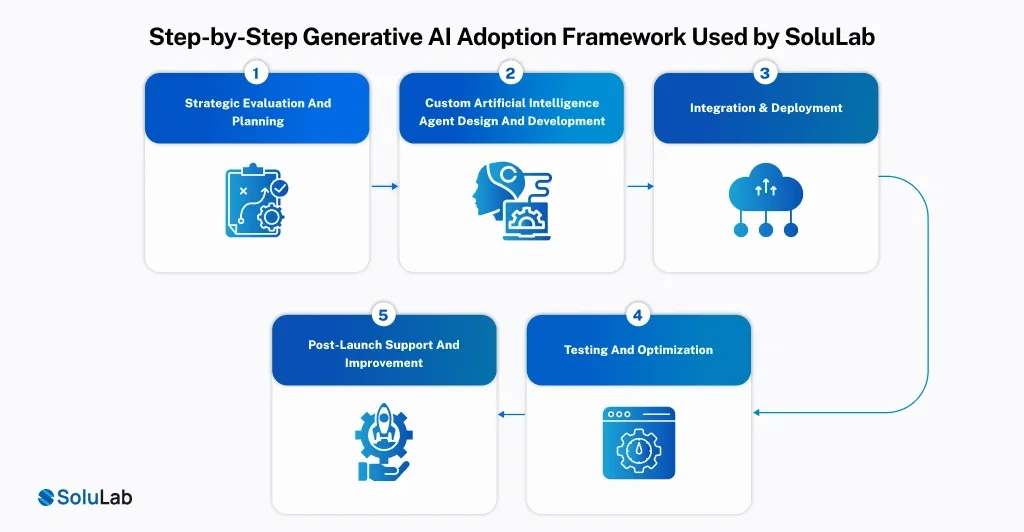
SoluLab has a systematic generative AI adoption model to build high-impact AI agent systems, enabling organizations to transition to scalable and measurable AI applications, which provide real business value.
1. Strategic Evaluation and Planning
SoluLab starts with a strategic evaluation matching the business objectives with the generative AI capabilities. The existence of a clear framework makes sure that projects are focused on measurable outcomes, and not on ad-hoc pilots; this is essential because frameworks allow for relating the aspects of experimentation to actual impact.
2. Custom Artificial Intelligence Agent Design and Development
After setting goals, it is possible to design and develop AI agents specific to use cases (e.g., automation or customer support) by SoluLab. Goal and technical feasibility prioritization helps decrease wasted resources and increase ROI, which is compliant with the best practices of enterprise AI adoption.
3. Integration & Deployment
SoluLab perfectly combines the AI agents with the current systems to guarantee interoperability and data governance, a frequent obstacle in enterprise deployments without a formal plan.
4. Testing and Optimization
Intensive testing and optimization of performance can be used to refine models and workflows before full AI-first implementation. This enhances reliability and solution to the dynamism of business needs, which is a move usually advisable in sustainable AI frameworks for scaling.
5. Post-launch Support and Improvement
We provide post-deployment performance monitoring, where models and agents are updated according to performance requirements or data modifications. Continuous improvement guarantees long-term value and can respond to changing use cases that are a component of organized AI adoption.
Challenges to Build an AI Agent Platform and How SoluLab Addresses Them
The development of an AI agent platform has serious technical challenges, particularly in the areas of data and integration. Such problems are usually overlooked by startups, and they can directly affect the accuracy, performance, and ROI.
1. Issues of Data Quality and Integration: The performance of AI agents demands high-volume data that is high-quality and unified, which is not always feasible, yet most of the organizations have disjointed data environments. According to one report, even 95% of IT leaders are convinced that the lack of integration hinders the use of AI, and only approximately every 28% of apps are linked to real-time access to data.
Solution: To overcome data quality and integration issues, SoluLab establishes powerful data governance models that standardize formats, unify data, and provide clean inputs before AI training or inference. This prepares regular feeds of data and enhances the performance of agents.
2. Complications of the Integration of the Legacy System: The outdated systems are a key setback. More than 9 in 10 organizations are unable to combine AI with previous infrastructure, and legacy dependence can require an indefinite number of hours of engineering effort before AI will operate effectively.
Solution: Applying middleware, API layers, and hybrid designs to connect older systems with a new artificial intelligence platform. SoluLab takes the time to modernize without replacements, resulting in easier AI integration and quicker implementation of agents.
3. Technical and Scalability Barriers: Most teams reach a point of scaling from a pilot to production. According to recent surveys, approximately half of agentic AI projects are currently languishing in pilot, and technical and observability problems, reported by 51-52 percent of the respondents as a major barrier.
Solution: Integrating engineering best practices such as MLOps pipelines, CI/CD workflow, and performance monitoring to make AI agents not only deployable but also scalable as data and user loads increase.
4. Preparation and Cleanup of Data Load: Research indicates that 6075 percent of the project effort in AI projects is spent on data preparation and not model development per se, which slows up timelines and increases expenses.
Solution: Putting a high value on automated ETL (Extract-Transform-Load) tools and controlled pre-AI training data cleaning. SoluLab is able to cut down manual preprocessing through scalable data pipelines and save time in general development, and minimize errors.
Conclusion
To create effective and trustworthy AI agent platforms, technical skills are not enough, but it is essential to do it in a systematic manner. The adoption framework SoluLab offers guarantees the flow of project creation, launch, and merging of strategic planning, development of expert models, and their integration.
Through this framework, startups and businesses are able to realize scalable and secure as well as high-performance AI agents that suit their business requirements. Recently, we delivered an AI agent system powered by 14+ autonomous agents for a French startup that wanted to improve decision-making through real-time orchestration and multi-agent automation
SoluLab, an AI agent development company, can help you build an AI agent using a generative AI adoption framework across industries. Book a free discovery call today!
FAQs
Neha is a curious content writer with a knack for breaking down complex technologies into meaningful, reader-friendly insights. With experience in blockchain, digital assets, and enterprise tech, she focuses on creating content that informs, connects, and supports strategic decision-making.