Key Takeaways
- AI in toll plazas combines camera-based plate reading, vehicle classification and analytics so vehicles can be charged without stopping.
- The biggest wins are faster throughput, fewer manual image reviews and less revenue leakage from misclassified or unreadable vehicles.
- Removing the barrier moves the hard problem downstream: unpaid tolls, tampered plates, false deductions and disputes.
- A barrier-free plaza needs an enforcement and exception loop designed before launch, not after the first complaints arrive.
- Read rate, leakage rate and dispute rate tell you far more about system health than a single “accuracy” number.
- GNSS tolling and AI agents in the back office are next, but privacy and explainability will set the pace.
AI in toll plazas uses cameras, sensors, and machine learning to identify vehicles, classify them, and charge the right toll without a stop. It replaces manual lanes and boom barriers with automatic number plate recognition, AI-based vehicle classification and real-time analytics.
The money behind it is growing. Grand View Research valued the global electronic toll collection market at $9.45 billion in 2024 and projects it will reach $21.50 billion by 2033, growing at a 9.7% CAGR.
Most guides stop at “AI reads the plate and traffic flows.” That’s the easy half. The hard half starts when there’s no barrier: what happens when a plate is unreadable, a tag has no balance or a driver disputes a charge? This guide covers both, including the enforcement loop and the KPIs that show whether an intelligent transportation system is collecting what it should.\

What Is AI in Toll Plazas?
AI in toll plazas means using computer vision and machine learning to automate the core toll tasks: detecting a vehicle, reading its plate, identifying its class, matching it to an account and posting the charge. Done well, it turns a toll plaza management system from a stop-and-pay checkpoint into a free-flowing data point on the highway.
1. How an AI Toll Plaza Works
A smart toll plaza follows five steps. Overhead gantries capture each vehicle with ANPR cameras and RFID readers. The license plate recognition system reads the plate, while a vehicle classification AI model counts axles and estimates size. The back office matches the vehicle to a tag or registered account. Finally, the system posts the toll and flags anything it can’t resolve for review.
2. AI Tolling vs Traditional Electronic Toll Collection
A standard electronic toll collection system relies mostly on an RFID tag such as FASTag or E-ZPass. AI adds a second, independent way to identify the vehicle. If the tag is missing, faulty or swapped onto the wrong vehicle class, the camera and classification models can still catch it. That redundancy is what makes open road tolling at highway speed possible.
3. Where Adoption Stands in 2026
India is the clearest example. More than 98% of national highway tolls are already collected electronically, and in July 2026 the government chose multi-lane free-flow (MLFF) tolling with ANPR and AI analytics alongside FASTag. Contracts were awarded for 17 plazas, five were live, and bids were invited for 104 more. Malaysia started ANPR-based tolling through its JustGo program in 2026, and the Philippines has installed AI-enabled plate cameras ahead of barrier-less expressways. Tolling is becoming one of the most visible uses of AI in transportation.
What Are the Benefits of AI in Toll Plazas?
AI in toll plazas cuts wait times, protects revenue, lowers operating costs and produces better data for planning. The benefits compound: a faster plaza with fewer misreads also needs fewer staff to review images.
1. Faster Throughput and Shorter Queues
A free-flowing lane processes vehicles at highway speed instead of one every few seconds. India’s first barrier-free plaza at Choryasi on NH-48 logged about 41,500 vehicles on its first day.
2. Revenue Protection
Vision models catch misclassified vehicles and missing tags that tag-only systems miss. Oklahoma Turnpike Authority’s AI image review, described in a North Highland case study, cut manual review workload by 60% at 98% accuracy.
3. Lower Operating Costs
Fewer booth operators, fewer manual image reviews and fewer equipment outages all reduce cost per transaction. Staff move from cash handling to exception review and customer support.
4. Better Data for Road Planning
Every transaction becomes a data point on volume, vehicle mix and travel time. Congestion is expensive, and the data shows it: Statista, charting INRIX figures, reported that drivers in Rome and Paris each lost about 165 hours to congestion in 2019. Toll data helps agencies see where those hours go, and a well-built predictive analytics model can forecast demand before roads are priced or widened.
5. Lower Emissions at the Plaza
Stop-and-go queues burn fuel. Removing the stop removes most of the idling, which matters on busy freight corridors.
What Are the Main Use Cases of AI in Toll Plazas?
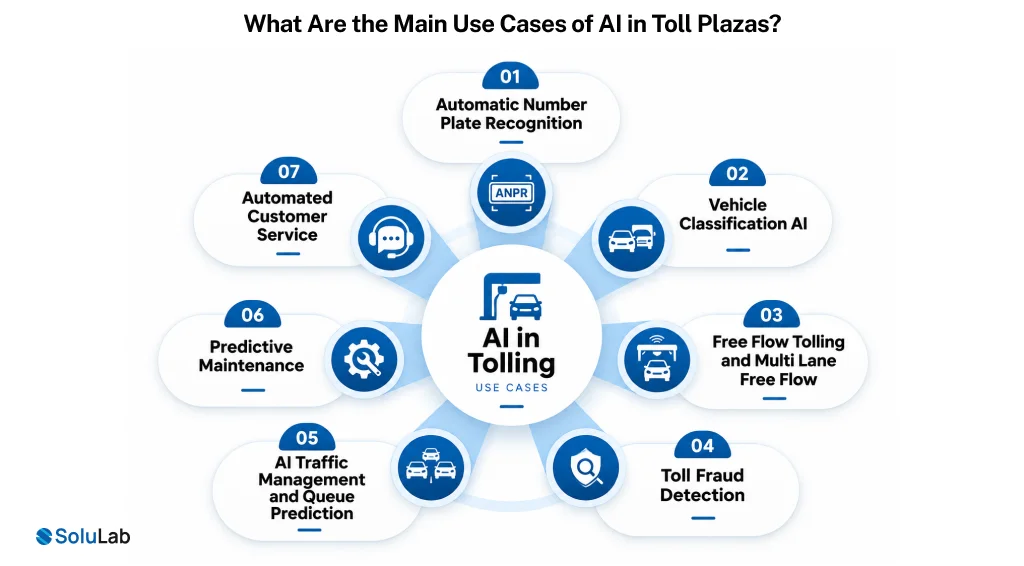
The main use cases are automatic number plate recognition, vehicle classification, free flow tolling, toll fraud detection, AI traffic management, predictive maintenance and automated customer service. Most operators start with the first two because they protect revenue directly.
1. Automatic Number Plate Recognition
ANPR is the backbone. An ANPR camera captures the plate, and license plate recognition software converts it to text with a confidence score. Modern ALPR software handles motion blur, glare and night conditions far better than older rule-based OCR. Running these models on gantry hardware keeps latency low and avoids streaming every frame to the cloud.
2. Vehicle Classification AI
Tolls depend on vehicle class, and misclassification is one of the quietest forms of revenue loss. A truck billed as a car costs the operator on every trip. Vision models count axles and measure silhouettes, then compare the result with the class on the tag. Accurate models need thousands of labeled images of local vehicle types.
3. Free Flow Tolling and Multi Lane Free Flow
Free flow tolling removes booths and barriers entirely. Vehicles pass under a gantry at normal speed while RFID, ANPR and classification run together. MLFF extends this across all lanes, so drivers don’t need to pick a toll lane or slow down.
4. Toll Fraud Detection
Fraud takes many forms: swapped tags, cloned plates, tags registered to the wrong class and repeated evasion by the same vehicles. Models trained on transaction history can flag patterns a rule engine misses, such as one plate appearing at two distant plazas within minutes.
5. AI Traffic Management and Queue Prediction
Computer vision traffic monitoring at the plaza feeds a wider traffic management system. AI predicts queue build-up, opens or closes lanes, detects stalled vehicles and spots incidents.
6. Predictive Maintenance
Cameras get dirty, readers drift out of alignment and gantry power fails. Predictive maintenance flags failing equipment before it causes missed reads. Deloitte’s 2026 Future of Infrastructure Survey of 985 infrastructure leaders found that 61% cite predictive maintenance as their leading current AI use case. Tolling agencies are no exception, because one dark camera can cost thousands of unbilled trips a day.
7. Automated Customer Service
Chatbots and virtual agents handle balance checks, charge explanations and dispute intake. That frees human staff for the complex cases that need judgment.
How Do You Build the Enforcement and Exception Loop?
Build the enforcement loop as part of the toll management system from day one. It should fuse every signal, score confidence, route doubtful cases to people, generate evidence and handle notices and disputes automatically. Toll violation enforcement is a product feature, not a back-office afterthought.
1. Fuse Every Signal
Never rely on one identifier. Combine the RFID read, the ANPR result, the vehicle class, make and color recognition, and timestamps from upstream gantries. When two signals disagree, that disagreement is the most useful flag you have.
2. Score Confidence and Keep Humans in the Loop
Auto-post charges only above a set confidence threshold, and route everything else to trained reviewers. Gartner expects 70% of government agencies to require explainable AI and human-in-the-loop mechanisms by 2029 for automated decisions that affect citizen services. A toll charge or penalty notice clearly qualifies, so design for responsible AI from the start.
3. Attach an Evidence Pack to Every Charge
Each enforcement transaction should carry the plate crop, a wide-angle frame, the classification result, the confidence score and the timestamp. Good evidence closes most disputes in one exchange.
4. Automate Notices and Collection
Link the toll collection system to vehicle registration records, send digital notices with a clear payment window and escalate unpaid cases automatically. Track which notices bounce, because a stale owner database quietly turns valid charges into write-offs.
5. Give Drivers a Fast Dispute Path
Let drivers see the evidence, contest a charge and get a decision online. Feed confirmed misreads back into model training so the same error doesn’t repeat.
Which KPIs Prove an AI Toll System Is Working?
A single “99% accuracy” claim says little. Measure read rate, accuracy, leakage, disputes and uptime separately, per lane and per condition. Here’s a practical scorecard for any automated toll collection system.
| KPI | What It Measures | Why It Matters |
| Plate read rate | Share of vehicles where a plate was read at all | Unread vehicles can’t be billed |
| Read accuracy | Share of reads that were correct | Wrong reads create false charges |
| Classification accuracy | Correct vehicle class versus ground truth | Misclassification drains revenue on every trip |
| Auto-post rate | Share of transactions posted without human review | Drives review staffing cost |
| Revenue leakage rate | Tolls owed but never collected | The true bottom-line metric |
| Dispute rate and resolution time | Complaints per 10,000 transactions and days to close | Signals trust and hidden misreads |
| Equipment uptime | Share of time each camera and reader is working | One dark camera can wipe out a lane |
How Do You Build an AI Toll Management System?
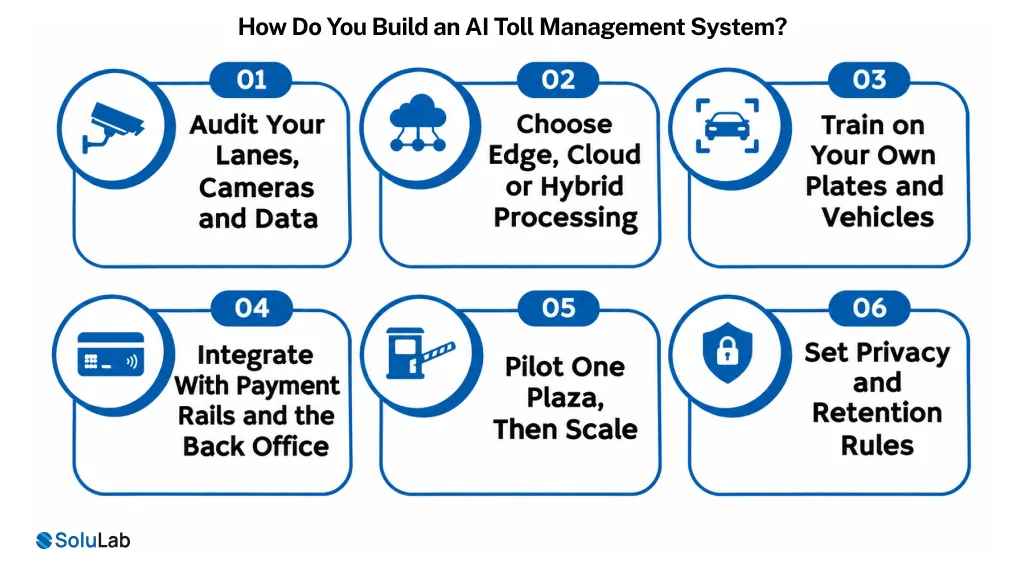
Start with an audit of your current lanes and data, then pilot one plaza with clear KPIs before scaling. The technology is proven. Integration with payment rails, registration databases and enforcement processes is where most projects slip.
1. Audit Your Lanes, Cameras and Data
Check camera angles, lighting, existing image archives, and back-office interfaces. Historical images become your first training and test set.
2. Choose Edge, Cloud or Hybrid Processing
Run plate reading and classification at the edge for speed, and send results plus evidence to the cloud for matching, analytics and review. Gantry sensors, power and connectivity call for an experienced IoT development company, because hardware faults cause a large share of missed reads in the field.
3. Train on Your Own Plates and Vehicles
Generic ANPR system models struggle with regional fonts, two-wheelers and local truck designs. Fine-tune on your own data and test on the hardest conditions you face. If that skill isn’t in-house, a computer vision development company that has tuned models on real road footage can shorten the process.
4. Integrate With Payment Rails and the Back Office
Connect to tag issuers, bank or wallet payments, vehicle registration records and your existing toll plaza software. Most delays come from these integrations, not from the AI models. Defining that architecture early is where an AI consulting engagement earns its keep.
5. Pilot One Plaza, Then Scale
Run AI alongside your current system first and compare results lane by lane. Move to free flow only when read rate, leakage and dispute rate meet your targets. For toll management software development at scale, a partner with custom AI software experience can take the pilot to a multi-plaza rollout.
6. Set Privacy and Retention Rules
Plate images are personal data in many jurisdictions. Define who can access them, how long they’re kept and when they’re deleted. Clear rules also make public acceptance easier.
What Are the Future Trends in AI Toll Collection?
The next wave of AI in toll plazas will move beyond the plaza itself: satellite-based charging, AI agents in the back office, distance-based pricing and interoperable systems across borders.
1. GNSS Toll Collection
GNSS toll collection charges vehicles by distance using satellite positioning, with no gantry needed. India deferred GPS-based tolling in July 2026 over security, privacy and operational concerns, choosing ANPR-based MLFF instead. Expect GNSS to arrive first for trucks and fleets, where onboard units already exist.
2. AI Agents in the Toll Back Office
Governments are moving toward AI agents for routine decisions, and the toll back office is an obvious fit. That means agents that triage review queues, draft dispute responses and reconcile transactions, with humans approving the final call. Teams exploring AI agent development for public services should start with these low-risk, high-volume tasks.
3. Distance-Based and Dynamic Pricing
Free flow gantries at entry and exit points make true distance-based billing possible. Pair that with demand forecasting and agencies can price congestion in real time.
4. Interoperability Across Operators
Drivers want one account across highways, cities and countries. Shared standards for tags, plate data and settlement will matter as much as camera quality.
5. Connected Vehicles
As vehicles gain built-in connectivity, the car itself may report its identity and route for tolling. Cameras will shift from primary identification to verification.

Conclusion
AI in toll plazas is no longer experimental. ANPR, vehicle classification AI and free-flow tolling are live on highways in India, Malaysia, the Philippines and beyond. The technology removes queues and protects revenue that tag-only systems miss.
The catch is what happens after the barrier comes down. Unreadable plates, unpaid notices, cloned plates and disputes decide whether a smart toll plaza actually collects what it’s owed. Build the enforcement loop and the KPI scorecard first, then scale.
If you’re planning a smart toll plaza or modernizing an existing toll collection system, SoluLab, an AI development company, can help your business design and build ANPR, vehicle classification, fraud detection and enforcement workflows that fit your lanes and back office. Book a free toll AI assessment with our team to map your pilot.
FAQs
Neha is a curious content writer with a knack for breaking down complex technologies into meaningful, reader-friendly insights. With experience in blockchain, digital assets, and enterprise tech, she focuses on creating content that informs, connects, and supports strategic decision-making.