Key Takeaways
- HR is the most heavily regulated commercial use of AI outside medical devices. The EU AI Act classifies employment AI as high-risk, and New York City requires an independent bias audit before you may use a hiring tool at all.
- The safest returns sit away from selection decisions. Job description drafting, interview scheduling, document processing and employee question answering carry real value and almost no legal exposure.
- Bias is a measurement problem before it is an ethics problem. If you cannot report selection rates by protected group, you cannot demonstrate the tool is lawful, regardless of how it was built.
- Explainability is a legal requirement here, not a nice-to-have. A candidate can ask why they were rejected, and “the model decided” is not an answer that survives scrutiny.
- Adoption moved faster than governance. Most organisations deployed something before deciding who owns the outcome of an automated employment decision.
Few functions have absorbed AI as quickly as HR, and none carries more regulatory weight for doing so. As recently as mid-2023, a Gartner survey of HR leaders found that only 5% had implemented generative AI, with over half still exploring and none in place.
Three years on, Gartner forecasts worldwide AI spending reaching $2.52 trillion in 2026, a 47% increase, and expects task-specific AI agents to appear in 40% of enterprise applications during the year, up from under 5% in 2025. HR technology moved with that wave.
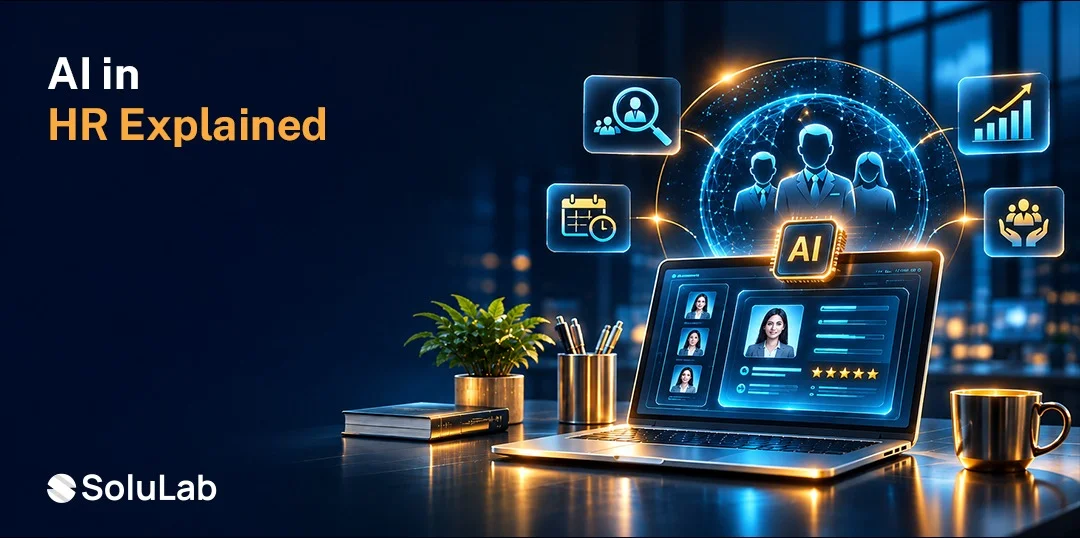
What has not kept pace is the governance around it, which matters more here than almost anywhere else because employment decisions are legally protected. This guide covers what ai in hr actually does, where it pays back, what regulators now require of you, and how to implement it without creating exposure.
What Is AI in HR?
AI in human resources is the use of machine learning and language models across the employee lifecycle: sourcing and screening candidates, scheduling interviews, drafting job descriptions, onboarding, answering employee questions, analysing engagement data and forecasting attrition. Where a system influences a hiring, promotion, or termination decision, it is legally regulated in a growing number of jurisdictions and carries obligations ordinary HR software does not.
The category divides cleanly into two halves, and the division is the single most useful thing to understand before buying anything.
1. Administrative AI, Which Is Low Risk
Drafting job descriptions, scheduling interviews, parsing documents, answering policy questions, summarising feedback. These touch no protected decision, carry no bias exposure of consequence, and are where most measurable value currently sits.
2. Decision-Influencing AI, Which Is High Risk
Ranking candidates, scoring assessments, recommending promotions, flagging flight risk, allocating tasks. The moment a system substantially assists a discretionary employment decision, a different legal regime applies to it.
3. Why the Line Matters Commercially
Both halves are sold as “AI in HR” by the same vendors, often in the same product. Buying them as one thing means accepting the compliance burden of the second half for the convenience of the first. Scoping the two separately is usually cheaper and always safer.
4. Where Agents Fit
Multi-step agents that complete HR workflows rather than answer single queries are arriving quickly, and they amplify both the benefit and the oversight question. We cover that specifically in AI agents in HR.
How Does AI in HR Work?
Five layers, and most of the engineering sits in the last two.
1. Data Is Assembled From Systems That Were Never Designed to Share
Applicant tracking, HRIS, payroll, learning platforms, and engagement surveys. HR data is unusually fragmented, and this step consistently takes longer than teams expect.
2. Documents Are Parsed Into Structured Fields
CVs, certifications, right-to-work documents and performance reviews arrive in every format imaginable. Language models extract fields without needing templates, which is the mechanics covered in intelligent document processing.
3. Models Score, Rank or Generate
Predictive models produce attrition risk or fit scores from historical patterns. Generative models draft descriptions, summaries and responses. The two have different failure modes and different legal profiles.
4. Guardrails and Bias Controls Gate the Output
Protected attributes excluded from features, proxy variables tested for, selection rates monitored by group, and confidence thresholds routing borderline cases to a human. This layer is where compliance lives.
5. Everything Is Logged for Audit and Explanation
Input, model version, output, the factors that drove it, the reviewer and the timestamp. In HR this is not operational hygiene, it is the evidence you produce when a candidate or a regulator asks why.
Top 8 AI in Human Resource Management Use Cases
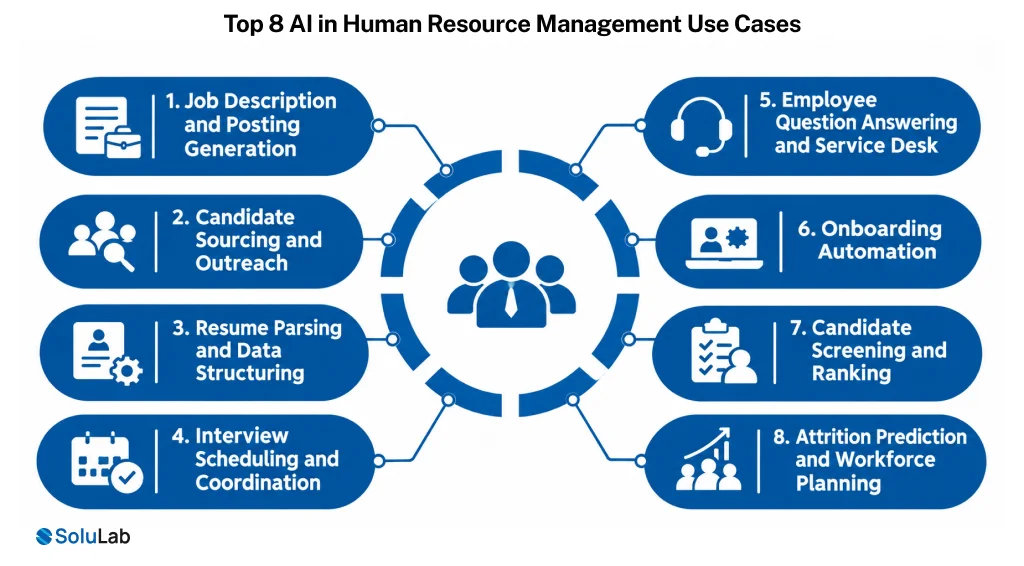
Ordered by return against risk, which is the order that matters rather than the order vendors present.
1. Job Description and Posting Generation
Drafting role descriptions from a brief, in consistent language, screened for exclusionary phrasing. Low risk, immediate value, and one of the fastest things to deploy.
2. Candidate Sourcing and Outreach
Finding and contacting plausible candidates from talent pools and public profiles. Sourcing widens the funnel rather than narrowing it, which keeps the risk profile lower than screening does.
3. Resume Parsing and Data Structuring
Turning applications into structured records. Parsing is mechanical extraction, not evaluation, which is why it sits comfortably on the low-risk side of the line.
4. Interview Scheduling and Coordination
Multi-party scheduling across calendars and time zones is pure logistics and consumes enormous recruiter time. No decision is influenced, so no bias exposure arises.
5. Employee Question Answering and Service Desk
Policy, benefits, leave and payroll queries answered from approved documentation with citation. This overlaps with our HR chatbot work, which covers the conversational layer in depth.
6. Onboarding Automation
Document collection, account provisioning across systems and task tracking. Integration-heavy rather than model-heavy, and frequently connected into core platforms as covered in AI ERP system work.
7. Candidate Screening and Ranking
The use case with the largest claimed benefit and by far the heaviest obligations. It is an automated employment decision tool in New York City and high-risk under the EU AI Act. Possible, but only with bias auditing, notice and human decision authority in place.
8. Attrition Prediction and Workforce Planning
Forecasting turnover risk and skills gaps from historical patterns. Useful at aggregate level for planning; legally fraught the moment an individual flight-risk score influences how a named person is treated.
Benefits of AI in HR
Here are a few benefits of AI in HR:
1. Recruiter Time Returned to Candidate Conversations
Scheduling, parsing, and drafting consume a large share of a recruiter’s week. Removing them does not reduce headcount so much as change what the role consists of.
2. Faster Time to Fill Without Lowering the Bar
Most delay in hiring is coordination rather than decision-making. Compressing the coordination shortens the cycle without touching the judgment.
3. More Consistent Candidate Experience
Every applicant receives the same quality of acknowledgement, update and explanation, which is difficult to achieve manually at volume and visible to candidates when it fails.
4. Employee Questions Answered Immediately
Policy and benefits queries resolved without a ticket, at any hour. The role of AI in HR service delivery is largely this, and it is unglamorous and genuinely appreciated.
5. Consistency That Reduces Legal Exposure Rather Than Creating It
Used carefully, a documented and monitored process is more defensible than hundreds of individual human judgments with no record. Consistency is a compliance asset when it is measured.
6. Workforce Planning Grounded in Data
Skills gaps, attrition patterns and internal mobility become visible at portfolio level, which changes planning conversations from anecdote to evidence.
What Regulators Require
This is the section most content on this topic skips, and in HR it determines what you can actually deploy.
1. The EU AI Act Classifies Employment AI as High-Risk
Systems used for recruitment, selection, promotion, termination, task allocation and worker monitoring fall into the high-risk category. That brings obligations for risk management, data governance, technical documentation, logging, human oversight, accuracy and transparency. This is not an interpretation question; employment is named explicitly.
2. New York City Requires an Independent Bias Audit
Local Law 144 took effect on 5 July 2023. It covers automated employment decision tools, defined as software using machine learning, statistical modelling, data analytics or AI to produce a simplified output such as a score, classification or recommendation that substantially assists or replaces discretionary decision-making. Before using one, an employer must have had a bias audit conducted, and must repeat it annually.
3. The Audit Must Be Genuinely Independent
The auditor must apply objective and impartial judgment and must hold no direct or material indirect financial interest in the employer, the entity using the tool, or the vendor that develops or distributes it. A vendor-supplied audit of a vendor’s own tool does not satisfy this.
4. Results Must Be Published and Candidates Notified
Bias audit results must be published before the tool is used, generally on the employer’s website. Candidates and employees must receive at least ten days’ notice, stating the qualifications the tool assesses, the data source and type, the retention policy, and their right to request an alternative assessment or a reasonable accommodation.
5. Penalties Are Modest but Disclosure Is Not
Civil penalties run $375 for a first violation and at least $500 for subsequent ones, capped at $1,500, with separate penalties for notice and audit failures. The financial exposure is small. The reputational exposure of publishing a bias audit that shows adverse impact is considerably larger, which is the real reason this law changes behaviour.
6. Other Jurisdictions Are Following
Illinois regulates AI use in video interviews. Colorado has enacted broader AI legislation touching employment. US federal enforcement runs through existing discrimination law, where a selection process with disparate impact is unlawful regardless of whether a human or a model produced it.
Risks: Bias, Explainability and the Audit Trail
Here are some risks you should know:
1. Historical Data Encodes Historical Decisions
A model trained on who was hired previously learns the preferences of whoever was hiring. If past selection was skewed, the model reproduces the skew and presents it as objectivity. This is the central risk, and it does not resolve itself.
2. Removing Protected Attributes Does Not Remove Bias
Proxies survive. Postcode, school, employment gaps, name-derived features and even writing style can correlate with protected characteristics. Proxy testing is a separate exercise from attribute exclusion, and skipping it is the most common technical failure.
3. You Cannot Demonstrate Fairness You Do Not Measure
Selection rates by protected group, monitored continuously, are the evidence. A tool with no disaggregated reporting cannot be shown to be lawful even if it happens to be fair.
4. “The Model Decided” Is Not an Explanation
A rejected candidate may ask why, and in several jurisdictions is entitled to an answer. Architectures chosen purely for accuracy can make that impossible to provide.
5. Automation Bias in Recruiters
A ranked list is anchoring. Reviewers accept a model’s ordering more readily than they would construct it themselves, which converts “decision support” into de facto decision-making without anyone choosing that.
6. Programmes Stall on Governance Rather Than Technology
Gartner expects more than 40% of agentic AI projects to be cancelled by the end of 2027, mostly for unclear business value and inadequate risk controls. In HR the inadequate-controls half of that is the dominant cause.
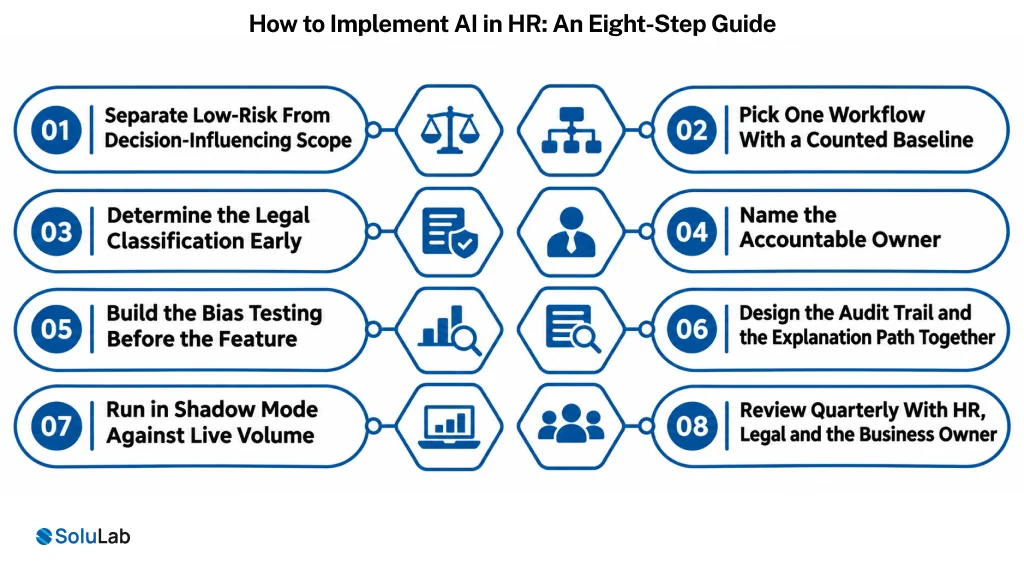
How to Implement AI in HR: An Eight-Step Guide
Risks: Bias, Explainability and the Audit Trail
Here are some risks you should know:
1. Historical Data Encodes Historical Decisions
A model trained on who was hired previously learns the preferences of whoever was hiring. If past selection was skewed, the model reproduces the skew and presents it as objectivity. This is the central risk, and it does not resolve itself.
2. Removing Protected Attributes Does Not Remove Bias
Proxies survive. Postcode, school, employment gaps, name-derived features and even writing style can correlate with protected characteristics. Proxy testing is a separate exercise from attribute exclusion, and skipping it is the most common technical failure.
3. You Cannot Demonstrate Fairness You Do Not Measure
Selection rates by protected group, monitored continuously, are the evidence. A tool with no disaggregated reporting cannot be shown to be lawful even if it happens to be fair.
4. “The Model Decided” Is Not an Explanation
A rejected candidate may ask why, and in several jurisdictions is entitled to an answer. Architectures chosen purely for accuracy can make that impossible to provide.
5. Automation Bias in Recruiters
A ranked list is anchoring. Reviewers accept a model’s ordering more readily than they would construct it themselves, which converts “decision support” into de facto decision-making without anyone choosing that.
6. Programmes Stall on Governance Rather Than Technology
Gartner expects more than 40% of agentic AI projects to be cancelled by the end of 2027, mostly for unclear business value and inadequate risk controls. In HR the inadequate-controls half of that is the dominant cause.
How to Implement AI in HR: An Eight-Step Guide
Here are a few trends you would see in AI in HR:
1. Agentic Workflows Across the Hiring Pipeline
Agents that coordinate scheduling, chase references, and progress candidates through stages, escalating exceptions. The benefit is real, and the oversight question is sharper, because an agent acting across stages touches regulated decisions more easily than a single-purpose tool.
2. Skills-Based Architecture Replacing Job-Title Architecture
Organisations moving from roles to skills inventories, with models inferring skills from work history and project data. This is the structural change that makes internal mobility measurable.
3. Bias Auditing Becoming a Procurement Requirement
Buyers are starting to ask vendors for independent audit evidence before purchase rather than after deployment. Expect audit documentation to become a standard RFP section.
4. Candidate-Side AI Changing the Signal
Applicants use the same models to write applications. Volume rises, differentiation falls, and screening signals that worked on human-written CVs degrade. Few HR teams have adjusted for this yet, and it is arguably the most underrated shift in the field.
5. Employee Service Consolidating Into One Interface
Policy, benefits, IT and payroll queries converging into a single assistant rather than separate portals, with routing behind it. The broader pattern is covered in AI agent use cases.
6. Monitoring Regulation Catching Up With Monitoring Technology
Worker monitoring is named in the EU AI Act’s high-risk category, and productivity analytics is drifting toward it. Treat anything that measures individual employees as regulated by default.
What AI HR Software Development Costs
Cost tracks integration count and compliance scope far more than model choice.
| Engagement | Typical range | What it covers | Timeline |
| Assessment and risk classification | $6,000 to $14,000 | Workflow selection, legal classification per jurisdiction, bias testing plan, build estimate | 2 to 4 weeks |
| Low-risk workflow build | $20,000 to $50,000 | Drafting, scheduling, parsing or employee Q&A, with one or two system integrations | 5 to 9 weeks |
| Employee service assistant | $45,000 to $50,000 | Retrieval over policy documents, citation, routing, HRIS integration, analytics | 10 to 16 weeks |
| Screening or ranking system | $50,000 | Model development, bias testing harness, disaggregated reporting, audit trail, explanation layer, documentation for independent audit | 16 to 26 weeks |
| Multi-workflow HR platform | $80,000+ | Several workflows, shared data layer, agent orchestration, governance framework | 24 weeks+ |
| Ongoing monitoring retainer | Monthly, scoped to volume | Selection rate monitoring, drift detection, threshold review, audit support | Rolling |
How SoluLab Can Help
We build HR AI with the compliance layer designed in, and we have delivered 500+ AI projects since 2014.
1. Risk Classification and Scope Design
We split your candidate workflows into low-risk and decision-influencing, classify each against the jurisdictions you hire in, and sequence them so value arrives before the heavy governance work.
2. Low-Risk Workflow Builds
Job description generation, sourcing support, resume parsing, scheduling and onboarding automation, integrated into the ATS and HRIS you already run.
3. Employee Service Assistants
Retrieval over your approved policy documentation with citation on every answer, routing to humans on anything consequential, and analytics showing what employees actually ask.
4. Screening Systems Built to Be Audited
Where you do need candidate ranking, we build the bias testing harness, disaggregated reporting and explanation layer alongside the model, and prepare the documentation an independent auditor will need.
5. Workforce Analytics and Planning
Attrition and skills modelling at aggregate level, designed to inform planning rather than to score named individuals.
6. Team Augmentation
Where you have the roadmap and need engineering capacity, you can hire AI developers into your existing team rather than outsourcing the whole build.
If you want custom AI HR solutions or AI HR software development for a defined workflow, start with a discovery call. Broader capability sits under AI solutions, and we will tell you plainly when a configuration change to your existing HRIS does the job, because it often does.

Conclusion
AI in HR is two different purchases wearing one name. The administrative half, drafting and scheduling and parsing and answering questions, is low risk, quick to deploy and genuinely useful, and most organisations have barely finished it.
The decision-influencing half, screening and ranking and scoring, is regulated as high-risk in the EU, requires an independent bias audit before use in New York City, and carries an obligation to explain outcomes to the people affected. Both are worth doing. They are not worth doing at the same time, with the same governance, by the same project.
If you are deciding where to start, which workflows carry legal exposure, or how to build screening that survives an audit, SoluLab, an AI development company, can help your business scope it properly. Book a discovery call and we will work through the first workflow with you.
FAQs
Neha is a curious content writer with a knack for breaking down complex technologies into meaningful, reader-friendly insights. With experience in blockchain, digital assets, and enterprise tech, she focuses on creating content that informs, connects, and supports strategic decision-making.