Key Takeaways
- The visible applications and the profitable ones are different. Personalisation and chatbots get the attention; forecasting, inventory and markdown optimisation carry the margin.
- Retail AI runs on data most retailers have and few have cleaned. Product master data, inventory accuracy and returns history decide feasibility more than model choice does.
- Forecasting is the highest-leverage application because every downstream decision depends on it. Buying, allocation, pricing and staffing all inherit the forecast’s error.
- Customer-facing AI is judged on a harsher standard. A wrong recommendation is forgettable; a wrong price or stock promise costs a sale and a complaint.
- Measure against margin, not engagement. Click-through on a recommendation tells you almost nothing about whether the quarter was better.
Retail has more AI deployed than almost any sector and less agreement about what it earned. The spend is not in doubt: Gartner forecasts worldwide AI spending reaching $2.59 trillion in 2026, a 47% increase year over year, with AI services alone at $585.5 billion, and expects task-specific AI agents to appear in 40% of enterprise applications during the year, up from under 5% in 2025.
Retailers were among the earliest buyers and are now the ones asking hardest what actually came back to the P&L. The pattern across the ones getting results is consistent and slightly unfashionable: the money is in demand planning, inventory and pricing rather than in the storefront.
This guide covers the real use cases for AI in retail & e-Commerce, what each one returns, how to sequence a rollout, and what a realistic build costs.
What Is AI in Retail and E-Commerce?
AI in Retail is the use of machine learning and language models across retail operations: forecasting demand, optimising inventory and replenishment, setting prices and markdowns, personalising storefronts, handling customer service and detecting fraud. AI in e-Commerce covers the same work for online-only operations, with search, product discovery and returns prediction carrying more weight than store execution does.
The two overlap heavily and diverge in one important respect.
1. Where Retail and E-Commerce Diverge
A physical retailer’s hardest problem is getting the right stock into the right store before anyone asks for it. An online retailer’s hardest problem is search, discovery and returns. Artificial intelligence in retail work therefore skews toward supply and allocation, while Artificial Intelligence in e-Commerce skews toward relevance and conversion.
2. Why Both Rest on the Same Foundation
Product master data, inventory accuracy and a clean transaction history. AI for retail projects fail on dirty product attributes far more often than on model selection, and no amount of modelling fixes a catalogue where the same item appears four times under different SKUs.
3. Predictive and Generative Do Different Jobs Here
Forecasting, pricing and fraud are predictive problems with measurable right answers. Product descriptions, search relevance and customer conversation are generative problems. Most AI retail solutions worth buying contain both, used for what each is good at.
4. Where Agents Fit
Multi-step agents that handle a service case or a replenishment exception end to end are arriving quickly. We cover that specifically in AI agents in retail & e-commerce and, on the shopper side, AI agents for online shopping.
Why AI in Retail Matters Now
1. Margin Pressure Has Nowhere Else To Go
Retailers have already squeezed procurement, renegotiated leases and cut head office. The remaining margin sits in decisions made thousands of times a week: what to buy, where to send it, when to discount it. Those are modelling problems, and they are the last large pool of recoverable margin most retailers have.
2. Relevance Decides the Sale Faster Than Price Does
A shopper comparing three sites decides in seconds, usually on whether the thing they wanted appeared. Poor search and discovery loses the sale before price enters the conversation at all. This is why AI for E-Commerce work on relevance tends to beat another round of discounting.
3. Demand Patterns Stopped Repeating Reliably
Forecasting on last year’s figures assumes last year rhymes with this one. For a growing share of categories it no longer does, between shifting channel mix, volatile promotions and demand that moves on social signal rather than season. Models that read current signals handle that; a year-on-year baseline cannot.
4. The Data Finally Sits in One Place
Most retailers spent the last decade consolidating POS, e-commerce, loyalty and supply chain data, often without a clear use for it. That groundwork is what makes Artificial intelligence in retail feasible now rather than five years ago, and it is why retailers who skipped it are still stuck.
5. Labour Cost and Availability Changed the Store Maths
Scheduling, replenishment and shelf checks were cheap when staff were plentiful. They are not now, which changes what automation is worth at store level and makes AI automation in retail a cost question rather than an innovation one.
6. Range and SKU Counts Outgrew Manual Management
A buyer could manage a few hundred lines by judgment. Nobody manages fifty thousand that way. Beyond a certain catalogue size, per-SKU decisions have to be modelled or they get made by blanket rule, and blanket rules are expensive.
Top 10 AI Use Cases in Retail and E-Commerce
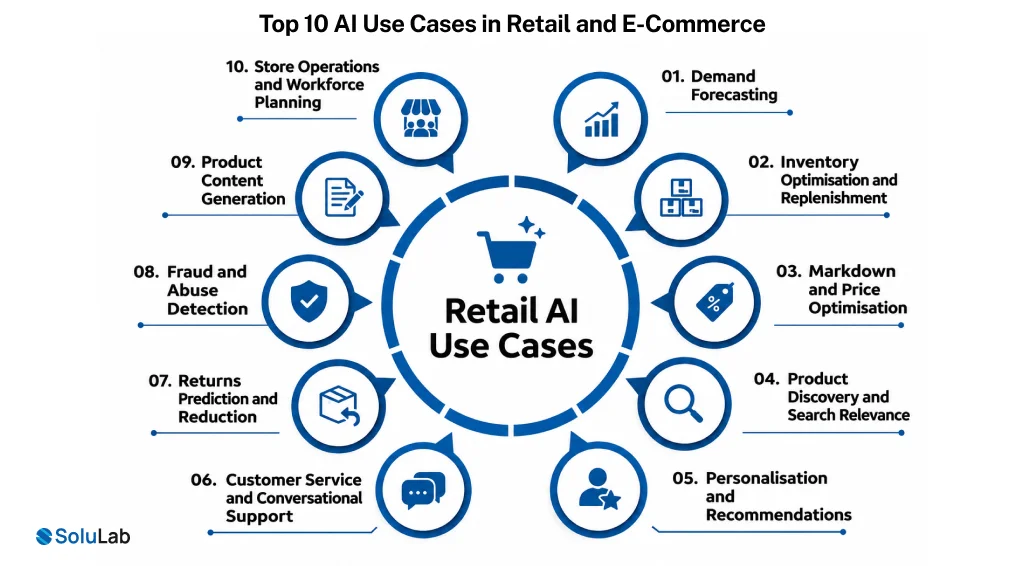
Ordered by return against difficulty rather than by visibility.
1. Demand Forecasting
The highest-leverage application, because buying, allocation, pricing and staffing all inherit the forecast. Models using promotions, weather, local events and cannibalisation effects beat the spreadsheet baseline most retailers still run. Detail sits in AI for Demand Forecasting.
2. Inventory Optimisation and Replenishment
Store-level and SKU-level stock decisions, safety stock sizing and automated replenishment triggers. AI for inventory management pays back fastest where stockouts and markdowns are already measured, which in most retailers they are.
3. Markdown and Price Optimisation
When to discount, by how much, and on which items. Markdown is often the single largest controllable margin leak in retail, and it is unusually well suited to modelling because the outcome is visible within weeks.
4. Product Discovery and Search Relevance
Semantic search that understands intent rather than matching keywords, plus visual search from a photo. On an online storefront, search abandonment is a direct revenue loss and relevance improvements show up quickly.
5. Personalisation and Recommendations
The most deployed and most over-credited application. It works, the uplift is real, and it is smaller than vendors imply once you measure incremental margin rather than click-through.
6. Customer Service and Conversational Support
Order status, returns, sizing and product questions resolved without an agent. The conversational layer specifically is covered in AI chatbot development and, for retail-specific deployments, in our work on AI-powered customer service.
7. Returns Prediction and Reduction
Predicting which orders will come back, and intervening at the point of sale with better sizing guidance or imagery. In apparel e-commerce this is frequently the largest single margin opportunity available.
8. Fraud and Abuse Detection
Payment fraud, promotion abuse, returns fraud and account takeover. Predictive, measurable and with a cost of error you can calculate directly.
9. Product Content Generation
Descriptions, attributes, alt text and localisation at catalogue scale. Unglamorous, immediately useful, and the application where generative models earn their place most clearly in retail.
10. Store Operations and Workforce Planning
Labour scheduling against forecast footfall, planogram compliance from shelf imagery, and shrink detection. AI automation in retail at store level depends on operational data quality more than anywhere else.
Benefits of AI in Retail and E-Commerce
1. Fewer Stockouts Without More Inventory
Better forecasting lets you hold less stock and miss fewer sales at the same time, which is the only way those two move together.
2. Margin Protected Through Smarter Markdowns
Discounting later, shallower and on fewer items. The effect is visible in gross margin within a season rather than a year.
3. Higher Conversion From Relevant Discovery
Shoppers who find what they wanted buy more often. AI for e-Commerce work on search and discovery tends to move conversion more reliably than recommendation widgets do.
4. Service Cost per Order Falls
Routine queries resolved without an agent, with escalation reserved for cases that need judgment. AI e-Commerce solutions of this kind scale through peak trading without seasonal hiring.
5. Returns Reduced at the Point of Decision
Intervening before the order is placed is worth considerably more than processing the return efficiently afterwards.
6. Catalogue Operations Decoupled From Headcount
Content generation and attribute enrichment stop scaling with the number of SKUs, which changes what range expansion costs.
AI for Inventory Management and Demand Forecasting
These two deserve separating out, because they are where most of the realised value in retail AI actually sits.
1. Why the Forecast Is the Foundation
Every downstream decision inherits its error. A buying plan, an allocation, a price and a staffing roster built on a bad forecast are all wrong in the same direction, and no amount of optimisation downstream recovers it.
2. What Modern Forecasting Adds Over the Baseline
Promotional lift modelled rather than guessed, cannibalisation between substitutes accounted for, weather and local event effects included, and new-product forecasting by attribute similarity instead of by analogue chosen manually.
3. Why Forecast Accuracy Is the Wrong Headline Metric
Accuracy improvements only matter where they change a decision. A 2% improvement on a fast-moving staple changes nothing; the same improvement on a long-lead seasonal item changes the whole buy. Measure by decision impact, not by aggregate error.
4. Where Inventory Models Earn Their Keep
Safety stock sized per SKU and location rather than by blanket rule, replenishment triggered by predicted rather than historical demand, and allocation that accounts for transfer cost. Grand View Research puts the predictive analytics market on track for USD 82.35 billion by 2030, a 28.3% compound rate from 2025, and retail planning is a substantial share of why.
5. The Data Problem Nobody Scopes
Inventory accuracy. A model trained on a stock position that is wrong 8% of the time learns the error. Fixing counts is unglamorous and it is frequently the highest-return work in the whole programme.
AI for Retail Analytics and E-Commerce Analytics
1. From Reporting to Decision Support
Dashboards tell you what happened. AI for retail analytics work that matters tells you what to do about it: which SKUs to exit, which stores to reallocate from, which promotion to stop.
2. Natural Language Access to Merchandising Data
Merchandisers asking questions of the data directly rather than queuing for an analyst. The benefit is cycle time on decisions rather than analytical depth.
3. Customer Lifetime Value and Cohort Modelling
Segmenting by predicted value rather than by past spend, which changes acquisition budgets and retention priorities. AI for e-Commerce Analytics of this kind is where marketing and merchandising decisions start to connect.
4. Attribution That Survives Scrutiny
Incrementality testing rather than last-click. This is the measurement discipline most retail AI programmes skip, and skipping it is why so many report uplift that the P&L cannot find.
5. Why Analytics Should Precede Automation
Automating a decision you cannot yet measure is how programmes lose their budget in the second year. Build the measurement first; it is cheaper and it tells you which automation is worth building.
How to Implement AI in Retail: An Eight-Step Rollout
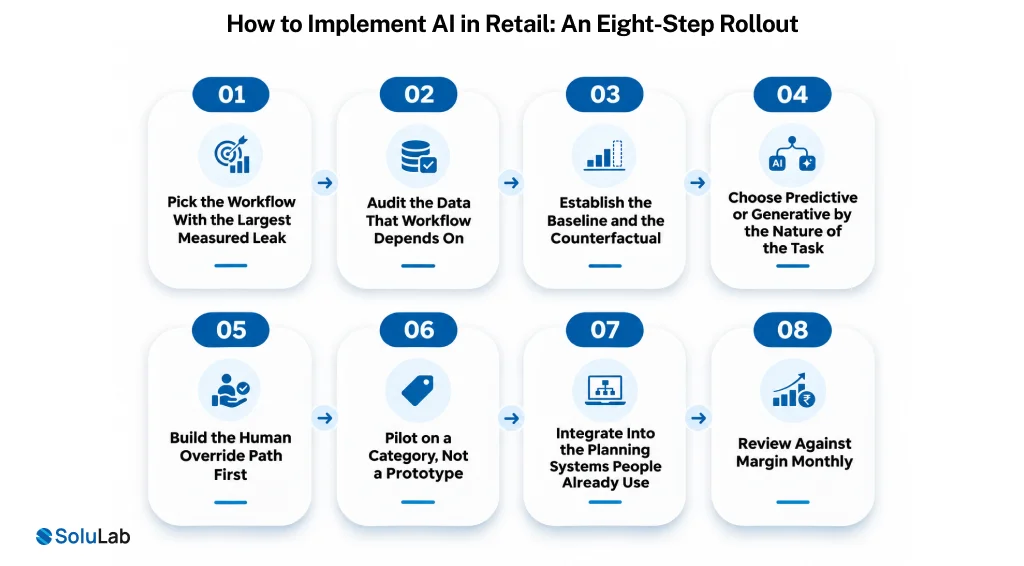
Here is a step-by-step guide on how to implement AI in retail:
1. Pick the Workflow With the Largest Measured Leak
Markdown rate, stockout rate, returns rate, service cost per order. Start where money is already visibly leaving rather than where the technology looks most impressive.
2. Audit the Data That Workflow Depends On
Product master data completeness, inventory accuracy, transaction history depth. This audit takes two weeks and prevents the most common failure in retail AI projects.
3. Establish the Baseline and the Counterfactual
What the metric is now, and how you will know the change came from the model rather than from the season. Without a holdout group or a staged rollout, you will never settle this argument internally.
4. Choose Predictive or Generative by the Nature of the Task
Forecasting, pricing and fraud are predictive. Content, search and conversation are generative. Teams that reach for a language model because it is available end up with expensive answers to arithmetic questions.
5. Build the Human Override Path First
Merchandisers will disagree with the model, sometimes correctly. An override that is logged and reviewed teaches you where the model is weak. An override that is impossible gets worked around in spreadsheets.
6. Pilot on a Category, Not a Prototype
One real category, real volume, a full season or trading cycle. Retail is seasonal and a four-week pilot proves very little about an annual pattern.
7. Integrate Into the Planning Systems People Already Use
Output that lands in the merchandising or ERP system gets acted on. Output in a separate dashboard gets ignored within a month. Integration work of this kind runs through our AI integration practice.
8. Review Against Margin Monthly
Not engagement, not accuracy. Gross margin, sell-through and the baseline metric from step three, reviewed with the commercial owner rather than the technology team.
Future Trends in AI-Powered Retail
Here are some future trends in AI powdered retail:
1. Agentic Shopping Changes Who the Customer Is
Shoppers delegating purchases to agents means your storefront is increasingly read by software. Structured product data and machine-readable availability stop being hygiene and become distribution.
2. Conversational Commerce Moving Beyond Support
Discovery and purchase inside a conversation rather than a product grid, which changes what merchandising means.
3. Forecasting Absorbing External Signals as Standard
Weather, local events, competitor pricing and social signal moving from optional enrichment to baseline inputs.
4. Visual Search and Image-Driven Discovery
Photograph-to-product becoming an expected feature rather than a differentiator, particularly in apparel and home.
5. Store Intelligence From Existing Cameras
Shelf availability, planogram compliance and queue management derived from infrastructure retailers already own, which changes the cost case considerably.
6. Consolidation Around Fewer Platforms
The appetite for a dozen point solutions is fading. Buyers want fewer systems with deeper integration, which changes how AI-powered retail Solutions get purchased.
AI Development for Retail and E-Commerce: What It Costs
Cost tracks data readiness and integration count far more than model sophistication.
| Engagement | Typical range | What it covers | Timeline |
| Data audit and use case assessment | $6,000 to $15,000 | Product data and inventory accuracy audit, workflow ranking, baseline definition, build estimate | 2 to 4 weeks |
| Single-workflow pilot | $25,000 to $60,000 | One model, one integration, holdout design, measurement against baseline | 6 to 10 weeks |
| Forecasting and inventory platform | $50,000 to $60,000 | Demand models, allocation logic, planning system integration, monitoring | 14 to 22 weeks |
| Storefront personalisation and search | $60,000 to $80,000 | Semantic search, recommendations, incrementality testing framework | 12 to 18 weeks |
| Full retail AI programme | $80,000+ | Several workflows, shared data layer, agent orchestration, governance | 24 weeks+ |
| Ongoing retainer | Monthly, scoped to model count | Retraining, drift monitoring, threshold review, seasonal recalibration | Rolling |
Real-World Examples of AI in Retail
Each is interesting less for what the technology did than for what happened next.
1. Amazon Go and Just Walk Out
Amazon Go’s cashier-less stores used overhead cameras and shelf sensors to track what shoppers picked up and charge them on the way out. The computer vision genuinely worked. The economics did not. Amazon removed Just Walk Out from its US Amazon Fresh stores in April 2024, replacing it with AI-powered Dash Carts, and in January 2026 announced it was closing all Amazon Fresh and Amazon Go stores, saying it had not found “the right economic model needed for large-scale expansion”.
What to take from it: a working model is not a working business case. Most blogs still describe Amazon Go in the present tense as a success story. Check the date on any retail AI case study before you cite it in a board paper.
2. Walmart and Bossa Nova
Walmart deployed roughly 500 shelf-scanning robots across its 4,700-plus US stores to track inventory and flag gaps. It ended the contract in November 2020 after concluding that its own staff could do about the same work, having found simpler and cheaper ways to manage shelf stock using people who were already in the aisles picking online orders.
What to take from it: before building a system to generate a signal, check whether an existing process already produces it. This is the most common avoidable waste in AI retail solutions projects, and it is a scoping failure rather than a technical one.
3. Sephora Virtual Artist: A Narrow Problem, Solved Properly
Sephora’s Virtual Artist lets shoppers try makeup on their own camera feed, built on ModiFace augmented reality and later extended with AI colour matching that finds the nearest shade from a photo. It has survived and expanded where many retail AR experiments did not.
What to take from it: it works because it removes a specific purchase blocker. Shade uncertainty is the reason people do not buy cosmetics online, and this addresses exactly that. The lesson is not “add AR”. It is to find the one thing stopping the purchase and aim at it.
4. Stitch Fix: Personalisation Is Not a Business Model on Its Own
Stitch Fix built one of retail’s most data-science-heavy personalisation operations, pairing algorithmic recommendation with human stylists. Client numbers and revenue declined anyway, and the company cut 15% of salaried staff in 2023 following a sales slump. It has since leaned back toward human stylists with AI supporting them rather than replacing them.
What to take from it: the most sophisticated personalisation in the sector did not rescue weak unit economics. Personalisation improves a business that works. It does not create one, which is the uncomfortable version of the point this article keeps making.
How SoluLab Can Help
We build and measure retail AI, and we have delivered 500+ AI projects since 2014.
1. Data Readiness and Use Case Ranking
We audit the product and inventory data your candidate workflows depend on, then rank them by measured leak rather than by technical appeal. This is AI consulting for retail work and it usually changes the project order.
2. Forecasting and Inventory Builds
Demand models with promotional and cannibalisation effects, safety stock sizing, and replenishment logic integrated into your planning systems. Our machine learning development services team handles the predictive side.
3. Storefront Search, Discovery and Content
Semantic and visual search, recommendations with incrementality testing built in, and catalogue content generation at scale. AI development for e-Commerce of this kind is where generative models fit properly.
4. Service and Conversational Systems
Order, returns and product question handling with escalation paths, built on generative AI development services and extended with AI agent development services where a workflow needs completing rather than answering.
5. Analytics and Measurement Frameworks
Incrementality testing, cohort and lifetime value modelling, and the reporting that makes a programme defensible at budget time. Adjacent patterns sit in AI in business and AI powered solutions.
6. Product Engineering for Retail Technology Vendors
For companies building what retailers buy, we handle model architecture, data pipelines and integration surface. Related work is covered under AI product development.

Conclusion
The uncomfortable finding in retail AI is that attention and return point in different directions. Personalisation and chatbots are visible, demonstrable and comparatively small. Forecasting, inventory and markdown optimisation are invisible to the customer and carry most of the margin, and they are harder because they depend on product and stock data that most retailers have never fully cleaned.
The retailers getting results started with the largest measured leak rather than the most impressive demo, audited their data before choosing a model, built a holdout so the result could be defended, and reviewed against gross margin rather than engagement. None of that requires a better model than the ones available two years ago. It requires picking the right problem and being willing to fix the data underneath it first.
If you are deciding which retail workflow to automate, or why a previous programme did not show up in the numbers, SoluLab, an AI development company, can help your business scope it properly. Book a discovery call and we will work through the first workflow with you.
FAQs
Neha is a curious content writer with a knack for breaking down complex technologies into meaningful, reader-friendly insights. With experience in blockchain, digital assets, and enterprise tech, she focuses on creating content that informs, connects, and supports strategic decision-making.