AI risk management is the organized process of finding, reducing, and dealing with the risks that come with AI technologies. Implementing formal AI in finance risk management frameworks is a big part of this. It involves a mix of tools, practices, and concepts working together.
From chatbots to fraud detection, banks use AI and ML to automate tasks, run the front and back office more smoothly, and improve the customer experience. In 2022, the global market for AI trust, risk, and security management was worth $1.7 billion. It’s expected to hit $7.4 billion by 2032, a 16.2% compound annual growth rate (CAGR).
In this blog, we’ll walk through what AI in risk management actually means, its benefits, where it’s headed, and the challenges that come with it.

What is AI in Risk Management?
AI risk management is a suite of tools and practices organizations deploy to protect themselves and their end users from the risks AI introduces. It means measuring those risks and putting solutions in place to shrink them, either by lowering how likely a problem is or how severe its impact would be. It may look like software engineering best practices on the surface, but it’s genuinely a different discipline.
According to NIST, as defined in their AI Risk Management Framework:
AI risk management is a component of responsible development and the use of AI systems. Responsible AI can help align decisions about AI system design, development, and use with the intended aims and values. It pushes companies and the teams building, testing, and using AI to think harder about both the expected and unexpected effects their systems could have, core concepts in responsible AI: human centricity, social responsibility, and sustainability. Understanding and managing these risks builds trustworthiness, and trustworthiness is what earns public trust.
Why do Companies Need AI in Risk Management?
Companies face a lot of risk these days, which is exactly why AI has become essential for identifying, assessing, and mitigating threats quickly and accurately.
1. Security Risk
Security risks show up when AI systems have vulnerabilities attackers can exploit, or that users introduce without realizing it. The result is unintended output. These risks can target the model itself, the data feeding it, or the software underneath. Whether proprietary, commercial, or open-source, AI and ML in data integration models all face the same threats: supply chain risks, data poisoning, prompt injection, personal information leaks, even theft of the model itself.
2. Ethical Risk
Ethical risks show up when an AI system’s behavior clashes with societal norms, legal requirements, or governance policies. Often the root cause is bias baked into training data, or new patterns that emerge from production data over time. Common examples: biased predictions, toxic or offensive outputs, responses that show prejudice or exclusion.
3. Operational Risk
Operational risks surface when a model’s predictions drift from what’s expected. The causes range from data drift and hallucinated results to corrupted datasets, unusual inputs, or broken data pipelines. Silent failures are the trickiest part: they don’t crash the model, they just quietly degrade its performance, which makes them hard to spot even as they mess with downstream processes.
Use Cases of AI in Risk Management
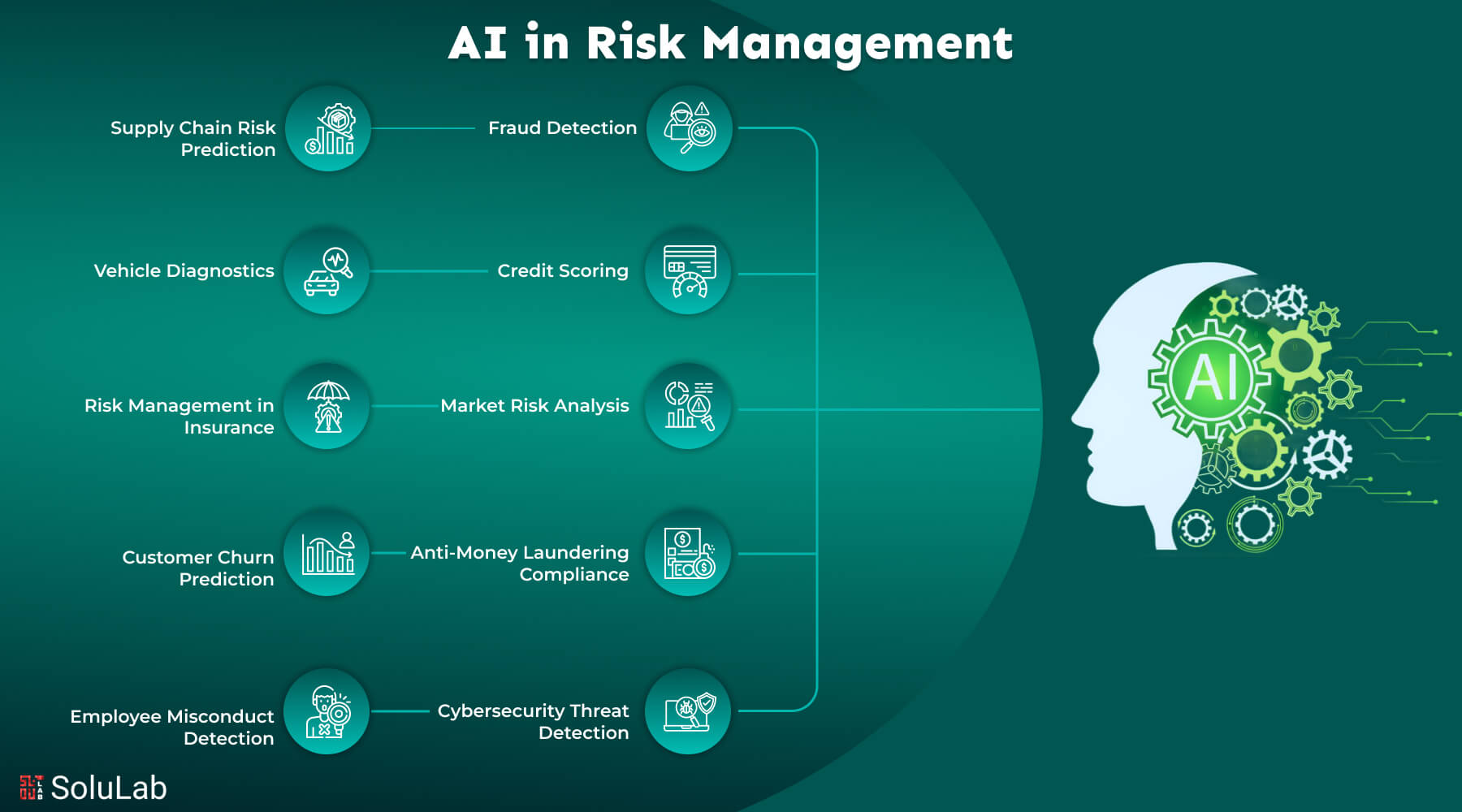
AI is reorganizing how risk gets handled across industries. From banking to healthcare, it’s making risk management more accurate, more efficient, and more proactive. Here’s how AI use cases is showing up across different corners of risk management:
1. Fraud Detection and Prevention in Banking: AI analyzes transaction patterns in real time, catching unusual activity that might signal fraud. If your card suddenly gets used for multiple high-value purchases in different locations, AI algorithms like TruthScan flag it immediately. Banks now catch fraudulent transactions faster and more accurately, saving millions in the process.
2. Credit Scoring and Assessment for Loan Disbursement: AI in banking looks past traditional credit scores, analyzing spending patterns, income stability, and bill payment history instead. This helps banks lend smarter, reduces default risk, and opens up loans to people with limited credit history.
3.Market Risk Analysis: AI processes vast amounts of market data, news, and social media sentiment to predict trends and potential risks. That helps traders and investors make informed calls by catching early warning signs of volatility or downturns.
4. Anti-Money Laundering Compliance: AI monitors transactions and customer behavior for suspicious patterns that might point to money laundering. It processes millions of transactions quickly, catching complex networks of suspicious activity that human analysts could easily miss.
5. Cybersecurity Threat Detection: AI automation continuously watches network traffic and user behavior for potential cyber threats. Security teams evaluating external exposure can use this comparison of attack surface management tools to pick platforms with cloud-native discovery, integrations, and round-the-clock monitoring that complement AI-driven threat detection.
6. Supply Chain Risk Prediction: AI analyzes supplier data, weather patterns, political events, and market conditions to predict supply chain disruptions before they hit. That lets companies line up alternative suppliers or routes in advance and keep operations smooth.
7. Drug Safety: AI helps pharmaceutical companies predict drug side effects by analyzing clinical trial data and patient records. AI in Drug Discovery can flag dangerous drug interactions and adverse reactions earlier in development, making medication safer before it ever reaches patients.
8. Vehicle Diagnostics: AI monitors vehicle performance data to predict mechanical failures before they happen. It analyzes sensor data from various car components to alert drivers about maintenance needs, heading off accidents and breakdowns.
9. Risk Management in Insurance: Insurance companies use AI to price premiums more accurately. Commercial insurance brokerages like Alliance Risk already lean on data-driven approaches to help businesses across industries secure coverage that reflects their real risk profile instead of broad actuarial categories.
10. Customer Churn Prediction: AI spots early signs that customers might leave by analyzing behavior patterns, complaints, and engagement levels. That lets companies step in proactively, keep valuable customers happy, and fix issues before they lead to churn.
11. Third-Party Vendor Risk Evaluation: AI evaluates vendor reliability by analyzing financial health, compliance records, and performance history. It continuously monitors news and updates about vendors, alerting companies to potential risks in their partner network.
12. Employee Misconduct Detection: AI monitors workplace communications and activity to catch potential misconduct like insider trading or harassment. It can spot unusual patterns in emails, trades, or access logs that hint at problematic behavior, all while respecting privacy guidelines.
Read More: AI in Fraud Detection 2026
How is AI in Risk Management Different from Traditional Software Risk?
AI models aren’t just about the “code” behind them, they’re shaped just as much by the data they train on. Traditional software relies on clearly defined rules and logic to turn inputs into outputs. AI learns those rules directly from large datasets instead of having them manually programmed in. That “learning” introduces a real challenge: since you can’t directly see how the model reaches its decisions, testing gets a lot more complex. Checking a handful of examples or edge cases no longer proves the model works correctly. It takes robust evaluation across comprehensive datasets to confirm it can handle the full range of scenarios it might encounter.
Metrics for AI Are Different From Traditional Software Testing
Evaluating adaptive AI models takes a completely different approach than testing regular software. Traditional programs can often hit near-perfect functionality, but AI works with noisy, imperfect data, which makes 100% accuracy nearly impossible in most cases. Classification models, for example, get judged on metrics like accuracy, while traditional software gets judged on usability or functionality. Leaning only on top-level metrics can mislead you, though, since AI models fail in unexpected ways across multiple dimensions at once.
The Many Modalities and Challenges of AI
AI spans a huge range of tasks, from simple binary classifications in spreadsheets to complex, language-based outputs from generative AI tools. Each type comes with its own failure points and challenges. And since Generative AI in Insurance often automates critical decision-making, it needs extra testing on top of the basics: checking for bias and fairness, and making sure sensitive information isn’t misused or exposed.
Why does AI demand a new approach to risk management? Because its unique nature creates challenges traditional methods simply weren’t built for. Fairness, privacy, reliability, managing these risks takes fresh thinking, not recycled playbooks.
How Does AI in Risk Management Help Organizations?
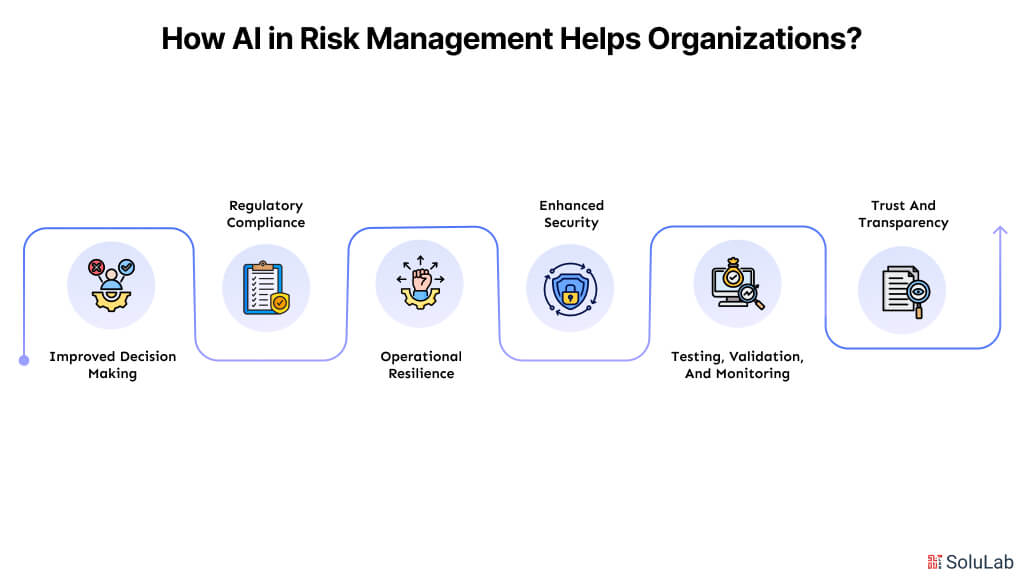
While the AI in customer service risk management process looks different from one organization to the next, most companies see a similar set of core benefits once they implement it well.
1. Enhanced Security
AI risk management is genuinely good at strengthening an organization’s security, especially on the cybersecurity front.
Through regular risk assessments and audits, organizations spot potential vulnerabilities across the entire AI lifecycle. Once a risk turns up, the next step is closing it, whether through technical fixes like stronger data security and model robustness, or organizational changes like ethical guidelines and tighter access controls.
Taking a proactive stance on threat detection and response helps companies handle risks before they snowball, cutting down on data breaches and softening the impact of cyberattacks.
2. Improved Decision-making
AI risk management also sharpens decision-making overall. By blending qualitative and quantitative data, statistical analysis alongside expert opinion, companies get a clearer picture of what’s actually at risk. That fuller view lets organizations prioritize the biggest risks and make smarter calls about deploying AI, striking a real balance between innovation and control.
3. Regulatory Compliance
As data protection gets more scrutiny, global regulations keep multiplying: GDPR, the California Consumer Privacy Act (CCPA), the EU AI Act, and more.
Falling short of these laws can mean major fines and legal headaches. AI risk management helps companies stay compliant, which matters even more given how fast AI regulation is evolving alongside the technology itself.
That’s why businesses turn to the best consent management platforms to meet transparency and data handling requirements. User centrics, a leading provider in this space, also offers insight into how emerging regulations like the EU AI Act intersect with privacy and consent obligations.
4. Operational Resilience
AI risk management keeps things running smoothly by addressing risks tied to AI systems in real time. It also builds long-term sustainability by pushing clear management practices and responsible ways of using AI.
5. Increased Trust and Transparency
At its core, AI risk management is about making AI systems more ethical by putting trust and transparency front and center.
That usually means bringing together a wide mix of stakeholders: executives, developers, data scientists, users, policymakers, even ethicists. That diversity is what ensures AI systems get built and used responsibly, with everyone’s interests actually considered.
6. Ongoing Testing, Validation, and Monitoring
Regular testing and monitoring matter for tracking an AI system’s performance and catching emerging threats early. It keeps organizations ahead of regulatory requirements and lets them address risks before they snowball, minimizing the damage any potential threat can do.
Read Also: Agentic AI in Cybersecurity
Applications and Key Benefits of AI in Risk Management
Artificial intelligence is making waves across industries as a genuine business operation, not just a novelty. In risk management specifically, AI application solutions and machine learning (ML) have become essential for boosting efficiency, streamlining processes, and cutting costs. Their edge comes from processing and analyzing massive amounts of unstructured data quickly, with minimal human involvement required. That’s also let banks and financial institutions cut operational and compliance costs while improving accuracy in credit decisions.
AI and ML solutions are genuinely good at generating precise, real-time data. That gives financial institutions deeper insight into customer behavior, sharper strategies, and fewer potential losses.
In risk management, AI/ML-driven tools also play a crucial role in model validation, back-testing, and stress testing, exactly what global regulatory bodies require. Here are some of the key advantages they bring:
1. Superior Forecasting Accuracy
Traditional regression models often struggle to capture the complex, non-linear relationships between the economy and a company’s financials, especially under stress. Machine learning excels here, recognizing intricate patterns and relationships that regression models miss, which leads to more accurate predictions.
2. Optimized Variable Selection Process
Risk models for decision-making lean heavily on picking the right variables, which used to be a time-consuming process. With Big Data analytics behind them, ML algorithms can sift through enormous datasets quickly and identify a comprehensive set of variables. That builds robust, data-driven models that hold up well under stress testing.
3. Richer Data Segmentation
Granular, detailed data segmentation matters for adapting to shifts in portfolio composition. ML algorithms enable advanced segmentation by analyzing multiple attributes at once. Unsupervised ML techniques like clustering push accuracy further, combining distance and density-based approaches for more insightful, reliable results.
Bringing AI and ML into risk management doesn’t just sharpen decision-making, it lays the groundwork for long-term resilience and adaptability.
Challenges of AI in Risk Management
Even with all these advantages, using AI in risk management comes with real challenges.
1. Cost Concerns: AI doesn’t come cheap. Processing and analyzing massive volumes of data costs real money, even with cloud-native services. The advanced tools and platforms essential for risk management often carry hefty price tags, which makes affordability a common hurdle for a lot of teams.
2. Privacy Issues: Data privacy is another major concern. Risk managers and security experts worry about how personal data gets handled by AI applications and machine learning tools. Misuse of that data can mean compliance breaches, legal trouble, or reputational damage. To prevent it, organizations need strict data protection measures: encryption, secure data transport, tokenization, or obfuscation for anything uploaded to the cloud.
Most mainstream cloud storage providers build these safeguards in, but the same can’t always be said for specialized AI platforms like Amazon Sage Maker, Amazon Recognition, Azure AI, or Google Cloud’s Vertex AI. These services may not fully support existing encryption key management systems, which raises the risk of data exposure. And the physical location of sensitive data used in AI operations often raises its own red flags around regulatory compliance.
Future of AI in Risk Management
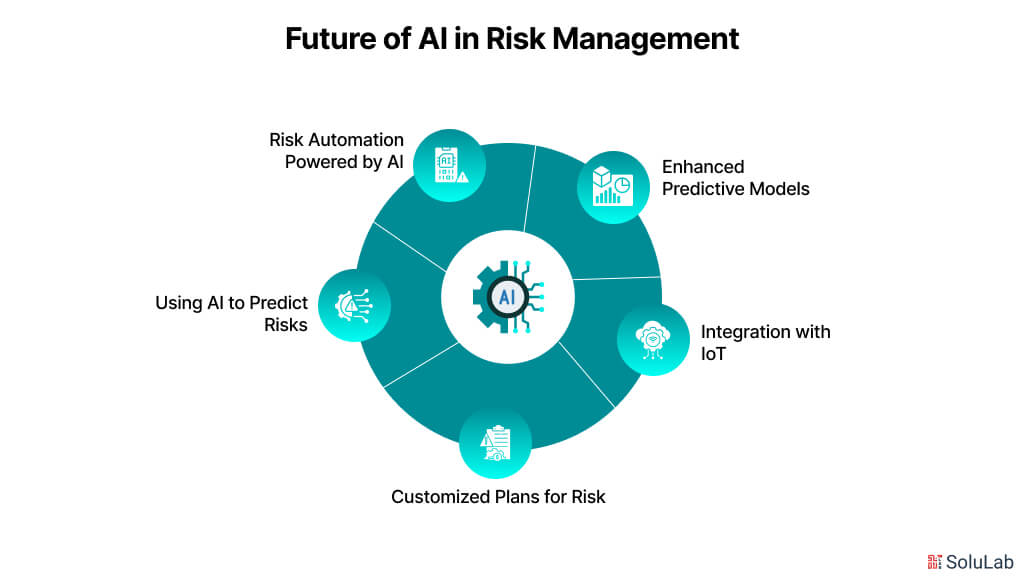
The future of top AI development companies in risk management looks genuinely exciting. It’s all about decisions that are better, faster, and more accurate. Here are some of the innovations reshaping the business:
1. Enhanced Predictive Models: AI is pushing forecasting models to a new level. These models predict risk better than ever because they can scan huge amounts of data and catch trends humans would likely miss. That means companies can prepare for problems before they even happen.
2. Integration with IoT: AI and the Internet of Things (IoT) pair well together. Combining AI with IoT devices lets companies watch risk in real time, whether that’s workplace equipment or cyber threats. Getting feedback instantly means solving problems instantly too.
3. Customized Plans for Risk: One-size-fits-all answers are fading out. AI lets businesses build risk management plans tailored to their specific needs, factoring in customer data, business goals, and market conditions.
4. Using AI to Predict Risks: AI is reshaping forecasting by delivering accurate information you can act on right away. Tools that predict market trends and evaluate supply chain risk help businesses stay ahead of the curve instead of reacting to it.
5. Risk Automation Powered by AI: Risk control keeps getting easier thanks to automation. AI handles the tedious work, checking compliance, spotting anomalies in data, freeing people up to focus on what actually needs a human.

Conclusion
Artificial Intelligence is changing how businesses operate, opening up real opportunities and possibilities. But as executive teams explore what AI can do, they’re also waking up to the new risks that come along with it.
And traditional risk assessment methods may not be enough to support the level of AI adoption leaders are pushing for. To use AI in a way that’s ethical, legal, and financially sound, companies need to identify and put a strong risk management strategy in place. That’s what gives them the control to work through AI’s challenges effectively instead of being blindsided by them.
SoluLab helped InfuseNet overcome challenges in AI model integration, intuitive interface design, and data security. By building a drag-and-drop Flow interface and data import from various sources, InfuseNet lets businesses create personalized AI applications, boosting productivity while keeping data privacy intact throughout. SoluLab, an AI development company, has a team of experts ready to help solve your business problems, so contact us today to discuss further.
FAQs
Shipra Garg is a tech-focused content strategist and copywriter specializing in Web3, blockchain, and artificial intelligence. She has worked with startups and enterprise teams to craft high-conversion content that bridges deep tech with business impact. Her work translates complex innovations into clear, credible, and engaging narratives that drive growth and build trust in emerging tech markets.