Key Takeaways
- Governments are investing in AI-powered national security systems to improve real-time threat detection, cyber defense, and intelligence analysis.
- AI helps defense agencies process massive volumes of surveillance, satellite, and communication data faster than traditional systems.
- Rising cyberattacks, geopolitical tensions, and autonomous warfare technologies are accelerating global AI adoption in defense infrastructure.
- AI-powered security solutions enhance border protection, predictive monitoring, disaster response, and military decision-making capabilities.
- Nations see AI as a strategic advantage for maintaining technological superiority, strengthening homeland security, and reducing operational risks.
Businesses globally are investing in AI-powered national security solutions to address growing cyber threats, digital warfare, border security challenges, and complex intelligence operations.
Traditional security systems often struggle to process massive volumes of real-time data and respond to evolving risks. Artificial intelligence development helps defense agencies improve surveillance, automate threat detection, cybersecurity, and support faster strategic decision-making.
From autonomous defense systems to predictive analytics and AI-driven intelligence platforms, modern governments are using AI to build smarter and more resilient security infrastructures.
Continue reading this blog to learn more about the impact of AI on national security and more.
Why is AI important for National Security?
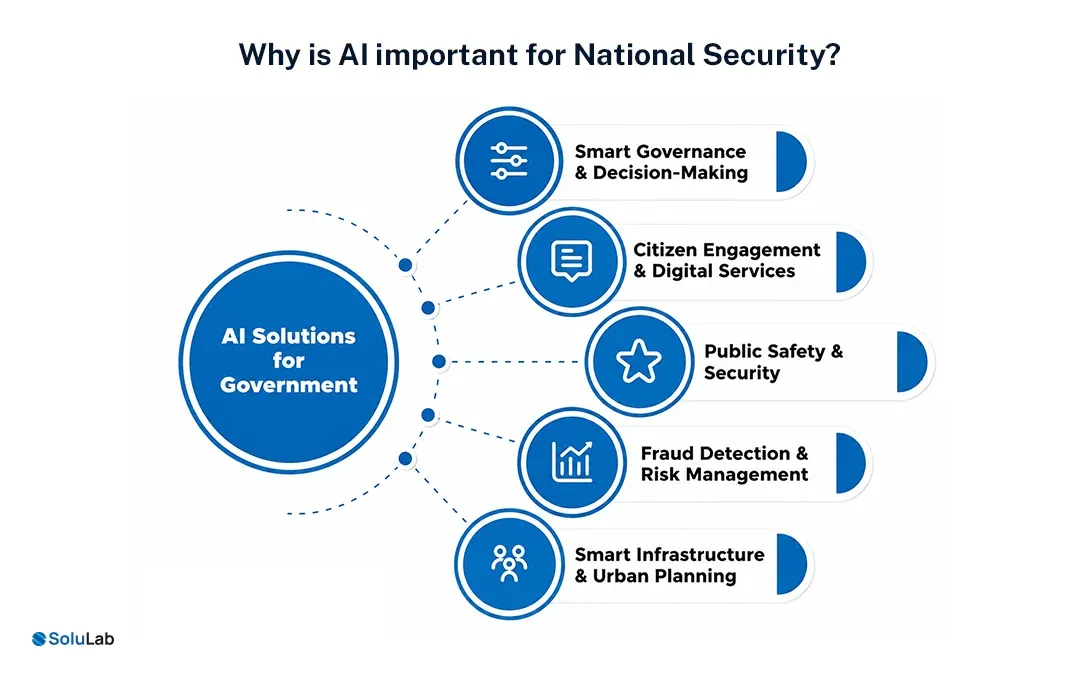
Artificial intelligence is becoming essential for national security as governments face evolving cyber threats, large-scale data challenges, border risks, and faster digital warfare across interconnected global systems.
- Faster threat detection: AI identifies suspicious activities instantly, improving response speed against cyberattacks, terrorism, and emerging national security threats.
- Advanced intelligence analysis: AI processes massive intelligence datasets quickly, helping agencies uncover patterns, risks, and critical operational insights efficiently.
- Improved border surveillance: AI-powered monitoring systems strengthen border protection through automated tracking, facial recognition, and real-time anomaly detection capabilities.
- Stronger cybersecurity defense: AI helps governments prevent cyber intrusions, ransomware attacks, and infrastructure breaches through predictive security monitoring systems.
- Better defense decision-making: AI supports military and security teams with real-time analytics, strategic forecasting, and automated operational assistance tools.

Impact of AI on National Security
AI integration with existing workflows or building AI agents helps defence and governments save time on manual tasks. Also, this system can identify risks before they even arise. In fact, the global AI in defense market is projected to grow $32.8 billion by 2031, with a CAGR of 30.1%.
- Faster AI battlefield testing: AI Fight Club simulates years of combat scenarios within weeks, dramatically accelerating defense innovation and operational readiness.
- Smarter human-machine collaboration: AI is improving military decision-making, but human oversight still remains critical in mission-sensitive operations.
- Real-time multi-domain defense operations: AI systems now support air, land, sea, space, and cyber missions through connected intelligence ecosystems.
- Predictive national security capabilities: Governments are investing in AI-powered solutions to anticipate cyber threats, detect anomalies early, and strengthen strategic defense planning.
- Rise of autonomous defense systems: AI-powered drones, surveillance systems, and pilot-optional aircraft are reshaping the future of modern warfare globally.
The Emerging AI Technologies Used in AI National Securities
Modern national security systems are adopting advanced AI technologies to improve threat detection, intelligence analysis, surveillance, cybersecurity, and real-time defense operations across increasingly complex digital environments.
- Machine Learning and Predictive Analytics: Machine learning helps governments analyze massive datasets, predict potential threats, identify suspicious behavior patterns, and improve strategic defense planning with faster, data-driven decision-making capabilities.
- Computer Vision: Computer vision enables smart surveillance, facial recognition, border monitoring, and object detection systems that strengthen public safety and improve real-time situational awareness across critical locations.
- Natural Language Processing (NLP): Natural Language Processing helps intelligence agencies analyze communications, documents, multilingual data, and online activities to identify threats, misinformation campaigns, and security risks more efficiently.
- Generative AI and Agentic AI: Generative AI and agentic AI technologies support defense simulations, autonomous decision-making, mission planning, and intelligent virtual systems that enhance operational efficiency and military readiness.
- Edge AI and IoT Integration: Edge AI combined with IoT devices enables faster real-time monitoring, secure data processing, and automated threat detection across connected defense infrastructure and surveillance systems.
Step-by-Step Guide to Implement AI Development in National Securities
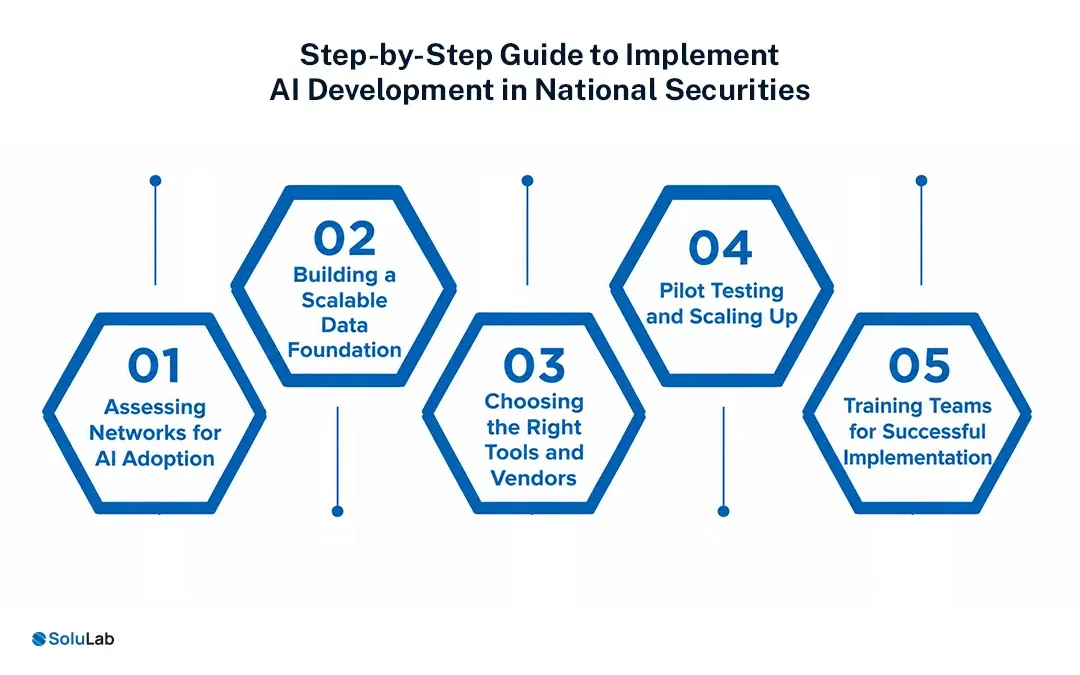
Governments are adopting AI trends in multiple ways to strengthen cybersecurity, improve surveillance, automate intelligence analysis, and build faster, smarter defense systems capable of responding to modern national security challenges effectively.
Step 1. Identify Security Challenges and Operational Gaps
Assess existing defense infrastructure, cybersecurity vulnerabilities, surveillance limitations, and intelligence bottlenecks to determine where AI-led development can improve operational efficiency and threat response capabilities.
Step 2. Define AI Objectives and Use Cases
Establish clear goals for AI implementation, such as predictive threat detection, border surveillance, autonomous monitoring, cybersecurity automation, or intelligence data analysis across national security operations.
Step 3. Build Secure Data Infrastructure
Develop encrypted and scalable data environments capable of handling surveillance footage, intelligence reports, cybersecurity logs, and defense communications required for reliable AI model training.
Step 4. Select Suitable AI Technologies
Choose technologies like machine learning, computer vision, NLP, and predictive analytics to create AI-powered solutions tailored for defense, surveillance, cybersecurity, and strategic intelligence applications.
Step 5. Train and Test AI Models
Use real-time datasets and simulated defense scenarios to train AI systems for accurate threat detection, risk prediction, anomaly identification, and operational decision-making under complex environments.
Step 6. Integrate AI Into Existing Systems
Deploy AI solutions within current defense platforms, surveillance systems, command centers, drones, and cybersecurity infrastructure while ensuring smooth integration and minimal operational disruption.
Step 7. Monitor, Optimize, and Scale Continuously
Continuously monitor AI system performance, retrain models with updated threat intelligence, strengthen cybersecurity safeguards, and scale AI deployment according to evolving national security requirements.
Benefits of AI-Powered National Security Solutions
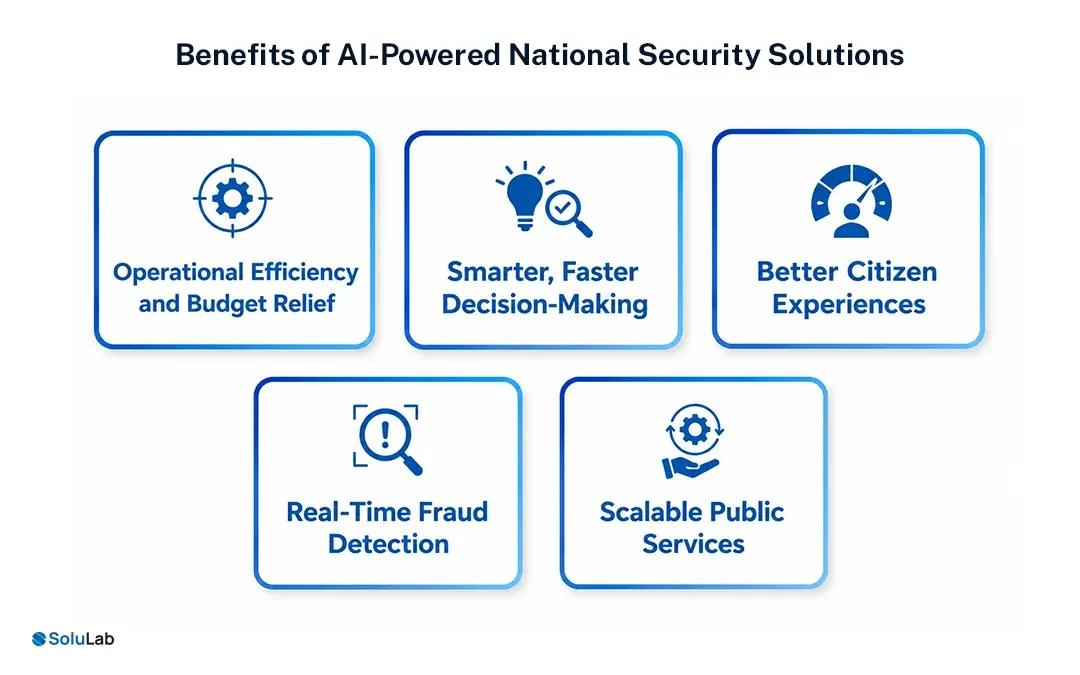
Governments worldwide are adopting Artificial Intelligence in National Security strategies to improve defense readiness, accelerate threat response, strengthen cybersecurity frameworks, and establish resilient Sovereign AI and national security ecosystems.
- Faster Threat Detection and Response: AI systems analyze massive security datasets instantly, helping agencies identify cyber threats, suspicious activities, and national risks before they escalate into critical incidents.
- Improved Operational Efficiency: AI automates surveillance, intelligence processing, and monitoring, reducing manual workload while optimizing resource allocation across defense and homeland security departments.
- Enhanced Decision-Making Capabilities: Real-time analytics and predictive intelligence enable military leaders and security agencies to make faster, data-driven decisions during high-risk situations and defense operations.
- Reduced Human Error: AI-powered automation minimizes operational mistakes in surveillance, cybersecurity monitoring, and intelligence analysis, improving overall accuracy in mission-critical national security environments.
- Scalable Security Infrastructure: AI enables governments to scale cybersecurity systems, defense networks, and surveillance infrastructure efficiently without significantly increasing operational complexity or manpower requirements.
- Real-Time Situational Awareness: AI integrates data from drones, sensors, satellites, and surveillance systems to provide live operational visibility across border security, military, and emergency response environments.
The Future of AI in National Security
The future of national security will rely heavily on intelligent automation, predictive defense systems, and advanced cyber capabilities powered by rapid advancements in AI app development services globally.
- Autonomous security ecosystems: Governments are building connected AI ecosystems that automate surveillance, threat detection, border monitoring, and emergency response operations with minimal human intervention.
- AI-powered predictive defense networks: Modern defense systems use AI to analyze intelligence data, forecast threats early, and improve strategic planning across military and cybersecurity operations.
- Human-AI collaboration in military operations: The human and AI collaboration ai in national security and defense will focus on AI-driven decision support for faster and smarter mission execution.
- Quantum computing and AI-driven cyber defense: Quantum-powered AI systems are expected to strengthen cybersecurity frameworks by detecting advanced cyber threats and protecting critical national infrastructure more efficiently.
- Expansion of AI in government operations: The adoption of AI in Defense and Government will continue growing through intelligent surveillance, autonomous defense technologies, and AI-assisted national security decision-making systems.
Real-World Use Cases of AI in National Security
AI is transforming national security strategies worldwide by helping governments strengthen cybersecurity, automate surveillance, improve intelligence analysis, and respond faster to evolving military and digital threats.
1. United States
The United States uses AI for defense intelligence, autonomous military systems, cybersecurity monitoring, and battlefield decision-making through initiatives led by the Department of Defense and DARPA.
2. India
India is integrating AI into border surveillance, drone monitoring, facial recognition systems, and predictive cybersecurity frameworks to strengthen defense infrastructure and internal security operations.
3. China
China heavily invests in AI-powered surveillance systems, smart city monitoring, autonomous defense technologies, and military intelligence programs to expand national security and strategic control capabilities.
4. Europe
European countries are adopting AI for cybersecurity resilience, intelligence sharing, border management, and defense modernization while maintaining strict regulations focused on ethical AI deployment and privacy protection.
How SoluLab Can Help With AI-Powered National Security Solutions?
Governments and defense organizations require advanced AI-powered security solutions to strengthen cybersecurity, surveillance, intelligence operations, and threat response systems against rapidly evolving national and global security challenges.
- AI-Powered Cybersecurity Solutions
- Defense Intelligence Analytics Systems
- AI Surveillance and Monitoring Platforms
- Facial Recognition and Computer Vision Solutions
- AI-Based Threat Detection Systems
- Autonomous Drone and Defense AI Solutions
- Predictive Analytics and Risk Assessment Platforms
- Generative AI and Agentic AI Integration Services
For example, SoluLab helped a leading Japanese supermarket chain implement AI face recognition, integrating CRM and billing data to enable personalized promotions, real-time analytics, and automated insights.
Resulting in increased footfall, higher revenue, improved customer loyalty, reduced walkouts, and enhanced operational efficiency. Connect with us to discuss your requirements.

Conclusion
Artificial intelligence is becoming a critical part of modern national security strategies. From cybersecurity and surveillance to defense and predictive threat analysis, AI helps governments improve operational efficiency, strengthen response systems, and manage evolving digital threats more effectively.
As global security challenges continue to grow, investing in AI-powered national security solutions is no longer optional but necessary for long-term resilience and preparedness.
Organizations working in defense, cybersecurity, and public safety must adopt scalable and secure AI technologies to stay ahead. SoluLab, an AI development company in USA, can help your business build advanced AI-powered security solutions tailored to your operational needs.
FAQs
Neha is a curious content writer with a knack for breaking down complex technologies into meaningful, reader-friendly insights. With experience in blockchain, digital assets, and enterprise tech, she focuses on creating content that informs, connects, and supports strategic decision-making.