Key Takeaways
- Governments are investing in AI to build smarter, more sustainable, and efficient urban infrastructure systems for growing city populations.
- AI helps optimize transportation, energy management, waste handling, public safety, and environmental monitoring through real-time data analytics and automation.
- Smart city technologies powered by AI improve citizen experiences while reducing operational costs and supporting long-term sustainability goals.
- AI-driven urban development enables governments to make faster, data-driven decisions for infrastructure planning, emergency response, and resource management.
- The future of sustainable cities will rely heavily on AI, IoT, predictive analytics, and automation to create connected urban ecosystems.
Governments worldwide are investing in advanced technologies to address growing urban challenges such as traffic congestion, energy consumption, waste management, public safety, and climate change.
As cities continue expanding, traditional infrastructure systems are struggling to support rising populations and sustainability goals efficiently. More than 56% of the global population currently lives in cities, increasing pressure on governments to adopt AI-powered urban planning and infrastructure modernization strategies.
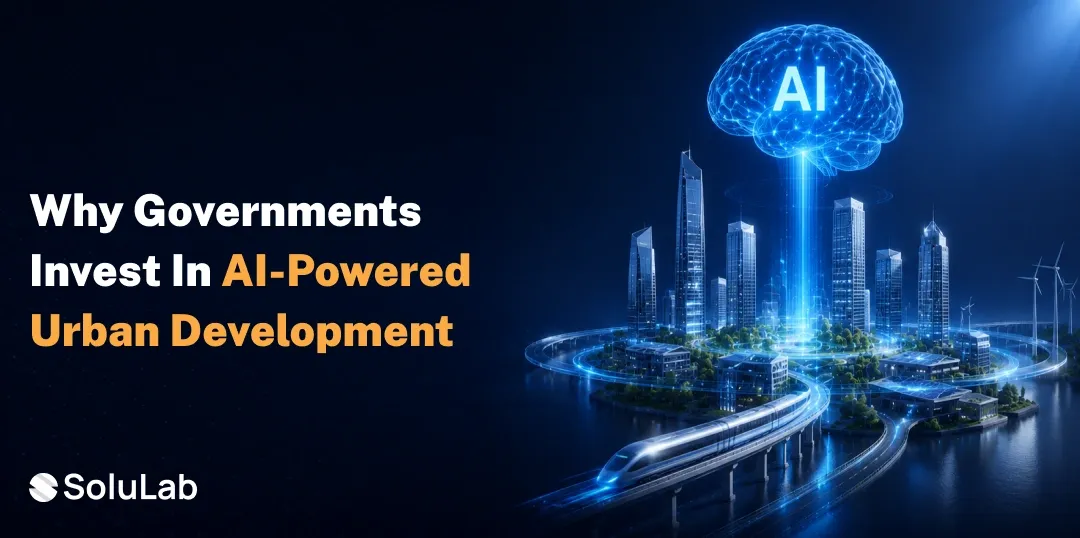
AI development solutions for Sustainable Urban Development are helping governments create smarter, more connected, and environmentally responsible cities through transportation systems, predictive infrastructure maintenance, smart energy management, and digital governance platforms.
What Is AI-Powered Sustainable Urban Development?
AI in sustainable urban development refers to the use of artificial intelligence technologies to improve how cities operate, manage resources, and deliver public services while reducing environmental impact and supporting long-term sustainability goals.
It combines AI, data analytics, IoT devices, automation, and smart infrastructure to help governments build efficient, connected, and environmentally responsible urban ecosystems. The global smart cities market is projected to reach USD 3.75 trillion by 2030.
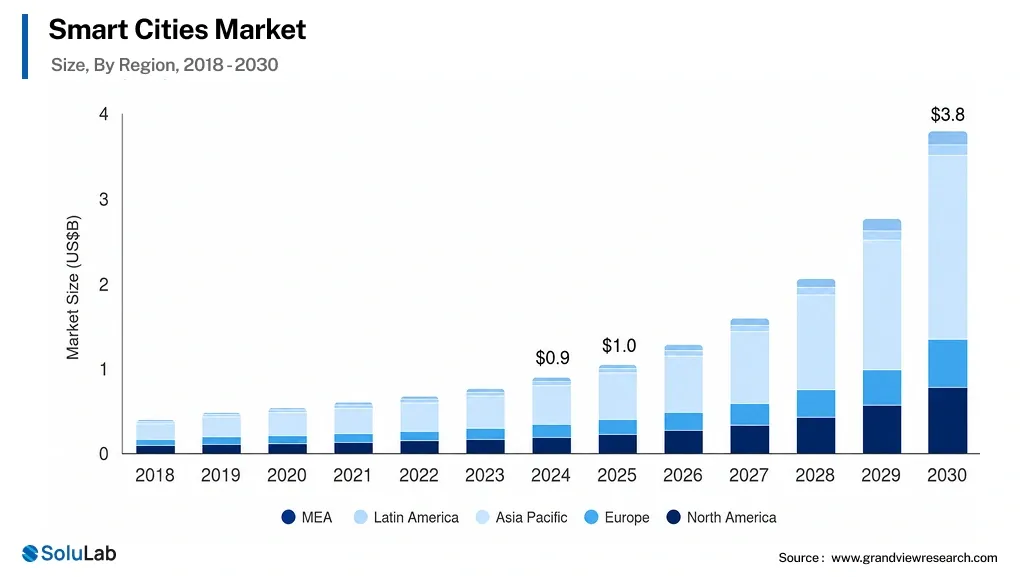
These AI-driven systems analyze massive amounts of real-time city data to improve:
- Traffic and transportation management
- Energy consumption and smart grids
- Waste and water management
- Public safety and emergency response
- Environmental monitoring and carbon reduction
- Urban planning and infrastructure optimization
For example, AI can automatically optimize traffic signals to reduce congestion, predict infrastructure failures before they occur, monitor air quality levels in real time, and improve energy distribution across smart buildings and utilities.
Key Reasons Governments Are Investing in AI Solutions
Governments worldwide are investing heavily in AI-powered solutions to modernize urban infrastructure, improve sustainability, optimize public services, reduce operational costs, and create smarter, safer, and environmentally responsible cities for future generations.
- Improving Traffic and Mobility Management: Governments use AI-powered traffic analytics, smart signaling systems, and predictive transportation models to reduce congestion, improve public transit efficiency, and support smoother urban mobility experiences.
- Public Safety and Emergency Response: AI-driven surveillance, predictive analytics, and emergency response systems help governments detect incidents faster, improve disaster management, and enhance overall public safety across urban environments.
- Optimizing Waste and Water Management: Smart AI systems monitor waste collection, recycling operations, water distribution, and leakage detection, helping cities improve resource utilization while minimizing environmental and operational inefficiencies.
- Supporting Climate and Environmental Goals: Governments leverage AI in sustainable urban development to monitor air quality, track carbon emissions, predict climate risks, and support environmentally responsible urban infrastructure planning initiatives.
- Enabling Smarter Infrastructure Planning: Using AI for urban planning, governments can analyze population growth, infrastructure demand, and land utilization patterns to design more efficient, scalable, and future-ready smart city ecosystems.
Major AI Technologies for Urban Development
Modern cities are increasingly adopting an advanced AI native strategy to improve infrastructure efficiency, automate public services, optimize resource management, and support long-term sustainability through intelligent, connected, and data-driven urban ecosystems.
- Machine learning and predictive analytics: Machine learning helps governments forecast traffic congestion, infrastructure failures, and energy demand patterns, enabling proactive planning and smarter urban decision-making through AI consulting services.
- Internet of Things (IoT) integration: IoT sensors collect real-time city data from transportation systems, utilities, and public infrastructure, helping authorities improve operational efficiency and environmental monitoring across urban ecosystems.
- Computer vision systems: AI-powered computer vision technologies support smart surveillance, traffic monitoring, public safety management, and automated incident detection for faster urban response and improved city security operations.
- Generative AI and urban simulation: Generative AI models help planners simulate infrastructure projects, optimize city layouts, and design sustainable development strategies using advanced custom AI development services and predictive modeling tools.
- Cloud AI and smart governance platforms: Cloud-based AI platforms centralize urban data, automate workflows, and improve citizen services through scalable AI-powered smart governance systems supporting efficient and transparent city administration.
How to Implement AI-Powered Sustainable Urban Development?
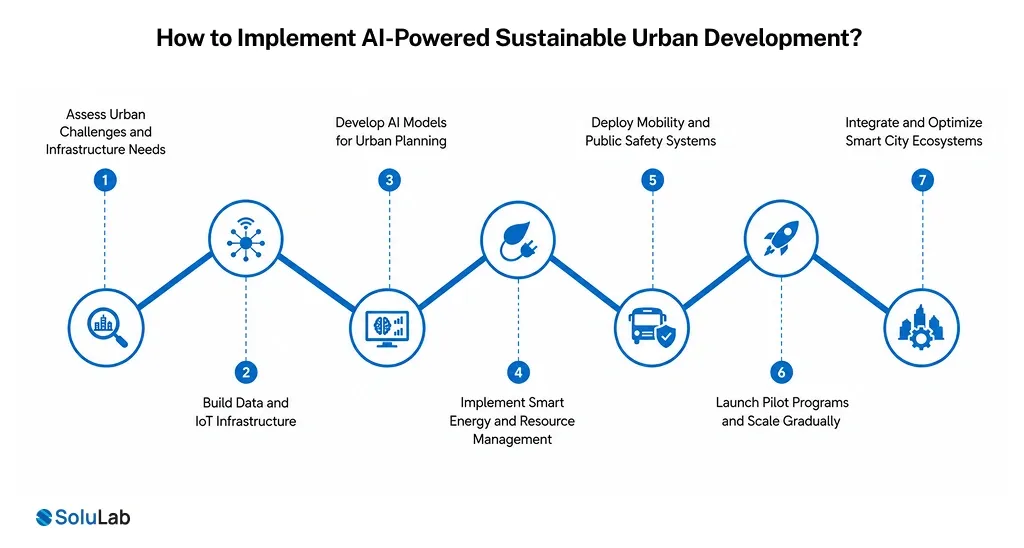
Governments and urban planners are adopting AI for smarter public services to improve sustainability, optimize infrastructure, modernize public services, and create efficient smart cities capable of supporting future urban populations responsibly.
1. Assess Urban Challenges and Infrastructure Needs
Cities must identify key urban issues, such as traffic congestion, pollution, energy inefficiencies, waste management problems, and aging infrastructure, before implementing scalable Artificial Intelligence for sustainable development strategies effectively.
2. Build Data and IoT Infrastructure
Successful urban AI implementation requires connected sensors, IoT devices, cloud platforms, and real-time data systems that enable governments to monitor, analyze, and optimize city-wide operations continuously.
3. Develop AI Models for Urban Planning
Governments should deploy predictive analytics and automation tools powered by AI for urban planning to improve transportation systems, land utilization, infrastructure expansion, and sustainable city management processes.
4. Implement Smart Energy and Resource Management
AI-powered systems help cities optimize electricity usage, monitor water distribution, automate waste collection, reduce operational inefficiencies, and support long-term environmental sustainability goals effectively.
5. Deploy Mobility and Public Safety Systems
Advanced AI solutions improve traffic flow, public transportation efficiency, emergency response systems, surveillance operations, and disaster management capabilities while enhancing overall urban safety and citizen experiences.
6. Launch Pilot Programs and Scale Gradually
Governments should begin with pilot deployments in selected urban zones to test system performance, infrastructure compatibility, operational efficiency, and citizen adoption before city-wide implementation initiatives.
7. Integrate and Optimize Smart City Ecosystems
Cities must adopt scalable smart city AI solutions that integrate transportation, utilities, environmental monitoring, governance systems, and public services while continuously improving performance through real-time analytics and AI-driven automation.
Benefits of AI Solutions for Governments and Citizens
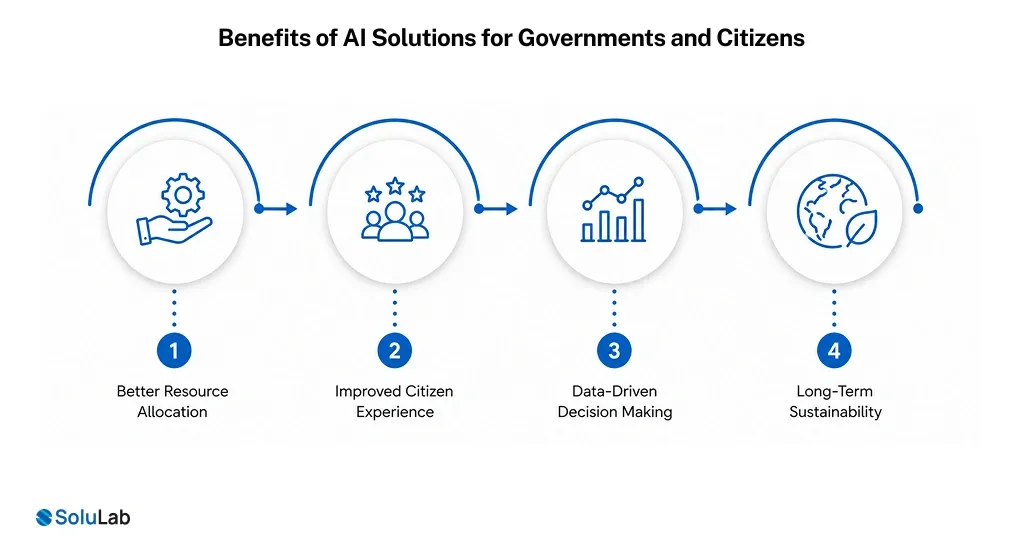
Governments worldwide are adopting AI technologies to improve urban efficiency, optimize public services, strengthen sustainability initiatives, and create smarter, citizen-focused ecosystems through intelligent automation, predictive analytics, and connected infrastructure systems.
- Better Resource Allocation: AI for urban development helps governments optimize budgets, infrastructure utilization, workforce deployment, and public resource distribution through predictive analytics, automation, and real-time operational monitoring systems.
- Improved Citizen Experience: AI in smart city development enhances transportation, healthcare access, emergency response, digital governance, and public utility services, delivering faster, safer, and more convenient experiences for citizens.
- Data-Driven Decision Making: AI systems analyze massive urban datasets in real time, enabling governments to make informed policy decisions, improve infrastructure planning, and respond proactively to urban challenges.
- Long-Term Sustainability: AI-driven environmental monitoring, smart energy systems, and predictive infrastructure management help cities reduce carbon emissions, improve efficiency, and support sustainable urban growth for future generations.
Real-World Examples of AI-Driven Smart Cities
AI-driven smart cities are transforming urban living by using artificial intelligence, IoT, predictive analytics, and automation to improve transportation, sustainability, governance, public safety, energy efficiency, and overall citizen experiences worldwide.
1. Singapore: AI-Powered Smart Nation Infrastructure
Singapore uses AI-driven traffic monitoring, predictive analytics, autonomous mobility testing, and smart sensor networks to optimize transportation, public services, urban planning, and environmental sustainability while improving real-time governance efficiency across the city.
2. Dubai – AI-Driven Governance and Smart Mobility
Dubai has implemented AI-powered traffic enforcement, digital governance platforms, smart city development in Dubai, intelligent waste management systems, and real-time city command centers to improve sustainability, operational efficiency, urban mobility, and public service accessibility.
3. Barcelona – Smart Waste and Urban Resource Management
Barcelona uses AI and IoT-enabled waste collection systems, intelligent street lighting, smart parking infrastructure, and urban analytics platforms to reduce operational costs, optimize resource utilization, and improve environmental sustainability throughout the city ecosystem.
The Future of AI in Sustainable Urban Development
The future of sustainable urban development will rely heavily on artificial intelligence trends to optimize infrastructure, improve public services, reduce environmental impact, and help governments build smarter, greener, and more connected cities.
- Autonomous urban infrastructure: Future cities will use AI-powered infrastructure management systems to automate traffic control, utility monitoring, public transportation, and predictive maintenance for highly efficient urban operations.
- Smarter environmental sustainability: AI-driven environmental systems will help cities monitor pollution, reduce emissions, optimize renewable energy usage, and improve climate resilience through intelligent resource management technologies.
- Waste management systems: Governments are increasingly adopting AI in plastic waste management to automate recycling, identify waste patterns, and improve sustainable disposal processes across urban ecosystems.
- Expansion of digital twin cities: Virtual AI-powered city models will simulate infrastructure performance, climate risks, and urban growth scenarios, enabling smarter planning and sustainable long-term development strategies.
- Connected IoT urban ecosystems: AI and IoT integration will create connected city environments where devices, sensors, and infrastructure communicate continuously to improve operational efficiency and citizen experiences.
- Sustainable energy optimization: AI systems will manage smart grids, energy distribution, and renewable power consumption efficiently, helping cities reduce operational costs and achieve carbon neutrality goals faster.
- Enterprise-scale AI adoption: Governments and municipalities are increasingly investing in enterprise AI solutions to modernize legacy systems, improve scalability, and support future-ready smart city infrastructure initiatives.
How SoluLab Helps Build AI Solutions for Sustainable Urban Development
SoluLab used AI native approach to help enterprises build scalable AI-powered urban ecosystems focused on sustainability, efficiency, security, and smarter public services.
- AI-Powered Traffic Management Solutions
- AI-powered parking management system
- Intelligent Energy Management Platforms
- AI-Based Waste Management Solutions
- Smart Water Monitoring Systems
- IoT Integration for Urban Infrastructure
- AI Chatbots for Public Services
- Autonomous Mobility and Transportation Systems
- AI Surveillance and Computer Vision Solutions
- Cloud and Edge AI Infrastructure
- AI Integration Services for Legacy Systems
- Sustainable Infrastructure Automation Solutions

Conclusion
Governments worldwide are investing in AI solutions to build smarter, safer, and more sustainable urban environments capable of handling future population growth and infrastructure demands efficiently.
From transportation and energy optimization to predictive public services and environmental monitoring, AI is changing how cities operate and deliver value to citizens.
Businesses and government organizations looking to modernize urban infrastructure can benefit from strategic AI adoption. SoluLab, an enterprise AI development company, can help your business build scalable and future-ready AI solutions.
FAQs
Neha is a curious content writer with a knack for breaking down complex technologies into meaningful, reader-friendly insights. With experience in blockchain, digital assets, and enterprise tech, she focuses on creating content that informs, connects, and supports strategic decision-making.