Key Takeaways
- The problem: Parking takes too long for drivers, which leads to traffic jams, fuel use, and general inefficiency in the urban setting where the population density is high.
- The Solution: AI-based navigation and predictive availability will direct drivers to open spaces, saving them on the search time, simplifying the traffic movement process, and making the user experience more pleasant.
- How SoluLab helps: SoluLab is an AI-native firm that incorporates artificial intelligence into its development processes to provide smart parking solutions at a lower cost and in less time. SoluLab assists companies in developing intelligent and scalable parking systems by integrating AI, IoT, and scalable architecture.
Finding a parking spot in busy urban areas often becomes a frustrating and time-consuming experience. Drivers circle endlessly, traffic builds up, fuel gets wasted, and businesses lose potential customers due to poor parking management.
Traditional systems simply cannot handle demand, leading to inefficiencies, congestion, and revenue leakage for operators.
However, by combining real-time data, predictive analytics, and automation, AI-powered smart parking systems improve how spaces are managed and utilized. From detecting available spots instantly to forecasting demand and optimizing traffic flow, AI development solutions enable faster decisions and parking experiences.
It not only reduces congestion but also helps operators maximize efficiency, improve compliance, and get new revenue opportunities in increasingly crowded urban environments.
What is an AI-Powered Smart Parking System?
AI parking refers to the use of artificial intelligence to manage and optimize parking spaces in real time. It combines computer vision, IoT sensors, and machine learning to detect availability, guide vehicles, predict demand, and automate pricing or enforcement.
This reduces congestion, improves space utilization, and enhances the overall parking experience for users and operators. The global smart parking systems market size is expected to reach USD 74.20 billion by 2035.

An AI parking system combines multiple technologies to make parking efficient:
- Cameras + Computer Vision: Detect whether a parking slot is occupied
- IoT Sensors: Track vehicle presence in real time
- Machine Learning Models: Predict parking availability and demand
- ANPR (License Plate Recognition): Automate entry, exit, and billing
- Mobile Apps / Dashboards: Guide users to available spots

How AI Can Predict Parking Availability?
AI is turning parking into proactive intelligence and allowing real-time visibility and demand forecasting, which strongly cuts down search time, congestion, and operational inefficiencies.
- Demand forecasting using data: AI-based parking systems use historical data, traffic trends, weather, and events to accurately forecast the demand of parking lots in various areas and at various times.
- Occupancy detection in real-time: AI models operate on live images of cameras and IoT sensors to maintain space availability continuously, so drivers can be provided with relevant and recent information about park space availability.
- Pattern recognition and learning: Machine learning identifies recurring usage patterns such as peak hours or seasonal spikes, improving prediction accuracy and enabling proactive parking management strategies.
- Allocation of space: The AI-Powered Autonomous Parking System is a system that intelligently redistributes parking spaces in real-time according to the demand forecast, minimizing unused space and maximizing the use of parking space in areas of high traffic.
- Analysis of user behavior: AI observes preferences of drivers, arrival time, and parking time to offer individualized suggestions and enhance efficiency in the general distribution of space.
- Integration with the navigation systems: Predictive insights are incorporated into the apps and maps, and direct the driver to the available spots to save time during the search and minimize congestion in the city.
Benefits of a Smart AI Parking System
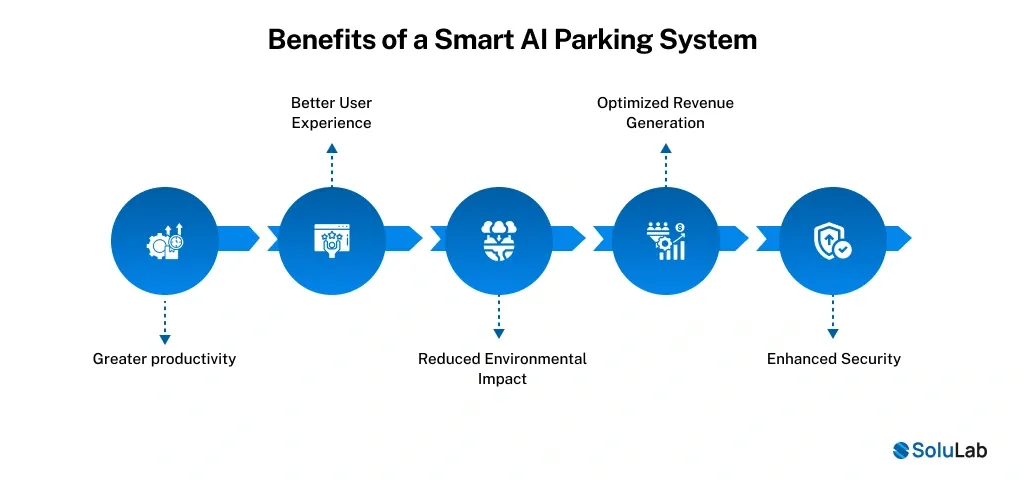
Smart parking is becoming smarter with intelligent automation, and cities and businesses will be able to minimize congestion, optimize usage, and provide smooth parking experiences through data-oriented and real-time decision-making systems.
- Greater productivity: AI-Based Smart Parking can be used to detect space and allocate it on-demand in real-time, shortening the time spent searching for a parking spot, lessening congestion, and enhancing the overall parking performance of the high-density urban and commercial setting.
- Better User Experience: AI smart parking system offers real-time directions, reservations, and automatic payments, which enable users to find and reach parking in the shortest possible time and minimize frustration and improve the convenience in their everyday commuting and traveling experience.
- Reduced Environmental Impact: Smart parking reduces congestion and vehicle movement, leading to lower emissions and improved urban sustainability. It contributes to sustainable urban mobility and supports environmental goals in smart city infrastructure planning.
- Optimized Revenue Generation: The smart pricing algorithms adaptively modify the prices of parking according to the demand, location, and time and assist the operators in increasing occupancy rates, minimizing leakage, and earning more and more predictable revenues.
- Enhanced Security: AI-enabled surveillance and automated monitoring detect anomalies, unauthorized access, and violations in real time, improving safety, ensuring compliance, and reducing dependency on manual enforcement systems.
How AI Optimizes Smart Parking Systems?

AI brings intelligence to parking systems by replacing static operations with real-time data, predictive insights, and automation, helping cities and businesses improve efficiency, reduce congestion, and maximize parking revenue.
1. Real-Time Parking Space Detection
AI-powered computer vision and IoT sensors continuously monitor parking spaces to detect occupancy with high accuracy. This eliminates manual checks, reduces errors, and provides instant visibility to users and operators through connected applications and dashboards.
2. Predictive Parking Availability
Machine learning models analyze historical data, peak hours, and external factors like events or weather to forecast parking demand. This helps drivers find spaces faster while enabling operators to plan capacity and reduce congestion during high-traffic periods.
3. Traffic Flow Optimization Inside Parking Areas
AI systems guide vehicles to the nearest available parking spots using real-time data and intelligent routing. This minimizes unnecessary vehicle movement, reduces fuel consumption, and improves overall traffic flow within parking facilities, especially in large or complex spaces.
4. Automated Enforcement & Compliance
AI-enabled ANPR systems track vehicle entry, exit, and duration of stay to detect violations such as overstaying or unpaid parking. This reduces dependency on manual enforcement, improves compliance rates, and ensures better revenue collection for operators.
5. Smart Reservation Systems
AI allows users to reserve parking spaces in advance based on predicted availability and preferences. It enhances user convenience, reduces uncertainty, and helps operators manage demand efficiently by allocating spaces dynamically based on real-time and forecasted data.
AI Technologies Powering Smart Parking
AI native strategy is transforming the parking infrastructure by facilitating the intelligent automation of parking infrastructure, real-time decision-making, and forecasting insights, which are used to enhance efficiency, drive down congestion, and create new revenue streams within both urban and enterprise settings.
- Computer Vision: Allows vehicle identification, license plate identification, and occupancy monitoring with cameras, which is the backbone of AI-based smart parking system intelligence.
- Machine Learning & Predictive Analytics: Takes the past and current data to predict demand in parking spaces, allocate optimally, and enhance the utilization percentage in an AI parking control solution.
- Edge AI for real-time processing: Processes data locally at devices or cameras, reducing latency and enabling instant decisions like slot detection and vehicle movement tracking without relying on cloud delays.
- Natural Language Processing (for user apps & chatbots): Powers conversational interfaces, allowing users to find parking, get directions, and receive updates through voice or chat-based interactions.
- Digital Twins for simulation and optimization: Creates virtual replicas of parking environments to simulate traffic flow, test scenarios, and optimize layouts or pricing strategies before real-world implementation.
Read Also: Impact of AI in Transportation
Future Trends in AI-Powered Parking (2026 and Beyond)
AI-led development is reshaping parking into a predictive, automated, and revenue-optimized ecosystem, enabling cities and enterprises to handle increasing vehicle density with intelligent, scalable infrastructure.
- Autonomous vehicle integration: AI will directly interact with self-driving cars, allowing the smooth parking, navigation, and retrieval process without the involvement of a human, which will enhance the efficiency of the environment and decrease the level of congestion in high-density areas.
- Smart mobility in the city: Parking systems will be a part of city infrastructure, linking traffic, mass transit, and navigation platforms to enhance traffic flow, creating a cohesive smart parking platform with the help of AI.
- Blockchain-based parking payments: The transparent blockchain-based parking payments will eliminate middlemen, minimise fraud, and allow automatic billing, which will improve trust and efficiency throughout AI-based parking solutions ecosystems.
- Hyper-personalized parking recommendations: AI will examine how people behave, what they like, and what they have done before, and provide recommendations on the best parking location, price, and times, which will enhance comfort among users and expand the monetization possibilities of operators.
- Full automation (robotic systems): AI will be used to combine robotics with vehicle parking and retrieval, and will allow maximization of space usage, reducing errors in human service, and facilitating high-density parking in cities.

Conclusion
AI is changing smart parking from a basic infrastructure layer into an intelligent, data-driven system that improves efficiency, reduces congestion, and enhances user experience.
With capabilities like real-time monitoring, predictive analytics, and automated enforcement, businesses and cities can optimize space utilization while increasing revenue and operational control.
As urban mobility continues to evolve, adopting AI in parking systems is becoming a strategic necessity rather than an option. Organizations that invest early gain a clear competitive and operational advantage.
If you’re looking to implement or scale such solutions, SoluLab, #1 AI integration service provider, can help your business build and deploy advanced smart parking systems.
FAQs
Neha is a curious content writer with a knack for breaking down complex technologies into meaningful, reader-friendly insights. With experience in blockchain, digital assets, and enterprise tech, she focuses on creating content that informs, connects, and supports strategic decision-making.