Key Takeaways
- AI has narrowed the resource gap between SMBs and large enterprises, especially in customer service, marketing, and operations.
- The businesses that win aren’t the ones with the biggest budget. They’re the ones that pick a few high-impact use cases and execute well.
- Enterprises invest in AI through structured platforms and dedicated teams. SMBs get the same results with the right AI integration for SMB partners and a much smaller budget.
- Skipping an honest readiness check before scaling is the most common reason SMB AI projects stall or underdeliver.
- AI governance isn’t just an enterprise concern. Even a two-person AI pilot needs basic rules around data access and accuracy checks.
Enterprise companies used to win on budget alone. More staff, more software, more data, more everything. AI is closing that gap faster than most small business owners realize.
A three-person marketing team can now run customer segmentation that once needed a data science department. A regional retailer can forecast demand with tools that were enterprise-only five years ago.
In fact, SMB generative AI investment is projected to grow by 15.4%, with larger SMBs expecting growth of 18.7%.
The advantage isn’t gone, but it’s smaller than it’s ever been, and it keeps shrinking for SMBs that invest with a plan instead of buying tools at random.
Why AI Levels the Playing Field for SMBs?
What Changed the Playing Field
- Cloud-based AI tools removed the infrastructure barrier: you no longer need in-house servers or a data center to run machine learning models.
- Pre-trained models cut the build time. A small business can use an existing large language model instead of training one from scratch, which used to take enterprise-size budgets.
- Pay-as-you-go pricing replaced massive upfront licensing costs, so a small team can test an idea for a few hundred dollars instead of a six-figure contract. 86% of family businesses actively or selectively use AI, and over 90% report improvements in efficiency, productivity, decision-making, competitiveness, or risk management.
- No-code and low-code AI platforms: Let non-technical staff build working tools without hiring a full engineering team.
- Open-source models and APIs: SMBs can access AI for business capability that used to sit behind enterprise-only vendor contracts.
Where SMBs Still Fall Behind?
- Enterprises have more historical data to train and fine-tune models on, and that data advantage is real.
- Larger companies have dedicated compliance and legal teams to manage AI risk. SMBs usually don’t.
- Enterprises can absorb a failed pilot. A small business’s AI budget often can’t survive two failed attempts in a row.
Top Ways SMBs Can Use AI to Compete
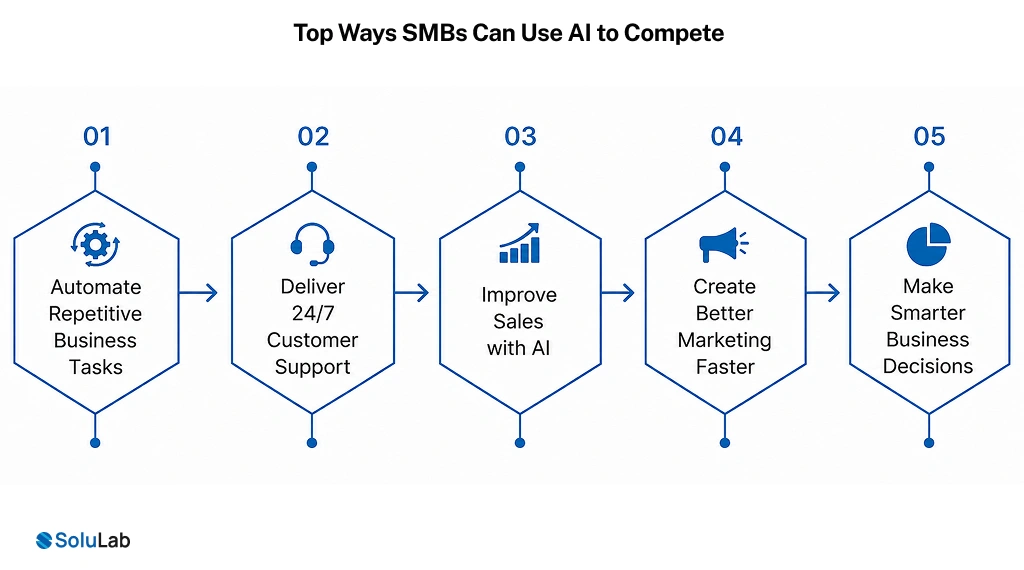
AI now lets small teams do more with less. These five areas deliver the fastest, most measurable results for SMBs going up against bigger, better-funded rivals.
1. Automate Repetitive Business Tasks
Manual, repetitive work drains hours every week from a small team. AI handles the routine so people can focus on higher-value work.
- Automate invoicing and data entry
- Handle scheduling and email replies
- Reduce manual errors and rework
2. Deliver 24/7 Customer Support
Customers expect quick answers at any hour. AI chatbots handle common questions without adding headcount.
- Answer FAQs instantly, day or night
- Route complex issues to humans
- Cut average response time sharply
3. Improve Sales with AI
AI helps small sales teams prioritize the right leads and close deals faster, often with custom AI development services support for the setup.
- Score leads by conversion likelihood
- Predict best times to follow up
- Personalize outreach at scale automatically
4. Create Better Marketing Faster
AI speeds up content creation and targeting, so small marketing teams produce more with the same budget.
- Generate ad copy and drafts fast
- Segment audiences for sharper targeting
- Test messaging variants before launch
5. Make Smarter Business Decisions
AI turns scattered data into clear signals, helping owners decide with confidence instead of guesswork.
- Forecast demand and cash flow
- Spot trends hidden in data
- Reduce guesswork in every decision
Step-by-Step AI Adoption Roadmap for SMBs
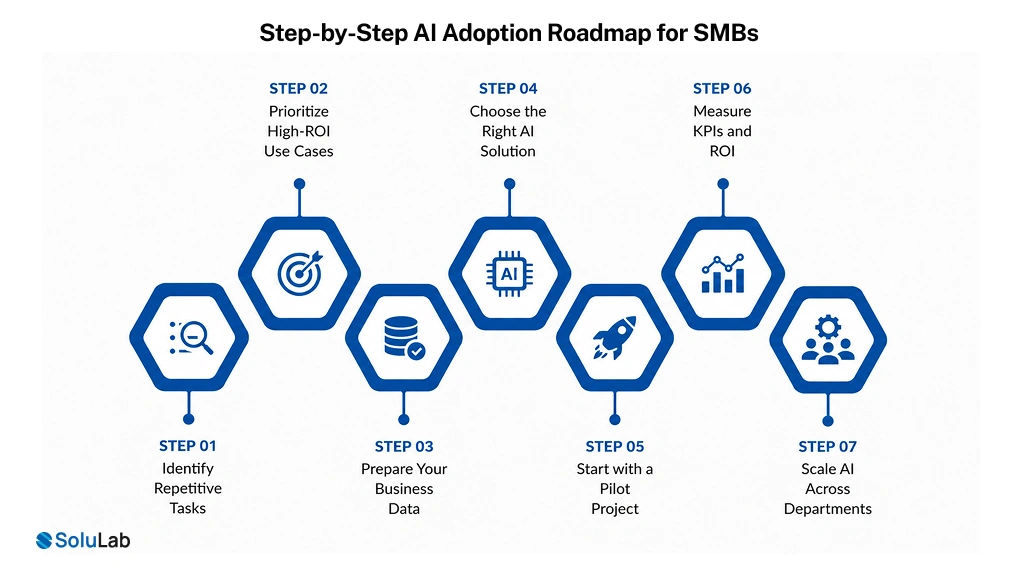
Most SMB AI projects fail from poor sequencing, not bad technology. Follow these seven steps in order to move from idea to a working AI tool that sticks.
Step 1: Identify Repetitive Tasks
List the tasks that eat the most time each week. These are your best starting points for AI.
- Track time spent on tasks
- Flag manual, rule-based daily work
- Rank tasks by time saved
Step 2: Prioritize High-ROI Use Cases
Not every task is worth automating first. Pick the one with the clearest payback.
- Estimate cost savings per task
- Weigh effort against expected impact
- Pick one use case first
Step 3: Prepare Your Business Data
AI performs only as well as the data behind it. Clean and organize data before you build.
- Audit data accuracy and completeness
- Remove duplicate or outdated records
- Centralize data in one system
Step 4: Choose the Right AI Solution
Match the tool to the task. A generative AI development company can help you avoid a costly wrong fit.
- Compare off-the-shelf versus custom tools
- Check integration with existing systems
- Confirm pricing fits your budget
Step 5: Start with a Pilot Project
Test the AI tool on a small scale before rolling it out across the whole company.
- Set a clear pilot timeline
- Involve a small test group
- Document issues as they surface
Step 6: Measure KPIs and ROI
Track results against the metric you set before launch, not after the fact.
- Compare results against baseline numbers
- Calculate time and cost saved
- Share results with your team
Step 7: Scale AI Across Departments
Once the pilot proves its value, expand the same approach to other teams.
- Apply lessons from the pilot
- Train other teams on tools
- Repeat the process for growth
High-Impact AI Use Cases for Small and Mid-Size Businesses
Not every AI use case is worth an SMB’s limited time and budget. These are the ones that tend to pay back fastest.
- Customer service automation with AI chatbots and support triage handle routine questions, freeing your small team for the calls that actually need a human.
- Marketing personalization segment customers and personalize email or ad content without hiring a dedicated data analyst.
- Demand forecasting predicts inventory needs with more accuracy than gut instinct or a basic spreadsheet formula.
- Document and invoice processing automates the repetitive back-office work that eats hours every week.
- Sales lead scoring ranks leads by likelihood to convert, so a small sales team spends time on the right accounts first.
- Fraud and anomaly detection, even a basic model catches unusual transactions a manual review would miss.
These use cases sit at the center of most AI use cases for small businesses that actually reach production, rather than staying stuck as a pilot forever.
Strategically Invest in AI That Scales
The gap between a company that gets real value from AI and one that doesn’t usually comes down to how the investment is structured, not the size of the budget.
How Enterprises Invest in AI?
- Build a dedicated AI or data science team with clear ownership over every model in production.
- Run a formal AI governance framework before deployment, covering data privacy, bias checks, and audit trails.
- Pilot on a small scale, then scale with enterprise infrastructure: cloud compute, MLOps pipelines, and dedicated monitoring tools.
- Budget for multi-year AI roadmaps, not single projects, so each new tool builds on the last one instead of starting over.
- Work with enterprise AI development services partners who can support integration across dozens of existing systems at once.
How SMBs Invest in AI
- Start with one use case that solves a real, measurable problem: don’t buy a platform before you know what it needs to do.
- Use pre-built tools and APIs instead of custom models wherever the off-the-shelf option gets you 80% of the value at a fraction of the cost.
- Partner with an experienced team for the first project. A short engagement with a custom AI development services provider often costs less than one failed in-house attempt.
- Track a clear metric from day one, whether that’s hours saved, leads converted, or support tickets resolved, so you know if the pilot actually worked.
- Reinvest savings from the first win into the next use case, building momentum instead of trying to do everything at once.
Build AI Readiness Before You Scale
Jumping straight to a company-wide AI rollout, without checking the basics first, is how most SMB AI budgets get wasted.
- Audit your data quality. AI is only as good as the data behind it, and most small businesses have messier data than they think.
- Check your team’s AI literacy. A tool nobody trusts or knows how to use won’t get adopted, no matter how good the model is.
- Confirm your systems can actually connect. An AI tool that can’t talk to your CRM or your inventory system creates more manual work, not less.
- Set a realistic budget range, including the cost of the pilot and at least one round of adjustments after launch.
- A short AI readiness assessment before you commit budget catches most of these gaps in a week or two, well before they become an expensive surprise.
AI Governance: The Step Most SMBs Skip
Governance sounds like an enterprise problem. It isn’t. A small business running an AI tool on customer data without basic rules is taking on real risk, just at a smaller scale.
- Decide who can access what data, and write it down, even if your “AI team” is one person.
- Set a human review step for high-stakes decisions: lending approvals, hiring screens, and legal-adjacent decisions should never run on autopilot.
- Check outputs for bias periodically, not just once at launch. Models drift as new data comes in.
- Keep a simple record of what data trained or fed each tool, so you can answer a customer’s question about their data if they ask.
AI governance solutions don’t need to be complicated for a small business. A one-page policy that your whole team actually reads beats a fifty-page document nobody opens.
Common Mistakes SMBs Make With AI
- Buying the tool before defining the problem. A shiny AI platform with no clear use case rarely earns back its cost.
- Skipping the pilot and going straight to full rollout. A pilot catches the issues a full launch would turn into a crisis.
- Underestimating the change management side. The best AI tool fails if your team doesn’t trust it or understand why it’s there.
- Ignoring data privacy rules that still apply. Small business size doesn’t exempt you from regulations around customer data.
- Treating AI adoption as a one-time project instead of an ongoing capability that needs upkeep, retraining, and the occasional rebuild.
Conclusion
AI has made it possible for a small business to compete with a much larger one, but only when the investment is deliberate. Pick one use case, measure it honestly, and build from there instead of chasing every new tool. The businesses winning right now aren’t the ones with enterprise budgets. They’re the ones executing a smaller plan well.
SoluLab, an AI development company, helps SMBs pick the right first use case and build it properly. Get in touch to talk through where AI fits your business.
FAQs
Neha is a curious content writer with a knack for breaking down complex technologies into meaningful, reader-friendly insights. With experience in blockchain, digital assets, and enterprise tech, she focuses on creating content that informs, connects, and supports strategic decision-making.