Key Takeaways
- AI compliance means proving, with evidence, that your AI systems meet the legal, ethical, and contractual obligations that apply to them.
- Obligation is set by what your AI does and where its output lands, not by which model or vendor you picked.
- The EU AI Act applies extraterritorially. A US company whose AI output reaches EU users is in scope regardless of where it is headquartered.
- High-risk deadlines moved, but transparency duties did not. Treating the delay as a pause is the expensive reading.
- Documentation written while design decisions are fresh costs a fraction of reconstructing it later from systems already running.
- Enterprise buyers now ask for AI governance evidence during procurement, which turns compliance into a revenue question, not just a legal one.
AI compliance is the practice of proving that your AI-powered systems meet the laws, standards, and contractual commitments that apply to them, with documentation an auditor or enterprise buyer would accept.
It covers system inventory, risk classification, data governance, testing, human oversight, monitoring, and incident response, rather than a policy document nobody reads.
The gap between adoption and control is the whole problem. In the 2026 Gartner CIO and Technology Executive Survey, 84% of respondents expected their enterprise to increase generative AI funding this year.
Gartner also projects that by 2028, half of organizations will adopt a zero-trust posture for data governance as unverified AI-generated data spreads. Spending is running ahead of controls. This guide covers what actually applies to you, what a working program contains, and where to start.

What is AI compliance?
AI compliance is the ongoing work of demonstrating that an AI system was built, deployed, and monitored in line with applicable regulation, recognized standards, and the promises you made to customers. The operative word is demonstrating. A control you cannot evidence does not count when a regulator or a procurement team asks.
1. Compliance is about evidence, not intent
Regulators do not audit your intentions. They audit records. What data trained the model, who signed off on deployment, what testing was done, how a human can override an automated decision, and what happened the last time the system misbehaved. No artifacts, no compliance. Whatever the policy said.
2. How it differs from AI governance
The two get used interchangeably and shouldn’t be. Governance is the internal operating structure that decides how AI gets built and who is accountable. Compliance is the external-facing proof that the structure produced acceptable outcomes. You need governance to generate compliance, which is why building an AI governance framework usually precedes any serious compliance work.
3. What falls in scope
More than most teams assume. Any system making or materially influencing a decision about a person is a candidate: hiring screens, credit scoring, insurance pricing, fraud flags, content moderation, medical triage. So are customer-facing assistants, which carry disclosure duties even when the underlying decision is trivial. Internal productivity tools sit lower on the risk scale but still touch data protection law.
Which AI regulations actually apply to your systems?
Obligation follows use case and market, not technology choice. Three layers stack on top of each other: general data protection law, AI-specific legislation, and sector rules from your existing regulator.
1. The EU AI Act and its risk tiers
The Act sorts systems into four tiers: prohibited, high-risk, limited-risk with transparency duties, and minimal-risk. High-risk covers recruitment and employee management, creditworthiness assessment, biometric identification, education access, critical infrastructure, law enforcement, and administration of justice, along with AI embedded in regulated products such as medical devices and machinery.
Misclassifying a high-risk system as limited-risk is the single most expensive mistake available here. Our EU AI Act breakdown covers the tier definitions and transparency audit requirements in detail, and the EU AI Act compliance checklist walks the assessment step by step.
2. What the Digital Omnibus actually changed
This is where most published guidance is now out of date. Regulation (EU) 2026/1744, the Digital Omnibus on AI, was published in the Official Journal on 24 July 2026 and entered into force on 27 July 2026, six days before the original high-risk deadline (Cloud Security Alliance).
| Obligation | Original date | Current date | |
| Prohibited practices (Article 5) | 2 Feb 2025 | Unchanged | |
| General-purpose AI model obligations | 2 Aug 2025 | Unchanged | |
| Article 50 transparency duties | 2 Aug 2026 | Unchanged, in force | |
| Watermarking for systems already on the market (Art. 50(2)) | 2 Aug 2026 | 2 Dec 2026 | |
| Annex III standalone high-risk systems | 2 Aug 2026 | 2 Dec 2027 | |
| Annex I product-embedded high-risk systems | 2 Aug 2027 | 2 Aug 2028 |
Read that table carefully. Two deadlines moved. Everything else stayed put. Transparency obligations have been live since August 2026, which means the disclosure and labeling work is due now, not in 2027.
3. Extraterritorial reach
The Act follows the logic GDPR established. Physical presence in the EU is not the trigger; market impact is. Placed on the EU market, used by people in the EU, or producing output used there? You are in scope. From Ohio or Bangalore just as much as from Berlin.
4. Standards that regulators actually reference
ISO/IEC 42001:2023 is the first international standard for AI management systems, and the NIST AI Risk Management Framework is its closest US analogue. Neither is law. Both function as the benchmark regulators and enterprise buyers use to judge whether governance is real or decorative. Building to them from the design stage, as we do on compliance-grade AI development engagements, is considerably cheaper than retrofitting.
Why does AI compliance matter now?
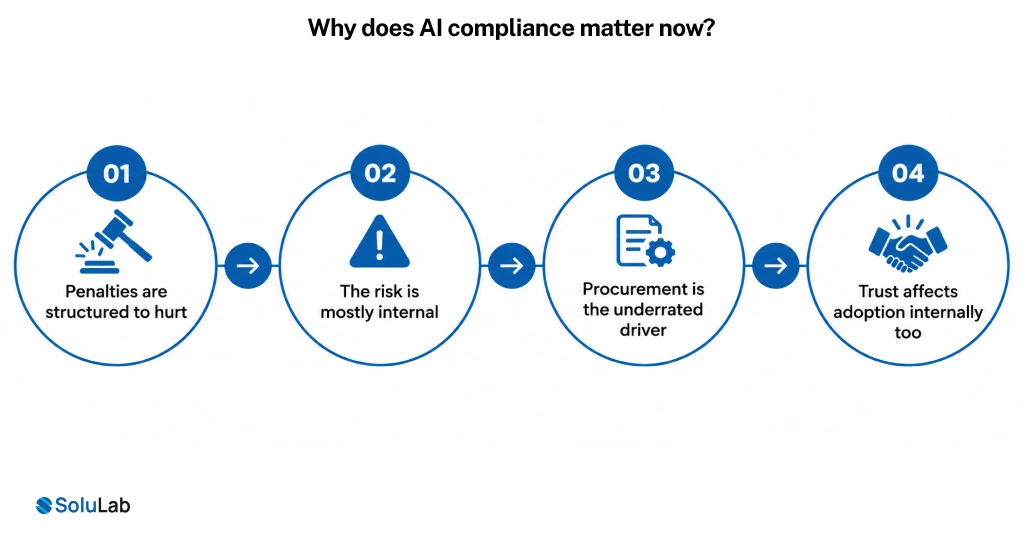
Because enforcement moved from theoretical to active, and because compliance evidence has quietly become a sales requirement. Both pressures arrived faster than most AI roadmaps anticipated.
1. Penalties are structured to hurt
EU AI Act penalties reach €35 million or 7% of worldwide annual turnover for prohibited practices, €15 million or 3% for high-risk obligation failures, and €7.5 million or 1% for supplying misleading information to regulators. Note that these are turnover-linked, not profit-linked. That converts a governance gap into CFO-level exposure rather than a legal department line item.
2. The risk is mostly internal
Gartner predicts that 40% of AI-related data breaches will arise from cross-border generative AI misuse by 2027, driven by unmanaged data flows and localized AI policies rather than sophisticated external attacks. Employees pasting proprietary data into unapproved tools is a bigger exposure for most companies than anything an adversary is doing.
3. Procurement is the underrated driver
Enterprise buyers increasingly ask vendors to evidence AI maturity before signing. What used to be a legal checkbox is now a gate in the sales cycle, and the security questionnaire has grown an AI section. In practice, this means a startup with clean model documentation closes deals that a better-performing competitor without it cannot.
4. Trust affects adoption internally too
Staff use AI more, not less, when there is a clear framework telling them what is permitted and monitored. A vague instruction to use good judgment produces either paralysis or shadow usage, and usually both in different departments. This is one reason responsible AI practice pays for itself even before any regulator is involved.
What does an AI compliance program actually contain?
Eight components. A program missing any one of them will fail an audit at exactly that point, which is a reliable pattern across the engagements we have run.
1. System inventory
A living register of every AI system in use, including vendor tools and anything a team spun up without telling IT. Most organizations discover two to three times more AI in use than leadership expected. This is always the first deliverable.
2. Risk classification
Each system mapped to a tier under the applicable regime, with the reasoning recorded. The reasoning matters as much as the conclusion, because a defensible classification you can explain beats a correct one you cannot.
3. Technical documentation
Model purpose, training data sources and provenance, architecture, performance characteristics, known limitations, and intended use boundaries. Writing this while design decisions are fresh costs a fraction of reconstructing it two years later from a system already in production.
4. Data governance
Lawful basis for training data, provenance tracking, retention rules, and controls on what crosses a border. This is where AI integration services work and compliance work meet, since data flow decisions made during integration determine what is provable later.
5. Testing, bias evaluation, and red teaming
Documented pre-deployment testing including adversarial evaluation. High-risk systems under the EU AI Act carry explicit adversarial testing expectations, and structured AI red teaming is how you generate that evidence rather than asserting it.
6. Human oversight
Defined points where a person can review, override, or halt an automated decision, with the authority and the interface to actually do it. An override button nobody is trained to use is not oversight.
7. Monitoring and drift detection
Production performance tracking, drift alerts, and periodic revalidation. Compliance is a state you maintain, not a certificate you earn, which puts it squarely in MLOps consulting territory.
8. Incident response
A defined path for when the system produces a harmful or non-compliant output: who is notified, what gets logged, what gets disclosed, and within what window.
Map your AI systems, classify risk, and build an audit-ready compliance roadmap. Get a Compliance Assessment
How do you get started with AI compliance?
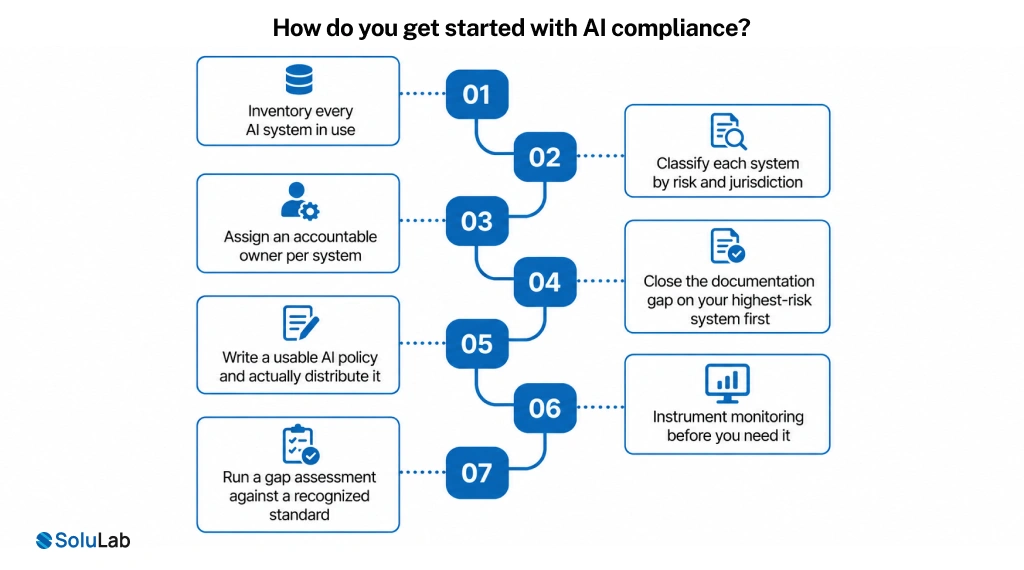
This is the getting-started sequence rather than the full framework build, which is a longer piece of work covered separately.
1. Inventory every AI system in use
Survey teams directly. Ask what tools they use, not whether they use AI, because half of them do not think of the meeting summarizer as AI. Include vendor features that quietly turned on AI in the last release.
2. Classify each system by risk and jurisdiction
For each entry, record what decision it influences, whose data it touches, and which markets its output reaches. That produces your obligation map. Most organizations find that a small number of systems carry nearly all the regulatory weight.
3. Assign an accountable owner per system
Not a committee. A named person for each high-risk system, with the authority to pause it. Shared accountability reliably becomes no accountability, and it is the first thing an auditor probes.
4. Close the documentation gap on your highest-risk system first
Do not attempt everything at once. Take the single highest-risk system, produce complete technical documentation for it, and use that as the template. The second one takes roughly a third of the time.
5. Write a usable AI policy and actually distribute it
Governance oversight at management level is common; policies employees have read and acknowledged are much less so. A policy sitting in a shared drive is not a control. Require acknowledgement and record it.
6. Instrument monitoring before you need it
Logging, drift detection, and output sampling set up while the system is calm, not during an incident. Retrofitting audit logs after the fact is one of the more painful engineering exercises in this space.
7. Run a gap assessment against a recognized standard
Assess against ISO/IEC 42001 or the NIST AI RMF, even if you never certify. The gap list becomes your roadmap, and it gives procurement teams a framework name they recognize. AI consulting input helps most here, because the gap between a technically correct answer and a defensible one is judgment, not knowledge.
Should you build, buy, or combine AI compliance tooling?
Buy the evidence-collection layer, build the parts specific to your models and data. Most organizations end up with a hybrid, and the split usually falls along the same line.
| Approach | Best for | Trade-off |
| AI compliance software platform | Control mapping, evidence collection, policy distribution, audit reporting | Generic to your models; still needs your technical documentation |
| Internal build on existing GRC tooling | Organizations with mature GRC already in place | Slower, and AI-specific controls need designing from scratch |
| Custom governance layer in the AI stack | Model registry, drift monitoring, decision logging, agent guardrails | Engineering investment; this is the part vendors cannot supply |
| Consulting-led assessment plus tooling | Getting from zero to defensible quickly | Higher upfront cost, faster time to audit readiness |
The honest read: compliance platforms are good at the paperwork layer and cannot generate the technical evidence that only your engineering team can produce. Buying a platform and assuming compliance is handled is the most common expensive misunderstanding in this category. For organizations that need capacity to build the technical layer, it usually makes sense to hire AI developers with governance experience rather than retraining a product team mid-flight.
Automating the regulatory monitoring side is a separate and genuinely useful play. Applying generative AI for compliance to track rule changes and map them to controls removes a real manual burden, particularly for teams operating across several jurisdictions.
Why do AI compliance programs fail?
They fail on ownership, scope discovery, and treating compliance as a document rather than an operating capability. The pattern repeats across sectors.
Deloitte’s research into enterprise AI found that only about one in five companies reported a mature governance model for autonomous AI agents, even as deployment accelerated. The oversight structure is lagging the deployment curve almost everywhere.
1. Reading the delay as a pause
The Annex III deferral to December 2027 bought time for one category of obligation. Transparency duties did not move. Teams that stood their program down in August 2026 are now behind on work that was already due, and they will pay more to catch up than they saved.
2. Nobody owns it
Legal thinks engineering owns model documentation. Engineering thinks legal owns regulatory interpretation. Both are half right, which produces a gap exactly where the evidence should be. Name an owner per system and a single accountable executive for the program.
3. Policy without enforcement
Management-level oversight is widespread. Policies that employees have actually read, acknowledged, and can find are much rarer. The distance between those two states is where most real exposure sits.
4. Compliance bolted on after launch
Retrofitting documentation, provenance, oversight interfaces, and audit logs onto a running system costs several times what building them in would have. Every team that has done both will tell you the same thing.
5. What good execution produces
On an anonymized engagement for a regulatory and compliance firm, our team built a compliance monitoring and regulatory intelligence platform using GPT-4-class models, LangChain, FastAPI, PostgreSQL, and document intelligence. It monitored regulatory publications, summarized changes, mapped obligations to internal controls, identified gaps, and produced audit-ready reports.
Reported outcomes were 66% faster regulatory impact assessment, 41% less compliance administration, and 36% better audit readiness. The interesting part was not the speed. It was that the firm could show an auditor a continuous trail rather than assembling one under deadline pressure.
Financial institutions across the bloc hit the same pattern. We covered that in our work on AI agents for risk and compliance, and the underlying discipline is the one described in AI in risk management.

Conclusion
AI compliance rewards teams who start narrow and start early. Inventory what you have, classify honestly, pick the highest-risk system, and document it properly before touching anything else. That single completed artifact teaches you more about your real exposure than a six-month policy exercise, and it gives procurement something concrete to show.
The regulatory timeline shifted once and could shift again. The underlying obligation did not, and neither did the commercial pressure from enterprise buyers asking for evidence. Documentation written while the design is fresh will always be cheaper than documentation reconstructed under audit.
SoluLab, an AI development company, can help your business inventory AI systems, classify risk, close documentation gaps, and build governance controls into the architecture rather than around it. We build to ISO/IEC 42001:2023 and the NIST AI Risk Management Framework from the design stage. And we will tell you plainly which of your systems carry real regulatory weight and which do not.
FAQs
Shipra Garg is a tech-focused content strategist and copywriter specializing in Web3, blockchain, and artificial intelligence. She has worked with startups and enterprise teams to craft high-conversion content that bridges deep tech with business impact. Her work translates complex innovations into clear, credible, and engaging narratives that drive growth and build trust in emerging tech markets.