Key Takeaways
- Compliance-grade AI development builds regulatory and audit requirements into the AI lifecycle from the start, data lineage, risk classification, human oversight, documentation, instead of bolting them on after deployment.
- This isn’t a nice-to-have anymore. 78% of executives say they couldn’t confidently pass an AI governance audit within 90 days, and only 12% of companies that already have a governance committee call it mature.
- The EU AI Act is still the biggest driver here, and its high-risk deadlines just moved: 2 December 2027 for Annex III systems, 2 August 2028 for Annex I. Violations can still cost up to €35 million, or 7% of global turnover.
- The practical work includes tracking where training data comes from, classifying model risk, documenting models, testing for bias, building in human oversight, watching for drift, and governing AI agents specifically.
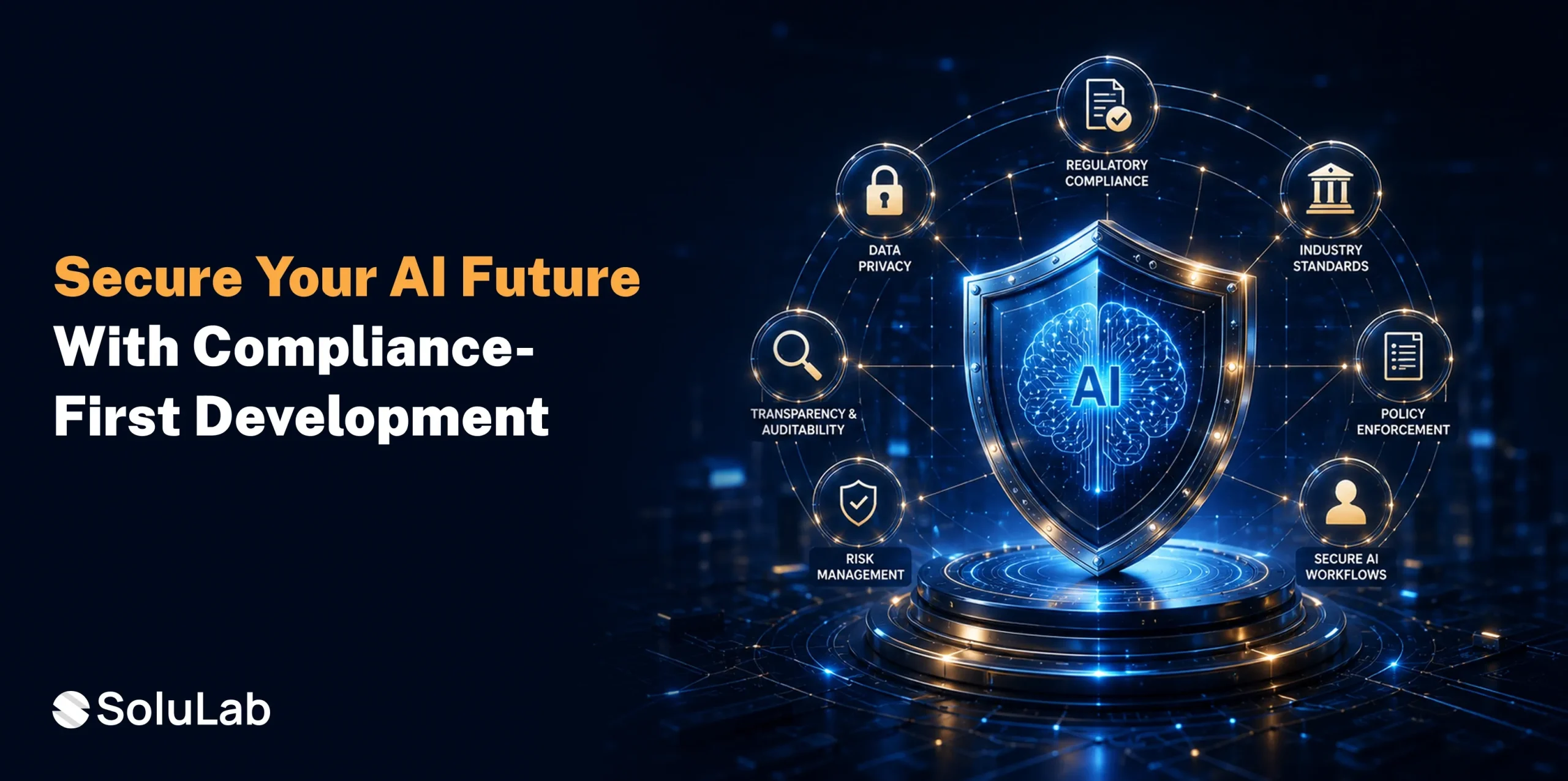
- SoluLab builds to ISO/IEC 42001:2023 and the NIST AI Risk Management Framework starting at the design stage; privacy, security and compliance get built into the architecture, not added after launch.
Most AI projects get built the same way: ship the prototype, prove it works, figure out governance later. That order doesn’t hold up anymore. Companies treating oversight as an afterthought are already feeling it. Grant Thornton’s 2026 AI Impact Survey found that 78% of business executives don’t have strong confidence that they could pass an independent AI governance audit within 90 days. Compliance-grade AI development, sometimes called compliant AI development or simply an AI compliance solution, is basically the opposite approach.
Compliance-grade AI development means building and deploying AI systems with regulatory, legal, and audit requirements engineered in from the first line of code, not added once the system is already live. Whether it’s framed as an AI compliance solution, AI compliance software, or a full compliance-ready AI development process, the underlying idea is the same: governance isn’t separate from the build; it’s part of it.
Frameworks like the EU AI Act, NIST’s AI Risk Management Framework, and ISO/IEC 42001 are maturing fast, and for companies in regulated industries or selling into enterprise accounts, this is no longer optional. Increasingly, it’s what gets you the deal in the first place. SoluLab’s AI development practice is built around that shift; the goal is systems that are production-ready and audit-ready at the same time, not one followed by the other.
Why compliance-grade development matters right now
The regulatory timeline actually shifted twice in the past year, and both changes matter if you’re planning an AI roadmap. Under the EU AI Act’s Digital Omnibus agreement, reached 7 May 2026, compliance deadlines for high-risk systems got pushed back — use-based systems under Annex III (hiring, credit scoring, law enforcement, education) now have until 2 December 2027, and product-embedded systems under Annex I (medical devices, machinery) move to 2 August 2028. That’s some breathing room, but the penalties haven’t softened: violating prohibited-practice rules can still cost €35 million or 7% of global annual turnover, and high-risk non-compliance tops out at €15 million or 3% of turnover.
And the gap between how fast companies are deploying AI and how ready they are to govern it is pretty stark:
- 75% of organizations have set up a dedicated AI governance committee, but only 12% would call it mature.
- Roughly 33% of enterprises meet governance standards adequate for the autonomous agents they’re already running in production, meaning two-thirds don’t.
- Spending on dedicated AI governance platforms is expected to hit $492 million in 2026, which tells you enterprises are starting to treat this as infrastructure rather than a policy binder nobody reads.
Sudip Saha, Principal Consultant for Enterprise Technology at Future Market Insights, frames it this way: enterprise AI governance is moving from optional risk management to mandatory compliance infrastructure as EU AI Act enforcement accelerates and financial regulators tighten explainability requirements. That’s also why more organizations are hiring dedicated AI governance consultants instead of leaving compliance to a legal-team checklist somewhere.
Compliance-Grade AI Development: Core Use Cases
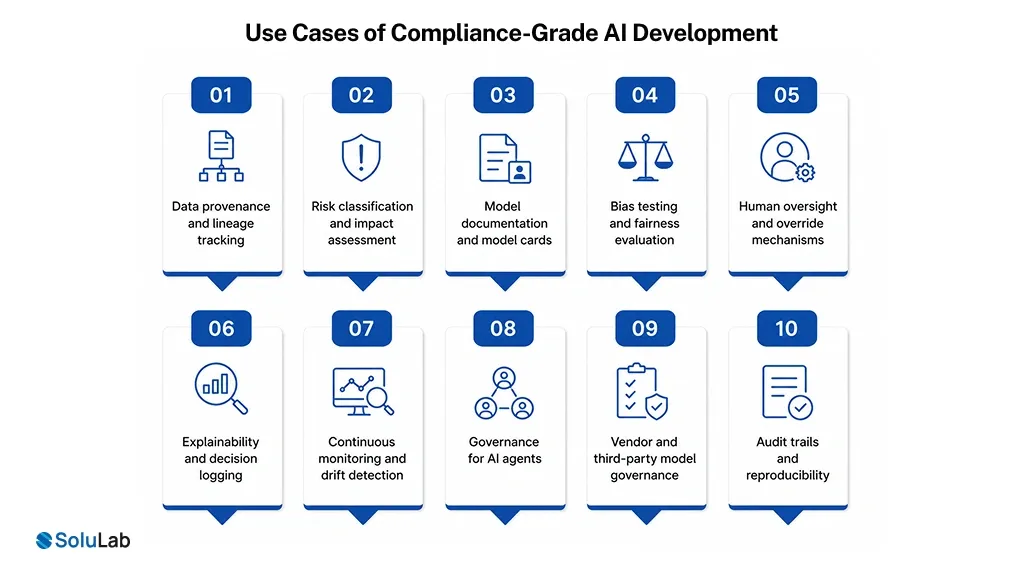
Compliance-grade practices show up at pretty much every stage of the AI lifecycle. Here’s where the discipline actually gets applied in practice and where a lot of AI compliance tools and AI compliance software on the market today are focused:
Data provenance and lineage tracking
Every dataset used for training or fine-tuning gets logged, versioned and traced back to its source, license and consent basis. This matters for GDPR data-subject requests, and it’s the only way to answer the question “was this specific record used to train the model” when someone asks. It’s a foundational layer of any serious machine learning development engagement — not something you add later.
Risk classification and impact assessment
Before a model gets built, it’s classified against a risk tier under the EU AI Act’s four-tier system of unacceptable, high, limited, and minimal risk, and a fundamental rights or algorithmic impact assessment runs where required. That classification decides which controls apply before deployment: human oversight, conformity assessment, EU database registration, all of it. Most enterprise AI compliance frameworks build this step in as the very first gate.
Model documentation and model cards
Every model version ships with documentation covering what it’s meant for, what its limitations are, what the training data looks like, and how it performed on evaluation, which mirrors what the EU AI Act’s Annex IV actually asks for.
Bias testing and fairness evaluation
Models get tested against defined fairness metrics across protected classes, with results logged and thresholds enforced as release gates. This matters most in credit scoring, hiring, and insurance underwriting, where a biased output isn’t just a bug; it’s a legal problem.
Human oversight and override mechanisms
High-stakes systems need defined checkpoints where a person can review, override or halt an automated decision. This is a legal requirement for high-risk systems under most current AI regulations, and it’s central to how SoluLab approaches enterprise AI security and governance for clients in regulated sectors.
Explainability and decision logging
Systems keep the reasoning behind their outputs, not just the outputs themselves, feature importance, confidence scores, whatever context got retrieved in an RAG pipeline, so a decision can be reconstructed and explained after the fact.
Continuous monitoring and AI compliance automation
Once a model is live, it gets watched for performance drift, data drift, and emerging bias, with alerts and rollback procedures tied to compliance metrics specifically, not just uptime or latency numbers. This is where AI automation earns its keep; manually re-checking every model against every rule doesn’t scale once you’re running more than a handful of systems.
Governance for AI agents
As agentic AI scales, governance has to cover autonomous multi-step workflows, not just single predictions. Close to three-quarters of companies plan to deploy agentic AI within two years, but only 21% say their governance model for it is mature. That gap is exactly what SoluLab’s AI agent development work is built to close, oversight, monitoring, and compliance checks go into the agent orchestration from the start, not after something goes wrong.
Vendor and third-party model governance
Companies building on foundation models or third-party APIs need to push documentation and security requirements upstream, too, since most enterprise AI systems today are a mix of what’s built in-house and what’s sourced externally.
Audit trails and reproducibility
Every training run, evaluation, and deployment gets logged in enough detail, code version, data version, and environment that the exact model behind a given decision can be reproduced months or years later, if a regulator or court ever asks for it.
Benefits Of Compliance-Grade AI Development Solutions
- Regulatory readiness without the scramble. Documenting continuously beats reconstructing evidence under deadline pressure, especially now that EU AI Act obligations are staggered out to December 2027 and August 2028.
- Reduced financial and legal exposure. EU AI Act penalties run into eight figures, and GDPR enforcement is already active in AI contexts. Systematic compliance genuinely lowers that risk.
- Faster enterprise sales cycles. Buyers in regulated industries increasingly ask for documented AI governance maturity during procurement. Teams that already have model cards and audit trails in place just close deals faster than teams scrambling to produce them.
- Better model quality, almost as a side effect. Data lineage tracking, bias testing, and drift monitoring tend to surface real engineering problems earlier, which improves performance right alongside governance.
- Organizational resilience. A documented, systematized AI lifecycle survives staff turnover and regulatory change far better than governance that only lives in a few people’s heads. A lot of this resilience comes down to having a real AI compliance management platform behind the scenes, rather than governance living in spreadsheets and one engineer’s head.
A structured AI risk management practice pays for itself here too; the earlier you catch and price a risk, the cheaper it is to fix.
Challenges of compliance-grade AI development
- Regulatory fragmentation. Requirements differ by jurisdiction and keep shifting; the EU AI Act’s own high-risk deadlines moved twice in the past year alone.
- Tooling immaturity. Purpose-built AI compliance tooling is still catching up, so a lot of organizations end up stitching together logging, documentation, and monitoring tools rather than using one integrated platform.
- Talent gaps. This kind of work needs people who understand both ML engineering and regulatory requirements, and that combination is still hard to find.
- Retrofitting cost. Companies with AI already in production often have to retrofit documentation and monitoring onto systems that were never built to produce that evidence in the first place, and that costs a lot more than building it in from day one. It’s part of why more enterprises are now sequencing governance into their broader AI transformation roadmap instead of treating it as a bolt-on later.
- Explainability limits. Some of the most capable model architectures, large deep-learning and generative AI models especially, are genuinely hard to explain at the level of an individual prediction, and that creates real tension with regulatory expectations around interpretability.
How SoluLab builds compliance-grade AI development?
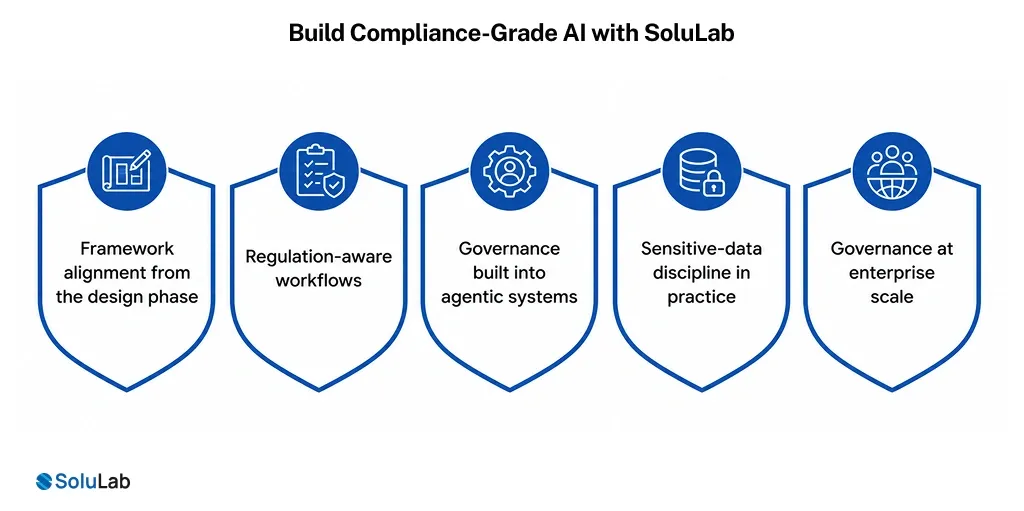
SoluLab, #1 AI integration service provider, treats privacy, security, and compliance as architectural requirements, not something patched in after launch. In practice, that looks like:
- Framework alignment from the design phase. Engagements are structured around ISO/IEC 42001:2023 (the international AI management system standard) and the NIST AI Risk Management Framework, so the governance controls map to frameworks that regulators and enterprise auditors already recognize, not something invented in-house. For clients that need to work toward formal AI compliance certification, this alignment is the starting point, not an afterthought bolted on before an audit.
- Regulation-aware workflows. Solutions support GDPR and EU AI Act-aligned workflows, with encrypted data management and role-based access controls built into the architecture instead of layered on afterward.
- Governance is built into agentic systems. For clients running multi-agent AI, SoluLab implements governance frameworks that monitor agent behavior, manage risk and support compliance with GDPR and HIPAA, which matters more every year, since agentic AI adoption is outpacing governance maturity across the industry.
- Sensitive-data discipline in practice. On Mendle, a generative AI-powered emotional wellness platform built by SoluLab, the team worked with an Emotional Memory Engine handling genuinely sensitive personal data the kind of project where privacy architecture and data handling controls aren’t optional extras, they’re the whole point.
- Governance at enterprise scale. On UpdateIA, an enterprise-grade generative AI ecosystem coordinating 14+ specialized AI agents across HR, CRM, finance and support functions, the team had to design oversight and access controls that could hold up consistently across a lot of autonomous agents and business-critical workflows running at once. It’s a good example of what enterprise AI development actually looks like once you’re past a single-model use case.
It’s also why SoluLab’s enterprise AI development and responsible AI work aren’t treated as two separate service lines. Between the framework alignment, the regulation-aware workflows and the agent governance, it adds up to a single AI compliance solution rather than a set of disconnected practices. In regulated environments, you can’t really separate the two anyway.
Where to Start with AI Compliance Solutions?
Most organizations start by taking stock of what AI systems they actually have, classifying each one by regulatory risk tier, then layering documentation, monitoring, and human-oversight controls onto the riskiest ones first before rolling the practice out across the rest of the portfolio.
Waiting for an audit, an incident, or a regulator’s letter to force the issue is by far the most expensive way to get here. Need your personalized consultation? Connect with our AI compliance experts!

Conclusion
AI governance used to be a compliance checkbox. Now it’s closer to a competitive differentiator. EU AI Act obligations are phasing in through 2027 and 2028, and enterprise buyers keep asking vendors to prove, not just claim, that their AI systems are governed responsibly. “Build fast, figure out governance later” just doesn’t hold up as a default anymore.
Compliance-grade AI development or compliance-focused AI development, if you’d rather call it that, closes that gap by treating traceability, oversight, and documentation as engineering requirements from day one, not paperwork you scramble to produce before an audit. And the payoff isn’t only lower regulatory risk organizations that get this right actually move faster over time, because governance that’s built into the architecture doesn’t need to be rebuilt every time the rules change.
SoluLab, a top AI development agency in USA, works with enterprises to build that foundation from the first line of code, aligned to ISO/IEC 42001, the NIST AI RMF, and whatever regulatory frameworks actually matter for their industry. However, you refer to it as regulatory AI development, an AI compliance solution, or just AI and compliance done right, the goal is the same: systems you can actually stand behind when someone asks how they work.
Let’s connect and design your compliant future!
FAQs
Shipra Garg is a tech-focused content strategist and copywriter specializing in Web3, blockchain, and artificial intelligence. She has worked with startups and enterprise teams to craft high-conversion content that bridges deep tech with business impact. Her work translates complex innovations into clear, credible, and engaging narratives that drive growth and build trust in emerging tech markets.