If you’re not choosing whether to adopt AI agents with zero‑knowledge proofs, you’re deciding how fast you want to fall behind. The global AI agents market is already valued at USD 7.63 billion in 2025 and is projected to reach USD 182.97 billion by 2033, growing at a CAGR of 49.6% from 2026 onward.
That’s not hype, it’s what every boardroom should be reading before the next budget cycle. At the same time, regulators (like the EU AI Act) are tightening compliance around data privacy, bias, and auditability, which is why AI security platforms using ZK cryptography are no longer a nice‑to‑have but a core layer for enterprise AI tech stack.
Zero-knowledge proofs enable your AI agents with privacy-compliance solutions to demonstrate that a decision is valid and compliant without revealing the underlying data, model weights, or proprietary logic. Let’s learn more about it in this article.
Key Takeaways
- The problem: Enterprises are pouring money into AI agents, but many still run on opaque, centralized models that can’t prove correctness, privacy, or compliance without exposing sensitive data or logic.
- The solution: Combine AI agent development with ZK proofs to build zero‑knowledge proof AI agents that run verifiable, privacy‑preserving workflows across finance, healthcare, supply chain, and crypto‑enabled operations.
- How SoluLab help: As an AI development Solution for enterprises, we help you build AI agents with ZK verification, design enterprise AI agent platforms with ZK security, and reduce the cost to build AI agents with ZK verification by aligning architecture with your existing stack.
Why Enterprises Are Now Combining AI Agents With ZK Proofs for Secure Automation?
By 2026, CXOs aren’t just chasing automation, they’re chasing trust‑minimized automation. Which means you need AI agents that can negotiate, sign contracts, and move data without forcing you to trust a single vendor, cloud provider, or internal team. That’s where zero‑knowledge proof AI agents step in.
Zero‑knowledge proofs let an AI agent prove that a computation (for example, a credit decision, a medical diagnosis, or a KYC check) was executed correctly, without revealing the input data, model parameters, or internal logic.
Several projects like zkVerify and zkML frameworks already show how you can prove AI training, inference, and governance on-chain, while keeping the underlying data encrypted.
From a business perspective, this unlocks enterprise use cases of zero‑knowledge AI such as:
- Confidential underwriting in finance where banks prove a loan profile meets criteria without seeing raw bank statements.
- Cross‑institutional AI diagnostics in healthcare, where providers share model insights without sharing patient records.
- Privacy‑preserving KYC and AML where institutions verify identity and compliance without exposing sensitive PII.
In short, AI security platforms using ZK cryptography don’t just secure AI, they turn AI agents into verifiable economic actors your legal, compliance, and risk teams can actually trust.
What Enterprise Problems Are Solved by AI Agent Platforms Using ZK Proof Security?
Let’s get concrete. Here are the big pain points this stack targets in 2026:
1. Opaque AI decisions:
- Without ZK, many AI agents are still black boxes. You can audit the inputs and outputs, but you can’t prove that the model didn’t cheat, bias‑tune, or drift after deployment.
- With AI agent development with ZK proofs, every critical inference can be accompanied by a ZK proof of correctness, which can be logged on‑chain or in a compliance layer.
2. Data privacy and jurisdiction risk:
- Global enterprises constantly juggle GDPR, HIPAA, CCPA, and local data‑locality rules.
- AI agents with privacy compliance solutions powered by ZK allow you to process or validate data in one jurisdiction while proving compliance from another, without transferring raw data.
3. Vendor lock‑in and model trust:
- If your AI agent runs inside a proprietary cloud or SaaS platform, you’re dependent on that vendor’s integrity and audit process.
- Deploy Zero Knowledge Proof AI on top of your workflows so proofs are stored in neutral, auditable layers (like blockchains or compliance ledgers), not just inside a vendor’s dashboards.
4. Regulatory fatigue:
- The EU AI Act and similar regimes are forcing high‑risk AI systems to prove their safety, fairness, and auditability.
- ZK proof AI compliance solutions let you prove adherence to rules (e.g., no banned data was used or bias metrics are within thresholds) without exposing the exact dataset or model.
If you’re running a best AI agent platform for enterprise automation, this stack lets you move from trust us to verify us, which is exactly what regulators and strategic partners want.
How Does This Architecture Work in Real‑World Enterprise Systems?
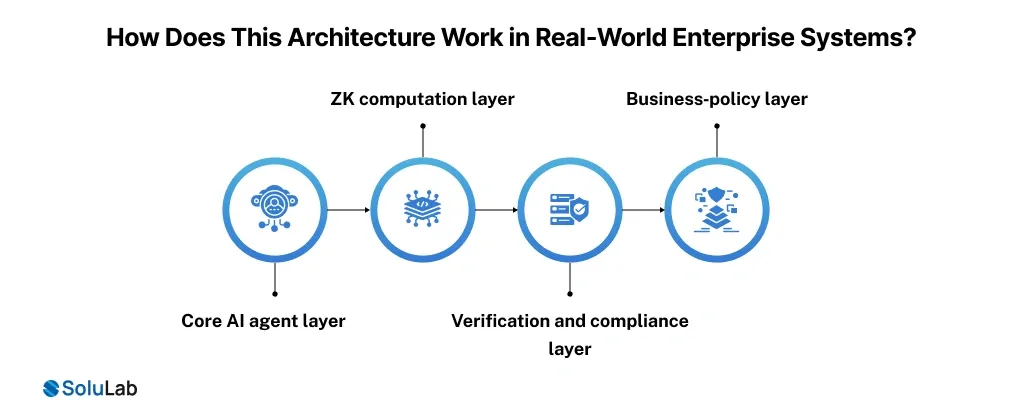
You don’t need to gut your stack to start using AI agents with ZK proofs. Most viable architectures in 2026 look like this at a high level:
1. Core AI agent layer:
- Your LLM development Company builds or tunes agents that run on LLMs, SLMs, or custom ML models.
- These agents live inside your existing ecosystem: CRMs, ERPs, payment gateways, or custom fintech rails.
2. ZK computation layer:
- Critical operations (e.g., lending decisions, insurance risk scoring, identity verification) are routed through a verifiable AI compute environment.
- Using frameworks like zkVMs or zkML systems, the agent generates a ZK proof that the computation was executed correctly, with the right inputs and constraints.
3. Verification and compliance layer:
- A ZK‑proof AI compliance solution verifies the proof either on‑chain (via a blockchain or rollup) or in a private, enterprise‑controlled ledger.
- This layer can expose human‑readable reports for auditors while keeping the raw data and model encrypted.
4. Business‑policy layer:
Smart contracts or policy engines can enforce rules: Only execute if the ZK proof passes, If the agent drifts, revert to human‑in‑loop, etc.
From our POV, this feels a lot like swapping a trust‑based approval layer with a mathematically verifiable one. It doesn’t replace your existing AI stack; it wraps it with a trust‑minimized layer.
Which Tools and SDKs Enable AI Agent Development with ZK Proofs for Enterprises Today?
The tooling landscape for AI agents with ZK proofs is still maturing, but enough infrastructure exists in 2026 to build real‑world products.
Here are the main categories you should know:
1. ZK verification layers:
- zkVerify provides a verify‑as‑a‑service layer that can plug into any AI agent pipeline, supporting multiple proof systems (SNARKs, STARKs, Plonk, Halo2, etc.) and offering hardware‑accelerated verification.
- Projects like Amadeus + zkVerify are already rolling out on‑chain verification for AI training and inference workloads.
2. ZK‑enabled AI frameworks:
- zkML stacks (e.g., Giza, zkLLM‑style tooling) let you compile machine‑learning models into circuits that can be verified with ZK proofs.
- These are ideal if you want AI agents with privacy compliance solutions for regulated industries like finance or healthcare.
3. Enterprise‑ready AI agent platforms:
- Several vendors now offer best AI agent platforms for enterprise automation that can plug into ZK verification layers, either directly or via APIs.
- These platforms help you orchestrate multi‑agent workflows, manage state, and integrate with legacy systems, which is where most AI agent development services for enterprises add the most value.
4. Blockchain‑native ZK stacks:
Modern ZK‑rollups and privacy‑focused chains now support higher throughput and lower proof costs, making deploying Zero Knowledge Proof AI more practical for high‑volume workloads.
If you’re evaluating ecosystems, focus on interoperability, multiple proof‑system support, and whether the stack can be integrated into your existing AI development Solution for enterprises without heavy rewrites.
What Enterprises Must Evaluate Before Deploying AI Agents with Zero-Knowledge Proofs
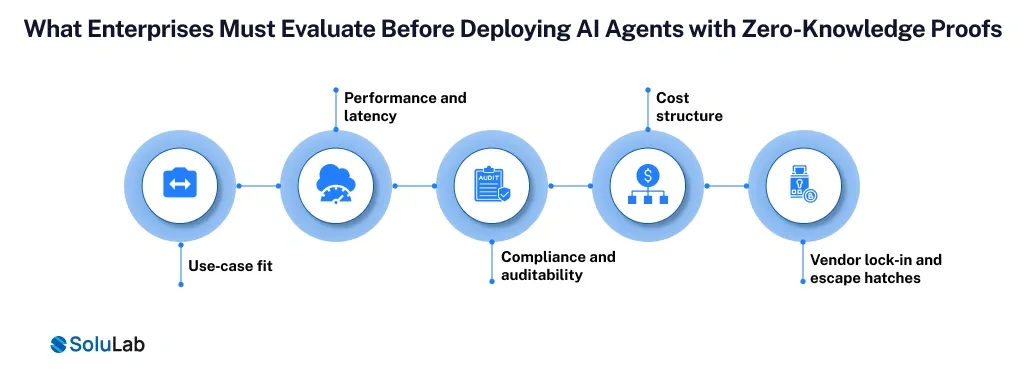
Before you sign any contract or commit budget, treat this like any other infrastructure decision: ask the right questions, not the glossy marketing questions.
Here’s a practical checklist:
1. Use‑case fit:
Are you really solving enterprise use cases of zero‑knowledge AI (e.g., sensitive data, cross‑border compliance, high‑risk AI decisions), or are you just adding ZK for branding?
2. Performance and latency:
- Proof generation for AI‑scale workloads can be heavy.
- Ask vendors about proof generation time, throughput, and whether they offload this to dedicated hardware or clouds.
3. Compliance and auditability:
- How do their ZK proof AI compliance solutions map to GDPR, HIPAA, EU AI Act, or local financial regulations?
- Can you export proof logs in a format your auditors will accept?
4. Cost structure:
- Ask for the cost to build AI agents with ZK verification, including both upfront and recurring costs (proof generation, storage, verification, and any blockchain‑layer fees).
- Some vendors hide complexity inside “managed service” pricing, which can balloon over time.
5. Vendor lock‑in and escape hatches:
- If your AI agent platform with ZK security depends on a single proof system or L1, you’ll struggle later when new, cheaper systems emerge.
- Push for modular, plugin‑style architectures where you can swap out ZK backends without rewriting your agents.
If you’re hiring AI developers, make sure they can walk you through this evaluation in operator‑friendly terms, not just academic whitepapers.
Costs, Performance Trade-offs, and ROI of AI Agent Development with ZK Proofs
Let’s talk money. In 2026, a typical medium‑complexity AI agent project can cost £16,000–£75,000 in implementation, with recurring OPEX of £1,800–£10,500 per month depending on scale and support.
Other estimates range from about $10,000 for simple chatbots to over $1.5 million for complex, cutting‑edge agents. Adding ZK‑based verification obviously increases complexity and cost, but the cost of implementing AI agents with ZK proofs varies based on:
1. Scope of verification:
- If you’re only verifying critical decisions (e.g., high‑value loans, compliance checks), the cost to build AI agents with ZK verification is manageable.
- If you’re trying to prove every single inference, the cost and latency spike.
2. Proof generation efficiency:
- Modern ZK stacks have reduced proof‑generation times by 70–90% since 2024, and many now offer GPU‑ or FPGA‑accelerated verification.
- This is why enterprise AI security platforms using ZK cryptography are becoming cost‑effective in 2026.
3. ROI levers:
- Reduced compliance risk: Avoiding regulatory fines or operational shutdowns can easily justify the extra cost of implementing AI agents with ZK proofs.
- Faster trust with partners: If you can prove that your AI agents are compliant and verifiable, you can close deals with banks, insurers, or regulated partners faster.
For a realistic roadmap, think of ZK not as an all‑or‑nothing layer, but as a progressive hardening strategy where you start with the highest‑risk, highest‑value AI agent use cases for businesses and gradually expand.
Which Industries Benefit the Most From AI Agents + ZK Proofs?
Not every industry needs ZK‑enabled AI agents, but these sectors are natural fits in 2026:
1. Financial services & DeFi:
- Banks, insurers, and crypto‑native lenders can use AI agents with privacy compliance solutions to prove creditworthiness, KYC, or risk‑scoring without exposing sensitive customer data.
- ZK‑verified DeFi markets are already emerging, where counterparties can prove solvency and compliance without revealing their full balance sheets.
2. Healthcare & life sciences:
- Enterprise use cases of zero‑knowledge AI in healthcare include cross‑institutional diagnostics, privacy‑preserving gen AI‑driven drug discovery, and automated claims and billing workflows.
- Providers can prove that AI agents are following clinical guidelines and regulatory constraints without exposing patient records.
3. Supply chain & compliance‑heavy industries:
Logistics, manufacturing, and ESG‑focused companies can use AI agents with ZK proofs to prove that environmental data, audit trails, or safety checks are valid, without exposing proprietary business data.
4. Crypto‑native and Web3‑forward enterprises:
For companies building token‑based ecosystems, deploying Zero Knowledge Proof AI helps you prove that reward distributions, governance actions, or DAO decisions were executed correctly, without exposing sensitive voter data or financial positions.
In short, any sector where data privacy, regulatory compliance, and cross‑organizational trust crowd your boardroom agenda is a prime candidate for AI agent development with ZK proofs.
How Can Enterprises Start Building AI Agents with ZK Verification Today?
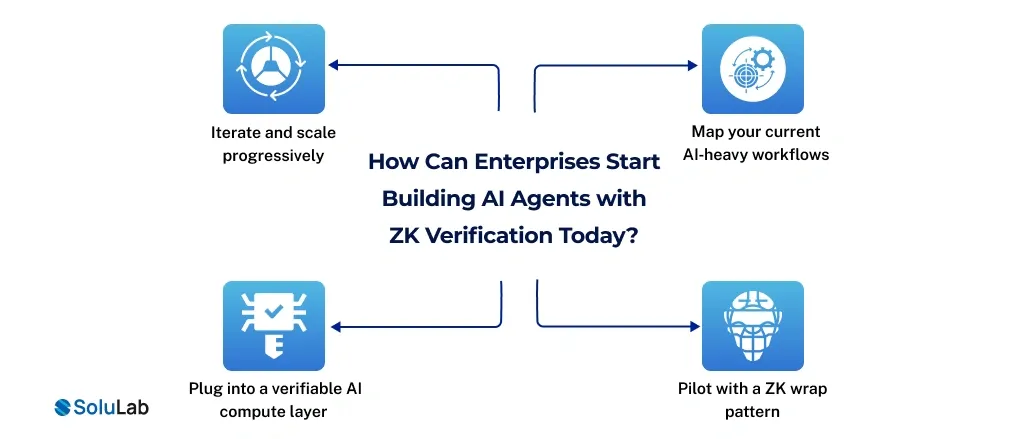
You don’t need to rewrite everything from scratch. Here’s a practical, operator‑friendly path:
1. Map your current AI‑heavy workflows:
- Identify which AI agents handle high‑risk decisions, sensitive data, or cross‑border operations.
- Start with AI agent development use cases for businesses where trust, compliance, or multi‑party validation matter most, like customer onboarding, credit scoring, or cross‑border supply‑chain checks.
2. Pilot with a ZK wrap pattern:
- Work with an AI development Company like SoluLab to build a small, high‑value pilot that wraps existing AI logic with a ZK‑proof AI compliance solution.
- For example, you can take a KYC/AML workflow and modify it so that every decision is accompanied by a ZK proof that checks were run against the right rules, without exposing raw PII.
3. Plug into a verifiable AI compute layer:
- Use a verifiable AI compute platform (like zkVerify or similar ZK‑verification-as‑a‑service providers) to offload the proof‑generation and verification work.
- This way you don’t need to become a ZK‑VM expert internally; you can focus on the business logic and let the AI security platform using ZK cryptography handle the math.
4. Iterate and scale progressively:
- Track metrics like time‑to‑decision, false‑positive reduction, compliance audit time, and cost to build AI agents with ZK verification across your pilot and then expand.
- Over time, you can evolve from a single ZK‑hardened AI agent into a full enterprise AI agent platform with ZK security that spans multiple workflows.
If you’re not sure where to start, hiring AI consultants who’ve already shipped best AI agent platforms for enterprise automation with ZK‑backed layers can shave months off your learning curve.
Conclusion
In 2026, the most powerful AI agents are not the ones that are just “smart”; they’re the ones that can prove they’re smart, compliant, and trustworthy, without exposing everything. By combining AI agent development with ZK proofs you’re not just adding another cryptographic gimmick; you’re building an enterprise AI agent platform with ZK security that can:
- Run AI agents with privacy compliance solutions across borders and regulators.
- Offer zero‑knowledge proof AI solutions for business that can be verified by partners, auditors, or even public markets.
- Turn opaque automation into verifiable economic agents that can participate in contracts, pools, and networks with math‑backed trust.
If you’re leading a product, operations, or engineering team in an enterprise or startup, the right move is not to wait and see, but to deploy Zero Knowledge Proof AI in a focused, high‑value workflow today and then scale from there.
FAQs
With over 3 years of experience, I specialize in breaking down complex Web3 and crypto concepts into clear, actionable content. From deep-dive technical explainers to project documentation, I help brands educate and engage their audience through well-researched, developer-friendly writing.