Key Takeaways
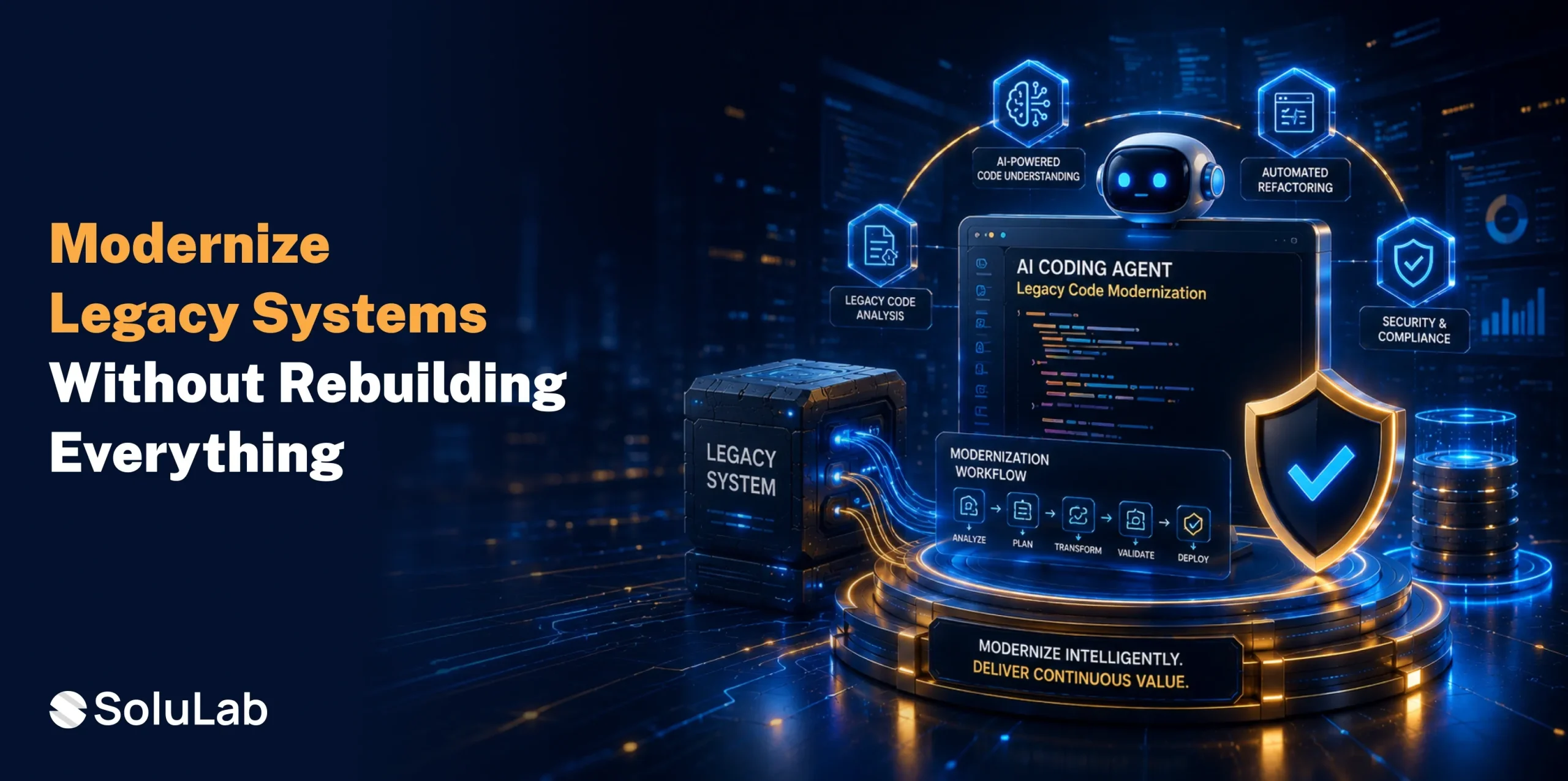
- AI coding agents automate repetitive refactoring tasks, helping development teams modernize legacy codebases faster while maintaining code quality and stability.
- Legacy application modernization succeeds when AI handles mechanical changes and experienced developers review architecture, business logic, and critical decisions.
- Incremental modernization strategies reduce technical debt, minimize downtime, lower migration risks, and deliver measurable improvements without complete system rewrites.
- Partnering with an AI software development company helps enterprises accelerate modernization projects, reduce costs, and improve long-term software maintainability.
Your legacy codebase is basically that friend who still uses a flip phone in 2026. It works, kind of, but everyone is tired of babysitting it. Here is the wild part. Over 75% of enterprises now lean on AI as part of their modernization plan. Three years ago, refactoring old code meant weeks of manual digging and hoping nothing broke.
Now, AI coding agents can read a tangled function, explain what it does, and clean it up before your coffee even cools down. No cap, this shift in workflow is real. So if your codebase feels stuck in 2015, let us break down how AI coding agents help you refactor it, without the chaos.
What Does Refactoring Legacy Codebases with AI Coding Agents Actually Mean?
Refactoring means changing how code is written, not what it does. The behavior stays the same. The structure gets cleaner. Legacy code usually means old, brittle, poorly documented software. It still runs the business; however, nobody wants to touch it.
AI coding agents are trained on massive codebases. They learn patterns across many languages. These models get fine-tuned for tasks like debugging, generating code, and cleaning up old systems.
Generally, teams bring in agents for the boring, repetitive parts: renaming variables, breaking up giant functions, and updating deprecated calls. That frees up developers for the tricky architectural decisions. This is the same division of labor that shapes most serious legacy application modernization engagements today. Agents absorb the mechanical volume, and engineers keep ownership of anything that touches business logic.
Why Old Code Becomes a Liability
Old systems accumulate what engineers call code smells. Duplicate functions. Long, confusing methods. Unclear naming. Each smell adds friction. Over time, that friction slows every release.
If nobody addresses it, the cost only grows. Bugs hide in the mess. New hires take longer to ramp up. Eventually, the system becomes too risky to change at all.
How Do AI Coding Agents Actually Refactor Old Code?
AI tools do not just guess at fixes. They rely on a few core techniques, often blended together, to understand and reshape source code safely.
Reading Code Like a Sentence, Not Just Text
Some models treat code as a sequence of tokens. This is called lexical pattern matching. The model scans for common inefficiencies and flags them in real time.
It might suggest extracting a function from a bloated method. Or moving a method up to a shared class. Or simply renaming a variable so it actually makes sense.
Understanding Structure Through Trees
Other systems go deeper. They parse code into an abstract syntax tree, which captures the hierarchy and structure underneath the syntax. That tree gets turned into vector embeddings a neural network can process.
Some tools use lossless semantic trees instead. These preserve formatting and attach type information to every element. That makes searches more accurate, and dependency upgrades far less risky.
Learning From What Developers Accept or Reject
Reinforcement learning adds another layer. Models get rewarded for outcomes like faster execution or higher test coverage. Moreover, they learn from developer feedback itself.
If a suggestion gets rejected often, the model adjusts. Over time, its recommendations start matching what your team actually wants, the same feedback loop that underpins most production-grade agentic AI development work, whether the agent is refactoring code or handling a business workflow.

Which Legacy Modernization Strategy Should You Pick?
Not every system needs a rewrite. Some just need a new home. Choosing the right approach is the real strategic work, more than picking a single tool.
| Strategy | What It Involves | Effort Level | Best Fit |
| Rehost | Move code as is to new infrastructure | Low | Speed matters more than polish |
| Replatform | Small tweaks to fit a modern platform | Low to medium | Quick wins, no rewrite needed |
| Refactor | Restructure code or design in place | Medium to high | Code is worth saving but needs air |
| Rebuild | Start over from scratch | High | The old design cannot carry you further |
| Replace | Swap in a commercial or SaaS product | Medium | A generic function you should not own |
| Retire | Shut the system down for good | Low | The system costs more than it delivers |
Most real programs mix a few of these. You might rehost ten services to buy breathing room. Then refactor the three that matter most. Then retire the two nobody actually uses anymore.
Where Do AI Agents Help Most, and Where Do Humans Still Matter?
This is where the honest conversation starts. AI agents are genuinely strong in some areas. In others, they can quietly introduce trouble if left unchecked.
The Parts Agents Handle Well
Agents excel at code archaeology. They read unfamiliar systems fast, explain confusing functions, and trace call graphs quicker than any human could cold. That used to be the slowest part of any project.
Mechanical refactoring is another strength. Renaming, restructuring, and updating deprecated APIs across thousands of files becomes a reviewable batch, not a week of tedium. Test generation also stands out, since agents can characterize existing behavior into a safety net of tests.
The Parts That Still Need a Human
Agents can faithfully reproduce a business rule they do not understand. That includes the bug the rule was quietly compensating for. They struggle to tell intentional weirdness apart from accidental weirdness.
If, however, a change touches design-level decisions, a human needs to weigh in. Agents lack the judgment to know why something was built strangely in the first place.
| Task Type | Best Handled By | Why |
| Renaming and type changes | AI agent | Repetitive, rule based, low risk |
| Reading unfamiliar code fast | AI agent | Speed at scale beats manual review |
| Generating characterization tests | AI agent | Builds a safety net before changes |
| Design-level architecture calls | Human developer | Requires context and business judgment |
| Preserving intentional quirks | Human developer | Agents cannot separate bug from feature |
| Final review before merge | Human developer | Accountability still belongs to people |
Real World Examples Worth Noting
Microsoft has deployed GitHub Copilot to help update aging Java and .NET systems, pairing it with generative models to assist COBOL migrations. AWS built agentic tools specifically to help companies rebuild mainframe architecture from the ground up.
Anthropic published a Code Modernization Playbook in early 2026, focused on COBOL systems, arguing that AI changes the economics of modernization by automating the discovery and documentation phases that once made migration prohibitively expensive work that traditionally required “armies of consultants” spending years mapping workflows. This is the same shift that’s pushing modernization partners toward AI-first legacy modernization instead of the slower, headcount-heavy consulting model COBOL projects have relied on for decades. Reports also suggest AI-driven refactoring has reached high accuracy rates in certain COBOL-to-Java conversions, though outcomes still vary by codebase complexity and how much undocumented business logic is buried inside.
One study found agentic tools work best as incremental cleanup partners. They deliver small, statistically meaningful improvements, like reducing class size, rather than sweeping redesigns. That is a feature, not a limitation.
How Do You Modernize Legacy Code: SoluLab’s Step-by-Step Process
A pragmatic sequence beats a big bang rewrite almost every single time. In case your team is starting from zero, here is how SoluLab’s workable order.
- Inventory and triage your systems by maintenance cost and risk.
- Build a safety net using characterization tests before touching anything.
- Pick one small, valuable slice with clear inputs and outputs.
- Apply the strangler fig pattern, routing new logic behind a facade.
- Let agents handle analysis and mechanical refactoring at scale.
- Have engineers review intent, edge cases, and anything unusual.
- Coordinate changes across repositories when APIs and clients both shift.
- Repeat slice by slice until the old system is fully replaced.
Martin Fowler named the strangler fig pattern years ago, and it still holds up. You grow new code around the old system. Eventually, the legacy parts can retire quietly.
Keeping the Process Honest
Small, reversible changes beat large opaque ones, especially when an agent wrote them. Someone should review every change that touches code the business depends on.
Additionally, treat modernization as an ongoing habit, not a one-time project. If it competes directly with feature work, it usually loses. Tie it to a recurring cadence instead.
Wrapping It Up
AI coding agents will not magically fix a decade of technical debt overnight. However, they do remove the single biggest bottleneck, which was always the sheer time it took a human to read and untangle old code.
The teams winning at this in 2026 are not the ones handing everything to an agent. They are the ones pairing fast, tireless machine reading with careful, experienced human judgment. That balance is what actually keeps modernization from becoming its own disaster. You can reach out to SoluLab, an AI Agent development company, to get a clear idea of code usage and what to keep an eye on while fixing technical errors. Consult our developers today.
FAQs
Deepika is a content writer who blends storytelling with strategic thinking. She explores topics across digital innovation, emerging tech, and the evolving blockchain industry. She enjoys breaking down complex ideas into simple, engaging narratives in the growing global markets.